PUBLISHER: Mordor Intelligence | PRODUCT CODE: 2154866

PUBLISHER: Mordor Intelligence | PRODUCT CODE: 2154866
South America Glucagon-like Peptide-1 (GLP-1) Agonists - Market Share Analysis, Industry Trends & Statistics, Growth Forecasts (2026 - 2031)
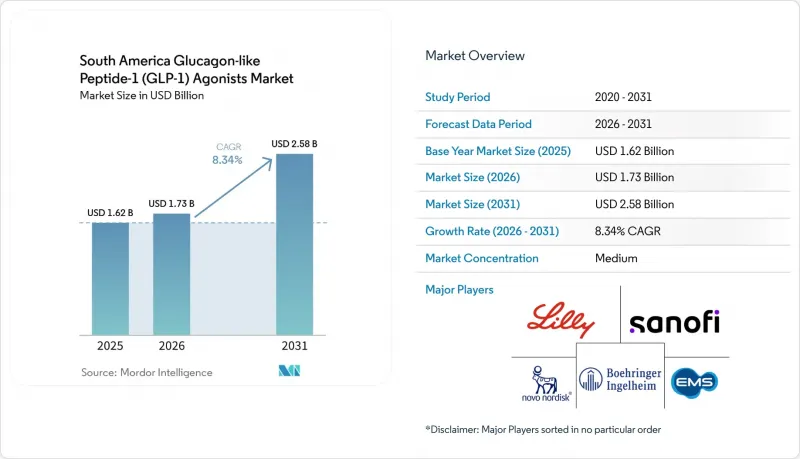
According to Mordor Intelligence, the South America glucagon-like peptide-1 (GLP-1) agonists market is projected to expand from USD 1.62 billion in 2025 and USD 1.73 billion in 2026 to USD 2.58 billion by 2031, registering a CAGR of 8.34% between 2026 and 2031.
South America Glucagon-like Peptide-1 (GLP-1) Agonists Market Trends and Insights
Rising Type 2 Diabetes and Obesity Treatment Demand
Diabetes and obesity create the basic demand base for the South American GLP-1 agonists market. The IDF projects diabetes cases in South and Central America will reach 52 million by 2050. This projection represents a 46% increase from the 2024 level. Regional diabetes expenditure reached USD 81 billion in 2024. That amount represented 8% of global diabetes expenditure.
The clinical role of these medicines also extends beyond glucose control. A 2025 SELECT analysis reported a 20% reduction in major adverse cardiovascular events with semaglutide. The study covered patients with obesity and established cardiovascular disease. The South American GLP-1 agonists market, therefore, has a broader clinical base than diabetes treatment alone. Treatment adoption will still depend on physician capacity and payer coverage.
Expansion of Specialist-Led Weight-Management Prescribing
Specialist prescribing is making obesity care more structured in major South American cities. Endocrinologists and obesity specialists can identify patients who need long-term therapy. They can also monitor treatment response and side effects. This care model supports continued use rather than intermittent purchases. It is especially relevant where medicines are largely paid for privately. The South American GLP-1 agonists market benefits when care pathways combine diagnosis, prescription, and follow-up.
Continuous glucose monitoring can support this approach for patients with diabetes. It gives clinicians more information when they adjust treatment plans. Novo Nordisk announced a Brazilian public-system pilot involving 1,000 patients at 3 health units in 2026. Future evaluation of public treatment models could affect the accessible patient population. The South American GLP-1 agonists market will remain tied to the availability of qualified prescribers and covered treatment pathways.
High Out-of-Pocket Treatment Cost
Out-of-pocket costs remain a major obstacle across the South American GLP-1 agonists market. Branded tirzepatide and high-dose semaglutide can exceed the budgets of many middle-income households. Cost pressure can lead patients to delay treatment or discontinue it. Lower-priced semaglutide can help in Brazil, but availability will differ across countries.
ANVISA cited manufacturing noncompliance and illegal sales without prescriptions. This intervention highlights the relationship between affordability and product safety. Patients need consistent access to regulated products. Countries without near-term semaglutide competition may face stronger affordability constraints. The South American GLP-1 agonists market will need both lower prices and reliable pharmacy oversight.
Other drivers and restraints analyzed in the detailed report include:
- Increasing Availability of Weekly Injectable Pens
- Local Manufacturing and Post-Patent Competition
- Restricted Reimbursement and Uneven Public-Sector Access
For complete list of drivers and restraints, kindly check the Table Of Contents.
Segment Analysis
Semaglutide held 51.35% of the South American GLP-1 agonists market share in 2025. Its position reflected established use through Ozempic for Type-2 Diabetes and Wegovy for obesity. The molecule has a long prescribing history across the region. Brazilian competition increased after the semaglutide patent expiry in March 2026. ANVISA approved Ozivy as the first synthetic semaglutide pen in May 2026. This approval introduced a regulated domestic alternative. More product options can increase use among price-sensitive patients.
Tirzepatide is forecast to expand at a 9.22% CAGR through 2031. Its dual GLP-1 and GIP mechanism supports its differentiated clinical position. Tirzepatide remains insulated from the Brazilian semaglutide price cycle. Liraglutide, dulaglutide, and exenatide retain roles in legacy prescribing and cost-focused procurement. Dulaglutide retains value through its auto-injector format. The other category can broaden as approved products enter the South American GLP-1 agonists market.
Injectable pens accounted for 87.42% of the South American GLP-1 agonists market size in 2025. They had the largest clinical evidence base and commercial availability. Injectable products also fit established pharmacy storage and dispensing practices. Weekly dosing supports ongoing treatment for patients who accept self-injection. However, device access can be difficult in remote locations. Cold-chain conditions can also limit distribution outside major cities.
Oral tablets are expected to grow at an 8.74% CAGR through 2031. Eli Lilly reported successful results from a third Phase 3 trial for orforglipron in August 2025. Oral products could appeal to patients who do not want injections. They could also reduce dependence on specialized device logistics. Regulatory approval is still required before these products affect regional sales. The South American GLP-1 agonists market could gain a broader delivery mix after approvals.
Complete Report Scope:
- By Molecule
- Exenatide
- Liraglutide
- Dulaglutide
- Lixisenatide
- Semaglutide
- Tirzepatide
- Others
- By Route of Administration
- Injectable Pens
- Oral Tablets
- By Indication
- Type-2 Diabetes
- Obesity / Weight Management
- Cardiovascular Risk Reduction
- Other Emerging Indications
- By Distribution Channel
- Hospital Pharmacies
- Retail Pharmacies
- Online Pharmacies
- Other Distribution Channels
- By Country
- Brazil
- Argentina
- Colombia
- Chile
- Peru
- Rest of South America
List of Companies Covered in this Report:
- Adalvo
- Amgen
- AstraZeneca
- Biocon
- Biomm S.A.
- Boehringer Ingelheim
- Bristol-Myers Squibb
- Eli Lilly and Company
- EMS
- Eurofarma Laboratorios S.A.
- Glenmark Pharmaceuticals
- Hypera S.A.
- Novo Nordisk
- Pfizer
- Sandoz Group
- Sanofi
- Sun Pharmaceuticals Industries
- Takeda Pharmaceuticals
- Teva Pharmaceutical Industries
- Torrent Pharmaceuticals
Additional Benefits:
- The market estimate (ME) sheet in Excel format
- 3 months of analyst support
TABLE OF CONTENTS
1 Introduction
- 1.1 Study Assumptions and Market Definition
- 1.2 Scope of the Study
2 Research Methodology
3 Executive Summary
4 Market Landscape
- 4.1 Market Overview
- 4.2 Market Drivers
- 4.2.1 Rising Type 2 Diabetes and Obesity Treatment Demand
- 4.2.2 Expansion of Specialist-Led Weight-Management Prescribing
- 4.2.3 Increasing Availability of Weekly Injectable Pens
- 4.2.4 Local Manufacturing and Post-Patent Competition
- 4.2.5 Digital Diabetes Care and Tele-pharmacy Enablement
- 4.2.6 Patient Preference for Oral and Lower-Burden Formulations
- 4.3 Market Restraints
- 4.3.1 High Out-of-Pocket Treatment Cost
- 4.3.2 Restricted Reimbursement and Uneven Public-Sector Access
- 4.3.3 Counterfeit, Compounded, and Irregular-Import Risk
- 4.3.4 Cold-Chain, Supply Allocation, and Pen-Component Constraints
- 4.4 Supply/Value Chain Analysis
- 4.5 Regulatory Landscape
- 4.6 Technological Outlook
- 4.7 Porter's Five Forces Analysis
- 4.7.1 Threat of New Entrants
- 4.7.2 Bargaining Power of Suppliers
- 4.7.3 Bargaining Power of Buyers
- 4.7.4 Threat of Substitutes
- 4.7.5 Competitive Rivalry
5 Market Size & Growth Forecasts (Value, USD)
- 5.1 By Molecule
- 5.1.1 Exenatide
- 5.1.2 Liraglutide
- 5.1.3 Dulaglutide
- 5.1.4 Lixisenatide
- 5.1.5 Semaglutide
- 5.1.6 Tirzepatide
- 5.1.7 Others
- 5.2 By Route of Administration
- 5.2.1 Injectable Pens
- 5.2.2 Oral Tablets
- 5.3 By Indication
- 5.3.1 Type-2 Diabetes
- 5.3.2 Obesity / Weight Management
- 5.3.3 Cardiovascular Risk Reduction
- 5.3.4 Other Emerging Indications
- 5.4 By Distribution Channel
- 5.4.1 Hospital Pharmacies
- 5.4.2 Retail Pharmacies
- 5.4.3 Online Pharmacies
- 5.4.4 Other Distribution Channels
- 5.5 By Country
- 5.5.1 Brazil
- 5.5.2 Argentina
- 5.5.3 Colombia
- 5.5.4 Chile
- 5.5.5 Peru
- 5.5.6 Rest of South America
6 Competitive Landscape
- 6.1 Market Concentration
- 6.2 Market Share Analysis
- 6.3 Company Profiles (includes Global level Overview, Market level overview, Core Segments, Financials as available, Strategic Information, Market Rank/Share for key companies, Products & Services, Recent Developments)
- 6.3.1 Adalvo
- 6.3.2 Amgen Inc.
- 6.3.3 AstraZeneca PLC
- 6.3.4 Biocon Limited
- 6.3.5 Biomm S.A.
- 6.3.6 Boehringer Ingelheim
- 6.3.7 Bristol Myers Squibb
- 6.3.8 Eli Lilly and Company
- 6.3.9 EMS
- 6.3.10 Eurofarma Laboratorios S.A.
- 6.3.11 Glenmark Pharmaceuticals Ltd.
- 6.3.12 Hypera S.A.
- 6.3.13 Novo Nordisk A/S
- 6.3.14 Pfizer Inc.
- 6.3.15 Sandoz
- 6.3.16 Sanofi
- 6.3.17 Sun Pharmaceutical Industries Ltd.
- 6.3.18 Takeda Pharmaceutical Company Limited
- 6.3.19 Teva Pharmaceutical Industries Ltd.
- 6.3.20 Torrent Pharmaceuticals Ltd.
7 Market Opportunities & Future Outlook
- 7.1 White-space & Unmet-need Assessment

