PUBLISHER: Mordor Intelligence | PRODUCT CODE: 2154869

PUBLISHER: Mordor Intelligence | PRODUCT CODE: 2154869
South America Human Insulin Drugs - Market Share Analysis, Industry Trends & Statistics, Growth Forecasts (2026 - 2031)
According to Mordor Intelligence, the South America human insulin drugs market is expected to grow from USD 1.29 billion in 2025 and is forecast to reach USD 1.55 billion by 2031, advancing at a CAGR of 3.23% from 2026 to 2031.
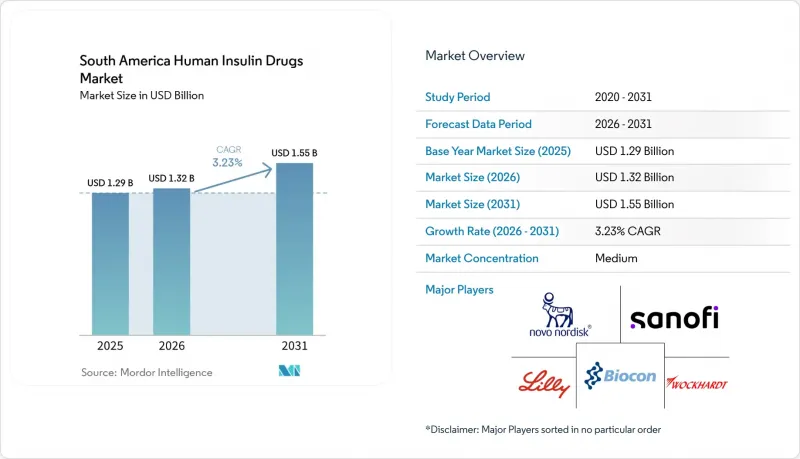
Diabetes care needs continue to widen across the region, while public procurement remains the main route through which patients obtain insulin. This report is Segmented by Product Type (Basal or Long-Acting Insulins, Bolus or Fast-Acting Insulins, Traditional Human Insulins, and More), Diabetes Type (Type 1 Diabetes, Type 2 Diabetes, Gestational Diabetes), Distribution Channel (Hospital Pharmacies, and More), and Country (Brazil, Argentina, Colombia, Chile, Peru, Rest of South America). The Market Forecasts are in Terms of Value (USD).
South America Human Insulin Drugs Market Trends and Insights
Rising Diabetes Diagnosis and Insulin Treatment Need
The South American human insulin drugs market draws its broadest volume support from the region's expanding diagnosed diabetes population. The International Diabetes Federation reported that 35 million adults in South and Central America had diabetes in 2024, and 30.4% of cases were undiagnosed. Diabetes-related health spending in the region reached USD 81 billion, which reflected the scale of the care gap facing public systems and the continuing need for medicines that can be procured at scale. The same source projects that the adult diabetes population will rise 46% to 52 million by 2050, indicating that the underlying treatment pool will keep expanding beyond the forecast period. More screening in primary care can turn undiagnosed cases into treatment episodes, increasing demand for established insulin products and requiring health systems to maintain dependable dispensing capacity.
Public-Sector Expansion of Insulin Coverage
Public health systems shape the South American human insulin drugs market because they purchase and distribute much of the region's insulin volume. Brazil incorporated rapid-acting and long-acting insulin analogs for type 2 diabetes into public care through SCTIE ordinances issued in November 2024.Argentina, Colombia, Chile, and Peru have also worked to expand diabetes coverage under broader universal health coverage goals, although the depth of coverage differs among national systems. Wider reimbursement can increase the number of patients receiving regular treatment through formal channels and reduce reliance on intermittent private purchases. It can also move purchasing toward large tenders with standardized prices. The result is higher unit demand but tighter average selling prices for suppliers that serve public programs, so market volume and supplier revenue do not necessarily move at the same rate.
Affordability and Out-of-Pocket Treatment Burden
Affordability limits the South American human insulin drugs market, where patients depend on out-of-pocket purchases. This issue is most visible in Peru, Bolivia, Paraguay, and some rural or peri-urban areas of Colombia and Ecuador, where public infrastructure and insurance coverage are thinner. Inconsistent coverage can reduce refill frequency, weaken adherence to prescribed treatment, and make supply disruptions more damaging for patients with limited financial flexibility. Smaller health systems often have less centralized formulary management than Brazil or Argentina. These constraints limit growth for private distributors outside the largest urban areas and leave access dependent on the capacity of local institutions and provincial purchasing.
Other drivers and restraints analyzed in the detailed report include:
- Local Production and Technology-Transfer Programs
- Biosimilar Insulin Price Competition
- Tender-Driven Price Compression
For complete list of drivers and restraints, kindly check the Table Of Contents.
Segment Analysis
Basal or long-acting insulins held 39.53% of the South American human insulin drugs market share in 2025, making them the largest product group. Their position reflects their role in ongoing glycemic management for people with type 2 diabetes. Public treatment pathways in Brazil, Colombia, Chile, and Peru support their routine use through institutional dispensing. Bolus or fast-acting products remain important in hospitals and for patients who need meal-time glucose control.
Combination and premixed insulin is expected to be the fastest-growing product category, with the South American human insulin drugs market for this group forecast to grow at a 4.25% CAGR through 2031. Fixed-ratio formulations can simplify treatment for people who need basal and meal-time coverage but find multiple injection schedules difficult to follow. This makes the category relevant where patient education and follow-up capacity vary across public care settings.
Complete Report Scope:
- By Product Type
- Basal or Long-Acting Insulins
- Bolus or Fast-Acting Insulins
- Traditional Human Insulins
- Combination and Premixed Insulins
- By Diabetes Type
- Type 1 Diabetes
- Type 2 Diabetes
- Gestational Diabetes
- By Distribution Channel
- Hospital Pharmacies
- Retail Pharmacies
- Online Pharmacies
- Other Distribution Channels
- By Country
- Brazil
- Argentina
- Colombia
- Chile
- Peru
- Rest of South America
List of Companies Covered in this Report:
- Beckton Dickinson
- Biocon
- Biomm S.A.
- Boehringer Ingelheim
- Eli Lilly and Company
- Exir Pharmaceutical Company
- Fundacao Ezequiel Dias
- Fundacao Oswaldo Cruz, including Bio-Manguinhos
- Gan & Lee Pharmaceuticals
- Gulf Pharmaceutical Industries, Julphar
- Libbs Farmaceutica Ltda.
- Medtronic
- Novo Nordisk
- Pfizer
- Sanofi
- Sedico Pharmaceuticals
- Tonghua Dongbao Pharmaceutical Co., Ltd.
- United Laboratories International Holdings Limited
- Wockhardt Limited
- Ypsomed
Additional Benefits:
- The market estimate (ME) sheet in Excel format
- 3 months of analyst support
TABLE OF CONTENTS
1 Introduction
- 1.1 Study Assumptions and Market Definition
- 1.2 Scope of the Study
2 Research Methodology
3 Executive Summary
4 Market Landscape
- 4.1 Market Overview
- 4.2 Market Drivers
- 4.2.1 Rising Diabetes Diagnosis and Insulin Treatment Need
- 4.2.2 Public-Sector Expansion of Insulin Coverage
- 4.2.3 Local Production and Technology-Transfer Programs
- 4.2.4 Biosimilar Insulin Price Competition
- 4.2.5 Human Insulin Demand in Underserved Care Settings
- 4.2.6 Digital Monitoring and Connected Delivery Adoption
- 4.3 Market Restraints
- 4.3.1 Affordability and Out-of-Pocket Treatment Burden
- 4.3.2 Tender-Driven Price Compression
- 4.3.3 Cold-Chain and Last-Mile Distribution Fragility
- 4.3.4 Substitution by Non-Insulin Diabetes Therapies
- 4.4 Supply Chain Analysis
- 4.5 Regulatory Landscape
- 4.6 Technological Outlook
- 4.7 Porter's Five Forces Analysis
- 4.7.1 Threat of New Entrants
- 4.7.2 Bargaining Power of Suppliers
- 4.7.3 Bargaining Power of Buyers
- 4.7.4 Threat of Substitutes
- 4.7.5 Competitive Rivalry
5 Market Size & Growth Forecasts (Value, USD)
- 5.1 By Product Type
- 5.1.1 Basal or Long-Acting Insulins
- 5.1.2 Bolus or Fast-Acting Insulins
- 5.1.3 Traditional Human Insulins
- 5.1.4 Combination and Premixed Insulins
- 5.2 By Diabetes Type
- 5.2.1 Type 1 Diabetes
- 5.2.2 Type 2 Diabetes
- 5.2.3 Gestational Diabetes
- 5.3 By Distribution Channel
- 5.3.1 Hospital Pharmacies
- 5.3.2 Retail Pharmacies
- 5.3.3 Online Pharmacies
- 5.3.4 Other Distribution Channels
- 5.4 By Country
- 5.4.1 Brazil
- 5.4.2 Argentina
- 5.4.3 Colombia
- 5.4.4 Chile
- 5.4.5 Peru
- 5.4.6 Rest of South America
6 Competitive Landscape
- 6.1 Market Concentration
- 6.2 Market Share Analysis
- 6.3 Company Profiles (includes Global level Overview, Market level overview, Core Segments, Financials as available, Strategic Information, Market Rank/Share for key companies, Products & Services, Recent Developments)
- 6.3.1 Becton, Dickinson and Company
- 6.3.2 Biocon Limited
- 6.3.3 Biomm S.A.
- 6.3.4 Boehringer Ingelheim International GmbH
- 6.3.5 Eli Lilly and Company
- 6.3.6 Exir Pharmaceutical Company
- 6.3.7 Fundacao Ezequiel Dias
- 6.3.8 Fundacao Oswaldo Cruz, including Bio-Manguinhos
- 6.3.9 Gan & Lee Pharmaceuticals
- 6.3.10 Gulf Pharmaceutical Industries, Julphar
- 6.3.11 Libbs Farmaceutica Ltda.
- 6.3.12 Medtronic plc
- 6.3.13 Novo Nordisk A/S
- 6.3.14 Pfizer Inc.
- 6.3.15 Sanofi S.A.
- 6.3.16 Sedico Pharmaceuticals
- 6.3.17 Tonghua Dongbao Pharmaceutical Co., Ltd.
- 6.3.18 United Laboratories International Holdings Limited
- 6.3.19 Wockhardt Limited
- 6.3.20 Ypsomed Holding AG
7 Market Opportunities & Future Outlook
- 7.1 White-space & Unmet-need Assessment

