PUBLISHER: Mordor Intelligence | PRODUCT CODE: 2154920

PUBLISHER: Mordor Intelligence | PRODUCT CODE: 2154920
RO Membrane Chemicals - Market Share Analysis, Industry Trends & Statistics, Growth Forecasts (2026 - 2031)
According to Mordor Intelligence, the RO membrane chemicals market is projected to grow from USD 2.56 billion in 2025 to USD 2.70 billion in 2026 and reach USD 3.63 billion by 2031, at a CAGR of 6.05% during the forecast period (2026-2031).
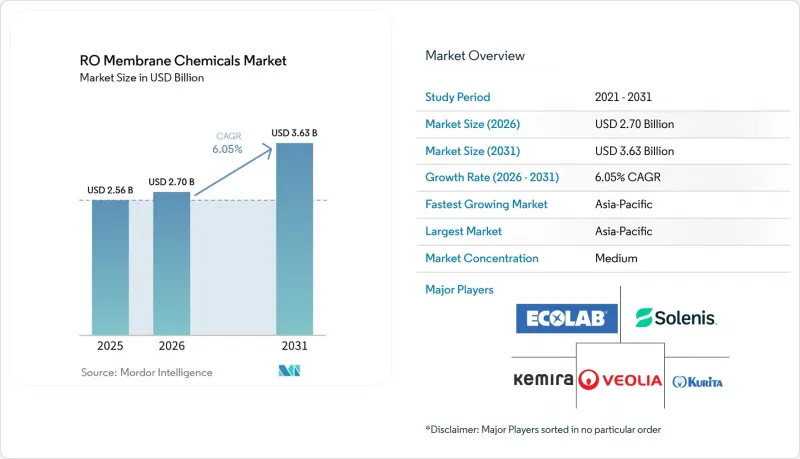
Global RO Membrane Chemicals Market Trends and Insights
Expansion Of Desalination And Water Reuse Capacity
Installed desalination capacity is projected to exceed 120 million m3 per day by 2026, with reverse osmosis expected to account for more than 70% of new desalination project awards in 2024 and 2025. This capacity-driven expansion generates recurring demand for RO membrane chemicals, as treatment plants require continuous control of scaling, biological growth, and cleaning cycles. The Middle East accounted for 53.1% of global contracted desalination capacity, and its operational capacity is projected to reach 41.0 million m3 per day by 2028. Spain committed EUR 23 billion to expand desalination and water reuse capacity, while Barcelona increased the share of desalinated water in its municipal supply from 3% to 33% during the 2024 drought.Water reuse retrofits in industrial areas across eastern China and Maharashtra can generate chemical demand more rapidly than large-scale greenfield projects, as existing RO trains require updated chemical programs when reuse requirements increase. Therefore, the RO Membrane Chemicals Market benefits from both new plant construction and the immediate need to enhance operating performance across installed systems.
Rising High-Purity Water Demand In Pharmaceuticals, Electronics, And Food Processing
High-purity water applications require consistent membrane performance and therefore favor chemical programs validated for specific operating conditions. Semiconductor fabrication represents a concentrated source of demand, as a 300 mm advanced-node wafer facility requires 1,500-2,000 gallons of ultrapure water per minute. As process nodes evolve, purity specifications become more stringent, increasing the need for fouling prevention and controlled cleaning. Pharmaceutical production also requires Water for Injection that complies with United States Pharmacopeia and European Pharmacopoeia standards, creating a defined need for validated cleaning chemicals. Food processing further contributes to demand, as membrane systems must remove protein and organic residues without disrupting production schedules. These end-use applications support the RO Membrane Chemicals Market, as unplanned membrane performance losses can affect product quality, plant utilization, and regulatory compliance.
Chemical Mis-Dosing Risk And Membrane Damage Liability
Polyamide thin-film composite membranes are highly sensitive to chemical dosing errors, particularly oxidant exposure. Research published in ACS ES&T Engineering found that chlorine-based disinfectants can cause aromatic substitution and amide bond cleavage in polyamide chains. The study reported that cumulative chlorine exposure of 1,000 ppm-hours can reduce salt rejection capability by 50% over a 3-year service period. A separate 2025 study found that inadequate dechlorination increased solute permeation by 766% and reduced salt rejection by 5% to 8%. Overdosing dechlorinating agents can also create conditions that promote sulfate-reducing bacteria, thereby undermining biofouling control. Operators may delay implementing a new treatment program when dosing errors could damage a large membrane array and result in replacement costs exceeding USD 1 million.
Other drivers and restraints analyzed in the detailed report include:
- Stricter Discharge And Membrane-Performance Compliance Requirements
- Digital Dosing And Predictive Membrane-Maintenance Adoption
- Regulatory Phase-Out Of High-Risk Biocides And Phosphorus-Containing Formulations
For complete list of drivers and restraints, kindly check the Table Of Contents.
Segment Analysis
Biocides accounted for 36.67% of the RO Membrane Chemicals Market in 2025 and expanded at a CAGR of 6.75% through 2031. They control biological fouling in seawater and brackish-water RO systems. The supplied draft identified biofouling as the primary failure mode in 49% of membrane autopsies reviewed by H2O Innovation Specialty Chemicals. This operational challenge continues to support the use of products that prevent microbial growth before it restricts membrane flux. Wastewater reuse applications and complex industrial effluents can contain more resilient microbial communities, increasing the need for effective biofouling control. The shift away from oxidizing biocides, which can degrade polyamide membranes, is driving demand for non-oxidizing alternatives, such as DBNPA and performic acid formulations. As operators assess treatment program compatibility with their membrane systems, these alternatives can generate substitution demand across the RO Membrane Chemicals Market. Kemira's EPA-registered FennoSurf 600 supports this trend as a core component of a chlorine-free process water treatment system.
Acid and alkaline membrane cleaners support scheduled clean-in-place programs; therefore, their demand closely correlates with system utilization and maintenance requirements. These products generate steady demand because membranes require cleaning even when capacity additions slow. Antiscalants and scale inhibitors are particularly important in desalination-focused locations, where seawater feedwater contains multivalent ions that require treatment. The supplied draft identified standard dosing ranges of 2-5 mg/L for these applications. ECHA-related reformulation requirements are shifting antiscalant demand toward green polymer and carboxylate chemistries as phosphonate restrictions become more stringent. Other product types include dechlorinating agents, pH adjusters, and coating polymers used in specialized pretreatment applications. Product selection depends on feedwater quality, membrane material, recovery rate, discharge requirements, and the operator's cleaning schedule. Suppliers in the RO Membrane Chemicals Industry can differentiate themselves through fit-for-purpose technical support rather than a single product category.
Complete Report Scope:
- By Product Type
- Biocides
- Acid Membrane Cleaners
- Alkaline Membrane Cleaners
- Antiscalants and Scale Inhibitors
- Other Product Types
- By Application
- Membrane Cleaning
- Membrane Fouling Control
- Membrane Scale Control
- Other Applications
- By End User
- Municipal Water and Desalination
- Industrial Water Treatment
- Commercial and Institutional Facilities
- Others
- By Geography
- Asia-Pacific
- China
- India
- Japan
- South Korea
- Rest of Asia-Pacific
- North America
- United States
- Canada
- Mexico
- Europe
- Germany
- United Kingdom
- France
- Italy
- Rest of Europe
- South America
- Brazil
- Argentina
- Rest of South America
- Middle East and Africa
- Saudi Arabia
- South Africa
- Rest of Middle East and Africa
- Asia-Pacific
Geography Analysis
Asia-Pacific held a 35.76% share of the RO membrane chemicals market in 2025 and is forecast to grow at a CAGR of 6.82% through 2031. Investments in semiconductor fabrication plants, public desalination programs, and stricter industrial discharge standards are driving regional demand. China's discharge standards are accelerating the shift toward biodegradable antiscalants in coastal provinces. In India, Gujarat, Tamil Nadu, and Andhra Pradesh are commissioning brackish-water desalination facilities to serve textile, petrochemical, and power generation clusters. Japan's planned 2025 revision to the Water Supply Law and its Circular Economy Vision 2030 are increasing the focus on wastewater reuse and digital monitoring solutions. South Korea's domestic ultra-pure water program is expected to gain a commercial reference when K-water begins supplying ultra-pure water to SK Hynix's M15X HBM facility in November 2025. These requirements encourage RO membrane chemicals suppliers to offer formulations tailored to local feedwater conditions, water reuse requirements, and semiconductor water-quality standards.
North America and Europe are relatively mature regions, where infrastructure upgrades and compliance requirements influence demand more than capacity additions. In North America, utilities are adopting higher-grade antiscalants and NSF/ANSI 60-certified biocide programs to meet water treatment requirements. European operators face increasing pressure to maintain membrane performance under the revised Urban Wastewater Treatment Directive. Spain's EUR 23 billion desalination commitment remains a significant catalyst for regional capacity expansion. Germany, the United Kingdom, France, and Italy continue to generate demand from pharmaceutical and food processing facilities, where validation requirements can discourage the use of commodity products. These regions favor suppliers that can demonstrate regulatory compliance, product consistency, and technical support across complex water treatment systems.
The Middle East and Africa, along with South America, generate demand driven by water scarcity, industrial development, and municipal water treatment needs. Saudi Arabia's zero-liquid-discharge programs in Jubail and Yanbu support the use of high-performance scale inhibitors and specialty biocides in industrial water treatment. The UAE's Taweelah expansion is expected to add 909,000 m3 per day of desalination capacity, increasing demand for pretreatment chemical sequences. Brazil and Argentina are expanding municipal RO capacity to address groundwater contamination and coastal salinity intrusion. Sub-Saharan Africa remains underserved, and the commissioning of large plants can generate periodic, project-driven demand rather than stable consumption. These regional differences require RO membrane chemicals market suppliers to balance large-scale desalination projects with smaller systems that may require local technical training and more affordable treatment program designs.
- American Water Chemicals, Inc.
- Applied Membranes, Inc.
- DuPont
- Ecolab Inc.
- Genesys International Ltd.
- H2O InnovationO Innovation
- Kemira Oyj
- King Lee Technologies
- Kurita Water Industries Ltd.
- Lenntech B.V.
- Solenis
- SUEZ
- Thermax Limited
- Universal Water Chemicals Pvt Ltd
- Veolia
Additional Benefits:
- The market estimate (ME) sheet in Excel format
- 3 months of analyst support
TABLE OF CONTENTS
1 INTRODUCTION
- 1.1 Study Assumptions and Market Definition
- 1.2 Scope of the Study
2 RESEARCH METHODOLOGY
3 EXECUTIVE SUMMARY
4 MARKET LANDSCAPE
- 4.1 Market Overview
- 4.2 Market Drivers
- 4.2.1 Expansion of Desalination and Water Reuse Capacity
- 4.2.2 Rising High-Purity Water Demand in Pharmaceuticals, Electronics, and Food Processing
- 4.2.3 Stricter Discharge and Membrane-Performance Compliance Requirements
- 4.2.4 Digital Dosing and Predictive Membrane-Maintenance Adoption
- 4.2.5 Higher Recovery-Rate Designs Increasing Scale-Control Requirements
- 4.3 Market Restraints
- 4.3.1 Chemical Mis-Dosing Risk and Membrane Damage Liability
- 4.3.2 Regulatory Phase-Out of High-Risk Biocides and Phosphorus-Containing Formulations
- 4.3.3 Total Cost of Ownership for Small and Technically Constrained Operators
- 4.4 Value Chain Analysis
- 4.5 Porter's Five Forces Analysis
- 4.5.1 Threat of New Entrants
- 4.5.2 Bargaining Power of Suppliers
- 4.5.3 Bargaining Power of Buyers
- 4.5.4 Threat of Substitutes
- 4.5.5 Competitive Rivalry
5 MARKET SIZE AND GROWTH FORECASTS (VALUE)
- 5.1 By Product Type
- 5.1.1 Biocides
- 5.1.2 Acid Membrane Cleaners
- 5.1.3 Alkaline Membrane Cleaners
- 5.1.4 Antiscalants and Scale Inhibitors
- 5.1.5 Other Product Types
- 5.2 By Application
- 5.2.1 Membrane Cleaning
- 5.2.2 Membrane Fouling Control
- 5.2.3 Membrane Scale Control
- 5.2.4 Other Applications
- 5.3 By End User
- 5.3.1 Municipal Water and Desalination
- 5.3.2 Industrial Water Treatment
- 5.3.3 Commercial and Institutional Facilities
- 5.3.4 Others
- 5.4 By Geography
- 5.4.1 Asia-Pacific
- 5.4.1.1 China
- 5.4.1.2 India
- 5.4.1.3 Japan
- 5.4.1.4 South Korea
- 5.4.1.5 Rest of Asia-Pacific
- 5.4.2 North America
- 5.4.2.1 United States
- 5.4.2.2 Canada
- 5.4.2.3 Mexico
- 5.4.3 Europe
- 5.4.3.1 Germany
- 5.4.3.2 United Kingdom
- 5.4.3.3 France
- 5.4.3.4 Italy
- 5.4.3.5 Rest of Europe
- 5.4.4 South America
- 5.4.4.1 Brazil
- 5.4.4.2 Argentina
- 5.4.4.3 Rest of South America
- 5.4.5 Middle East and Africa
- 5.4.5.1 Saudi Arabia
- 5.4.5.2 South Africa
- 5.4.5.3 Rest of Middle East and Africa
- 5.4.1 Asia-Pacific
6 COMPETITIVE LANDSCAPE
- 6.1 Market Concentration
- 6.2 Strategic Moves
- 6.3 Market Share (%)/Ranking Analysis
- 6.4 Company Profiles (includes Global Level Overview, Market Level Overview, Core Segments, Financials as available, Strategic Information, Products and Services, Recent Developments)
- 6.4.1 American Water Chemicals, Inc.
- 6.4.2 Applied Membranes, Inc.
- 6.4.3 DuPont
- 6.4.4 Ecolab Inc.
- 6.4.5 Genesys International Ltd.
- 6.4.6 H2O InnovationO Innovation
- 6.4.7 Kemira Oyj
- 6.4.8 King Lee Technologies
- 6.4.9 Kurita Water Industries Ltd.
- 6.4.10 Lenntech B.V.
- 6.4.11 Solenis
- 6.4.12 SUEZ
- 6.4.13 Thermax Limited
- 6.4.14 Universal Water Chemicals Pvt Ltd
- 6.4.15 Veolia
7 MARKET OPPORTUNITIES AND FUTURE OUTLOOK
- 7.1 White-Space and Unmet-Need Assessment

