PUBLISHER: Mordor Intelligence | PRODUCT CODE: 2154940

PUBLISHER: Mordor Intelligence | PRODUCT CODE: 2154940
Europe Winter Tourism - Market Share Analysis, Industry Trends & Statistics, Growth Forecasts (2026 - 2031)
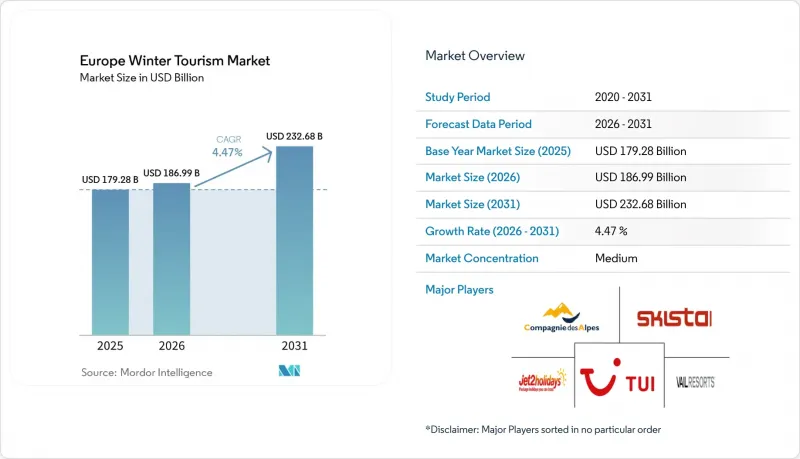
According to Mordor Intelligence, the Europe winter tourism market size is projected to expand from USD 179.28 billion in 2025 and USD 186.99 billion in 2026 to USD 232.68 billion by 2031, registering a CAGR of 4.47% between 2026 and 2031.
Europe Winter Tourism Market Trends and Insights
Recovering Intra-European Air Connectivity
As intra-European air connectivity rebounds, winter tourism in Europe is seeing a boost. An increased regional seat supply and enhanced access to key gateways bolster this resurgence in winter travel. In 2025, European Revenue Passenger Kilometers (RPKs) rose 5.9%, while load factors remained robust at 83.6% through November. This indicates airlines are filling their planes at healthy commercial levels, steering clear of temporary discounts. In a notable move, SAS ramped up its Copenhagen schedule for the winter of 2025/26, boosting seat capacity by 40% and introducing six new routes. Among these is Kittila, nestled in Finnish Lapland, which opens doors to sought-after Arctic winter experiences. While Europe as a whole experienced moderate growth, Slovakia saw a marked surge in inbound air traffic in Q4 2025 compared to Q4 2024. This highlights that secondary winter destinations, not just major hubs, are benefiting from renewed airlift. Such expanded air access is pivotal for Europe's winter tourism landscape. It diversifies demand across a wider array of destinations, enhances occupancy rates beyond flagship resorts, and bolsters the commercial appeal of smaller winter tourism hubs.
Growing Popularity of Multi-Activity Winter Packages
As multi-activity winter packages gain traction, Europe's winter tourism market is evolving, capturing more value from each traveler. According to Atout France's 2026 mountain winter barometer, most visitors engaged in at least one snow activity, with many also valuing wellness and social interactions as key travel motivators. Club Med noted a surge in ski bookings for Winter 2026, with its Serre Chevalier location seeing a particularly significant uptick. This underscores the rising appeal of all-inclusive, activity-centric offerings at mountain destinations. Resorts are now enhancing revenue per stay by focusing on wellness, dining, family experiences, and guided outdoor programs, rather than relying solely on lift-ticket sales. Such diversified packages not only bolster the European winter tourism market but also lessen reliance on daily snow conditions, making winter trips more enticing for diverse groups with varied motivations.
Volatile Energy Prices Inflating Resort OPEX
Volatile energy prices remain a direct pressure point for the Europe winter tourism market because snowmaking, lift systems, heated facilities, and hospitality operations carry a high electricity burden during the winter season. Compagnie des Alpes responded by locking in its French electricity needs at fixed rates for 2026 and 2027, while also hedging a large majority of its 2028 and 2029 requirements, which shows how important scale and treasury capacity have become in winter tourism operations Large groups can use this type of hedging to protect margins. Still, smaller independent operators often have less room to absorb swings in utility costs or pass them on without weakening demand. The result is a widening cost gap between integrated operators and local independents, especially in mountain areas where snow production and transport infrastructure are already capital-intensive. In the European winter tourism market, this restraint works through profitability and pricing pressure rather than through a sudden collapse in demand, making it especially important for operators with older infrastructure and tighter balance sheets.
Other drivers and restraints analyzed in the detailed report include:
- Expansion of Low-Cost Long-Haul Services into Nordic Hubs
- Accelerated Investment in Snow-Independent Attractions
- Rising Insurance Premiums For Adventure Sports Operators
For complete list of drivers and restraints, kindly check the Table Of Contents.
Segment Analysis
Skiing & Snowboarding held a 33.41% share of the activity mix in 2025, maintaining its position as the leading activity category in the Europe winter tourism market. The segment remains supported by Europe's deep resort base, strong domestic participation, and the continued appeal of premium sub-categories such as freeriding, ski-safari travel, and ski-in and ski-out stays. The category still anchors most resort economics because lift access, rental spend, ski school demand, and mountain lodging remain closely linked in established Alpine corridors. At the same time, value is moving upward within the segment because travelers with higher budgets are more willing to pay for convenience, premium accommodation, and curated multi-day experiences than for standard access alone. This means the Europe winter tourism market is not only sustaining skiing demand but also extracting greater value from the premium segments within that demand base.
Northern Lights & Arctic Experiences is the fastest-growing activity segment, with a projected 5.63% CAGR through 2026 to 2031, reflecting the rapid rise of Nordic winter travel in the Europe winter tourism market. Northern Norway recorded strong tourism growth in 2025 as winter demand strengthened, which supports the growing commercial pull of aurora-led travel and broader Arctic experiences. Winter city breaks and Christmas-market travel add another layer to this activity mix because they draw culturally motivated travelers who are less dependent on mountain snow conditions and more focused on seasonal atmosphere, food, and short-stay convenience. The European winter tourism market is therefore broadening from a ski-centered model into a wider winter experience model that includes Arctic viewing, wellness, soft adventure, and urban seasonal travel.
Hotels & Resorts retained the dominant accommodation share at 41.53% in 2025, giving them the largest slice of the market share among lodging formats. Their position remains strong because premium Alpine and Nordic destinations still favor professionally managed hospitality, recognizable service standards, and bundled amenities for travelers who are paying high seasonal rates. At the same time, Vacation Rentals/Airbnb is the fastest-growing accommodation segment, with a 5.12% CAGR through 2031, indicating how much demand is shifting toward flexible, self-catering, and group-friendly formats. European short-term rental supply reached millions of units as of December 2025, up year on year, which confirms that alternative accommodation continues to scale across the region.
Operational performance data also shows that managed rental formats are competing more directly with hotels than before. Auvergne-Rhone-Alpes Tourisme reported that tourism residences achieved high occupancy in winter 2025/26, ahead of hotels and holiday villages, indicating strong demand for branded, service-enhanced rental stock. Premium hotel investment has not slowed, with Ennismore signing Mama Shelter Val Thorens in October 2025 for a 2027 opening, which shows that global hospitality brands still see value in flagship Alpine addresses. The European winter tourism industry is therefore moving toward a mixed lodging model in which hotels, managed residences, chalets, and rental stock each serve different value pools rather than competing on the same terms.
Complete Report Scope:
- By Activity Type
- Skiing & Snowboarding
- Snowshoeing & Winter Hiking
- Northern-Lights & Arctic Experiences
- Winter City Breaks & Christmas Markets
- Others (Adventure Sports, Religious Travel, Wellness Travel)
- By Accommodation Type
- Hotels & Resorts
- Chalets & Cabins
- Vacation Rentals / Airbnb
- Hostels
- Others
- By Traveler Origin
- Domestic
- Intra-Europe
- Long-Haul (non-Europe)
- By Booking Channel
- Online Travel Agencies (OTAs)
- Direct (Resort / Hotel Websites)
- Traditional Travel Agents
- Mobile-only Apps
- By Destination
- Western Europe (United Kingdom,France,Germany,Austria,Switzerland)
- Northern Europe (Sweden,Norway, Finland, Iceland)
- Southern Europe (Italy,Spain, Andorra)
- Central & Eastern Europe (Poland,Slovakia,Czech Republic,Slovenia,Bulgaria)
List of Companies Covered in this Report:
- Compagnie des Alpes
- SkiStar AB
- TUI AG
- Vail Resorts Inc.
- Jet2holidays
- Crystal Ski Holidays
- Sunweb Group
- Club Med
- Expedia Group
- Booking Holdings
- Accor SA
- Pierre & Vacances-Center Parcs
- Airbnb Inc.
- Alpitour World
- FTI Group
- Thomas Cook (revived brand)
- Balkan Holidays
- Inghams (Hotelplan)
- Lufthansa Holidays
- SnowTrex (TravelTrex GmbH)
Additional Benefits:
- The market estimate (ME) sheet in Excel format
- 3 months of analyst support
TABLE OF CONTENTS
1 Introduction
- 1.1 Study Assumptions & Market Definition
- 1.2 Scope of the Study
2 Research Methodology
3 Executive Summary
4 Market Landscape
- 4.1 Market Overview
- 4.2 Market Drivers
- 4.2.1 Recovering intra-European air connectivity
- 4.2.2 Growing popularity of multi-activity winter packages
- 4.2.3 Expansion of low-cost long-haul services into Nordic hubs
- 4.2.4 Accelerated investment in snow-independent attractions
- 4.2.5 Climate-aligned resort certification gaining traction
- 4.2.6 Alpine rail-link upgrades shortening travel times
- 4.3 Market Restraints
- 4.3.1 Volatile energy prices inflating resort OPEX
- 4.3.2 Rising insurance premiums for adventure sports operators
- 4.3.3 Snow-reliability risk for low-altitude resorts
- 4.3.4 Growing anti-overtourism regulation in heritage cities
- 4.4 Value / Supply-Chain Analysis
- 4.5 Regulatory Landscape
- 4.6 Technological Outlook
- 4.7 Porter's Five Forces Analysis
- 4.7.1 Bargaining Power of Suppliers
- 4.7.2 Bargaining Power of Buyers
- 4.7.3 Threat of New Entrants
- 4.7.4 Threat of Substitutes
- 4.7.5 Competitive Rivalry
5 Market Size & Growth Forecasts (Value)
- 5.1 By Activity Type
- 5.1.1 Skiing & Snowboarding
- 5.1.2 Snowshoeing & Winter Hiking
- 5.1.3 Northern-Lights & Arctic Experiences
- 5.1.4 Winter City Breaks & Christmas Markets
- 5.1.5 Others (Adventure Sports, Religious Travel, Wellness Travel)
- 5.2 By Accommodation Type
- 5.2.1 Hotels & Resorts
- 5.2.2 Chalets & Cabins
- 5.2.3 Vacation Rentals / Airbnb
- 5.2.4 Hostels
- 5.2.5 Others
- 5.3 By Traveler Origin
- 5.3.1 Domestic
- 5.3.2 Intra-Europe
- 5.3.3 Long-Haul (non-Europe)
- 5.4 By Booking Channel
- 5.4.1 Online Travel Agencies (OTAs)
- 5.4.2 Direct (Resort / Hotel Websites)
- 5.4.3 Traditional Travel Agents
- 5.4.4 Mobile-only Apps
- 5.5 By Destination
- 5.5.1 Western Europe (United Kingdom,France,Germany,Austria,Switzerland)
- 5.5.2 Northern Europe (Sweden,Norway, Finland, Iceland)
- 5.5.3 Southern Europe (Italy,Spain, Andorra)
- 5.5.4 Central & Eastern Europe (Poland,Slovakia,Czech Republic,Slovenia,Bulgaria)
6 Competitive Landscape
- 6.1 Market Concentration
- 6.2 Strategic Moves
- 6.3 Market Share Analysis
- 6.4 Company Profiles (includes Global level Overview, Market level overview, Core Segments, Financials as available, Strategic Information, Market Rank/Share for key companies, Products & Services, and Recent Developments)
- 6.4.1 Compagnie des Alpes
- 6.4.2 SkiStar AB
- 6.4.3 TUI AG
- 6.4.4 Vail Resorts Inc.
- 6.4.5 Jet2holidays
- 6.4.6 Crystal Ski Holidays
- 6.4.7 Sunweb Group
- 6.4.8 Club Med
- 6.4.9 Expedia Group
- 6.4.10 Booking Holdings
- 6.4.11 Accor SA
- 6.4.12 Pierre & Vacances-Center Parcs
- 6.4.13 Airbnb Inc.
- 6.4.14 Alpitour World
- 6.4.15 FTI Group
- 6.4.16 Thomas Cook (revived brand)
- 6.4.17 Balkan Holidays
- 6.4.18 Inghams (Hotelplan)
- 6.4.19 Lufthansa Holidays
- 6.4.20 SnowTrex (TravelTrex GmbH)
7 Market Opportunities & Future Outlook
- 7.1 White-space & Unmet-Need Assessment

