PUBLISHER: Mordor Intelligence | PRODUCT CODE: 2154969

PUBLISHER: Mordor Intelligence | PRODUCT CODE: 2154969
South America Glass Packaging - Market Share Analysis, Industry Trends & Statistics, Growth Forecasts (2026 - 2031)
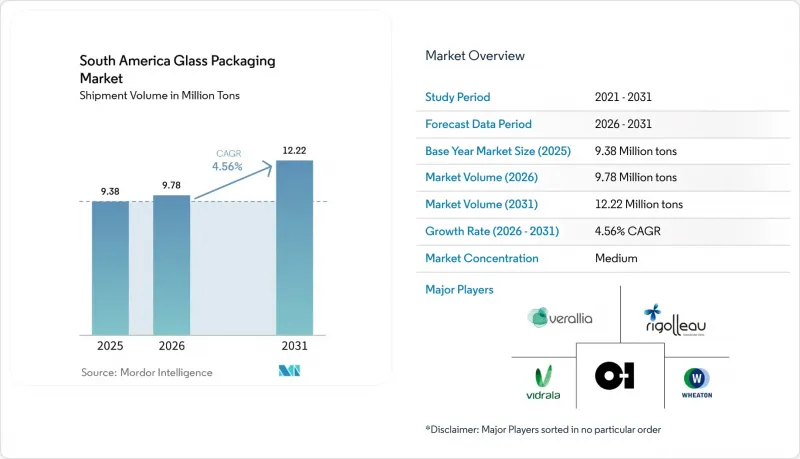
According to Mordor Intelligence, the South America glass packaging market size was valued at 9.4 million tons in 2025 and estimated to grow from 9.8 million tons in 2026 to reach 12.2 million tons by 2031, at a CAGR of 4.6% during the forecast period (2026-2031).
South America Glass Packaging Market Trends and Insights
Premiumization of Beer, Wine, Spirits, and Cachaca Packaging
Premium beverage producers in the South America glass packaging market increasingly use glass to support product quality, heritage, and sustainability claims, especially when a package must distinguish a higher-priced product from mainstream beverages. Export-focused cachaca brands use custom bottle shapes and embossed labels to position their products in international channels, where presentation can influence buyer perceptions before a product is sampled. Cachaca 51 introduced a new export glass packaging edition for distribution in Europe and South America in 2025. Wine producers in Chile and Argentina continue to use heavier flint and antique green bottles for export products, despite softer domestic wine consumption during 2024 and 2025, because export buyers often expect established bottle formats. O-I Glass opened a distribution hub in Caxias do Sul in December 2025 with a minimum order of 1,000 units, making smaller orders more accessible to wineries and juice producers that could not meet larger factory minimums. This model supports growth through a premium product mix and access to services rather than through commodity beverage volumes, and it provides local brands with a more practical route to glass packaging.
Expansion of Pharmaceutical and Cosmetic Glass Packaging
Brazilian pharmaceutical production is driving recurring demand for glass containers with chemical resistance suitable for injectable products, including applications in which material performance is central to product safety. ANVISA primary packaging requirements and pharmacopoeial standards establish a compliance baseline for pharmaceutical glass applications, making substitution more difficult than in ordinary food and beverage uses. Wheaton Brasil Vidros opened a logistics center in 2026 and set a target to increase international sales by 20% and improve service for cosmetics and pharmaceutical customers. Brazil's prestige beauty categories favor glass for fragrance bottles and high-end skincare packaging because they rely on visual presentation and a premium retail position. Colombia's personal care exporters also need accurately molded containers for specialized products, creating demand that regional suppliers have only partly addressed. Pharmaceutical and cosmetics demand can improve furnace utilization by enabling precision glass capabilities to serve both applications and reduce reliance on a single end-use category.
Furnace Energy and Fuel-Cost Exposure
Glass melting requires temperatures above 1,500°C, which makes energy a major production-cost variable and leaves operating margins sensitive to changes in fuel costs. Fuel price volatility creates uncertainty for furnace planning in Argentina, Brazil, and Chile because furnaces require continuous heat and cannot easily adjust to short-term price movements. Smaller producers face greater challenges because lower-energy furnace systems require substantial capital investment and extensive planning before installation. Oxy-combustion and hybrid-electric installations can cost EUR 50 million to EUR 120 million per furnace, placing the most efficient technology beyond the immediate reach of many domestic operators. This investment burden can widen the efficiency gap between domestic producers and multinational operators with larger capital resources and broader procurement networks. Energy exposure, therefore, remains a central constraint on the South America glass packaging market, especially where local demand does not support the investment required for new technology.
Other drivers and restraints analyzed in the detailed report include:
- Rising Recycled-Content Requirements and Circular-Economy Procurement
- Regional Furnace Investments Improving Supply Reliability
- Plastic and Aluminum Substitution in Mainstream Beverages
For complete list of drivers and restraints, kindly check the Table Of Contents.
Segment Analysis
Bottles and jars held 67.6% of regional volume in 2025, supported by demand from beverages, food, and condiments. Glass maintains its position in these categories because premium brands value shelf appeal and chemical inertness. Craft beer and premium spirits producers increasingly opt for heavier, custom-molded bottles rather than standard formats. Specialty food packs and cosmetic jars add a smaller but growing demand as prestige lines move from plastic to glass. Vials and ampoules are forecast to grow at a 6.1% CAGR through 2031, the fastest rate among product formats.
Pharmaceutical manufacturing is the main driver of the stronger outlook for vials and ampoules, as regional producers expand their capacity to produce injectables rather than relying entirely on imported finished drugs. Policies supporting domestic drug production are shifting some pharmaceutical glass procurement toward regional suppliers and increasing the importance of dependable specifications, available capacity, and supply continuity. SCHOTT Pharma offers type I borosilicate ampoules in ISO 9187-compliant formats from 1 ml to 30 ml. Gerresheimer supplies pharmaceutical primary packaging that meets Ph. Eur., USP, and JP requirements. The South America glass packaging industry is therefore moving toward a mix in which pharmaceutical formats grow faster than mass-market containers, and the South America glass packaging market depends more on technical capability than on simple volume expansion.
Flint glass held 62.6% of 2025 volume because wine, premium spirits, cosmetics, fragrance, and food jars often require colorless containers. The material allows products and brand design to remain visible on retail shelves. Premium producers can accept the higher cost of clear glass when it supports their positioning. Green glass continues to serve mainstream and premium beer across antique green, emerald green, and standard green formats. Specialty tints, blue glass, and artisanal finishes remain limited to smaller luxury and craft applications.
Amber glass is projected to expand at a 5.8% CAGR through 2031, driven mainly by pharmaceutical applications that require protection from light exposure during storage and distribution. Amber glass blocks ultraviolet wavelengths below 450 nm and protects light-sensitive injectable formulations, which gives it a clear functional role beyond color selection. This performance supports use in biologics, vaccines, and contrast media, where package quality is closely linked to formulation stability. Pharmaceutical amber containers must meet exact requirements for dimensions, hydrolytic resistance, and color consistency, so quality assurance requirements are higher than in ordinary beverage production. These requirements make it harder to add pharmaceutical-grade capacity and support stronger pricing than commodity flint production in the South America glass packaging market.
Complete Report Scope:
- By Product Type
- Bottles and Jars
- Vials and Ampoules
- Other Product Types
- By Color
- Flint
- Amber
- Green
- Other Colors
- By Capacity
- Less than 200 ml
- 200-500 ml
- 500-1000 ml
- More than 1000 ml
- By End-Use Industry
- Food
- Beverage
- Alcoholic Beverage
- Beer
- Wine
- Spirits
- Other Alcoholic Beverages
- Non-Alcoholic Beverage
- Carbonated Soft Drinks
- Juices
- Dairy Product-Based Drinks
- Other Non-Alcoholic Beverages
- Alcoholic Beverage
- Pharmaceuticals
- Cosmetics and Personal Care
- Other End-Use Industries
- By Country
- Brazil
- Argentina
- Chile
- Colombia
- Rest of South America
List of Companies Covered in this Report:
- O-I Glass, Inc.
- Verallia Brasil S.A.
- Vidrala, S.A.
- Wheaton Brasil Vidros Ltda.
- Rigolleau S.A.
- Cattorini Hnos. S.A.I.C.F. e I.
- Cristalerias de Chile S.A.
- Cristaleria Toro SpA
- Fabrica Paraguaya de Vidrios S.A.
- Saverglass SAS
- Gerresheimer AG
- SCHOTT Pharma AG & Co. KGaA
- Stevanato Group S.p.A.
- Corning Incorporated
- Rayen Cura S.A.I.C.
- Nueva Cristaleria Avellaneda S.A.I.C.
- Vitrofar S.A.
- Cristaleria La Estrella S.A.
- Oeste Glass S.R.L.
Additional Benefits:
- The market estimate (ME) sheet in Excel format
- 3 months of analyst support
TABLE OF CONTENTS
1 INTRODUCTION
- 1.1 Study Assumptions and Market Definition
- 1.2 Scope of the Study
2 RESEARCH METHODOLOGY
3 EXECUTIVE SUMMARY
4 MARKET LANDSCAPE
- 4.1 Market Overview
- 4.2 Impact of Macroeconomic Factors on the Market
- 4.3 Market Drivers
- 4.3.1 Premiumization of Beer, Wine, Spirits, and Cachaca Packaging
- 4.3.2 Expansion of Pharmaceutical and Cosmetic Glass Packaging
- 4.3.3 Rising Recycled-Content Requirements and Circular-Economy Procurement
- 4.3.4 Regional Furnace Investments Improving Supply Reliability
- 4.3.5 Growth of Refillable and Returnable Beverage Systems
- 4.3.6 Short-Run and Customized Packaging Demand From Local Brands
- 4.4 Market Restraints
- 4.4.1 Furnace Energy and Fuel-Cost Exposure
- 4.4.2 Plastic and Aluminum Substitution in Mainstream Beverages
- 4.4.3 Long-Distance Freight and Breakage Risk Across the Region
- 4.4.4 Uneven Collection Infrastructure Outside Major Urban Corridors
- 4.5 Industry Value Chain Analysis
- 4.6 Regulatory Landscape and Industry Standards
- 4.7 Recycling Trends for Glass Packaging
- 4.8 Export-Import Data Under Relevant HS Codes
- 4.9 Raw Material Analysis
- 4.9.1 Silica Sand
- 4.9.2 Soda Ash
- 4.9.3 Limestone and Dolomite
- 4.9.4 Cullet
- 4.9.5 Refractory Materials and Furnace Components
- 4.10 Demand and Supply Analysis
- 4.11 Technological Outlook
- 4.12 Porter's Five Forces Analysis
- 4.12.1 Bargaining Power of Suppliers
- 4.12.2 Bargaining Power of Buyers
- 4.12.3 Threat of New Entrants
- 4.12.4 Threat of Substitute Products
- 4.12.5 Intensity of Competitive Rivalry
5 MARKET SIZE AND GROWTH FORECASTS (VOLUME)
- 5.1 By Product Type
- 5.1.1 Bottles and Jars
- 5.1.2 Vials and Ampoules
- 5.1.3 Other Product Types
- 5.2 By Color
- 5.2.1 Flint
- 5.2.2 Amber
- 5.2.3 Green
- 5.2.4 Other Colors
- 5.3 By Capacity
- 5.3.1 Less than 200 ml
- 5.3.2 200-500 ml
- 5.3.3 500-1000 ml
- 5.3.4 More than 1000 ml
- 5.4 By End-Use Industry
- 5.4.1 Food
- 5.4.2 Beverage
- 5.4.2.1 Alcoholic Beverage
- 5.4.2.1.1 Beer
- 5.4.2.1.2 Wine
- 5.4.2.1.3 Spirits
- 5.4.2.1.4 Other Alcoholic Beverages
- 5.4.2.2 Non-Alcoholic Beverage
- 5.4.2.2.1 Carbonated Soft Drinks
- 5.4.2.2.2 Juices
- 5.4.2.2.3 Dairy Product-Based Drinks
- 5.4.2.2.4 Other Non-Alcoholic Beverages
- 5.4.2.1 Alcoholic Beverage
- 5.4.3 Pharmaceuticals
- 5.4.4 Cosmetics and Personal Care
- 5.4.5 Other End-Use Industries
- 5.5 By Country
- 5.5.1 Brazil
- 5.5.2 Argentina
- 5.5.3 Chile
- 5.5.4 Colombia
- 5.5.5 Rest of South America
6 COMPETITIVE LANDSCAPE
- 6.1 Market Concentration
- 6.2 Strategic Moves and Developments
- 6.3 Market Share Analysis
- 6.4 Company Profiles (includes Global Level Overview, Market Level Overview, Core Segments, Financials as available, Strategic Information, Market Rank/Share, Products and Services, Recent Developments)
- 6.4.1 O-I Glass, Inc.
- 6.4.2 Verallia Brasil S.A.
- 6.4.3 Vidrala, S.A.
- 6.4.4 Wheaton Brasil Vidros Ltda.
- 6.4.5 Rigolleau S.A.
- 6.4.6 Cattorini Hnos. S.A.I.C.F. e I.
- 6.4.7 Cristalerias de Chile S.A.
- 6.4.8 Cristaleria Toro SpA
- 6.4.9 Fabrica Paraguaya de Vidrios S.A.
- 6.4.10 Saverglass SAS
- 6.4.11 Gerresheimer AG
- 6.4.12 SCHOTT Pharma AG & Co. KGaA
- 6.4.13 Stevanato Group S.p.A.
- 6.4.14 Corning Incorporated
- 6.4.15 Rayen Cura S.A.I.C.
- 6.4.16 Nueva Cristaleria Avellaneda S.A.I.C.
- 6.4.17 Vitrofar S.A.
- 6.4.18 Cristaleria La Estrella S.A.
- 6.4.19 Oeste Glass S.R.L.
7 MARKET OPPORTUNITIES AND FUTURE OUTLOOK
- 7.1 White-Space and Unmet-Need Assessment

