PUBLISHER: Mordor Intelligence | PRODUCT CODE: 2154972

PUBLISHER: Mordor Intelligence | PRODUCT CODE: 2154972
South America Proximity Access Control - Market Share Analysis, Industry Trends & Statistics, Growth Forecasts (2026 - 2031)
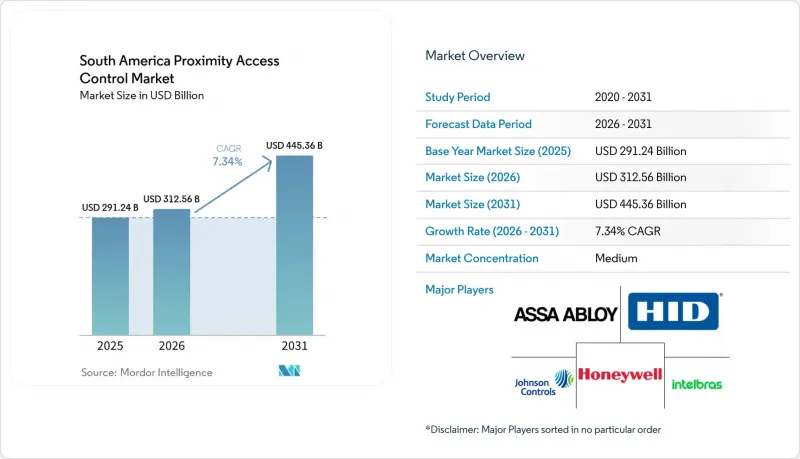
According to Mordor Intelligence, the South America proximity access control market size was USD 291.24 million in 2025 and is estimated to increase from USD 312.56 million in 2026 to USD 445.36 million by 2031, at a CAGR of 7.34% during the forecast period (2026-2031).
South America Proximity Access Control Market Trends and Insights
Expansion of Cloud-Managed Access Control
Cloud-managed systems are changing how sites buy and administer physical access control. Facility operators can manage policies across multiple locations without installing servers at every property. Hybrid cloud and on-premise configurations are expected to represent 70% of new installations in Brazil in 2026. This mix shows that customers still need local control alongside remote management. Data center capacity in Sao Paulo, Bogota, and Buenos Aires supports wider adoption beyond the largest cities. The South America proximity access control market therefore gives service providers an opening to combine cloud administration with local support.
Brazil-Led Commercial and Logistics Construction
Commercial and logistics construction in Brazil creates demand for access systems at warehouses, ports, offices, and technical areas. These locations require controlled entry at loading bays, administration blocks, and restricted zones. Intelbras identified advanced biometrics and digital locks among its 2026 development priorities. Brazil's NR-18 labor safety standards also support controlled site entry for worker identification. These conditions keep construction-related demand important to the South America proximity access control market.
Import Duties and Currency Volatility
Imported reader modules, controller boards, and encrypted credentials face tariffs in several South American countries. Brazil's Imposto de Importacao and Imposto sobre Produtos Industrializados add to the landed cost of electronic security hardware. Currency weakness raises local costs when premium components are priced in USD. Budget constraints can delay upgrades even when a site needs better security. Local manufacturing can reduce exposure for domestic suppliers, including Intelbras in Brazil. This pressure limits volume for premium imported products in the South America proximity access control market outside high-value projects.
Other drivers and restraints analyzed in the detailed report include:
- Rising Demand for Multi-Technology Credentials
- Integration of Physical Access with Identity and Security Platforms
- Fragmented Installer and Integrator Capability
For complete list of drivers and restraints, kindly check the Table Of Contents.
Segment Analysis
Hardware held 68.54% of the South America proximity access control market size in 2025. This position reflected the region's continued need for physical devices at new and existing sites. Door controllers provided the local connection between credentials, doors, and wider management systems. Card and proximity readers formed the largest part of equipment demand at offices, government facilities, and commercial properties. Biometric readers served financial services and public sites that required higher assurance at selected doors. Keypads and wireless locks extended coverage to smaller openings and locations where conventional wiring was difficult. First-generation projects therefore continued to require substantial upfront equipment spending. Replacement projects also required readers and controllers when sites moved to stronger encrypted formats. Hardware suppliers needed dependable local stock because a missing component could delay an entire installation. The category remained essential even where customers adopted a subscription-based management platform.
Software is projected to expand at an 8.24% CAGR through 2031. Cloud-hosted platforms allow authorized staff to administer policies across several offices, warehouses, or retail locations. Managed services can reduce the need for every site to maintain dedicated server equipment and specialist personnel. Hybrid systems retain local functions while allowing regional teams to oversee users and door events remotely. On-premise software still serves public and health care settings that keep credential information within local infrastructure. Mobile credential management supports Bluetooth LE readers and connects physical entry with digital identity programs. It also lets organizations introduce phone-based entry alongside existing RFID cards. Hybrid cloud and on-premise configurations are expected to account for 70% of new Brazilian installations in 2026. This practical preference shows that cloud adoption does not remove the need for local resilience. The South America proximity access control market consequently includes both recurring software revenue and lasting equipment demand.
RFID held 52.36% of South America proximity access control market share in 2025. The category covers the established 125 kHz format and the newer 13.56 MHz format. It remains common because readers provide quick entry and work across many physical access settings. Corporate offices use RFID for regular employee traffic at entrances and internal doors. Government facilities use the technology where credentials must be issued and administered at scale. Financial facilities value the ability to combine cards with additional verification at sensitive areas. Many deployments are now replacing outdated readers instead of building completely new door infrastructure. That approach reduces disruption because existing cabling and door hardware can often remain in place. Reader replacement also gives customers a way to improve protection without changing every part of the system. The installed base therefore keeps RFID central to spending in the South America proximity access control market.
RFID is also projected to expand at an 8.76% CAGR through 2031. The projection reflects the ongoing move from 125 kHz Wiegand readers to encrypted 13.56 MHz credentials. Legacy Wiegand systems transmit credential data in cleartext and are more exposed to cloning. MIFARE DESFire EV3 and HID iCLASS SE offer encrypted alternatives for these upgrade projects. The resulting demand is RFID revenue, but it represents security hardening within the same technology family. HID Global's 2025 collaboration with Invenzi added OSDP communication and credential-cloning protection to Brazilian deployments. NFC supports digital credential programs that work with devices and wallet services. Bluetooth LE supports mobile entry at campuses, shared workspaces, and commercial buildings. These technologies work alongside RFID rather than simply replacing it. Technology selection also needs to consider developing rules for biometric and electronic credential information.
Complete Report Scope:
- By Solution
- Hardware
- Door Controllers
- Card and Proximity Readers
- Biometric Readers
- Keypads and Wireless Locks
- Software
- On-Premise Platforms
- Cloud (Hosted, Managed, Hybrid ACaaS)
- Mobile Credential Management
- Hardware
- By Technology
- RFID (125 kHz, 13.56 MHz)
- NFC
- Bluetooth LE
- Wi-Fi / Zigbee / Z-Wave
- By Authentication Mode
- Single-Factor (Card/Pin)
- Biometric-Only
- Multi-Factor (Card + Biometric / Mobile + Pin)
- By Access Control Type
- Card Readers
- Biometric Scanners
- Proximity Readers
- Alarms and Intrusion Sensors
- Metal Detectors
- Door Controllers
- Wireless Locks
- By End-user Industry
- Government and Public Services
- Banking and Financial Services
- IT and Telecom
- Transportation and Logistics
- Retail and Hospitality
- Healthcare and Life Sciences
- Residential and Smart Homes
- Manufacturing and Warehousing
- By Geography
- Brazil
- Argentina
- Colombia
- Rest of South America
List of Companies Covered in this Report:
- ASSA ABLOY AB
- Allegion plc
- HID Global Corporation
- dormakaba Holding AG
- Johnson Controls International plc
- Honeywell International Inc.
- Intelbras S/A Industria de Telecomunicacao Eletronica Brasileira
- Gallagher Group Limited
- SALTO Systems, S.L.
- Genetec Inc.
- Suprema Inc.
- IDEMIA Group S.A.S.
- Thales S.A.
- Bosch Sicherheitssysteme GmbH
- Axis Communications AB
- Nedap N.V.
- Identiv, Inc.
- Vanderbilt Industries, Inc.
- Paxton Access Ltd.
- Hangzhou Hikvision Digital Technology Co., Ltd.
- Zhejiang Dahua Technology Co., Ltd.
- Schneider Electric SE
Additional Benefits:
- The market estimate (ME) sheet in Excel format
- 3 months of analyst support
TABLE OF CONTENTS
1 INTRODUCTION
- 1.1 Study Assumptions and Market Definition
- 1.2 Scope of the Study
2 RESEARCH METHODOLOGY
3 EXECUTIVE SUMMARY
4 MARKET LANDSCAPE
- 4.1 Market Overview
- 4.2 Market Drivers
- 4.2.1 Expansion of Cloud-Managed Access Control
- 4.2.2 Growth of Brazil-Led Commercial and Logistics Construction
- 4.2.3 Rising Demand for Multi-Technology Credentials
- 4.2.4 Integration of Physical Access With Identity and Security Platforms
- 4.2.5 Government and Public Infrastructure Security Modernization
- 4.2.6 Replacement of Legacy Low-Frequency Proximity Installations
- 4.3 Market Restraints
- 4.3.1 Import Duties and Currency Volatility
- 4.3.2 Fragmented Installer and Integrator Capability
- 4.3.3 Data-Protection Exposure From Biometric and Mobile Credentials
- 4.3.4 Interoperability Constraints Across Installed Card Systems
- 4.4 Impact of Macroeconomic Factors on the Market
- 4.5 Industry Value Chain Analysis
- 4.6 Regulatory Landscape
- 4.7 Technological Outlook
- 4.8 Porter's Five Forces Analysis
- 4.8.1 Bargaining Power of Suppliers
- 4.8.2 Bargaining Power of Buyers
- 4.8.3 Threat of New Entrants
- 4.8.4 Threat of Substitutes
- 4.8.5 Competitive Rivalry
5 MARKET SIZE AND GROWTH FORECASTS (VALUE)
- 5.1 By Solution
- 5.1.1 Hardware
- 5.1.1.1 Door Controllers
- 5.1.1.2 Card and Proximity Readers
- 5.1.1.3 Biometric Readers
- 5.1.1.4 Keypads and Wireless Locks
- 5.1.2 Software
- 5.1.2.1 On-Premise Platforms
- 5.1.2.2 Cloud (Hosted, Managed, Hybrid ACaaS)
- 5.1.2.3 Mobile Credential Management
- 5.1.1 Hardware
- 5.2 By Technology
- 5.2.1 RFID (125 kHz, 13.56 MHz)
- 5.2.2 NFC
- 5.2.3 Bluetooth LE
- 5.2.4 Wi-Fi / Zigbee / Z-Wave
- 5.3 By Authentication Mode
- 5.3.1 Single-Factor (Card/Pin)
- 5.3.2 Biometric-Only
- 5.3.3 Multi-Factor (Card + Biometric / Mobile + Pin)
- 5.4 By Access Control Type
- 5.4.1 Card Readers
- 5.4.2 Biometric Scanners
- 5.4.3 Proximity Readers
- 5.4.4 Alarms and Intrusion Sensors
- 5.4.5 Metal Detectors
- 5.4.6 Door Controllers
- 5.4.7 Wireless Locks
- 5.5 By End-user Industry
- 5.5.1 Government and Public Services
- 5.5.2 Banking and Financial Services
- 5.5.3 IT and Telecom
- 5.5.4 Transportation and Logistics
- 5.5.5 Retail and Hospitality
- 5.5.6 Healthcare and Life Sciences
- 5.5.7 Residential and Smart Homes
- 5.5.8 Manufacturing and Warehousing
- 5.6 By Geography
- 5.6.1 Brazil
- 5.6.2 Argentina
- 5.6.3 Colombia
- 5.6.4 Rest of South America
6 COMPETITIVE LANDSCAPE
- 6.1 Market Concentration
- 6.2 Strategic Moves
- 6.3 Market Share Analysis
- 6.4 Company Profiles (includes Global Level Overview, Market Level Overview, Core Segments, Financials as available, Strategic Information, Market Rank/Share, Products and Services, Recent Developments)
- 6.4.1 ASSA ABLOY AB
- 6.4.2 Allegion plc
- 6.4.3 HID Global Corporation
- 6.4.4 dormakaba Holding AG
- 6.4.5 Johnson Controls International plc
- 6.4.6 Honeywell International Inc.
- 6.4.7 Intelbras S/A Industria de Telecomunicacao Eletronica Brasileira
- 6.4.8 Gallagher Group Limited
- 6.4.9 SALTO Systems, S.L.
- 6.4.10 Genetec Inc.
- 6.4.11 Suprema Inc.
- 6.4.12 IDEMIA Group S.A.S.
- 6.4.13 Thales S.A.
- 6.4.14 Bosch Sicherheitssysteme GmbH
- 6.4.15 Axis Communications AB
- 6.4.16 Nedap N.V.
- 6.4.17 Identiv, Inc.
- 6.4.18 Vanderbilt Industries, Inc.
- 6.4.19 Paxton Access Ltd.
- 6.4.20 Hangzhou Hikvision Digital Technology Co., Ltd.
- 6.4.21 Zhejiang Dahua Technology Co., Ltd.
- 6.4.22 Schneider Electric SE
7 MARKET OPPORTUNITIES AND FUTURE OUTLOOK
- 7.1 White-Space and Unmet-Need Assessment

