PUBLISHER: Mordor Intelligence | PRODUCT CODE: 2155230

PUBLISHER: Mordor Intelligence | PRODUCT CODE: 2155230
Microcellular Plastics - Market Share Analysis, Industry Trends & Statistics, Growth Forecasts (2026 - 2031)
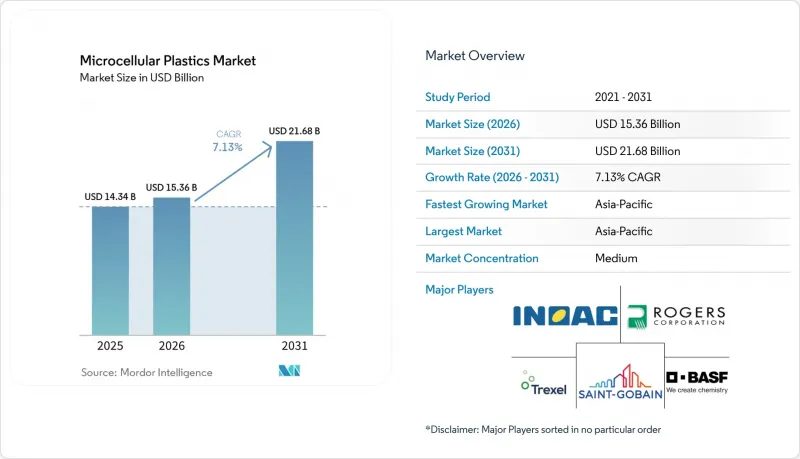
According to Mordor Intelligence, the microcellular plastics market size was valued at USD 14.34 billion in 2025 and is estimated to grow from USD 15.36 billion in 2026 to reach USD 21.68 billion by 2031, at a CAGR of 7.13% during the forecast period (2026-2031).
Global Microcellular Plastics Market Trends and Insights
Automotive and Electric-Vehicle Lightweighting
Battery electric vehicles carry battery packs weighing 400-700 kg, increasing the need to reduce mass in other vehicle systems. Microcellular foam injection molding can lower component density by 8%-12% and reduce the weight of larger interior assemblies by 20%-30%. Trexel described applications for instrument panel carriers, door panels, and center consoles at K 2025. Global electric-vehicle sales exceeded 17 million units in 2025, and broader use across vehicle platforms can expand demand for lightweight molded parts. FORVIA stated that its Microject Advanced process was in serial production with leading original equipment manufacturers by October 2025 and reduced a part's lifetime carbon dioxide equivalent emissions by up to 50%. The process can also remove certain painting and airbag chute-channel steps, reducing tooling complexity for suppliers with multistep production lines.
Demand for High-Performance Thermal and Acoustic Insulation
Building energy requirements are making insulation performance a purchasing consideration for developers and contractors. The revised Energy Performance of Buildings Directive required member states to improve the energy performance of residential buildings and supported the renovation of 35 million buildings by 2030. Rigid microcellular polyurethane foam can reach thermal conductivity of 0.022 W/m*K, helping wall systems meet tighter thermal requirements with less thickness. BASF broke ground on a Cellasto microcellular polyurethane plant in Dahej, India, in February 2025, and the facility is expected to operate in the second half of 2026. The investment targets automotive noise, vibration, and harshness applications in India's vehicle sector.
High Material, Equipment, and Validation Costs
High material, equipment, and validation costs remain an immediate barrier for the microcellular plastics industry. Supercritical-fluid injection units need specialized screws, mixing sections, and pressure-control hardware that conventional molding platforms do not require. Automotive qualification for structural microcellular parts often takes 18-24 months, increasing the working-capital requirement for smaller Tier-2 suppliers. Testing must address noise, vibration, and harshness performance, dimensional stability, and crash behavior before an original equipment manufacturer can approve a component. Simulation tools such as Moldex3D and Autodesk Moldflow require microcellular process inputs that smaller processors may not maintain. ENGEL's October 2025 acquisition of Trexel could reduce total ownership cost for some processors by connecting MuCell hardware with machine platforms.
Other drivers and restraints analyzed in the detailed report include:
- Material Reduction and Carbon-Intensity Benefits
- Expansion of Sustainable Food and Protective Packaging
- Limited Processing Capacity and Specialist Know-How
For complete list of drivers and restraints, kindly check the Table Of Contents.
Segment Analysis
Polyurethane held 28.57% of the microcellular plastics market share in 2025 and is projected to expand at a 7.86% CAGR through 2031. Its position reflects use in automotive noise, vibration, and harshness components, building insulation, footwear midsoles, and industrial seals. BASF's Cellasto materials are used in jounce bumpers, top mounts, and coil spring isolators, where defined hardness and deflection behavior are required. Building renovation requirements and vehicle electrification support demand for low-density materials near battery enclosures and within vehicle interiors. BASF introduced Lupragen N 208 in December 2025, a reactive amine catalyst designed to remain in the polyurethane network and address low-emission requirements in interior foam applications.
Polyvinyl chloride retained relevance in wire and cable jacketing and flooring, where chemical resistance and dimensional stability are important. Polystyrene microcellular grades served protective packaging and cold-chain logistics, although the single-use plastics regulation created pressure on these applications. Polycarbonate and polyethylene terephthalate supported high-clarity and high-barrier food and electronics packaging applications. Polyethylene terephthalate can also fit deposit-return recycling systems that are already used for beverage packaging. Other materials included polypropylene, polylactic acid, and engineering thermoplastics. Sekisui Chemical's Advancell expandable microsphere technology can be used with polyvinyl chloride, polypropylene, polyethylene, thermoplastic vulcanizate, and ethylene propylene diene monomer, widening access to in-matrix foaming without supercritical-fluid equipment. These material options let processors select a balance of stiffness, cushioning, appearance, recyclability, and processing cost.
Complete Report Scope:
- By Material Type
- Polyurethane
- Polyvinyl Chloride
- Polystyrene
- Polycarbonate
- Polyethylene Terephthalate
- Others
- By Form
- Rigid Microcellular Plastics
- Flexible Microcellular Plastics
- Others
- By End-User Industry
- Food Packaging
- Automotive and Transportation
- Building and Construction
- Healthcare
- Electrical and Electronics
- Other End-User Industries
- By Geography
- Asia-Pacific
- China
- India
- Japan
- South Korea
- ASEAN Countries
- Rest of Asia-Pacific
- North America
- United States
- Canada
- Mexico
- Europe
- Germany
- United Kingdom
- France
- Italy
- NORDIC Countries
- Rest of Europe
- South America
- Brazil
- Argentina
- Rest of South America
- Middle East and Africa
- Saudi Arabia
- South Africa
- Rest of Middle East and Africa
- Asia-Pacific
Geography Analysis
Asia-Pacific held 40.16% of the microcellular plastics market share in 2025 and is projected to advance at an 8.06% CAGR through 2031. China's electric-vehicle assembly activity supported the qualification of components for battery enclosures, seat frames, and instrument panels. India's automotive and residential construction sectors increased demand for microcellular polyurethane materials. BASF began construction of its Dahej Cellasto plant in February 2025, and the plant is expected to operate in the second half of 2026. ARMACELL opened a manufacturing facility in Pune in June 2025, adding ArmaGel XG production capacity for high-temperature and cryogenic service. Japan and South Korea contributed advanced processing capabilities for electronics sealing and cushioning. Sekisui's Advancell platform was relevant to precision electronics manufacturers in both countries.
North America and Europe represented mature demand clusters where regulation strengthened the use case for microcellular plastics. The U.S. flexible packaging sector generated USD 41.5 billion in annual sales, and food applications accounted for nearly 50% of demand. This base creates an opportunity within the microcellular plastics market for converters that can achieve material savings in food and protective packaging. U.S. tax incentives for energy-efficient homes and commercial buildings supported insulation upgrade cycles. Germany remained an important location for automotive supplier development and visible-surface applications. FORVIA reported that Microject Advanced had reached serial production with leading original equipment manufacturers and had won a Society of Plastics Engineers innovation award in October 2025. The Packaging and Packaging Waste Regulation and the Energy Performance of Buildings Directive created aligned demand across packaging and construction applications.
South America and Middle East and Africa remained earlier-stage demand regions in the microcellular plastics market. Brazil had the region's most developed automotive assembly base and began qualifying microcellular polypropylene and polyurethane parts for localized vehicle platforms. Argentina and other South American markets were more accessible through packaging and construction applications. Saudi Arabia's construction pipeline, including NEOM and Red Sea development zones, supported demand for insulation in high-temperature projects. South Africa's mining and industrial services activities created niche demand for vibration-damping and sealing materials. Limited processing capacity and specialist know-how constrained local conversion in both regions. Imported fabricated parts, therefore, accounted for more near-term demand than locally processed foam, leaving an opening for compounding and conversion investment.
- ARMACELL
- BASF
- Borealis AG
- Evonik Industries AG
- Formosa Plastics Corporation
- General Plastics Manufacturing Company
- INEOS
- INOAC CORPORATION
- LyondellBasell Industries N.V.
- Rogers Corporation
- Saint-Gobain
- Sekisui Chemical Co., Ltd.
- Trexel
Additional Benefits:
- The market estimate (ME) sheet in Excel format
- 3 months of analyst support
TABLE OF CONTENTS
1 Introduction
- 1.1 Study Assumptions and Market Definition
- 1.2 Scope of the Study
2 Research Methodology
3 Executive Summary
4 Market Landscape
- 4.1 Market Overview
- 4.2 Market Drivers
- 4.2.1 Automotive and Electric-Vehicle Lightweighting
- 4.2.2 Demand for High-Performance Thermal and Acoustic Insulation
- 4.2.3 Material Reduction and Carbon-Intensity Benefits
- 4.2.4 Expansion of Sustainable Food and Protective Packaging
- 4.2.5 OEM Integration of Physical Foaming Equipment
- 4.3 Market Restraints
- 4.3.1 High Material, Equipment, and Validation Costs
- 4.3.2 Limited Processing Capacity and Specialist Know-How
- 4.3.3 Surface-Finish and Dimensional-Consistency Risk
- 4.4 Value Chain Analysis
- 4.5 Porter's Five Forces Analysis
- 4.5.1 Bargaining Power of Suppliers
- 4.5.2 Bargaining Power of Buyers
- 4.5.3 Threat of New Entrants
- 4.5.4 Threat of Substitutes
- 4.5.5 Competitive Rivalry
5 Market Size and Growth Forecasts (Value)
- 5.1 By Material Type
- 5.1.1 Polyurethane
- 5.1.2 Polyvinyl Chloride
- 5.1.3 Polystyrene
- 5.1.4 Polycarbonate
- 5.1.5 Polyethylene Terephthalate
- 5.1.6 Others
- 5.2 By Form
- 5.2.1 Rigid Microcellular Plastics
- 5.2.2 Flexible Microcellular Plastics
- 5.2.3 Others
- 5.3 By End-User Industry
- 5.3.1 Food Packaging
- 5.3.2 Automotive and Transportation
- 5.3.3 Building and Construction
- 5.3.4 Healthcare
- 5.3.5 Electrical and Electronics
- 5.3.6 Other End-User Industries
- 5.4 By Geography
- 5.4.1 Asia-Pacific
- 5.4.1.1 China
- 5.4.1.2 India
- 5.4.1.3 Japan
- 5.4.1.4 South Korea
- 5.4.1.5 ASEAN Countries
- 5.4.1.6 Rest of Asia-Pacific
- 5.4.2 North America
- 5.4.2.1 United States
- 5.4.2.2 Canada
- 5.4.2.3 Mexico
- 5.4.3 Europe
- 5.4.3.1 Germany
- 5.4.3.2 United Kingdom
- 5.4.3.3 France
- 5.4.3.4 Italy
- 5.4.3.5 NORDIC Countries
- 5.4.3.6 Rest of Europe
- 5.4.4 South America
- 5.4.4.1 Brazil
- 5.4.4.2 Argentina
- 5.4.4.3 Rest of South America
- 5.4.5 Middle East and Africa
- 5.4.5.1 Saudi Arabia
- 5.4.5.2 South Africa
- 5.4.5.3 Rest of Middle East and Africa
- 5.4.1 Asia-Pacific
6 Competitive Landscape
- 6.1 Market Concentration
- 6.2 Strategic Moves
- 6.3 Market Share (%)/Ranking Analysis
- 6.4 Company Profiles (includes Global Overview, Market Overview, Core Segments, Financials as available, Strategic Information, Products and Services, and Recent Developments)
- 6.4.1 ARMACELL
- 6.4.2 BASF
- 6.4.3 Borealis AG
- 6.4.4 Evonik Industries AG
- 6.4.5 Formosa Plastics Corporation
- 6.4.6 General Plastics Manufacturing Company
- 6.4.7 INEOS
- 6.4.8 INOAC CORPORATION
- 6.4.9 LyondellBasell Industries N.V.
- 6.4.10 Rogers Corporation
- 6.4.11 Saint-Gobain
- 6.4.12 Sekisui Chemical Co., Ltd.
- 6.4.13 Trexel
7 Market Opportunities and Future Outlook
- 7.1 White-Space and Unmet-Need Assessment

