PUBLISHER: Mordor Intelligence | PRODUCT CODE: 2155239

PUBLISHER: Mordor Intelligence | PRODUCT CODE: 2155239
North America Built To Rent Residential - Market Share Analysis, Industry Trends & Statistics, Growth Forecasts (2026 - 2031)
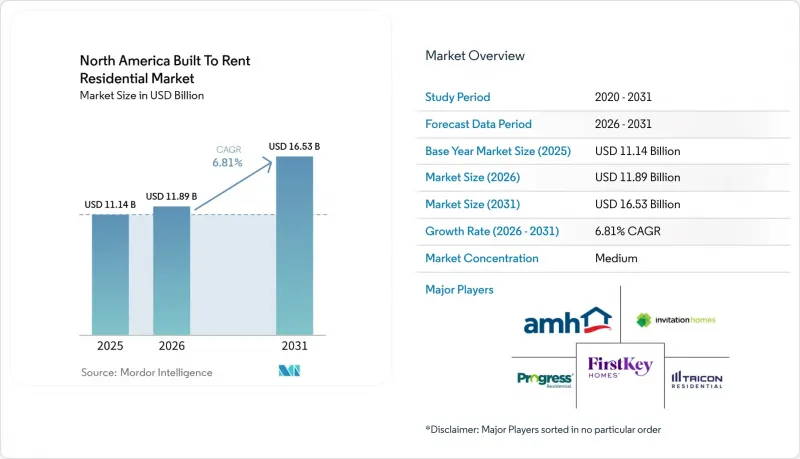
According to Mordor Intelligence, the North America built to rent residential market size is projected to be USD 11.14 billion in 2025, USD 11.89 billion in 2026, and reach USD 16.53 billion by 2031, growing at a CAGR of 6.81% from 2026 to 2031.
North America Built To Rent Residential Market Trends and Insights
Housing Affordability Challenges Increase Rental Demand
Homeownership costs are extending the period during which households rent, which supports demand for professionally managed homes. Median monthly owner costs for mortgaged United States homeowners rose to USD 2,035 in 2024 from USD 1,960 in 2023, according to the United States Census Bureau. The median age of first-time homebuyers reached 40 in 2025, while first-time buyers accounted for 21% of homebuyers, underscoring how difficult it has become for many renters to move into homeownership. In the North America built to rent residential market, this pattern can lengthen occupancy because households that were once expected to buy within several years remain renters. Among renters surveyed in 2025 who intended to move within a year, 59% planned to keep renting. Owners who offer well-located homes and predictable resident services can therefore address demand that is based on affordability as well as convenience.
Millennial and Gen Z Household Formation Expands Built to Rent Demand
Delayed household formation leaves a large group of younger adults who may enter the rental market as their finances improve. An estimated 1.82 million millennial and Generation Z households were missing in 2025, based on historical household formation rates for adults aged 18 to 44. The income needed to purchase a median-priced United States starter home was USD 86,000 in 2025, placing ownership beyond the reach of many people in their 20s and early 30s. Headship among adults aged 25 to 34 fell to 43.7% in 2024, which indicates that this delay has continued beyond the immediate pandemic period. The North America built to rent residential market can serve these households through flexible leases, managed maintenance, and locations near employment centers. This demand is not limited to renters who cannot buy, since managed communities also appeal to younger residents who value flexibility and less responsibility for home upkeep.
Higher Financing Costs Reduce Project Feasibility
Higher debt costs have constrained the number of projects that can move from planning into construction. Senior construction lending has shifted from a maximum loan-to-cost ratio of 85% to 70%-75%, requiring developers to raise more costly equity or subordinated capital. Single-family built-for-rent starts totaled 62,000 in the four quarters ending in the first quarter of 2026, down 26% from 84,000 in the preceding four-quarter period. Better-capitalized operators can continue development when smaller developers pause projects. AMH allocated USD 550 million in disposition proceeds to fund 1,400 new wholly owned development homes in 2026. The North America built to rent residential market may therefore see a larger role for owners with established lender relationships and recycled capital.
Other drivers and restraints analyzed in the detailed report include:
- Sun Belt Population and Employment Growth Accelerate Built to Rent Development
- Institutional Capital Expands Purpose-Built Rental Supply
- Oversupply in Selected Markets Pressures Occupancy and Rental Growth
For complete list of drivers and restraints, kindly check the Table Of Contents.
Segment Analysis
Multifamily built to rent held 46.5% of the North America built to rent residential market share in 2025, reflecting its ability to support larger portfolios and lower per-unit land costs. Purpose-built rental apartments serve higher-density urban residents, while purpose-built rental houses / townhomes provide more privacy and outdoor space in suburban settings. Single-family built to rent / built to rent communities are projected to grow at an 8.4% CAGR through 2031. This growth reflects continued household demand for detached homes, private yards, and shared community features. The North America built to rent residential market size for these homes is supported by households that seek the space of ownership but cannot purchase.
Operators are matching product design with local land costs and resident needs. Apartments can offer higher density in areas where land is scarce, while horizontal communities can serve families and households seeking more space. Offsite and modular construction can shorten multifamily timelines by 30% to 60% compared with traditional methods. Tricon Residential opened its Winchester community in Riverside County, California, with support from a USD 92 million investment from Blackstone Real Estate, demonstrating that purpose-built rental houses / townhomes can extend beyond traditional Sun Belt locations.
Complete Report Scope:
- By Type
- Multifamily Built to Rent
- Single-Family Built to Rent / Built to Rent Communities
- Purpose-Built Rental Apartments
- Purpose-Built Rental Houses / Townhomes
- By Management Model
- In-House Operator
- Third-Party Operator
- Hybrid Management
- By Price Segment
- Premium / Luxury
- Mid-Market
- Affordable & Workforce Housing
- By Country
- United States
- Canada
- Mexico
List of Companies Covered in this Report:
- Invitation Homes Inc.
- AMH
- Progress Residential
- FirstKey Homes
- Tricon Residential Inc.
- Greystar Real Estate Partners, LLC
- Blackstone Inc.
- Pretium Partners
- The Amherst Group LLC
- Main Street Renewal
- VineBrook Homes Trust, Inc.
- AvalonBay Communities, Inc.
- Mill Creek Residential Trust LLC
- Cortland Partners, LLC
- Brookfield Asset Management Ltd.
- Hunt Companies, Inc.
- Heitman LLC
- Lennar Corporation
- Taylor Morrison Home Corporation
- Camden Property Trust
Additional Benefits:
- The market estimate (ME) sheet in Excel format
- 3 months of analyst support
TABLE OF CONTENTS
1 Introduction
- 1.1 Study Assumptions and Market Definition
- 1.2 Scope of the Study
2 Research Methodology
3 Executive Summary
4 Market Landscape
- 4.1 Market Overview
- 4.2 Market Drivers
- 4.2.1 Housing Affordability Challenges Increase Rental Demand
- 4.2.2 Millennial and Gen Z Household Formation Expands Build-to-Rent Demand
- 4.2.3 Baby Boomer Downsizing Supports Managed Rental Communities
- 4.2.4 Sun Belt Population and Employment Growth Accelerate Build-to-Rent Development
- 4.2.5 Institutional Capital Expands Purpose-Built Rental Supply
- 4.2.6 Offsite Construction Improves Build-to-Rent Delivery Timelines
- 4.3 Market Restraints
- 4.3.1 Higher Financing Costs Reduce Project Feasibility
- 4.3.2 Oversupply in Selected Markets Pressures Occupancy and Rental Growth
- 4.3.3 Local Zoning and Entitlement Challenges Delay Low-Rise Rental Projects
- 4.3.4 Policy Restrictions on Institutional Ownership Increase Investment Uncertainty
- 4.4 Value and Supply-Chain Analysis
- 4.5 Regulatory Landscape
- 4.6 Technological Outlook
- 4.7 Key Market Trends in the North America Built to Rent Residential Market
- 4.8 Industry Attractiveness - Porter's Five Forces Analysis
- 4.8.1 Bargaining Power of Suppliers
- 4.8.2 Bargaining Power of Consumers
- 4.8.3 Threat of New Entrants
- 4.8.4 Threat of Substitutes
- 4.8.5 Intensity of Competitive Rivalry
5 North America Built to Rent Residential Market, Market Size & Growth Forecasts (Value in USD) - 2020-2031
- 5.1 By Type
- 5.1.1 Multifamily Built to Rent
- 5.1.2 Single-Family Built to Rent / Built to Rent Communities
- 5.1.3 Purpose-Built Rental Apartments
- 5.1.4 Purpose-Built Rental Houses / Townhomes
- 5.2 By Management Model
- 5.2.1 In-House Operator
- 5.2.2 Third-Party Operator
- 5.2.3 Hybrid Management
- 5.3 By Price Segment
- 5.3.1 Premium / Luxury
- 5.3.2 Mid-Market
- 5.3.3 Affordable & Workforce Housing
- 5.4 By Country
- 5.4.1 United States
- 5.4.2 Canada
- 5.4.3 Mexico
6 Competitive Landscape
- 6.1 Market Concentration
- 6.2 Strategic Moves
- 6.3 Market Share Analysis
- 6.4 Company Profiles (Includes Global Level Overview, Market Level Overview, Core Segments, Financials as Available, Strategic Information, Products & Services, and Recent Developments)
- 6.4.1 Invitation Homes Inc.
- 6.4.2 AMH
- 6.4.3 Progress Residential
- 6.4.4 FirstKey Homes
- 6.4.5 Tricon Residential Inc.
- 6.4.6 Greystar Real Estate Partners, LLC
- 6.4.7 Blackstone Inc.
- 6.4.8 Pretium Partners
- 6.4.9 The Amherst Group LLC
- 6.4.10 Main Street Renewal
- 6.4.11 VineBrook Homes Trust, Inc.
- 6.4.12 AvalonBay Communities, Inc.
- 6.4.13 Mill Creek Residential Trust LLC
- 6.4.14 Cortland Partners, LLC
- 6.4.15 Brookfield Asset Management Ltd.
- 6.4.16 Hunt Companies, Inc.
- 6.4.17 Heitman LLC
- 6.4.18 Lennar Corporation
- 6.4.19 Taylor Morrison Home Corporation
- 6.4.20 Camden Property Trust
7 Market Opportunities & Future Outlook
- 7.1 White-Space and Unmet-Need Assessment

