PUBLISHER: Mordor Intelligence | PRODUCT CODE: 2156930

PUBLISHER: Mordor Intelligence | PRODUCT CODE: 2156930
Europe Built To Rent Residential - Market Share Analysis, Industry Trends & Statistics, Growth Forecasts (2026 - 2031)
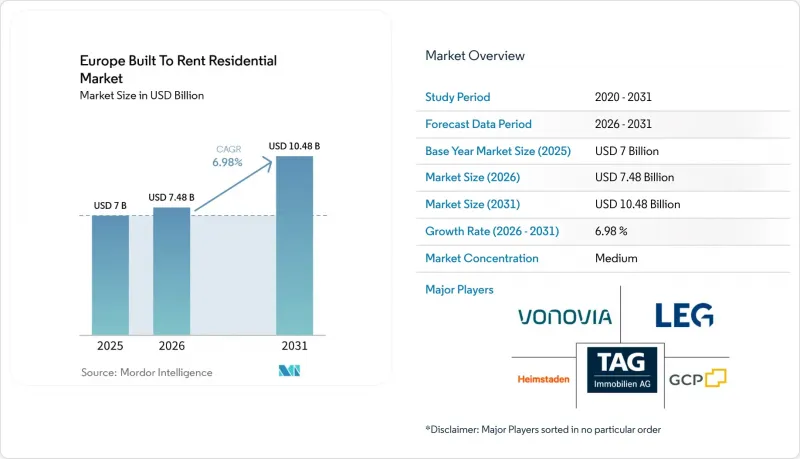
According to Mordor Intelligence, the Europe built to rent residential market size was valued at USD 7 billion in 2025 and is estimated to grow from USD 7.48 billion in 2026 to reach USD 10.48 billion by 2031, at a CAGR of 6.98% during the forecast period (2026-2031).
Europe Built To Rent Residential Market Trends and Insights
Urban Rental Housing Shortages Drive Build to Rent Demand
Housing supply constraints are creating a durable base of tenant demand for the Europe built to rent residential market. Housing completions in Europe declined 5.5% in 2025 from 2024, while permitting activity remained weak. France had 2.8 million pending social housing applications, Germany required at least 400,000 new homes each year, and the Netherlands needed nearly 1 million additional dwellings by 2031. These shortages are most visible in affordable and mid-priced housing, where professionally managed rental homes can serve households that do not qualify for social housing. The European Union and the European Investment Bank announced a 2025 plan to invest USD 10.8 billion over 2 years in housing, renovation, and research. Scarce supply makes completed and occupied assets more valuable to investors because they offer an immediate operating platform in markets where development pipelines are constrained.
Institutional Capital Increases Investment in Residential Assets
Long-term investors are directing more capital toward rental housing, which supports the Europe built to rent residential market. Greystar closed its Greystar Equity Partners Europe II fund with more than USD 2.9 billion in commitments in 2025, supporting rental housing and purpose-built student accommodation expansion. ABP Pension Fund and Greystar invested USD 568.1 million in 779 affordable and mid-market rental homes in Utrecht during September 2025. More than two-thirds of the Utrecht homes were offered at regulated rents below USD 1,404 per month, which links institutional capital to a broader affordability objective. Institutional investors typically favor assets that provide stable income, standardized operations, and clear performance data. This preference is strengthening larger platforms that can source projects, manage resident services, and operate portfolios across several cities.
High Interest Rates and Development Financing Costs Reduce Project Viability
Development financing costs continue to limit new supply in the Europe built to rent residential market. Higher debt costs and construction inflation have made some German projects difficult to justify, particularly outside the largest cities. In the United Kingdom, operating leakage, which is the gap between gross rental income and net rental income, widened from 25% to more than 30%. This reduces the yield available to a developer after property operating expenses. Investors may respond by purchasing completed portfolios or using forward-funding structures instead of taking full development risk. That choice supports transaction activity but can restrict the pace at which new rental homes reach the market.
Other drivers and restraints analyzed in the detailed report include:
- Mortgage Affordability Challenges Extend Rental Demand
- Single-Family Rental Communities Expand Build to Rent Supply
- Planning, Permitting, and Building Safety Delays Slow Project Delivery
For complete list of drivers and restraints, kindly check the Table Of Contents.
Segment Analysis
Purpose-built rental apartments held 56.2% of the Europe built to rent residential market share in 2025. Their leading position reflects the concentration of institutional development in large urban centers, where apartment buildings can support professional leasing, maintenance, and resident-service teams. The format provides unit density that helps managers spread staffing and operating costs across a larger base of homes. It also suits forward-funding agreements because projects are generally standardized and can be delivered in defined phases. The Europe built to rent residential industry has used these projects to establish recognizable operating platforms in major cities. Apartment-led communities remain important where renters value proximity to jobs, transport, and urban services.
Single-family built to rent / built to rent communities are forecast to grow at an 8.2% CAGR from 2026 to 2031. These communities address households seeking additional living space without the cost of ownership. They can be built in suburban locations where land costs are lower than in central apartment districts. Greystar's 2026 garden-style housing plan shows how a large operator is applying this format at scale in the United Kingdom. The model requires careful local management because homes are more dispersed than apartment units. Rental houses and townhomes can also fit markets such as the Netherlands and Nordic countries, where lower-density home types are part of established housing patterns.
Complete Report Scope:
- By Type
- Multifamily Built to Rent
- Single-Family Built to Rent / Built to Rent Communities
- Purpose-Built Rental Apartments
- Purpose-Built Rental Houses / Townhomes
- By Management Model
- In-house Operator
- Third-party Operator
- Hybrid Management
- By Price Segment
- Premium / Luxury
- Mid-Market
- Affordable & Workforce Housing
- By Country
- United Kingdom
- Germany
- France
- Italy
- Spain
- Rest of Europe
List of Companies Covered in this Report:
- Vonovia SE
- LEG Immobilien SE
- Heimstaden Bostad AB
- TAG Immobilien AG
- Grand City Properties S.A.
- Greystar Europe
- Legal & General Group plc
- Grainger plc
- Get Living
- Quintain Limited
- Covivio
- PATRIZIA SE
- CBRE Investment Management
- Blackstone Property Partners Europe
- Hines Europe
- Savills Investment Management
- Akelius Residential Property AB
- PRS REIT plc
- Moda Living
- M&G Real Estate
Additional Benefits:
- The market estimate (ME) sheet in Excel format
- 3 months of analyst support
TABLE OF CONTENTS
1 Introduction
- 1.1 Study Assumptions and Market Definition
- 1.2 Scope of the Study
2 Research Methodology
3 Executive Summary
4 Market Landscape
- 4.1 Market Overview
- 4.2 Market Drivers
- 4.2.1 Urban Rental Housing Shortages Drive Build to Rent Demand
- 4.2.2 Institutional Capital Increases Investment in Residential Assets
- 4.2.3 Mortgage Affordability Challenges Extend Rental Demand
- 4.2.4 Single-Family Rental Communities Expand Build to Rent Supply
- 4.2.5 Energy Retrofit Projects Create Value-Add Build to Rent Opportunities
- 4.2.6 Resident Data Analytics Improve Operating Efficiency and Asset Performance
- 4.3 Market Restraints
- 4.3.1 High Interest Rates and Development Financing Costs Reduce Project Viability
- 4.3.2 Planning, Permitting, and Building Safety Delays Slow Project Delivery
- 4.3.3 Diverse Rent Control Regulations Increase Cross-Border Investment Complexity
- 4.3.4 EPC Compliance Costs and Retrofit Requirements Increase Development Expenses
- 4.4 Value and Supply-Chain Analysis
- 4.5 Regulatory Landscape
- 4.6 Technological Outlook
- 4.7 Key Market Trends in the Europe Built to Rent Residential Market
- 4.8 Industry Attractiveness - Porter's Five Forces Analysis
- 4.8.1 Bargaining Power of Suppliers
- 4.8.2 Bargaining Power of Consumers
- 4.8.3 Threat of New Entrants
- 4.8.4 Threat of Substitutes
- 4.8.5 Intensity of Competitive Rivalry
5 Market Size & Growth Forecasts (Value, USD)
- 5.1 By Type
- 5.1.1 Multifamily Built to Rent
- 5.1.2 Single-Family Built to Rent / Built to Rent Communities
- 5.1.3 Purpose-Built Rental Apartments
- 5.1.4 Purpose-Built Rental Houses / Townhomes
- 5.2 By Management Model
- 5.2.1 In-house Operator
- 5.2.2 Third-party Operator
- 5.2.3 Hybrid Management
- 5.3 By Price Segment
- 5.3.1 Premium / Luxury
- 5.3.2 Mid-Market
- 5.3.3 Affordable & Workforce Housing
- 5.4 By Country
- 5.4.1 United Kingdom
- 5.4.2 Germany
- 5.4.3 France
- 5.4.4 Italy
- 5.4.5 Spain
- 5.4.6 Rest of Europe
6 Competitive Landscape
- 6.1 Market Concentration
- 6.2 Strategic Moves
- 6.3 Market Share Analysis
- 6.4 Company Profiles (Includes Global Level Overview, Market Level Overview, Core Segments, Financials as Available, Strategic Information, Products & Services, and Recent Developments)
- 6.4.1 Vonovia SE
- 6.4.2 LEG Immobilien SE
- 6.4.3 Heimstaden Bostad AB
- 6.4.4 TAG Immobilien AG
- 6.4.5 Grand City Properties S.A.
- 6.4.6 Greystar Europe
- 6.4.7 Legal & General Group plc
- 6.4.8 Grainger plc
- 6.4.9 Get Living
- 6.4.10 Quintain Limited
- 6.4.11 Covivio
- 6.4.12 PATRIZIA SE
- 6.4.13 CBRE Investment Management
- 6.4.14 Blackstone Property Partners Europe
- 6.4.15 Hines Europe
- 6.4.16 Savills Investment Management
- 6.4.17 Akelius Residential Property AB
- 6.4.18 PRS REIT plc
- 6.4.19 Moda Living
- 6.4.20 M&G Real Estate
7 Market Opportunities & Future Outlook
- 7.1 White-Space and Unmet-Need Assessment

