PUBLISHER: Mordor Intelligence | PRODUCT CODE: 2155247

PUBLISHER: Mordor Intelligence | PRODUCT CODE: 2155247
South America Automotive Electric Actuators - Market Share Analysis, Industry Trends & Statistics, Growth Forecasts (2026 - 2031)
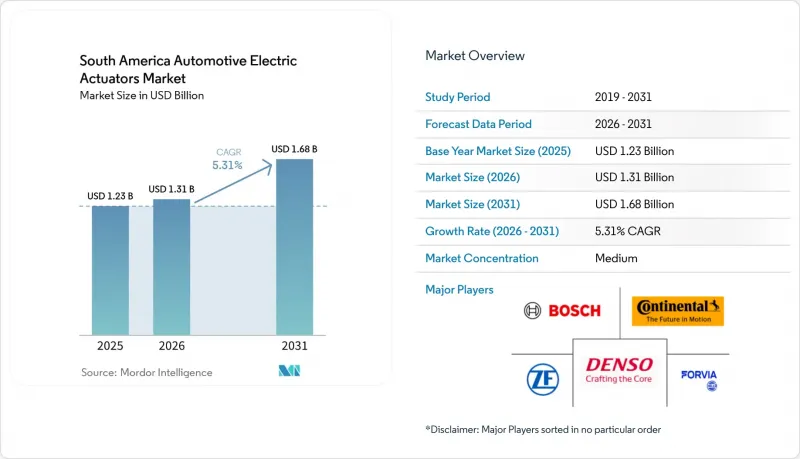
According to Mordor Intelligence, the South America automotive electric actuators market was valued at USD 1.23 billion in 2025 and is projected to grow from USD 1.31 billion in 2026 to USD 1.68 billion by 2031, registering a CAGR of 5.31% during the 2026-2031 forecast period.
South America Automotive Electric Actuators Market Trends and Insights
Accelerated Electric Vehicle Adoption
Regional EV sales recorded strong growth in 2025 compared with 2024. Brazil accounted for a significant share of the regional growth. Plug-in hybrid vehicles represented a substantial share of EV sales in South America. Those vehicles need actuation for both combustion and electric powertrain functions. This can raise the number of components used in each vehicle. The South American automotive electric actuators market benefits as vehicle makers introduce these systems across a wider range of price points . BYD committed BRL 5.5 billion, equivalent to USD 1.07 billion, for the first phase of its Camacari factory. The plant is planned to scale toward 300,000 vehicles per year. BYD also targeted 50% local component sourcing by the end of 2026. This gives Brazil-qualified suppliers a clearer route to new vehicle programs. It also shifts attention from imported parts toward local technical qualification. The South American automotive electric actuators market can gain when suppliers meet the operating and sourcing requirements of these platforms.
Growing Integration of ADAS
Safety-rating requirements and export-oriented vehicle production are supporting the adoption of advanced driver-assistance systems (ADAS) in South America. The South NCAP protocol is expected to take effect in the near term and remain in force for several years. It will place greater emphasis on autonomous emergency braking, blind-spot detection, and lane-departure warning systems. These functions depend on electrical systems that respond to commands from sensors and control units. Electric actuators convert these commands into braking, steering, and closure actions. As these features become increasingly common in vehicles beyond the premium segment, the South American automotive electric actuators market is expanding.
High Manufacturing and Electronic Component Costs
The landed cost structure in South America can disadvantage actuator producers compared with Asian and European suppliers. Brazilian duties on electronic components can exceed 30% of the declared value. The cost is important for throttle controllers, ADAS-related products, and thermal management valves. These applications need imported electronics with automotive-grade performance. Higher input costs make it harder to match prices when sourcing from Asia. The South American automotive electric actuators market rewards suppliers that can reduce exposure through localization. In May 2026, Bosch decided to localize electronic board production in Campinas as part of its BRL 1 billion (USD 171 million) investment. Local production can reduce exposure to imported boards and logistics delays. However, such investments require production volumes that major Tier-1 suppliers can more easily support. Smaller companies may lack the financial capacity to invest in local electronics production. Consequently, the South American automotive electric actuators industry may favor suppliers with established scale.
Other drivers and restraints analyzed in the detailed report include:
- Stricter Emission and Environmental Regulations
- Rising Consumer Demand for Luxury and Comfort Features
- Economic and Political Volatility
For complete list of drivers and restraints, kindly check the Table Of Contents.
Segment Analysis
Passenger cars held 73.23% of the South American automotive electric actuators market share in 2025. The segment is supported by private vehicle ownership and higher electrical content in new models. The result is higher actuator content per vehicle as new powertrain architectures enter the region. Mid-priced passenger cars are adding ADAS content that was previously concentrated in premium models. South NCAP requirements strengthen the value of automatic emergency braking across price levels. Premium growth in Argentina also supports higher-value seat and closure applications. Chinese luxury vehicles in Brazil add further pressure to increase feature content. These changes raise revenue potential even without a comparable increase in vehicle unit volumes.
Commercial vehicle sales are projected to grow at a CAGR of 6.14% through 2031, driven by fleet electrification, e-commerce logistics, and infrastructure investments. Brazil's logistics and agribusiness sectors support truck demand, while expanding last-mile delivery, freight transportation, and infrastructure projects increase demand across South America. The South American automotive electric actuators market is expected to benefit from demand for advanced commercial vehicle control systems, including powertrain management, braking, steering, HVAC, and automated vehicle applications. Fleet operators' focus on efficiency, safety, and emissions compliance is expected to support demand.
Complete Report Scope:
- By Vehicle Type
- Passenger Car
- Commercial Vehicle
- By Application Type
- Throttle Actuator
- Seat Adjustment Actuator
- Brake Actuator
- Closure Actuator
- Others
- By Distribution Channel
- Original Equipment Manufacturer (OEMs)
- Aftermarket
- By Country
- Brazil
- Argentina
- Chile
- Colombia
- Rest of South America
List of Companies Covered in this Report:
- Continental AG
- Robert Bosch GmbH
- Hella KGaA Hueck & Co.
- Wabco Holdings Inc.
- Sonceboz SA
- BorgWarner Inc
- Denso Corporation
- Johnson Electric
- CTS Corporation
- ZF Friedrichshafen AG
- Valeo SA
- Nidec Corporation
Additional Benefits:
- The market estimate (ME) sheet in Excel format
- 3 months of analyst support
TABLE OF CONTENTS
1 Introduction
- 1.1 Study Assumptions and Market Definition
- 1.2 Scope of the Study
2 Research Methodology
3 Executive Summary
4 Market Landscape
- 4.1 Market Overview
- 4.2 Market Drivers
- 4.2.1 Accelerated Electric Vehicle (EV) Adoption
- 4.2.2 Stricter Emission & Environmental Regulations
- 4.2.3 Growing Integration of ADAS (Advanced Driver Assistance Systems)
- 4.2.4 Rising Consumer Demand for Luxury & Comfort Features
- 4.2.5 Industrial Nearshoring & Automotive Manufacturing Investments
- 4.2.6 Transition to Miniaturized and Software-Defined Functionality
- 4.3 Market Restraints
- 4.3.1 High Manufacturing and Electronic Component Costs
- 4.3.2 Economic and Political Volatility
- 4.3.3 Regional Supply Chain Vulnerabilities and Bottlenecks
- 4.3.4 Lagging Public Charging and High-Voltage Grid Infrastructure
- 4.4 Value Chain and Supply-Chain Analysis
- 4.5 Regulatory Landscape
- 4.6 Technological Outlook
- 4.7 Porter's Five Forces Analysis
- 4.7.1 Threat of New Entrants
- 4.7.2 Bargaining Power of Buyers
- 4.7.3 Bargaining Power of Suppliers
- 4.7.4 Threat of Substitutes
- 4.7.5 Competitive Rivalry
5 Market Size & Growth Forecasts (Value (USD) and Volume (Units))
- 5.1 By Vehicle Type
- 5.1.1 Passenger Car
- 5.1.2 Commercial Vehicle
- 5.2 By Application Type
- 5.2.1 Throttle Actuator
- 5.2.2 Seat Adjustment Actuator
- 5.2.3 Brake Actuator
- 5.2.4 Closure Actuator
- 5.2.5 Others
- 5.3 By Distribution Channel
- 5.3.1 Original Equipment Manufacturer (OEMs)
- 5.3.2 Aftermarket
- 5.4 By Country
- 5.4.1 Brazil
- 5.4.2 Argentina
- 5.4.3 Chile
- 5.4.4 Colombia
- 5.4.5 Rest of South America
6 Competitive Landscape
- 6.1 Market Concentration
- 6.2 Strategic Moves
- 6.3 Market Share Analysis
- 6.4 Company Profiles (Includes Global Level Overview, Market Level Overview, Core Segments, Financials as Available, Strategic Information, Market Rank/Share for Key Companies, Products and Services, SWOT Analysis, and Recent Developments)
- 6.4.1 Continental AG
- 6.4.2 Robert Bosch GmbH
- 6.4.3 Hella KGaA Hueck & Co.
- 6.4.4 Wabco Holdings Inc.
- 6.4.5 Sonceboz SA
- 6.4.6 BorgWarner Inc
- 6.4.7 Denso Corporation
- 6.4.8 Johnson Electric
- 6.4.9 CTS Corporation
- 6.4.10 ZF Friedrichshafen AG
- 6.4.11 Valeo SA
- 6.4.12 Nidec Corporation
7 Market Opportunities & Future Outlook
- 7.1 White-space and Unmet-Need Assessment

