PUBLISHER: Mordor Intelligence | PRODUCT CODE: 2155251

PUBLISHER: Mordor Intelligence | PRODUCT CODE: 2155251
Malabsorption Syndrome - Market Share Analysis, Industry Trends & Statistics, Growth Forecasts (2026 - 2031)
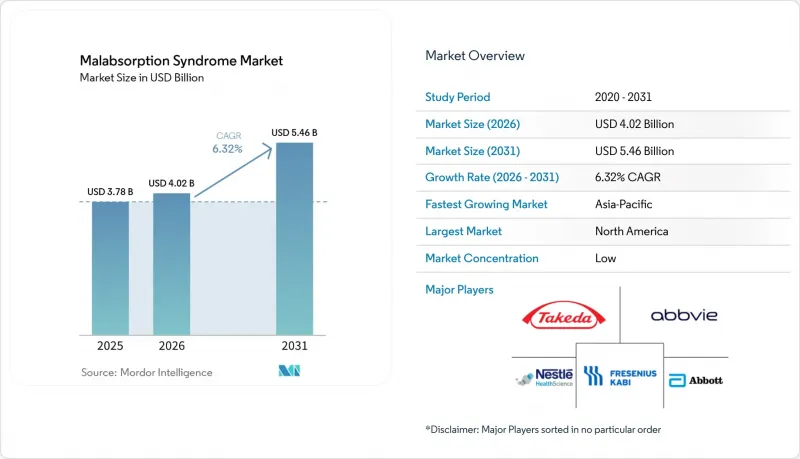
According to Mordor Intelligence, the malabsorption syndrome market size is projected to be USD 3.78 billion in 2025, USD 4.02 billion in 2026, and reach USD 5.46 billion by 2031, growing at a CAGR of 6.32% from 2026 to 2031.
Global Malabsorption Syndrome Market Trends and Insights
Rising Prevalence of Gastrointestinal and Pancreatic Disorders
India had become the leading country for new inflammatory bowel disease incidence by 2025, which changes the geographic focus of the malabsorption syndrome market. The 2024 European guidelines extended pancreatic enzyme replacement therapy indications beyond chronic pancreatitis to patients after bariatric surgery, type 2 diabetes, and esophageal surgery. This combination of a growing Asian inflammatory bowel disease population and wider pancreatic insufficiency eligibility increases the number of patients who may need long-term treatment. Companies with existing biologic or enzyme replacement products can serve these populations without developing separate treatment platforms.
Broader Screening and Diagnostic Access
The 2025 European Society for the Study of Coeliac Disease guidelines permitted a conditional biopsy-free pathway for selected adults younger than 45 years The pathway requires IgA anti-TG2 levels of at least 10 times the upper limit of normal and confirmation through a second serology test. France's Haute Autorite de Sante stated in 2026 that only 10% to 20% of its estimated 670,000 affected patients had a confirmed diagnosis. Germany reported a diagnosis delay of 5 to 7 years and an undiagnosed rate of up to 80%, while Italy introduced a public pediatric screening program in 2025. These differences in access create uneven demand across Europe. Serology-first pathways can reduce procedural barriers and may bring more patients into dietary, nutrition, and treatment programs.
High Therapy and Diagnostic Costs With Uneven Reimbursement
The average cost of preparing a home parenteral nutrition bag increased 75.40% in the United States between 2016 and 2024. Reimbursement declined from 2022 to 2024, while 17 of 24 parenteral nutrition compounding ingredients appeared on shortage lists at the same time. Home parenteral nutrition pharmacy providers declined by an average of 15.60% annually, and Medicare beneficiaries using home enteral nutrition declined 27% under the Competitive Bidding Program. March 2025 coverage guidance added documentation requirements for parenteral nutrition reimbursement. These conditions increase the administrative and financial burden for homecare suppliers. Hospital-based nutrition providers face fewer reimbursement barriers than independent home infusion providers.
Other drivers and restraints analyzed in the detailed report include:
- Expansion of Clinical Nutrition and Enzyme Replacement
- Aging and Pediatric High-Risk Populations
- Underdiagnosis and Nonstandardized Diagnostic Pathways
For complete list of drivers and restraints, kindly check the Table Of Contents.
Segment Analysis
Celiac disease accounted for 34.70% of the malabsorption syndrome market share in 2025. Its position reflects a broad patient base across Europe and North America, where prevalence is estimated at 1% to 2% of the global population. Inflammatory bowel disease remains an important revenue contributor because biologic pipelines address a growing pool of chronic patients. Pancreatic and enzyme deficiency disorders gained relevance after European guidelines widened exocrine pancreatic insufficiency indications. The other categories include lactase deficiency, small intestinal bacterial overgrowth, and tropical sprue, which contribute to narrower volumes. The disease mix requires suppliers to serve conditions with different diagnostic routes and treatment durations.
Short bowel syndrome and intestinal failure are projected to record an 8.90% CAGR through 2031, the highest growth rate among disease categories. The malabsorption syndrome market size for this category is supported by GLP-2 analog development and stronger survival outcomes after pediatric surgery. Teduglutide generated USD 800 million in annual sales despite daily injections, showing willingness to fund therapies for patients with severe intestinal failure. Zealand Pharma initiated the EASE-5 Phase 3 study of 10.00mg twice-weekly subcutaneous glepaglutide in February 2026. The study enrolled 90.00 patients in the United States and Europe. Entera Bio also presented pharmacokinetic data for an oral GLP-2 tablet in 2025, placing convenience and adherence alongside clinical efficacy in product competition.
Treatment held 61.80% of the malabsorption syndrome market share in 2025. This includes dietary management, medical nutrition, pancreatic enzyme replacement therapy, and biologic medicines. Anti-inflammatory biologics have the highest per-patient revenue potential in inflammatory bowel disease. Annual biologic spending in the United States commonly exceeds USD 20,000 for these patients. Enzyme replacement and nutritional supplements address the different needs of patients with pancreatic insufficiency and short bowel syndrome. The broad treatment range supports a large installed base of recurring care.
Diagnosis is forecast to grow at an 8.10% CAGR through 2031. The 2025 European conditional no-biopsy pathway raises the importance of validated IgA anti-TG2 immunoassay platforms. Fresenius Kabi launched 3.00 enteral nutrition products in 2025 and received European approval for PediSmof, a three-chamber pediatric parenteral nutrition bag. Its 2025 vedolizumab biosimilar licensing agreement also extended its work from nutrition into gastrointestinal immunology. Endoscopy and biopsy may face lower volumes in parts of Europe where noninvasive protocols gain acceptance. North American providers continue to use biopsy for most adult patients, preserving demand for both procedural and serological diagnostic approaches.
Complete Report Scope:
- By Disease
- Celiac Disease
- Inflammatory Bowel Disease
- Pancreatic and Enzyme Deficiency Disorders
- Short Bowel Syndrome & Intestinal Failure
- Others
- By Offering
- Diagnosis
- Blood, Serological & Nutrient Deficiency Tests
- Stool & Breath Tests
- Endoscopy & Biopsy
- Others
- Treatment
- Dietary Management & Medical Nutrition
- Enzyme Replacement & Nutritional Supplementation
- Drug Therapy (Anti-inflammatorys, antibiotics, antidiarrheals, bile acid binders)
- Others
- Diagnosis
- By Route of Administration
- Oral
- Parenteral
- Enteral
- Subcutaneous
- Others
- By Distribution Channel
- Hospital Pharmacies
- Retail Pharmacies
- Online Pharmacies
- Direct Institutional Sales
- Others
- By End User
- Hospitals
- Specialty Clinics & Nutrition Centers
- Diagnostic & Research Centers
- Homecare Settings
- Others
- By Geography
- North America
- United States
- Canada
- Mexico
- Europe
- Germany
- United Kingdom
- France
- Italy
- Spain
- Rest of Europe
- Asia-Pacific
- China
- Japan
- India
- Australia
- South Korea
- Rest of Asia-Pacific
- Middle East and Africa
- GCC
- South Africa
- Rest of Middle East and Africa
- South America
- Brazil
- Argentina
- Rest of South America
- North America
Geography Analysis
North America held 40.80% of the malabsorption syndrome market share in 2025. Medicare's parenteral nutrition coverage framework and a concentrated specialist pharmacy network support the region's position. The United States had the highest total inflammatory bowel disease patient count of any country in 2025. Fresenius Kabi's 2025 agreement for 7,000 Ivenix pumps and parenteral nutrition products shows the scale of institutional procurement in the region. Canada had the highest age-standardized inflammatory bowel disease prevalence rate, supporting high treatment intensity. North American growth is constrained by the 75.40% rise in home parenteral nutrition preparation costs from 2016 to 2024 and reimbursement declines since 2022.
Europe is the second-largest regional group in the malabsorption syndrome market. Italy introduced a legally mandated celiac screening program for children in 2025, while Germany continued to report diagnosis delays of 5 to 7 years and underdiagnosis of up to 80.00%. France's updated 2026 recommendations recognized that only 10% to 20% of an estimated 670,000 affected people had confirmed diagnoses. These differences create uneven access to diagnosis, nutrition services, and treatment. Europe also has strong clinical nutrition demand because established hospitals and specialty providers use standardized parenteral and enteral products. Country-specific screening and reimbursement policies will continue to influence commercial access.
Asia-Pacific is projected to grow at an 8.80% CAGR through 2031, the highest regional rate in the malabsorption syndrome market. Asian inflammatory bowel disease prevalence rose materially and India had become the leading country for new incidence by 2025. East Asia recorded an annual age-standardized prevalence increase of 1.50%. Growing wheat-based diets may raise celiac disease risk in populations with limited diagnostic systems. The Middle East and Africa and South America remain earlier-stage regions, where limited treatment infrastructure restricts uptake. Brazil remains an anchor for South America, where clinical interest in pancreatic enzyme replacement for short bowel syndrome has increased.
- Abbott Laboratories
- Abbvie
- Aspen Pharmacare
- Bausch Health
- Baxter
- Chiesi Farmaceutici
- Cosmo Pharmaceuticals
- Digestive Care, Inc.
- dsm-firmenich AG
- Entero Therapeutics, Inc.
- Ferring Pharmaceuticals
- Fresenius
- Zealand Pharma
- Merck
- Nestle
- Dr. Falk Pharma GmbH & Co. KG
- Organon and Co.
- Pfizer
- Sanofi
- Takeda Pharmaceuticals
- Tillotts Pharma AG
Additional Benefits:
- The market estimate (ME) sheet in Excel format
- 3 months of analyst support
TABLE OF CONTENTS
1 Introduction
- 1.1 Study Assumptions & Market Definition
- 1.2 Scope of the Study
2 Research Methodology
3 Executive Summary
4 Market Landscape
- 4.1 Market Overview
- 4.2 Market Drivers
- 4.2.1 Rising Prevalence of Gastrointestinal and Pancreatic Disorders
- 4.2.2 Broader Screening and Diagnostic Access
- 4.2.3 Expansion of Clinical Nutrition and Enzyme Replacement
- 4.2.4 Aging and Pediatric High-Risk Populations
- 4.2.5 Reimbursement-Linked Shift to Home Nutrition and Remote Adherence
- 4.2.6 Microbiome and Organoid-Enabled Precision Malabsorption Care
- 4.3 Market Restraints
- 4.3.1 High Therapy and Diagnostic Costs With Uneven Reimbursement
- 4.3.2 Underdiagnosis and Nonstandardized Diagnostic Pathways
- 4.3.3 Fragmented Etiology Diluting Commercial Treatment Endpoints
- 4.3.4 Dietary Adherence and Cross-Contamination Confounding Clinical Outcomes
- 4.4 Supply Chain Analysis
- 4.5 Regulatory Landscape
- 4.6 Technological Outlook
- 4.7 Porter's Five Forces Analysis
- 4.7.1 Threat of New Entrants
- 4.7.2 Bargaining Power of Suppliers
- 4.7.3 Bargaining Power of Buyers
- 4.7.4 Threat of Substitutes
- 4.7.5 Intensity of Competitive Rivalry
5 Market Size & Growth Forecasts (Value, USD)
- 5.1 By Disease
- 5.1.1 Celiac Disease
- 5.1.2 Inflammatory Bowel Disease
- 5.1.3 Pancreatic and Enzyme Deficiency Disorders
- 5.1.4 Short Bowel Syndrome & Intestinal Failure
- 5.1.5 Others
- 5.2 By Offering
- 5.2.1 Diagnosis
- 5.2.1.1 Blood, Serological & Nutrient Deficiency Tests
- 5.2.1.2 Stool & Breath Tests
- 5.2.1.3 Endoscopy & Biopsy
- 5.2.1.4 Others
- 5.2.2 Treatment
- 5.2.2.1 Dietary Management & Medical Nutrition
- 5.2.2.2 Enzyme Replacement & Nutritional Supplementation
- 5.2.2.3 Drug Therapy (Anti-inflammatorys, antibiotics, antidiarrheals, bile acid binders)
- 5.2.2.4 Others
- 5.2.1 Diagnosis
- 5.3 By Route of Administration
- 5.3.1 Oral
- 5.3.2 Parenteral
- 5.3.3 Enteral
- 5.3.4 Subcutaneous
- 5.3.5 Others
- 5.4 By Distribution Channel
- 5.4.1 Hospital Pharmacies
- 5.4.2 Retail Pharmacies
- 5.4.3 Online Pharmacies
- 5.4.4 Direct Institutional Sales
- 5.4.5 Others
- 5.5 By End User
- 5.5.1 Hospitals
- 5.5.2 Specialty Clinics & Nutrition Centers
- 5.5.3 Diagnostic & Research Centers
- 5.5.4 Homecare Settings
- 5.5.5 Others
- 5.6 By Geography
- 5.6.1 North America
- 5.6.1.1 United States
- 5.6.1.2 Canada
- 5.6.1.3 Mexico
- 5.6.2 Europe
- 5.6.2.1 Germany
- 5.6.2.2 United Kingdom
- 5.6.2.3 France
- 5.6.2.4 Italy
- 5.6.2.5 Spain
- 5.6.2.6 Rest of Europe
- 5.6.3 Asia-Pacific
- 5.6.3.1 China
- 5.6.3.2 Japan
- 5.6.3.3 India
- 5.6.3.4 Australia
- 5.6.3.5 South Korea
- 5.6.3.6 Rest of Asia-Pacific
- 5.6.4 Middle East and Africa
- 5.6.4.1 GCC
- 5.6.4.2 South Africa
- 5.6.4.3 Rest of Middle East and Africa
- 5.6.5 South America
- 5.6.5.1 Brazil
- 5.6.5.2 Argentina
- 5.6.5.3 Rest of South America
- 5.6.1 North America
6 Competitive Landscape
- 6.1 Market Concentration
- 6.2 Market Share Analysis
- 6.3 Company Profiles (includes Global Level Overview, Market Level Overview, Core Segments, Financials as available, Strategic Information, Market Rank/Share, Products and Services, Recent Developments)
- 6.3.1 Abbott Laboratories
- 6.3.2 AbbVie Inc.
- 6.3.3 Aspen Pharmacare Holdings Limited
- 6.3.4 Bausch Health Companies Inc.
- 6.3.5 Baxter International Inc.
- 6.3.6 Chiesi Farmaceutici S.p.A.
- 6.3.7 Cosmo Pharmaceuticals N.V.
- 6.3.8 Digestive Care, Inc.
- 6.3.9 dsm-firmenich AG
- 6.3.10 Entero Therapeutics, Inc.
- 6.3.11 Ferring B.V.
- 6.3.12 Fresenius Kabi AG
- 6.3.13 Zealand Pharma A/S
- 6.3.14 Merck and Co., Inc.
- 6.3.15 Nestle Health Science
- 6.3.16 Dr. Falk Pharma GmbH & Co. KG
- 6.3.17 Organon and Co.
- 6.3.18 Pfizer Inc.
- 6.3.19 Sanofi SA
- 6.3.20 Takeda Pharmaceutical Company Limited
- 6.3.21 Tillotts Pharma AG
7 Market Opportunities & Future Outlook
- 7.1 White-Space and Unmet-Need Assessment

