PUBLISHER: Mordor Intelligence | PRODUCT CODE: 2155256

PUBLISHER: Mordor Intelligence | PRODUCT CODE: 2155256
Telco Cloud Assurance Software - Market Share Analysis, Industry Trends & Statistics, Growth Forecasts (2026 - 2031)
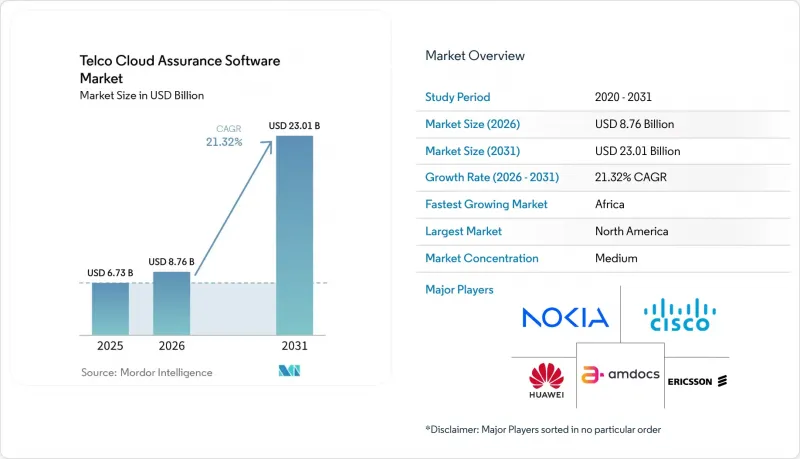
According to Mordor Intelligence, the telco cloud assurance software market size was valued at USD 6.73 billion in 2025 and is estimated to grow from USD 8.76 billion in 2026 to reach USD 23.01 billion by 2031, at a CAGR of 21.32% during the forecast period (2026-2031).
Global Telco Cloud Assurance Software Market Trends and Insights
AI-Driven Automation and Closed-Loop Operations
The Telco Cloud Assurance Software Market is moving from alarm-led operations to systems that identify problems, determine responses, and execute approved actions. Vendors are applying large language models and multi-agent designs across radio, core, and transport operations, which reduces the manual effort required to correlate complex events. Nokia and Google Cloud announced 6 specialized AI agents for Nokia Assurance Center in June 2026, with a SaaS release planned for September 2026. The companies stated that the platform is designed to reduce network problem-solving time by 50-80%.Mavenir introduced an Agentic Service Assurance Framework in June 2026 that aligns with TM Forum IG1251 and IG1453 and is intended to coordinate closed-loop operations across domains. Operators still need policy controls and auditable decision paths because models trained on one network can perform poorly when exposed to a different topology or traffic pattern.
5G and Multi-Vendor Network Complexity
5G standalone networks create a larger assurance task because radio, transport, and core components generate different telemetry streams. The Telco Cloud Assurance Software Market benefits when operators need to connect these data sources without relying on a single equipment supplier. O-RAN environments add another layer of complexity because disaggregated components must work together while meeting strict latency and security requirements. O-RAN Alliance Release 5, completed in November 2025, added Zero Trust enhancements, TLS 1.3 requirements, and AI and machine learning security controls. Ericsson and Nokia announced a March 2026 agreement to cross-list rApps across their respective ecosystems, giving service providers access to more validated automation applications. The unresolved need is assurance at the fronthaul layer, where time-sensitive traffic limits the use of conventional telemetry collection methods.
Legacy-Network Integration Costs
Legacy integration slows the Telco Cloud Assurance Software Market because operators often have to connect new platforms with older interfaces and custom data models. Established OSS estates can include systems added through previous acquisitions or built for earlier network generations. Each connection may require translation logic before telemetry can be interpreted consistently by a cloud-native platform. A parallel operating period is often needed to confirm that assurance workflows remain reliable before retiring older systems. This means an operator can pay for the maintenance of the legacy estate while also funding a new assurance deployment. The practical result is longer procurement cycles and greater attention to integration scope, internal skills, and ongoing connector maintenance.
Other drivers and restraints analyzed in the detailed report include:
- Real-Time QoE and SLA Monitoring Demand
- Cloud-Native OSS/BSS Migration
- Multi-Cloud Security and Data-Sovereignty Requirements
For complete list of drivers and restraints, kindly check the Table Of Contents.
Segment Analysis
Solutions accounted for 72.78% of the Telco Cloud Assurance Software Market share in 2025. Operators favor software platforms when they need continuous access to in-network telemetry rather than periodic reporting from a managed service provider. Direct integration into the OSS environment can support faster event correlation and closed-loop actions. The segment also benefits from installed licensing structures that let established carriers add assurance modules to existing technology estates. Nokia has positioned Autonomous Network Fabric as a deployment option that can support cloud delivery and hybrid environments. This approach reflects the need to combine software flexibility with the operating controls required by network teams.
Services are projected to expand at a 22.76% CAGR through 2031. Smaller carriers often lack enough internal expertise in cloud operations, AI model configuration, and assurance workflow tuning. Managed service providers can support configuration, model training, and performance monitoring after deployment. Outcome-based agreements also appeal to operators that prefer to purchase a defined assurance result rather than operate every capability in-house. Service growth does not eliminate demand for software, because the two components increasingly work together within the same delivery model. Agentic frameworks may further narrow the distinction when software carries out tasks that were previously delivered by specialist operations teams.
Network Assurance held 21.98% of the Telco Cloud Assurance Software Market share in 2025. The category includes long-established needs such as performance monitoring, fault management, and capacity planning. Its leading position reflects the maturity of network-layer observability compared with cross-domain service correlation. Spending remains distributed across service, security, and customer experience functions instead of concentrating in a single assurance category. ETSI ZSM is helping standardize interfaces between network operations and higher-layer service assurance. This creates pressure to replace isolated tools with platforms that can connect multiple assurance functions.
Slicing and SLA Assurance is projected to expand at a 21.52% CAGR through 2031, the highest rate among assurance functions. These use cases require joined-up telemetry across radio, transport, core, service, and security layers. Operators need this information to show that dedicated network slices are meeting contractual commitments. The business case is different from conventional monitoring because measurable service quality can support premium enterprise offerings. Customer Experience Assurance is also becoming more relevant as operators link network indicators with subscriber outcomes. This pushes assurance beyond the network operations center and toward customer-facing service management for sectors that require dependable connectivity.
Complete Report Scope:
- By Component
- Solutions
- Services
- By Assurance Function
- Network Assurance
- Service Assurance
- Security Assurance
- Customer Experience Assurance
- Other Assurance Functions
- By Deployment Model
- On-Premises
- Cloud-Based
- By Operator Type
- Mobile Network Operators
- Fixed and Cable Operators
- Neutral Hosts and Wholesale Operators
- By Application
- Fault Detection and Root-Cause Analysis
- Performance and Capacity Optimization
- Network Slicing and SLA Management
- Predictive Maintenance
- Other Applications
- By Geography
- North America
- United States
- Canada
- Mexico
- South America
- Brazil
- Argentina
- Rest of South America
- Europe
- Germany
- United Kingdom
- France
- Italy
- Russia
- Rest of Europe
- Asia-Pacific
- China
- India
- Japan
- South Korea
- Southeast Asia
- Australia
- Rest of Asia-Pacific
- Middle East
- Saudi Arabia
- United Arab Emirates
- Turkey
- Israel
- Rest of Middle East
- Africa
- South Africa
- Nigeria
- Egypt
- Rest of Africa
- North America
Geography Analysis
North America accounted for 32.04% of the Telco Cloud Assurance Software Market share in 2025. The region benefits from carrier spending on Open RAN modernization and the migration of established OSS systems to cloud environments. AT&T's USD 14 billion Open RAN agreement with Ericsson supports demand for tools that can correlate information across disaggregated network components. T-Mobile's standalone 5G buildout creates a separate source of demand for platforms that process 5G core telemetry without reliance on older packet-core architecture. Canada and Mexico add incremental activity as operators advance their 5G programs. South America remains a developing opportunity, led by Brazil and Argentina, though economic volatility and foreign-exchange pressures can delay capital-intensive software projects.
Europe remains an important region for the Telco Cloud Assurance Software Market because its operators face both modernization and compliance requirements. GDPR and NIS2 encourage architectures that keep sensitive data in controlled locations and provide clear records of handling practices. Energy management is also moving into assurance decisions as operators assess the performance of cloud-native network functions. Mavenir stated in February 2026 that its work with Deutsche Telekom achieved up to 65% energy savings in a live 5G Core network. Asia-Pacific is supported by commercial standalone 5G deployments in China, 5G densification in India, South Korea's mature ecosystem, and digital transformation across Southeast Asia. The GSMA expects data center electricity consumption to reach 950 TWh by 2030, which increases the importance of energy-aware network operations.
Africa is projected to expand at a 21.63% CAGR through 2031, the fastest regional rate in the Telco Cloud Assurance Software Market. Greenfield 5G deployments can adopt AI-native assurance systems without carrying the same legacy OSS burden found in more mature markets. South Africa, Nigeria, and Kenya are relevant markets because operators are managing mixed technology environments and power constraints. Cassava Technologies introduced an AI-native Autonomous Network platform at MWC 2026 for networks spanning 2G through 5G and satellite backhaul. The Middle East is also a commercially active environment, supported by Saudi Arabia's Vision 2030 and the United Arab Emirates' digital programs. Netcracker reported that Zain KSA completed a cloud-native BSS and OSS transformation in March 2025, which supports wider adoption of modern assurance capabilities.
- Telefonaktiebolaget LM Ericsson
- Nokia Corporation
- Huawei Technologies Co., Ltd.
- Amdocs Limited
- Cisco Systems, Inc.
- NEC Corporation
- Hewlett Packard Enterprise Company
- International Business Machines Corporation
- Broadcom Inc.
- NETSCOUT SYSTEMS, INC.
- Spirent Communications plc
- VIAVI Solutions Inc.
- EXFO Inc.
- TEOCO Corporation
- Comarch S.A.
- RADCOM Ltd.
- Infovista S.A.S.
- Ciena Corporation
- ServiceNow, Inc.
- Oracle Corporation
- Microsoft Corporation
- Juniper Networks, Inc.
Additional Benefits:
- The market estimate (ME) sheet in Excel format
- 3 months of analyst support
TABLE OF CONTENTS
1 INTRODUCTION
- 1.1 Study Assumptions and Market Definition
- 1.2 Scope of the Study
2 RESEARCH METHODOLOGY
3 EXECUTIVE SUMMARY
4 MARKET LANDSCAPE
- 4.1 Market Overview
- 4.2 Impact of Macroeconomic Factors on the Market
- 4.3 Market Drivers
- 4.3.1 5G and Multi-Vendor Network Complexity
- 4.3.2 Real-Time QoE and SLA Monitoring Demand
- 4.3.3 Cloud-Native OSS/BSS Migration
- 4.3.4 AI-Driven Automation and Closed-Loop Operations
- 4.3.5 Slice-Level SLA Monetization
- 4.3.6 Energy-Aware Assurance and Carbon Telemetry
- 4.4 Market Restraints
- 4.4.1 Legacy-Network Integration Costs
- 4.4.2 Multi-Cloud Security and Data-Sovereignty Requirements
- 4.4.3 Fragmented Open RAN Assurance Governance
- 4.4.4 Limited Labeled Telemetry for Explainable Telco AI
- 4.5 Industry Value Chain Analysis
- 4.6 Regulatory Landscape
- 4.7 Technological Outlook
- 4.8 Porter's Five Forces Analysis
- 4.8.1 Bargaining Power of Suppliers
- 4.8.2 Bargaining Power of Buyers
- 4.8.3 Threat of New Entrants
- 4.8.4 Threat of Substitutes
- 4.8.5 Rivalry Among Existing Competitors
5 MARKET SIZE AND GROWTH FORECASTS (VALUE)
- 5.1 By Component
- 5.1.1 Solutions
- 5.1.2 Services
- 5.2 By Assurance Function
- 5.2.1 Network Assurance
- 5.2.2 Service Assurance
- 5.2.3 Security Assurance
- 5.2.4 Customer Experience Assurance
- 5.2.5 Other Assurance Functions
- 5.3 By Deployment Model
- 5.3.1 On-Premises
- 5.3.2 Cloud-Based
- 5.4 By Operator Type
- 5.4.1 Mobile Network Operators
- 5.4.2 Fixed and Cable Operators
- 5.4.3 Neutral Hosts and Wholesale Operators
- 5.5 By Application
- 5.5.1 Fault Detection and Root-Cause Analysis
- 5.5.2 Performance and Capacity Optimization
- 5.5.3 Network Slicing and SLA Management
- 5.5.4 Predictive Maintenance
- 5.5.5 Other Applications
- 5.6 By Geography
- 5.6.1 North America
- 5.6.1.1 United States
- 5.6.1.2 Canada
- 5.6.1.3 Mexico
- 5.6.2 South America
- 5.6.2.1 Brazil
- 5.6.2.2 Argentina
- 5.6.2.3 Rest of South America
- 5.6.3 Europe
- 5.6.3.1 Germany
- 5.6.3.2 United Kingdom
- 5.6.3.3 France
- 5.6.3.4 Italy
- 5.6.3.5 Russia
- 5.6.3.6 Rest of Europe
- 5.6.4 Asia-Pacific
- 5.6.4.1 China
- 5.6.4.2 India
- 5.6.4.3 Japan
- 5.6.4.4 South Korea
- 5.6.4.5 Southeast Asia
- 5.6.4.6 Australia
- 5.6.4.7 Rest of Asia-Pacific
- 5.6.5 Middle East
- 5.6.5.1 Saudi Arabia
- 5.6.5.2 United Arab Emirates
- 5.6.5.3 Turkey
- 5.6.5.4 Israel
- 5.6.5.5 Rest of Middle East
- 5.6.6 Africa
- 5.6.6.1 South Africa
- 5.6.6.2 Nigeria
- 5.6.6.3 Egypt
- 5.6.6.4 Rest of Africa
- 5.6.1 North America
6 COMPETITIVE LANDSCAPE
- 6.1 Market Concentration
- 6.2 Strategic Moves
- 6.3 Market Share Analysis
- 6.4 Company Profiles (includes Global Level Overview, Market Level Overview, Core Segments, Financials as available, Strategic Information, Market Rank/Share, Products and Services, Recent Developments)
- 6.4.1 Telefonaktiebolaget LM Ericsson
- 6.4.2 Nokia Corporation
- 6.4.3 Huawei Technologies Co., Ltd.
- 6.4.4 Amdocs Limited
- 6.4.5 Cisco Systems, Inc.
- 6.4.6 NEC Corporation
- 6.4.7 Hewlett Packard Enterprise Company
- 6.4.8 International Business Machines Corporation
- 6.4.9 Broadcom Inc.
- 6.4.10 NETSCOUT SYSTEMS, INC.
- 6.4.11 Spirent Communications plc
- 6.4.12 VIAVI Solutions Inc.
- 6.4.13 EXFO Inc.
- 6.4.14 TEOCO Corporation
- 6.4.15 Comarch S.A.
- 6.4.16 RADCOM Ltd.
- 6.4.17 Infovista S.A.S.
- 6.4.18 Ciena Corporation
- 6.4.19 ServiceNow, Inc.
- 6.4.20 Oracle Corporation
- 6.4.21 Microsoft Corporation
- 6.4.22 Juniper Networks, Inc.
7 MARKET OPPORTUNITIES AND FUTURE OUTLOOK
- 7.1 White-Space and Unmet-Need Assessment

