PUBLISHER: Mordor Intelligence | PRODUCT CODE: 2155269

PUBLISHER: Mordor Intelligence | PRODUCT CODE: 2155269
Warehouse Dimensioning Vision Systems - Market Share Analysis, Industry Trends & Statistics, Growth Forecasts (2026 - 2031)
According to Mordor Intelligence, the warehouse dimensioning vision systems market size was valued at USD 141.76 million in 2025 and is estimated to expand from USD 162.64 million in 2026 to reach USD 336.89 million by 2031, at a CAGR of 15.68% during the forecast period (2026-2031).
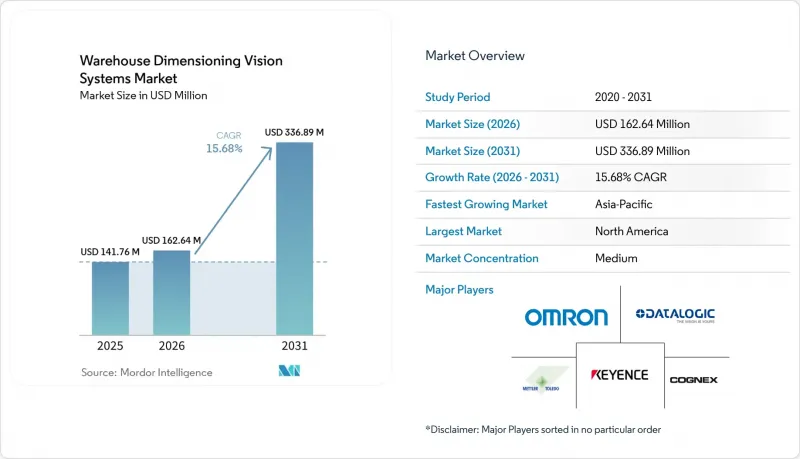
Global Warehouse Dimensioning Vision Systems Market Trends and Insights
E-Commerce Parcel Volume Expansion Sustains Baseline Demand
Global e-commerce parcel volumes continued to grow strongly, indicating sustained demand rather than a brief volume rebound. China recorded robust growth in express delivery volumes, supporting both domestic fulfillment investment and automated dimensioning deployments. These volumes make manual measurement harder to manage at large sites because small errors repeat across large shipment flows and can affect freight charges, storage decisions, and throughput. Facilities that process high volumes of parcels each day can face material freight and storage losses from minor measurement inaccuracies, especially when parcel dimensions enter several operating systems. The warehouse dimensioning vision systems market is therefore linked to the need for reliable, high-throughput measurement during receiving, sorting, and outbound handling. In India, Southeast Asia, and Brazil, new fulfillment sites are increasingly designed with automated measurement in place rather than added later, which gives operators more consistent data from their opening day.
Dimensional-Weight Billing and Freight-Cost Recovery Create Direct ROI Triggers
FedEx and UPS applied package-dimension rounding rules on August 2025, rounding every fractional package inch upward before calculating dimensional weight. The revised approach raised the cost of imprecise measurements for lightweight and bulky e-commerce shipments that occupy considerable shipping space without having a high actual weight. Repeated rounding across 3 dimensions can raise cubic volume and may lead to additional handling surcharges, so even modest errors can accumulate across a large shipment base. The National Motor Freight Classification update in July 2025 introduced new density-based classes for less-than-truckload shipments, reinforcing the need for accurate dimensions in freight classification. Certified systems provide auditable records that can support invoice disputes, retrospective reviews, and freight-cost recovery after carriers have issued bills. This role gives the warehouse dimensioning vision systems market a clearer financial case in purchasing decisions that otherwise require longer return-on-investment periods.
High Initial Investment and Integration Costs Constrain Mid-Market Access
Production-grade dynamic systems require spending on sensors, conveyor changes, information technology middleware, application programming interfaces, and certification testing, rather than a single equipment purchase. These costs can place the technology beyond the immediate reach of smaller logistics operators with narrow fulfillment margins and less predictable shipment volumes. Older sites often require custom middleware for legacy warehouse management and enterprise resource planning systems, making a technically workable project harder to approve financially. This can extend project timing from weeks to months and add service costs that can match hardware spending. The result is a two-tier warehouse dimensioning vision systems market in which large carriers, major 3PLs, and national retailers adopt sooner than independent operators. Subscription offerings and modular hardware are easing access, but total cost of ownership remains a procurement barrier in markets where operating margins are under continued pressure.
Other drivers and restraints analyzed in the detailed report include:
- Warehouse Automation and Labor Shortages Embed Dimensioning in Broader Programs
- WMS Integration Transforms Dimensioning From Data Collection to Execution Intelligence
- Measurement Errors on Non-Standard Packages Sustain Manual Measurement Pathways
For complete list of drivers and restraints, kindly check the Table Of Contents.
Segment Analysis
Dynamic/In-Motion Dimensioning Systems held 58.81% of revenue in 2025, which gave them the largest warehouse dimensioning vision systems market share among system types. Their position reflects the needs of high-throughput sites where stopping packages for static measurement can reduce sortation efficiency and interrupt the wider conveyor flow. These systems can measure packages at speeds up to 3.3 meters per second. They can also combine dimensional measurement and barcode reading during 1 conveyor pass, which reduces the need for separate identification and measurement stages. This design supports consistent data capture while goods move through a busy facility.
Static Dimensioning Systems serve receiving docks and compliance stations where operators need controlled measurements and have less need for uninterrupted conveyor processing. Mettler-Toledo's TLD870 can measure up to 240 pallets per hour and drew interest from Japanese logistics operators because of its warehouse management system integration. Mobile/Portable Dimensioning Systems are projected to expand at a 16.14% CAGR through 2031. Forklift-mounted and handheld units support trailer measurement, temporary work areas, and changing warehouse layouts. The Honeywell and Stereolabs solution showed how mobile equipment can capture parcel and pallet data without fixed conveyors. Portable designs can reduce the rigidity of fixed installations when workflows change.
3D Stereo Vision held 34.56% of revenue in 2025, accounting for the leading warehouse dimensioning vision systems market share by technology. Its installed base reflects decades of industrial use and a record of calibration and reliability in settings where measured data must be dependable. These characteristics matter when logistics operators seek production certification. Stereo vision also serves mixed stock-keeping unit environments that require dependable depth measurement across varied items. Its established position supports continued use in many dimensioning deployments.
Structured-Light 3D Vision is projected to expand at a 16.27% CAGR through 2031. It can better manage non-cuboidal and transparent packages when stereo algorithms lose feature correspondence. Its use with artificial intelligence inference can extend measurement coverage for profiles that laser-only systems handle poorly. Zivid introduced the Zivid 3 XL250 in November 2025 with millimeter-level accuracy up to 4.5 meters, a 2.5 square meter field of view, and point-cloud capture in under 500 milliseconds. Time-of-Flight 3D Vision, Laser and Camera Vision, and other systems serve the remaining demand, while sensor fusion gains relevance in docks with difficult lighting. SICK introduced its Nova platform in August 2026, combining deep-learning artificial intelligence with precise 3D height-data profiling for detection that does not depend on color or contrast.
Complete Report Scope:
- By System Type
- Static Dimensioning Systems
- Dynamic / In-Motion Dimensioning Systems
- Mobile / Portable Dimensioning Systems
- By Vision Technology
- 3D Stereo Vision
- Structured-Light 3D Vision
- Time-of-Flight (ToF) 3D Vision
- Laser + Camera Vision
- Other Vision Technologies
- By Object Type
- Parcels and Cartons
- Polybags and Soft Packages
- Pallets and Large Freight
- Irregular / Non-Standard Objects
- By Application
- Space and Slotting Optimization
- Shipping and Freight Billing
- Cartonization and Packaging Optimization
- Inventory Master-Data Capture
- Sortation and Routing
- Quality / Dimension Verification
- By End-User
- E-commerce and Fulfillment Centers
- 3PL / Contract Logistics
- Retail Distribution Centers
- Courier, Express, and Parcel
- Manufacturing and Industrial Warehouses
- Wholesale and Distribution
- Other End-Users
- By Geography
- North America
- United States
- Canada
- Mexico
- South America
- Brazil
- Argentina
- Rest of South America
- Europe
- Germany
- United Kingdom
- France
- Italy
- Spain
- Rest of Europe
- Asia-Pacific
- China
- Japan
- India
- South Korea
- ASEAN
- Rest of Asia-Pacific
- Middle East and Africa
- Middle East
- Saudi Arabia
- United Arab Emirates
- Turkey
- Rest of the Middle East
- Africa
- South Africa
- Nigeria
- Egypt
- Rest of Africa
- Middle East
- North America
Geography Analysis
North America held 33.51% of global revenue in 2025, accounting for the leading warehouse dimensioning vision systems market share by region. Dense e-commerce fulfillment networks and mature carrier compliance programs support the region's position. FedEx and UPS package-dimension rounding rules gave United States operators a direct reason to upgrade measurement systems. Warehouse wages remained elevated, while transportation, warehousing, and utilities faced persistent job vacancies. These labor conditions favor investment in systems that reduce manual measurement work.
Canada is a secondary regional market through its national carrier networks and retailer-owned distribution centers, while Mexico's nearshoring-led manufacturing expansion is creating new warehouses with vision systems included at the design stage.Europe is a major regional cluster, led by Germany, the United Kingdom, and France. European packaging regulation supports right-sizing, which increases interest in cartonization applications. SICK's group revenue demonstrates the scale of European sensor manufacturing. Mettler-Toledo's Norwegian production site and Zivid's Oslo base support Scandinavia's role in product development and manufacturing.
Asia-Pacific is projected to expand at a 16.38% CAGR through 2031, the fastest regional rate in the warehouse dimensioning vision systems market. China processed a substantial volume of express delivery shipments, with strong annual growth, supporting demand for domestic and multinational dimensioning systems. Japan's aging workforce supports labor-substitution investments, including pallet and static dimensioners used by logistics operators. India's expanding e-commerce industry, South Korea's advanced logistics network, and Vietnam's manufacturing-park fulfillment projects provide additional regional demand. South America, the Middle East, and Africa remain smaller developing markets, where the extension of dimensional-weight billing by global logistics companies serves as an important adoption catalyst.
- Cognex Corporation
- SICK AG
- Keyence Corporation
- Mettler-Toledo International Inc.
- Datalogic S.p.A.
- Honeywell International Inc.
- VITRONIC GmbH
- Zebra Technologies Corporation
- Cubiscan, Quantronix, Inc.
- Rice Lake Weighing Systems
- Bizerba SE & Co. KG
- Interroll Holding AG
- Siemens AG
- PCE Instruments, PCE Holding GmbH
- Vanderlande Industries B.V.
- Korber AG
- Mujin, Inc.
- Parcelcube, ATRAX Group
- OMRON Corporation
- The Raymond Corporation
- vMeasure, e-con Systems India Private Limited
Additional Benefits:
- The market estimate (ME) sheet in Excel format
- 3 months of analyst support
TABLE OF CONTENTS
1 INTRODUCTION
- 1.1 Study Assumptions and Market Definition
- 1.2 Scope of the Study
2 RESEARCH METHODOLOGY
3 EXECUTIVE SUMMARY
4 MARKET LANDSCAPE
- 4.1 Market Overview
- 4.2 Impact of Macroeconomic Factors on the Market
- 4.3 Market Drivers
- 4.3.1 E-Commerce Parcel Volume Expansion
- 4.3.2 Dimensional-Weight Billing and Freight-Cost Recovery
- 4.3.3 Warehouse Automation and Labor Shortages
- 4.3.4 Integration of Dimensioning Data with Warehouse Management Systems
- 4.3.5 Edge AI for Irregular-Parcel Classification
- 4.3.6 Dimensioning Data as a Foundation for Dynamic Cartonization
- 4.4 Market Restraints
- 4.4.1 High Initial Investment and Integration Costs
- 4.4.2 Measurement Errors with Soft, Reflective, and Irregular Packages
- 4.4.3 Cybersecurity and Data-Residency Exposure from Connected Vision Systems
- 4.4.4 Limited Availability of Vision-System Integration Specialists
- 4.5 Industry Value and Supply-Chain Analysis
- 4.6 Regulatory Landscape
- 4.7 Technological Outlook
- 4.7.1 Two-Dimensional and Three-Dimensional Vision Capture
- 4.7.2 Structured-Light and Time-of-Flight Imaging
- 4.7.3 Laser and Infrared Sensor Fusion
- 4.7.4 Edge AI and Embedded Inference
- 4.7.5 Multi-Angle Capture for Non-Cuboidal Packages
- 4.7.6 Digital Twins and Dimensional Master-Data Enrichment
- 4.7.7 Cloud-Based Analytics and Remote Diagnostics
- 4.8 Porter's Five Forces Analysis
- 4.8.1 Bargaining Power of Suppliers
- 4.8.2 Bargaining Power of Buyers
- 4.8.3 Threat of New Entrants
- 4.8.4 Threat of Substitutes
- 4.8.5 Competitive Rivalry
5 MARKET SIZE AND GROWTH FORECASTS (VALUE)
- 5.1 By System Type
- 5.1.1 Static Dimensioning Systems
- 5.1.2 Dynamic / In-Motion Dimensioning Systems
- 5.1.3 Mobile / Portable Dimensioning Systems
- 5.2 By Vision Technology
- 5.2.1 3D Stereo Vision
- 5.2.2 Structured-Light 3D Vision
- 5.2.3 Time-of-Flight (ToF) 3D Vision
- 5.2.4 Laser + Camera Vision
- 5.2.5 Other Vision Technologies
- 5.3 By Object Type
- 5.3.1 Parcels and Cartons
- 5.3.2 Polybags and Soft Packages
- 5.3.3 Pallets and Large Freight
- 5.3.4 Irregular / Non-Standard Objects
- 5.4 By Application
- 5.4.1 Space and Slotting Optimization
- 5.4.2 Shipping and Freight Billing
- 5.4.3 Cartonization and Packaging Optimization
- 5.4.4 Inventory Master-Data Capture
- 5.4.5 Sortation and Routing
- 5.4.6 Quality / Dimension Verification
- 5.5 By End-User
- 5.5.1 E-commerce and Fulfillment Centers
- 5.5.2 3PL / Contract Logistics
- 5.5.3 Retail Distribution Centers
- 5.5.4 Courier, Express, and Parcel
- 5.5.5 Manufacturing and Industrial Warehouses
- 5.5.6 Wholesale and Distribution
- 5.5.7 Other End-Users
- 5.6 By Geography
- 5.6.1 North America
- 5.6.1.1 United States
- 5.6.1.2 Canada
- 5.6.1.3 Mexico
- 5.6.2 South America
- 5.6.2.1 Brazil
- 5.6.2.2 Argentina
- 5.6.2.3 Rest of South America
- 5.6.3 Europe
- 5.6.3.1 Germany
- 5.6.3.2 United Kingdom
- 5.6.3.3 France
- 5.6.3.4 Italy
- 5.6.3.5 Spain
- 5.6.3.6 Rest of Europe
- 5.6.4 Asia-Pacific
- 5.6.4.1 China
- 5.6.4.2 Japan
- 5.6.4.3 India
- 5.6.4.4 South Korea
- 5.6.4.5 ASEAN
- 5.6.4.6 Rest of Asia-Pacific
- 5.6.5 Middle East and Africa
- 5.6.5.1 Middle East
- 5.6.5.1.1 Saudi Arabia
- 5.6.5.1.2 United Arab Emirates
- 5.6.5.1.3 Turkey
- 5.6.5.1.4 Rest of the Middle East
- 5.6.5.2 Africa
- 5.6.5.2.1 South Africa
- 5.6.5.2.2 Nigeria
- 5.6.5.2.3 Egypt
- 5.6.5.2.4 Rest of Africa
- 5.6.5.1 Middle East
- 5.6.1 North America
6 COMPETITIVE LANDSCAPE
- 6.1 Market Concentration
- 6.2 Strategic Moves
- 6.3 Market Share Analysis
- 6.4 Company Profiles (includes Global Level Overview, Market Level Overview, Core Segments, Financials as available, Strategic Information, Market Rank/Share, Products and Services, Recent Developments)
- 6.4.1 Cognex Corporation
- 6.4.2 SICK AG
- 6.4.3 Keyence Corporation
- 6.4.4 Mettler-Toledo International Inc.
- 6.4.5 Datalogic S.p.A.
- 6.4.6 Honeywell International Inc.
- 6.4.7 VITRONIC GmbH
- 6.4.8 Zebra Technologies Corporation
- 6.4.9 Cubiscan, Quantronix, Inc.
- 6.4.10 Rice Lake Weighing Systems
- 6.4.11 Bizerba SE & Co. KG
- 6.4.12 Interroll Holding AG
- 6.4.13 Siemens AG
- 6.4.14 PCE Instruments, PCE Holding GmbH
- 6.4.15 Vanderlande Industries B.V.
- 6.4.16 Korber AG
- 6.4.17 Mujin, Inc.
- 6.4.18 Parcelcube, ATRAX Group
- 6.4.19 OMRON Corporation
- 6.4.20 The Raymond Corporation
- 6.4.21 vMeasure, e-con Systems India Private Limited
7 MARKET OPPORTUNITIES AND FUTURE OUTLOOK
- 7.1 White-Space and Unmet-Need Assessment

