PUBLISHER: Mordor Intelligence | PRODUCT CODE: 2155270

PUBLISHER: Mordor Intelligence | PRODUCT CODE: 2155270
Wind Turbine Blade Imaging Inspection Systems - Market Share Analysis, Industry Trends & Statistics, Growth Forecasts (2026 - 2031)
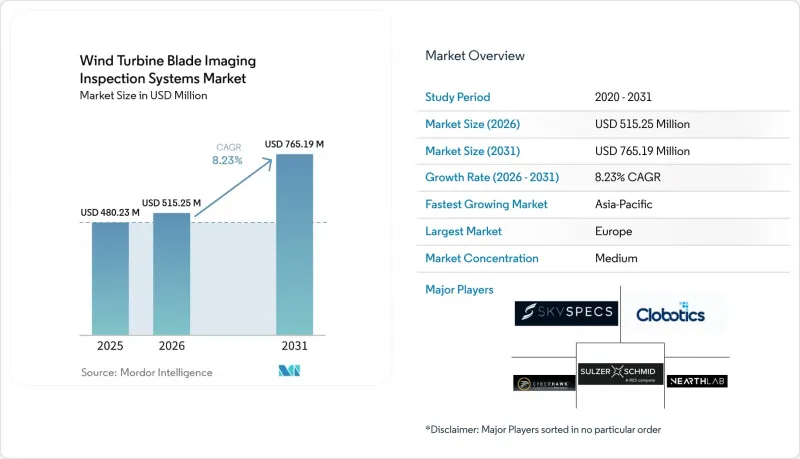
According to Mordor Intelligence, the wind turbine blade imaging inspection systems market size was USD 515.25 million in 2026 and is forecast to reach USD 765.19 million by 2031 at a CAGR of 8.23% over 2026-2031.
Global Wind Turbine Blade Imaging Inspection Systems Market Trends and Insights
Expansion of Aging Wind Turbine Fleets
Global installed wind capacity exceeded 1,245 GW by mid-2025 and expanded at a 13.5% annual rate. Many onshore turbines installed from 2005 to 2015 have reached an age when blade degradation, including leading-edge erosion and subsurface delamination, requires closer attention. Leading-edge erosion can reduce aerodynamic efficiency after 5-8 years and damage can accelerate after 10 years. Wind farms in Germany, Denmark, and the U.S. Midwest had average ages above 12 years. The wind turbine blade imaging inspection systems market benefits because operators use survey and crawler data to support life-extension decisions. This practice places inspection records alongside remaining-useful-life assessments, financial planning, and maintenance planning rather than treating them only as compliance documentation.
Rising Offshore Inspection Complexity
Offshore inspection costs per turbine were 2.5-3.5 times higher than comparable onshore services in the wind turbine blade imaging inspection systems market in 2026. Maritime access, equipment stabilization, vessel logistics, platform motion, and limited weather windows increase the work required at sea. Rope-access work can take 6-10 hours or several days for a floating turbine. North Sea offshore capacity exceeded 32 GW in 2025, sustaining demand for higher-value inspection work. Floating platforms require UAV flight systems that account for hull motion. This need favors providers that can combine hull-motion compensation, flight control, imaging, and offshore operating experience in the wind turbine blade imaging inspection systems market.
Beyond Visual Line of Sight Approval Constraints
Routine beyond visual line of sight operations are important for remote and offshore inspection programs. The FAA published its proposed Part 108 rule on August 7, 2025, under Executive Order 14307. The proposed approach uses performance-based requirements, but the rule remained under White House review as of September 2026. Operators therefore continued to depend on case-by-case waivers in the United States. The UK Civil Aviation Authority introduced an atypical air environment policy for drone infrastructure inspections. These policies are developing, but they do not yet provide a predictable operating basis for large fleet programs in the wind turbine blade imaging inspection systems market.
Other drivers and restraints analyzed in the detailed report include:
- Adoption of AI-Assisted Defect Recognition
- Demand for Reduced Turbine Downtime
- Image Quality Degradation in Harsh Weather
For complete list of drivers and restraints, kindly check the Table Of Contents.
Segment Analysis
Internal Blade Crawler Imaging Systems are projected to expand at a 9.67% CAGR from 2026 to 2031. Their role reflects the need to assess structural conditions that are not visible from the blade exterior. Crawler platforms can use high-resolution cameras, 3D LiDAR, and internal lighting to record shear-web cracks, bondline failures, and root damage. Aerones introduced Crawler Gen 3 in December 2025 with coverage of up to 90% of the blade interior, a 360° 5K camera, and a 61MP root-zone lens. The InInspekt project launched an autonomous multi-sensor crawler prototype in February 2026 for internal defect detection.
Multirotor Drone Imaging Systems held 49.85% share in 2025. Their position in the wind turbine blade imaging inspection systems market reflects their use as the first inspection method across different hub heights and blade designs. They provide broad external coverage in the wind turbine blade imaging inspection systems market without the time and access requirements of rope work. Fixed-Wing and VTOL systems serve longer survey missions at large offshore farms where range per charge matters, while tethered, ground-based, climbing, and contact systems serve continuity testing and other tasks that need close physical sensor contact. Cornis received certification to operate Voliro T in May 2025, using optical, LiDAR, and electrical continuity sensors during one deployment.
LiDAR Sensors are projected to advance at a 9.72% CAGR from 2026 to 2031. Their growth is connected to the need for accurate 3D geometry in fatigue simulations. IEC 61400-23 Ed.4 published in May 2026 required digital twin-based fatigue simulation validation for offshore blade type certification. The requirement applies to certification submissions after Q3 2026. LiDAR-equipped platforms can supply geometry inputs more accurately than photogrammetric reconstruction.
RGB and High-Resolution Optical Sensors accounted for 41.30% share in 2025. Optical imaging aligns closely with visual inspection practices used by operations and maintenance teams. It also provides a lower hardware-cost baseline than several alternative sensing methods. Thermal and Infrared Sensors identify subsurface delamination through heat-signature differences that optical cameras cannot detect, while ultrasonic, phased-array, and shearography tools serve assignments requiring integrity validation for insurers or lenders. Electrical continuity and conductivity sensors support lightning protection system assessments in the wind turbine blade imaging inspection systems market under IEC 61400-24 requirements.
Complete Report Scope:
- By Product Type
- Multirotor Drone Imaging Systems
- Fixed-Wing and VTOL Imaging Systems
- Tethered and Ground-Based Imaging Systems
- Internal Blade Crawler Imaging Systems
- External Robotic Climbing and Contact-Imaging Systems
- Other Product Types
- By Sensor Technology
- RGB and High-Resolution Optical Sensors
- Thermal and Infrared Sensors
- LiDAR Sensors
- Ultrasonic and Phased-Array Sensors
- Electrical Continuity and Conductivity Sensors
- Shearography and Other Non-Destructive Testing Sensors
- By Commercial Offering
- Integrated Hardware and Software Systems
- Hardware-Only Systems
- Inspection Software and Analytics Platforms
- Other Commercial Offerings
- By End-User
- Wind Farm Owners, Operators, Utilities, and Independent Power Producers
- Independent Service Providers
- Wind Turbine Manufacturers
- Engineering, Procurement, and Construction Companies
- Other End-Users
- By Geography
- North America
- United States
- Canada
- Mexico
- South America
- Brazil
- Argentina
- Rest of South America
- Europe
- Germany
- United Kingdom
- France
- Italy
- Spain
- Rest of Europe
- Asia-Pacific
- China
- Japan
- India
- South Korea
- ASEAN
- Rest of Asia-Pacific
- Middle East and Africa
- Middle East
- Saudi Arabia
- United Arab Emirates
- Turkey
- Rest of the Middle East
- Africa
- South Africa
- Nigeria
- Rest of Africa
- Middle East
- North America
Geography Analysis
Europe held 36.45% share in 2025. The region's concentrated North Sea offshore fleet supported the wind turbine blade imaging inspection systems market with higher service costs than comparable onshore sites across the UK, Germany, Denmark, the Netherlands, and Belgium. The RePowerEU program targets 510 GW of renewable energy by 2030, supporting inspection needs from new assets and older fleets nearing their 20-year design-life threshold. IEC 61400-5:2020/AMD1:2025 and IEC 61400-23 Ed.4 strengthened the focus on blade testing and digital twin validation.
Asia-Pacific is projected to expand at a 9.81% CAGR from 2026 to 2031. China's scale in onshore and offshore wind underpins demand, and its March 2025 life-extension guidance required condition-based preventive maintenance for qualifying wind farms. The guidance applied to the country's large installed base commissioned before 2018. China also published T/SXKJFW 571-2026 in June 2026 for UAV-based resistance detection on wind turbine blades. Japan and South Korea are developing offshore programs as floating wind procurement advances, while price-sensitive ASEAN markets favor scalable software-led services.
North America combines an aging U.S. onshore fleet, including Midwest farms above 12 years on average, with new East Coast offshore projects that require regular condition checks. South America, led by Brazil and Argentina, has demand linked to renewable energy targets and high-capacity-factor corridors. Efficient, low-logistics inspection methods are relevant where access is difficult and wind corridors have high capacity factors. The Middle East and Africa remains earlier in development, with projects in Saudi Arabia, the United Arab Emirates (UAE), Turkey, and South Africa. UV exposure, salt spray, and extreme temperature swings can increase coating assessment needs and favor sensor payloads calibrated for these environments.
- SkySpecs Inc.
- Cyberhawk Innovations Limited
- Perceptual Robotics Ltd.
- Sulzer & Schmid Laboratories AG
- Clobotics Corporation
- Nearthlab Co., Ltd.
- Voliro AG
- Cornis SAS
- Aero Enterprise GmbH
- Helvetis
- Drone Volt SA
- Terra Drone Corporation
- Aerodyne Group
- SZ DJI Technology Co., Ltd.
- Flyability SA
- DELAIR SAS
- Skyfish LLC
- Airpix
- Eagle Eye Innovations Ltd.
- HighEye
Additional Benefits:
- The market estimate (ME) sheet in Excel format
- 3 months of analyst support
TABLE OF CONTENTS
1 INTRODUCTION
- 1.1 Study Assumptions and Market Definition
- 1.2 Scope of the Study
2 RESEARCH METHODOLOGY
3 EXECUTIVE SUMMARY
4 MARKET LANDSCAPE
- 4.1 Market Overview
- 4.2 Market Drivers
- 4.2.1 Expansion of Aging Wind Turbine Fleets
- 4.2.2 Rising Offshore Inspection Complexity
- 4.2.3 Adoption of AI-Assisted Defect Recognition
- 4.2.4 Demand for Reduced Turbine Downtime
- 4.2.5 Shift Toward Repeatable Digital Blade Records
- 4.2.6 Increasing Need for Internal Blade Imaging
- 4.3 Market Restraints
- 4.3.1 Beyond Visual Line of Sight Approval Constraints
- 4.3.2 Image Quality Degradation in Harsh Weather
- 4.3.3 Shortage of Qualified Blade-Data Analysts
- 4.3.4 Fragmented Defect Taxonomies and Data Standards
- 4.4 Impact of Macroeconomic Factors on the Market
- 4.5 Industry Value Chain Analysis
- 4.6 Regulatory Landscape
- 4.7 Technological Outlook
- 4.8 Porter's Five Forces Analysis
- 4.8.1 Bargaining Power of Suppliers
- 4.8.2 Bargaining Power of Buyers
- 4.8.3 Threat of New Entrants
- 4.8.4 Threat of Substitutes
- 4.8.5 Intensity of Competitive Rivalry
5 MARKET SIZE AND GROWTH FORECASTS (VALUE)
- 5.1 By Product Type
- 5.1.1 Multirotor Drone Imaging Systems
- 5.1.2 Fixed-Wing and VTOL Imaging Systems
- 5.1.3 Tethered and Ground-Based Imaging Systems
- 5.1.4 Internal Blade Crawler Imaging Systems
- 5.1.5 External Robotic Climbing and Contact-Imaging Systems
- 5.1.6 Other Product Types
- 5.2 By Sensor Technology
- 5.2.1 RGB and High-Resolution Optical Sensors
- 5.2.2 Thermal and Infrared Sensors
- 5.2.3 LiDAR Sensors
- 5.2.4 Ultrasonic and Phased-Array Sensors
- 5.2.5 Electrical Continuity and Conductivity Sensors
- 5.2.6 Shearography and Other Non-Destructive Testing Sensors
- 5.3 By Commercial Offering
- 5.3.1 Integrated Hardware and Software Systems
- 5.3.2 Hardware-Only Systems
- 5.3.3 Inspection Software and Analytics Platforms
- 5.3.4 Other Commercial Offerings
- 5.4 By End-User
- 5.4.1 Wind Farm Owners, Operators, Utilities, and Independent Power Producers
- 5.4.2 Independent Service Providers
- 5.4.3 Wind Turbine Manufacturers
- 5.4.4 Engineering, Procurement, and Construction Companies
- 5.4.5 Other End-Users
- 5.5 By Geography
- 5.5.1 North America
- 5.5.1.1 United States
- 5.5.1.2 Canada
- 5.5.1.3 Mexico
- 5.5.2 South America
- 5.5.2.1 Brazil
- 5.5.2.2 Argentina
- 5.5.2.3 Rest of South America
- 5.5.3 Europe
- 5.5.3.1 Germany
- 5.5.3.2 United Kingdom
- 5.5.3.3 France
- 5.5.3.4 Italy
- 5.5.3.5 Spain
- 5.5.3.6 Rest of Europe
- 5.5.4 Asia-Pacific
- 5.5.4.1 China
- 5.5.4.2 Japan
- 5.5.4.3 India
- 5.5.4.4 South Korea
- 5.5.4.5 ASEAN
- 5.5.4.6 Rest of Asia-Pacific
- 5.5.5 Middle East and Africa
- 5.5.5.1 Middle East
- 5.5.5.1.1 Saudi Arabia
- 5.5.5.1.2 United Arab Emirates
- 5.5.5.1.3 Turkey
- 5.5.5.1.4 Rest of the Middle East
- 5.5.5.2 Africa
- 5.5.5.2.1 South Africa
- 5.5.5.2.2 Nigeria
- 5.5.5.2.3 Rest of Africa
- 5.5.5.1 Middle East
- 5.5.1 North America
6 COMPETITIVE LANDSCAPE
- 6.1 Market Concentration
- 6.2 Strategic Moves
- 6.3 Market Share Analysis
- 6.4 Company Profiles (includes Global Level Overview, Market Level Overview, Core Segments, Financials as available, Strategic Information, Market Rank/Share, Products and Services, Recent Developments)
- 6.4.1 SkySpecs Inc.
- 6.4.2 Cyberhawk Innovations Limited
- 6.4.3 Perceptual Robotics Ltd.
- 6.4.4 Sulzer & Schmid Laboratories AG
- 6.4.5 Clobotics Corporation
- 6.4.6 Nearthlab Co., Ltd.
- 6.4.7 Voliro AG
- 6.4.8 Cornis SAS
- 6.4.9 Aero Enterprise GmbH
- 6.4.10 Helvetis
- 6.4.11 Drone Volt SA
- 6.4.12 Terra Drone Corporation
- 6.4.13 Aerodyne Group
- 6.4.14 SZ DJI Technology Co., Ltd.
- 6.4.15 Flyability SA
- 6.4.16 DELAIR SAS
- 6.4.17 Skyfish LLC
- 6.4.18 Airpix
- 6.4.19 Eagle Eye Innovations Ltd.
- 6.4.20 HighEye
7 MARKET OPPORTUNITIES AND FUTURE OUTLOOK
- 7.1 White-Space and Unmet-Need Assessment

