PUBLISHER: Mordor Intelligence | PRODUCT CODE: 2155309

PUBLISHER: Mordor Intelligence | PRODUCT CODE: 2155309
Wall-Climbing Inspection Robot Imaging - Market Share Analysis, Industry Trends & Statistics, Growth Forecasts (2026 - 2031)
According to Mordor Intelligence, the wall-climbing inspection robot imaging market size is projected to be USD 112.43 million in 2025, USD 126.49 million in 2026, and reach USD 249.14 million by 2031, growing at a CAGR of 14.52% from 2026 to 2031.
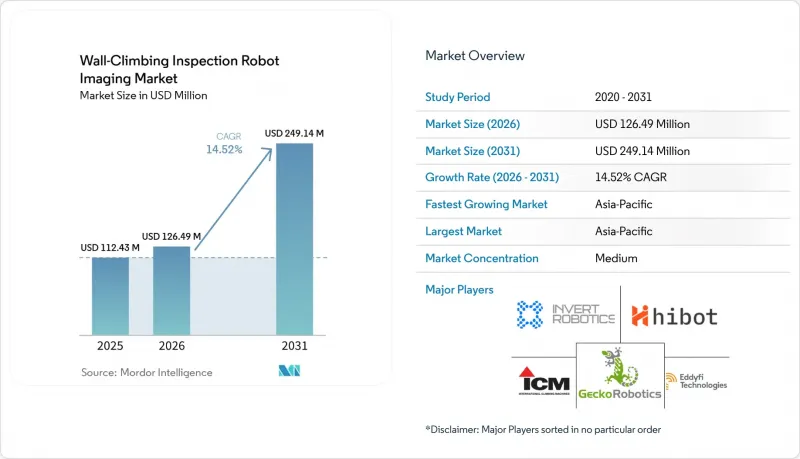
Global Wall-Climbing Inspection Robot Imaging Market Trends and Insights
Aging Critical Infrastructure and Inspection Backlogs
Deferred maintenance has created inspection backlogs across power plants, refineries, bridges, and marine terminals. The American Society of Civil Engineers reported more than USD 2.6 trillion in U.S. infrastructure funding gaps in its 2025 assessment. These gaps underscore the need for clear condition data before owners can prioritize maintenance work. The wall-climbing inspection robot imaging market benefits when crawlers can inspect tanks, piers, and chimney stacks without extended scaffold work. HausBots, EDF, and ACS-Solutions completed robotic ultrasonic tomography trials on a 200 m concrete chimney during 2025. The demonstration supported the use of robotic surveys for tall concrete structures and added practical evidence for higher-frequency inspection programs.
Height-Safety Compliance and Rope-Access Risk Reduction
Working at height remains a major constraint in conventional inspection planning. OSHA fall-protection requirements increase the need to control exposure during inspection work. Robotic access can reduce the need for personnel to work on elevated or difficult surfaces. HausBots used its HB3 crawler for an ultrasonic inspection of a 70 m Cemex rotary kiln in 2025 without personnel working at height during the survey. This changes the evaluation from equipment cost alone to risk management and site access planning. The wall-climbing inspection robot imaging market can gain where operators must document safe inspection methods across regulated assets.
High System Cost and Specialist Integration Requirements
Advanced multimodal systems commonly cost from USD 150,000 to more than USD 500,000 when crawler hardware, sensors, software, training, and integration are included. The upfront cost can exceed the procurement capacity of smaller inspection companies. It also creates a longer approval process in price-sensitive applications. The availability of experienced NDT and integration personnel adds to the challenge. Service and rental models can reduce the initial capital burden for operators that want to test robotic methods. The wall-climbing inspection robot imaging market may therefore expand first through larger owners and service providers that can absorb integration costs.
Other drivers and restraints analyzed in the detailed report include:
- Demand for Repeatable Digital Asset-Integrity Records
- Expansion of Multimodal NDT Imaging Payloads
- Surface-Condition and Adhesion Reliability Limits
For complete list of drivers and restraints, kindly check the Table Of Contents.
Segment Analysis
Multispectral/Hyperspectral Imaging is forecast to grow at an 18.12% CAGR through 2031. This category supports material-level surface analysis beyond standard visual inspection. A 2025 review found that hyperspectral imaging can distinguish material composition at the pixel level in mobile robot applications. This capability can help identify corrosion chemistry, coating degradation, and moisture ingress.
RGB/Visible-Light Imaging accounted for 38.81% of the wall-climbing inspection robot imaging market size in 2025. It remains widely used because it fits established camera systems and supports mature defect-detection models. A 2026 study reported a crack-width relative error of 0.53% for an onboard real-time segmentation network on a negative-pressure wall-climbing robot. Thermal/Infrared Imaging remains important for corrosion under insulation and subsurface delamination. 3D/Stereo Imaging supports defect geometry measurement for inspection reports. Other imaging technologies, including radar and acoustic approaches, remain suited to reinforced concrete cases that require deeper assessment in the wall-climbing inspection robot imaging market.
Complete Report Scope:
- By Imaging Technology
- RGB / Visible-Light Imaging
- Thermal / Infrared Imaging
- 3D / Stereo Imaging
- Multispectral / Hyperspectral Imaging
- Other Imaging Technologies
- By Imaging Systems
- Camera Hardware
- Thermal Cameras
- 3D Imaging Systems
- Lighting / Optical Accessories
- Imaging Processing and AI Vision Software
- By Application
- Surface Defect and Crack Detection
- Corrosion Detection and Mapping
- Weld Inspection
- Coating / Paint Inspection
- Structural Condition Assessment
- Other Applications
- By End-User Industry
- Oil and Gas
- Power Generation and Utilities
- Infrastructure and Construction
- Marine and Offshore
- Wind Energy
- Manufacturing
- Other End-User Industries
- By Geography
- North America
- United States
- Canada
- Mexico
- South America
- Brazil
- Argentina
- Rest of South America
- Europe
- Germany
- United Kingdom
- France
- Italy
- Spain
- Rest of Europe
- Asia-Pacific
- China
- Japan
- India
- South Korea
- Rest of Asia-Pacific
- Middle East and Africa
- Middle East
- Saudi Arabia
- United Arab Emirates
- Turkey
- Rest of the Middle East
- Africa
- South Africa
- Nigeria
- Rest of Africa
- Middle East
- North America
Geography Analysis
Asia-Pacific held 31.23% of the wall-climbing inspection robot imaging market share in 2025 and is forecast to grow at a 15.34% CAGR through 2031. China's storage tank base, Japan's bridge inspection requirements, India's rehabilitation activity, and South Korea's shipbuilding investment support varied demand across the region. Japan's NETIS framework can make registered systems eligible for government-funded project specifications. Didon Robotics developed an electromagnetic permanent-magnet climbing quadruped and had supply agreements with 2 Korean shipyards and 1 European customer by December 2025. Domestic suppliers are also pursuing inspection work in Indian and Middle Eastern oil and gas applications.
North America and Europe are high-value demand centers due to mature NDT services, industrial asset density, and inspection requirements. Height-safety rules, bridge inspection frameworks, and investment in aging infrastructure support U.S. demandThe. The U.S. Navy awarded Gecko Robotics a five-year IDIQ contract in March 2026, with an initial value of USD 54 million and a ceiling of USD 71 million, for inspection and maintenance-planning activities. European demand includes applications involving chimneys, cooling towers, and offshore structures. HausBots reported 300% turnover growth in 2025 and more than USD 2 million in new deals while expanding distribution in Japan, Singapore, and South Korea.
The Middle East, Africa, and South America remain smaller demand pools with specific long-term opportunities. ADNOC's 2025 agreements with Gecko Robotics included the deployment of robotics and Emirati technician training. Brazil's offshore fields and Nigeria's aging pipeline and tank infrastructure offer potential applications as service models that reduce first-deployment costs. The wall-climbing inspection robot imaging market can expand in these regions as providers demonstrate reliable field outcomes and workable service pricing.
- Gecko Robotics, Inc.
- HiBot Corporation
- Invert Robotics Group Limited
- International Climbing Machines, Inc.
- Eddyfi Technologies Inc.
- HausBots Ltd
- Waygate Technologies GmbH
- GE Vernova Inc.
- ANYbotics AG
- Boston Dynamics, Inc.
- Deep Trekker Inc.
- CUES, Inc.
- Rausch GmbH
- Minicam Limited
- Inspector Systems GmbH
- Kummert GmbH
- NDT Global GmbH and Co. KG
- MFE Inspection Solutions, LLC
- Nexxis
- SuperDroid Robots, Inc.
Additional Benefits:
- The market estimate (ME) sheet in Excel format
- 3 months of analyst support
TABLE OF CONTENTS
1 INTRODUCTION
- 1.1 Study Assumptions and Market Definition
- 1.2 Scope of the Study
2 RESEARCH METHODOLOGY
3 EXECUTIVE SUMMARY
4 MARKET LANDSCAPE
- 4.1 Market Overview
- 4.2 Market Drivers
- 4.2.1 Aging Critical Infrastructure and Inspection Backlogs
- 4.2.2 Height-Safety Compliance and Rope-Access Risk Reduction
- 4.2.3 Demand for Repeatable Digital Asset-Integrity Records
- 4.2.4 Expansion of Multimodal NDT Imaging Payloads
- 4.2.5 Workforce Constraints in Hazardous Inspection Trades
- 4.2.6 Robotic Chimney and Rough-Concrete Tomography Validation
- 4.3 Market Restraints
- 4.3.1 High System Cost and Specialist Integration Requirements
- 4.3.2 Surface-Condition and Adhesion Reliability Limits
- 4.3.3 Defect-Classification Liability and Third-Party Validation Requirements
- 4.3.4 Inconsistent Data Standards Across Asset Owners and NDT Workflows
- 4.4 Impact of Macroeconomic Factors on the Market
- 4.5 Industry Supply Chain Analysis
- 4.6 Regulatory Landscape
- 4.7 Technological Outlook
- 4.8 Porter's Five Forces Analysis
- 4.8.1 Bargaining Power of Suppliers
- 4.8.2 Bargaining Power of Buyers
- 4.8.3 Threat of New Entrants
- 4.8.4 Threat of Substitutes
- 4.8.5 Intensity of Competitive Rivalry
5 MARKET SIZE AND GROWTH FORECASTS (VALUE)
- 5.1 By Imaging Technology
- 5.1.1 RGB / Visible-Light Imaging
- 5.1.2 Thermal / Infrared Imaging
- 5.1.3 3D / Stereo Imaging
- 5.1.4 Multispectral / Hyperspectral Imaging
- 5.1.5 Other Imaging Technologies
- 5.2 By Imaging Systems
- 5.2.1 Camera Hardware
- 5.2.2 Thermal Cameras
- 5.2.3 3D Imaging Systems
- 5.2.4 Lighting / Optical Accessories
- 5.2.5 Imaging Processing and AI Vision Software
- 5.3 By Application
- 5.3.1 Surface Defect and Crack Detection
- 5.3.2 Corrosion Detection and Mapping
- 5.3.3 Weld Inspection
- 5.3.4 Coating / Paint Inspection
- 5.3.5 Structural Condition Assessment
- 5.3.6 Other Applications
- 5.4 By End-User Industry
- 5.4.1 Oil and Gas
- 5.4.2 Power Generation and Utilities
- 5.4.3 Infrastructure and Construction
- 5.4.4 Marine and Offshore
- 5.4.5 Wind Energy
- 5.4.6 Manufacturing
- 5.4.7 Other End-User Industries
- 5.5 By Geography
- 5.5.1 North America
- 5.5.1.1 United States
- 5.5.1.2 Canada
- 5.5.1.3 Mexico
- 5.5.2 South America
- 5.5.2.1 Brazil
- 5.5.2.2 Argentina
- 5.5.2.3 Rest of South America
- 5.5.3 Europe
- 5.5.3.1 Germany
- 5.5.3.2 United Kingdom
- 5.5.3.3 France
- 5.5.3.4 Italy
- 5.5.3.5 Spain
- 5.5.3.6 Rest of Europe
- 5.5.4 Asia-Pacific
- 5.5.4.1 China
- 5.5.4.2 Japan
- 5.5.4.3 India
- 5.5.4.4 South Korea
- 5.5.4.5 Rest of Asia-Pacific
- 5.5.5 Middle East and Africa
- 5.5.5.1 Middle East
- 5.5.5.1.1 Saudi Arabia
- 5.5.5.1.2 United Arab Emirates
- 5.5.5.1.3 Turkey
- 5.5.5.1.4 Rest of the Middle East
- 5.5.5.2 Africa
- 5.5.5.2.1 South Africa
- 5.5.5.2.2 Nigeria
- 5.5.5.2.3 Rest of Africa
- 5.5.5.1 Middle East
- 5.5.1 North America
6 COMPETITIVE LANDSCAPE
- 6.1 Market Concentration
- 6.2 Strategic Moves
- 6.3 Market Share Analysis
- 6.4 Company Profiles (includes Global Level Overview, Market Level Overview, Core Segments, Financials as available, Strategic Information, Market Rank/Share, Products and Services, Recent Developments)
- 6.4.1 Gecko Robotics, Inc.
- 6.4.2 HiBot Corporation
- 6.4.3 Invert Robotics Group Limited
- 6.4.4 International Climbing Machines, Inc.
- 6.4.5 Eddyfi Technologies Inc.
- 6.4.6 HausBots Ltd
- 6.4.7 Waygate Technologies GmbH
- 6.4.8 GE Vernova Inc.
- 6.4.9 ANYbotics AG
- 6.4.10 Boston Dynamics, Inc.
- 6.4.11 Deep Trekker Inc.
- 6.4.12 CUES, Inc.
- 6.4.13 Rausch GmbH
- 6.4.14 Minicam Limited
- 6.4.15 Inspector Systems GmbH
- 6.4.16 Kummert GmbH
- 6.4.17 NDT Global GmbH and Co. KG
- 6.4.18 MFE Inspection Solutions, LLC
- 6.4.19 Nexxis
- 6.4.20 SuperDroid Robots, Inc.
7 MARKET OPPORTUNITIES AND FUTURE OUTLOOK
- 7.1 White-Space and Unmet-Need Assessment

