PUBLISHER: Mordor Intelligence | PRODUCT CODE: 2155313

PUBLISHER: Mordor Intelligence | PRODUCT CODE: 2155313
Waterproof Tapes - Market Share Analysis, Industry Trends & Statistics, Growth Forecasts (2026 - 2031)
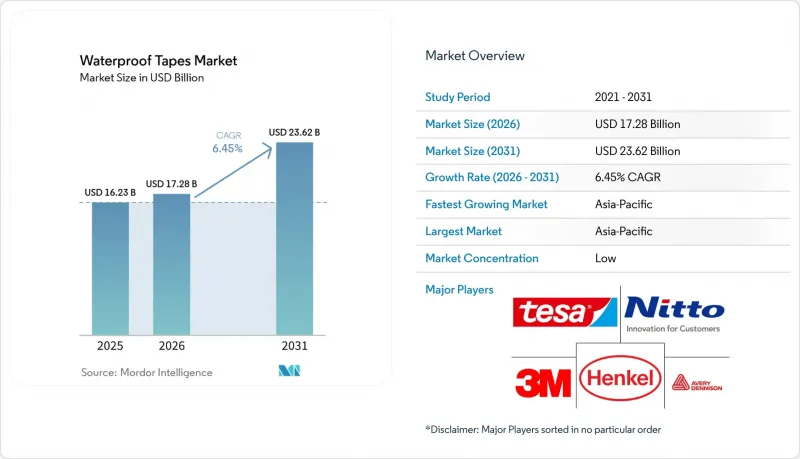
According to Mordor Intelligence, the waterproof tapes market size was valued at USD 16.23 billion in 2025 and is estimated to grow from USD 17.28 billion in 2026 to reach USD 23.62 billion by 2031, at a CAGR of 6.45% during the forecast period (2026-2031).
Global Waterproof Tapes Market Trends and Insights
Expansion of Building Waterproofing and Infrastructure Maintenance
Infrastructure renewal gives the waterproof tapes market a steadier source of demand than new construction activity alone. Repairs to older roofs, facades, and joints require moisture-management products that can be fitted around existing structures. In the United States, older housing creates recurring work on building envelopes and supports demand for repair-oriented sealing systems. Tape products can be applied in a single pass, without the cure periods associated with liquid alternatives. This makes them useful in commercial projects and prefabricated construction, where installation speed affects scheduling. The waterproof tapes market benefits where contractors value reduced preparation, simpler handling, and dependable performance on complex surfaces. These conditions are common in repair work, prefabricated projects, and installations with limited access or narrow scheduling windows. Tape can also simplify sequencing because the installer does not need to wait for a wet-applied material to cure before the next task begins.
Rising Moisture-Protection Requirements in Electronics and Electric Vehicles
Transport electrification changes tape requirements because battery modules need insulation, moisture protection, and thermal stability at the same time. Silicone and high-performance acrylic formulations are favored where conventional grades cannot withstand repeated thermal cycling. These applications support demand for thinner materials that retain adhesion under sustained operating stress. The waterproof tapes market also gains from device designs that need precision die-cut parts for tight spaces. European repair requirements for smartphones can add sealing demand when devices are opened and reassembled. Manufacturers must balance thin construction with resistance to moisture, heat, and repeated handling after repair. This gives high-performance tapes a role in maintaining device protection without adding the weight or space associated with more complex sealing approaches.
Raw Material Price Volatility
Waterproof tape production depends on films, acrylic monomers, butyl rubber, and silicone inputs whose prices can change quickly. This exposure is most difficult for converters that do not have supply contracts or internal resin capacity. Frequent input adjustments can require several price-list changes within a quarter and make project budgeting harder for customers. Larger manufacturers can manage some of this risk through longer purchasing arrangements and broader sourcing options. Smaller converters may have to pass through cost movements using shorter customer contracts. The waterproof tapes market remains exposed to this uneven cost position, especially where price competition limits a producer's ability to recover higher input costs. The resulting pressure can affect product selection, contract terms, and the timing of customer purchases. It also encourages manufacturers to improve sourcing discipline and to prioritize applications where technical value supports more stable pricing.
Other drivers and restraints analyzed in the detailed report include:
- Growth of Healthcare Wearables and Waterproof Medical Fixation
- Preference for Fast, Clean, Lightweight Sealing over Liquid Sealants
- Competition from Liquid Sealants, Membranes, and Mechanical Fasteners
For complete list of drivers and restraints, kindly check the Table Of Contents.
Segment Analysis
Silicone held 43.16% of the waterproof tapes market share in 2025 and is projected to advance at a 7.04% CAGR through 2031. Its position reflects the alignment between silicone performance and requirements in electronics, electric vehicle assembly, and skin-contact medical uses. The material can maintain function across temperatures from -50 °C to 200 °C, which is important for battery enclosures and power electronics. It also supports moisture protection and dielectric performance in applications subject to sustained thermal cycling. These combined needs restrict the suitability of commodity products in high-value assemblies.
Acrylic remains widely used in building and construction, packaging, and general industrial applications because it provides ultraviolet stability and works with water-based carrier systems. Butyl tapes remain important for underground waterproofing, pipe-joint sealing, and roofing penetrations where irregular or wet surfaces require cold-applied adhesion. Other resins, including rubber-based hot-melt and hybrid chemistries, address food-contact packaging and high-humidity industrial conditions. Resin demand is gradually separating between premium silicone and advanced acrylic formulations, and value-focused products used in infrastructure applications. This keeps silicone central to the waterproof tapes industry, where validated performance matters more than initial material cost. Buyers in these uses are less likely to change materials without evidence that an alternative can maintain insulation, sealing, and durability requirements. As a result, resin selection is closely tied to the operating conditions and approval needs of the finished assembly.
Complete Report Scope:
- By Resin Type
- Silicone
- Acrylic
- Butyl
- Others
- By Substrate Type
- Plastic
- Metal
- Rubber
- Others
- By End-Use Industry
- Electrical and Electronics
- Automotive
- Building and Construction
- Healthcare
- Packaging
- Others
- By Geography
- Asia-Pacific
- China
- India
- Japan
- South Korea
- ASEAN Countries
- Rest of Asia-Pacific
- North America
- United States
- Canada
- Mexico
- Europe
- Germany
- United Kingdom
- France
- Italy
- NORDIC Countries
- Rest of Europe
- South America
- Brazil
- Argentina
- Rest of South America
- Middle East and Africa
- Saudi Arabia
- South Africa
- Rest of Middle East and Africa
- Asia-Pacific
Geography Analysis
Asia-Pacific held 36.57% of the waterproof tapes market share in 2025 and is projected to advance at a 7.68% CAGR through 2031. The region is both a large electronics manufacturing center and a major construction market. China supports regional demand through electronics production, infrastructure work, and electric vehicle assembly. Japan and South Korea emphasize precision formats for display, automotive, and advanced device applications. Nitto Denko Corporation completed a Kaohsiung manufacturing and research facility in July 2026 after a TWD 4.48 billion (approximately USD 140.3 million) investment.
The facility produces polyvinyl chloride tapes and electronic adhesive tapes for semiconductor and automotive customers. India, the Association of Southeast Asian Nations countries, and South Korea add growth across healthcare, infrastructure, and automotive production. This supports broad demand for both commodity and mid-performance grades. North America benefits from infrastructure repair, a large automotive aftermarket, and broad retail distribution for repair products. Mexico contributes to industrial demand through automotive assembly and manufacturing investment. Canada provides a separate niche for butyl and advanced acrylic products that retain adhesion during cold-weather installation. Across North America, mature repair channels and established contractor practices support recurring demand for products used in maintenance as well as new construction.
Europe is influenced by building rules that favor airtight and moisture-managed envelopes in new construction and deep renovation. South America is led by Brazil and Argentina, where housing, infrastructure, and packaging support demand. Chile has a need for flexible waterproofing solutions in new construction and repairs to earthquake-affected structures. The Middle East and Africa demand is supported by construction in Gulf Cooperation Council countries and industrial maintenance in South Africa. Saudi Arabia's Vision 2030 infrastructure pipeline and continued commercial real estate development in the United Arab Emirates represent concentrated sources of construction-related demand. The regional opportunity remains tied to the pace of project execution and the ability of tape suppliers to meet local performance and distribution requirements.
- 3M
- Avery Dennison Corporation
- Henkel AG & Co. KGaA
- IPG
- LINTEC Corporation
- Lohmann
- Medline Industries, LP
- NICHIBAN Co., Ltd.
- Nitto Denko Corporation
- SEKISUI CHEMICAL CO., LTD.
- Shurtape Technologies, LLC
- Teraoka Seisakusho co.,Ltd.
- tesa SE
Additional Benefits:
- The market estimate (ME) sheet in Excel format
- 3 months of analyst support
TABLE OF CONTENTS
1 Introduction
- 1.1 Study Assumptions and Market Definition
- 1.2 Scope of the Study
2 Research Methodology
3 Executive Summary
4 Market Landscape
- 4.1 Market Overview
- 4.2 Market Drivers
- 4.2.1 Expansion of Building Waterproofing and Infrastructure Maintenance
- 4.2.2 Rising Moisture-Protection Requirements in Electronics and Electric Vehicles
- 4.2.3 Growth of Healthcare Wearables and Waterproof Medical Fixation
- 4.2.4 Preference for Fast, Clean, Lightweight Sealing over Liquid Sealants
- 4.2.5 E-Commerce and Do-It-Yourself Repair Adoption
- 4.3 Market Restraints
- 4.3.1 Raw Material Price Volatility
- 4.3.2 Competition from Liquid Sealants, Membranes, and Mechanical Fasteners
- 4.3.3 Product Differentiation and Certification Complexity
- 4.4 Value Chain Analysis
- 4.5 Porter's Five Forces Analysis
- 4.5.1 Bargaining Power of Suppliers
- 4.5.2 Bargaining Power of Buyers
- 4.5.3 Threat of New Entrants
- 4.5.4 Threat of Substitutes
- 4.5.5 Competitive Rivalry
5 Market Size and Growth Forecasts (Value)
- 5.1 By Resin Type
- 5.1.1 Silicone
- 5.1.2 Acrylic
- 5.1.3 Butyl
- 5.1.4 Others
- 5.2 By Substrate Type
- 5.2.1 Plastic
- 5.2.2 Metal
- 5.2.3 Rubber
- 5.2.4 Others
- 5.3 By End-Use Industry
- 5.3.1 Electrical and Electronics
- 5.3.2 Automotive
- 5.3.3 Building and Construction
- 5.3.4 Healthcare
- 5.3.5 Packaging
- 5.3.6 Others
- 5.4 By Geography
- 5.4.1 Asia-Pacific
- 5.4.1.1 China
- 5.4.1.2 India
- 5.4.1.3 Japan
- 5.4.1.4 South Korea
- 5.4.1.5 ASEAN Countries
- 5.4.1.6 Rest of Asia-Pacific
- 5.4.2 North America
- 5.4.2.1 United States
- 5.4.2.2 Canada
- 5.4.2.3 Mexico
- 5.4.3 Europe
- 5.4.3.1 Germany
- 5.4.3.2 United Kingdom
- 5.4.3.3 France
- 5.4.3.4 Italy
- 5.4.3.5 NORDIC Countries
- 5.4.3.6 Rest of Europe
- 5.4.4 South America
- 5.4.4.1 Brazil
- 5.4.4.2 Argentina
- 5.4.4.3 Rest of South America
- 5.4.5 Middle East and Africa
- 5.4.5.1 Saudi Arabia
- 5.4.5.2 South Africa
- 5.4.5.3 Rest of Middle East and Africa
- 5.4.1 Asia-Pacific
6 Competitive Landscape
- 6.1 Market Concentration
- 6.2 Strategic Moves
- 6.3 Market Share (%)/Ranking Analysis
- 6.4 Company Profiles (includes Global Overview, Market Overview, Core Segments, Financials as available, Strategic Information, Products and Services, and Recent Developments)
- 6.4.1 3M
- 6.4.2 Avery Dennison Corporation
- 6.4.3 Henkel AG & Co. KGaA
- 6.4.4 IPG
- 6.4.5 LINTEC Corporation
- 6.4.6 Lohmann
- 6.4.7 Medline Industries, LP
- 6.4.8 NICHIBAN Co., Ltd.
- 6.4.9 Nitto Denko Corporation
- 6.4.10 SEKISUI CHEMICAL CO., LTD.
- 6.4.11 Shurtape Technologies, LLC
- 6.4.12 Teraoka Seisakusho co.,Ltd.
- 6.4.13 tesa SE
7 Market Opportunities and Future Outlook
- 7.1 White-Space and Unmet-Need Assessment

