PUBLISHER: Mordor Intelligence | PRODUCT CODE: 2155329

PUBLISHER: Mordor Intelligence | PRODUCT CODE: 2155329
Hemocytometer - Market Share Analysis, Industry Trends & Statistics, Growth Forecasts (2026 - 2031)
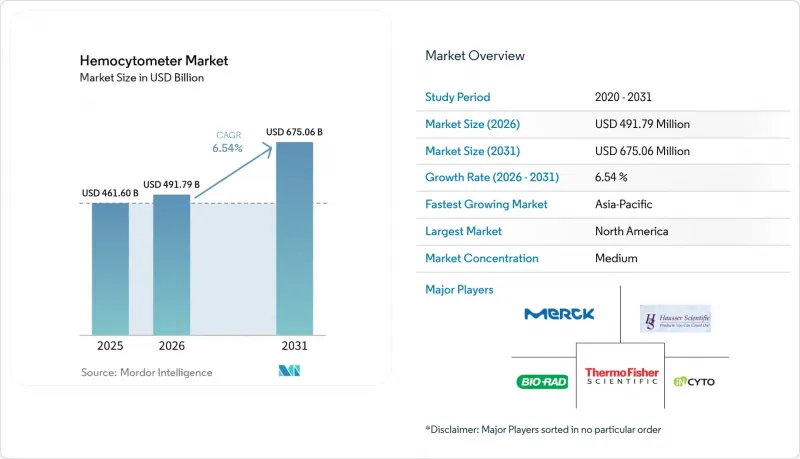
According to Mordor Intelligence, the hemocytometer market size is projected to be USD 461.60 million in 2025, USD 491.79 million in 2026, and reach USD 675.06 million by 2031, growing at a CAGR of 6.54% from 2026 to 2031.
Global Hemocytometer Market Trends and Insights
Growing Cell and Gene Therapy Manufacturing Workflows
Cell and gene therapy manufacturing requires viable cell density measurements during processing, expansion, and release. The hemocytometer market benefits when facilities need a direct reference method besides automated equipment. The FDA finalized its guidance on manufacturing flexibilities for human cellular and gene therapy products on May 5, 2026. Direct observation can help users identify debris, clumps, and morphology before batch disposition. Suppliers can benefit by providing calibrated chambers, traceable procedures, and records that support method qualification.
Increasing Demand for Rapid Cell Viability and Concentration Assessment
Cell viability assessment is increasingly used as a process control activity in biologics and cell therapy workflows. A 2026 study evaluated digital holographic microscopy across 40 industrial and academic CHO cultures at densities reaching 100 million cells per mL. ISO 20391-2:2019 remained current after its February 2025 confirmation and supports structured evaluation of cell counting methods. Hemocytometers remain useful during validation when laboratories need a familiar visual reference. The hemocytometer market benefits where laboratories need both rapid results and interpretable cell images.
Substitution by Automated Cell Counters and Flow Cytometers
Automated counters and flow cytometers offer speed and reduced manual effort for routine cell enumeration. This creates the greatest pressure in high-volume diagnostic work. Direct microscopy remains useful for cerebrospinal fluid, semen, yeast, cell aggregates, and other complex samples. Sysmex's 2026 XR-Series release illustrates continued investment in hematology automation. The hemocytometer market can remain relevant as a reference and verification tool beside automated systems.
Other drivers and restraints analyzed in the detailed report include:
- Adoption of Automated Imaging and Digital Counting
- Expansion of Biotechnology and Life-Science Research
- Manual-Counting Variability and Operator Dependence
For complete list of drivers and restraints, kindly check the Table Of Contents.
Segment Analysis
Manual hemocytometers held 57.65% of hemocytometer market share in 2025, supported by installed use across research, clinical diagnostics, and emerging-market laboratories. Buyers value their modest infrastructure needs, controlled procurement costs, and established Neubauer Improved grid procedures. These factors slow migration even as automated alternatives become more accessible. The hemocytometer market size for automated hemocytometers is forecast to grow at an 8.65% CAGR from 2026 to 2031. Growth is led by cell therapy developers, CDMOs, and pharmaceutical quality-control laboratories that need standardized records.
Automated formats improve comparability across users and retain images for later review. NanoEntek's July 2026 EVE HT A26 release targeted high-throughput workflows with automated sample processing. Manual products remain useful when laboratories need low-cost access, flexibility, or direct morphological review. Product choice increasingly depends on throughput and data requirements rather than a single preference for manual or automated work. The hemocytometer market includes long-established manual demand alongside higher-value automated development.
Glass chambers accounted for 47.87% of hemocytometer market share in 2025 and remain important in validated methods and regulated quality-control environments. Certified glass products offer documented geometry and familiar optical performance for procedures based on reference formats. Plastic and polymer chambers are forecast to grow at an 8.87% CAGR from 2026 to 2031. Their growth reflects single-use handling needs in high-throughput and contamination-sensitive workflows. The hemocytometer market size for polymer chambers is supported by sterile packaging and reduced cleaning requirements.
NanoEntek's C-Chip uses optical PMMA and a controlled 100 µm chamber depth. Merck KGaA's Millicell product uses optical-grade plastic with a Neubauer Improved ruling pattern. These products preserve a familiar chamber method while changing handling and disposal. Composite materials remain an emerging option for specialized research that combines selected optical and single-use characteristics. The hemocytometer market benefits because laboratories weigh validation history, sterility, cost, and convenience differently.
Complete Report Scope:
- By Product
- Automated Hemocytometer
- Manual Hemocytometer
- By Chamber Material
- Glass
- Plastic and Polymer
- Composite Materials
- By Application
- Blood Cell Counting
- Cell Viability Assessment
- Other Applications
- By End User
- Diagnostic Laboratories
- Hospitals and Clinics
- Pharmaceutical & Biotechnological Companies
- Contract Development and Manufacturing Organizations
- Other End-Users
- Geography
- North America
- United States
- Canada
- Mexico
- Europe
- Germany
- United Kingdom
- France
- Italy
- Spain
- Rest of Europe
- Asia-Pacific
- China
- Japan
- India
- Australia
- South Korea
- Rest of Asia-Pacific
- Middle East and Africa
- GCC
- South Africa
- Rest of Middle East and Africa
- South America
- Brazil
- Argentina
- Rest of South America
- North America
Geography Analysis
North America held 42.56% of hemocytometer market share in 2025, supported by cell therapy manufacturing, laboratory accreditation, and biopharma investment. The United States has a central role because it concentrates research laboratories and advanced therapy programs. FDA guidance issued in 2026 keeps attention on appropriate manufacturing controls for cell and gene therapy products. This supports procurement of traceable counting methods and quality-control tools. Canada and Mexico add smaller volumes as laboratory infrastructure investment broadens.
Europe holds the second-largest regional position in the hemocytometer market, with Germany, the United Kingdom, and France leading demand. Germany has a supply role through precision glassware producers, including Glaswarenfabrik Karl Hecht GmbH and Paul Marienfeld GmbH. European advanced therapy manufacturing requires traceable and validated procedures under applicable good manufacturing practice expectations. Italy, Spain, and the rest of Europe add demand through hospital modernization and expanding contract research activity. The region favors products that combine familiar methods with clear compliance documentation.
Asia-Pacific is forecast to grow at a 7.54% CAGR through 2031. China, India, and South Korea are expanding biopharma capacity and laboratory infrastructure. Thermo Fisher Scientific expanded Bioprocess Design Centers in Incheon, Hyderabad, and Singapore during December 2025. China supports automated demand, India supports cost-effective manual demand, and Middle East and Africa and South America are developing markets linked to laboratory capacity and healthcare investment.
- Abbott Laboratories
- Agilent Technologies
- Avantor
- Beckton Dickinson
- Bio-Rad Laboratories
- Danaher
- Glaswarenfabrik Karl Hecht GmbH and Co. KG
- Hausser Scientific Co.
- HemoCue AB
- HORIBA
- Merck
- Mindray
- Mxrady Lab Solutions Private Limited
- NanoEntek, Inc.
- Paul Marienfeld GmbH and Co. KG
- Roche Diagnostics International Ltd
- Siemens Healthineers
- Sysmex
- Thermo Fisher Scientific
- Thomas Scientific
- Unico
- Wuhan Servicebio Technology Co., Ltd.
Additional Benefits:
- The market estimate (ME) sheet in Excel format
- 3 months of analyst support
TABLE OF CONTENTS
1 Introduction
- 1.1 Study Assumptions & Market Definition
- 1.2 Scope Of The Study
2 Research Methodology
3 Executive Summary
4 Market Landscape
- 4.1 Market Overview
- 4.2 Market Drivers
- 4.2.1 Growing Cell and Gene Therapy Manufacturing Workflows
- 4.2.2 Increasing Demand for Rapid Cell Viability and Concentration Assessment
- 4.2.3 Adoption of Automated Imaging and Digital Counting
- 4.2.4 Expansion of Biotechnology and Life-Science Research
- 4.2.5 Rising Point-of-Care White Blood Cell Testing
- 4.2.6 Disposable Chambers Reducing Cross-Contamination Risk
- 4.3 Market Restraints
- 4.3.1 Substitution by Automated Cell Counters and Flow Cytometers
- 4.3.2 Manual-Counting Variability and Operator Dependence
- 4.3.3 Limited Standardization Across Chamber Designs and Protocols
- 4.3.4 Qualification and Data-Integrity Requirements for Digital Systems
- 4.4 Supply-Chain Analysis
- 4.5 Regulatory Landscape
- 4.6 Technological Outlook
- 4.7 Porter's Five Forces Analysis
- 4.7.1 Threat Of New Entrants
- 4.7.2 Bargaining Power Of Buyers
- 4.7.3 Bargaining Power Of Suppliers
- 4.7.4 Threat Of Substitutes
- 4.7.5 Competitive Rivalry
5 Market Size & Growth Forecasts (Value, USD)
- 5.1 By Product
- 5.1.1 Automated Hemocytometer
- 5.1.2 Manual Hemocytometer
- 5.2 By Chamber Material
- 5.2.1 Glass
- 5.2.2 Plastic and Polymer
- 5.2.3 Composite Materials
- 5.3 By Application
- 5.3.1 Blood Cell Counting
- 5.3.2 Cell Viability Assessment
- 5.3.3 Other Applications
- 5.4 By End User
- 5.4.1 Diagnostic Laboratories
- 5.4.2 Hospitals and Clinics
- 5.4.3 Pharmaceutical & Biotechnological Companies
- 5.4.4 Contract Development and Manufacturing Organizations
- 5.4.5 Other End-Users
- 5.5 Geography
- 5.5.1 North America
- 5.5.1.1 United States
- 5.5.1.2 Canada
- 5.5.1.3 Mexico
- 5.5.2 Europe
- 5.5.2.1 Germany
- 5.5.2.2 United Kingdom
- 5.5.2.3 France
- 5.5.2.4 Italy
- 5.5.2.5 Spain
- 5.5.2.6 Rest of Europe
- 5.5.3 Asia-Pacific
- 5.5.3.1 China
- 5.5.3.2 Japan
- 5.5.3.3 India
- 5.5.3.4 Australia
- 5.5.3.5 South Korea
- 5.5.3.6 Rest of Asia-Pacific
- 5.5.4 Middle East and Africa
- 5.5.4.1 GCC
- 5.5.4.2 South Africa
- 5.5.4.3 Rest of Middle East and Africa
- 5.5.5 South America
- 5.5.5.1 Brazil
- 5.5.5.2 Argentina
- 5.5.5.3 Rest of South America
- 5.5.1 North America
6 Competitive Landscape
- 6.1 Market Concentration
- 6.2 Market Share Analysis
- 6.3 Company Profiles {(Includes Global Level Overview, Market Level Overview, Core Segments, Financials As Available, Strategic Information, Market Rank/Share For Key Companies, Products & Services, And Recent Developments)}
- 6.3.1 Abbott Laboratories
- 6.3.2 Agilent Technologies, Inc.
- 6.3.3 Avantor, Inc.
- 6.3.4 Becton, Dickinson and Company
- 6.3.5 Bio-Rad Laboratories, Inc.
- 6.3.6 Danaher Corporation
- 6.3.7 Glaswarenfabrik Karl Hecht GmbH and Co. KG
- 6.3.8 Hausser Scientific Co.
- 6.3.9 HemoCue AB
- 6.3.10 HORIBA, Ltd.
- 6.3.11 Merck KGaA
- 6.3.12 Mindray Medical International Limited
- 6.3.13 Mxrady Lab Solutions Private Limited
- 6.3.14 NanoEntek, Inc.
- 6.3.15 Paul Marienfeld GmbH and Co. KG
- 6.3.16 Roche Diagnostics International Ltd
- 6.3.17 Siemens Healthineers AG
- 6.3.18 Sysmex Corporation
- 6.3.19 Thermo Fisher Scientific Inc.
- 6.3.20 Thomas Scientific
- 6.3.21 Unico
- 6.3.22 Wuhan Servicebio Technology Co., Ltd.
7 Market Opportunities & Future Outlook
- 7.1 White-Space & Unmet-Need Assessment

