PUBLISHER: Mordor Intelligence | PRODUCT CODE: 2155336

PUBLISHER: Mordor Intelligence | PRODUCT CODE: 2155336
Cold-Pressed Oil - Market Share Analysis, Industry Trends & Statistics, Growth Forecasts (2026 - 2031)
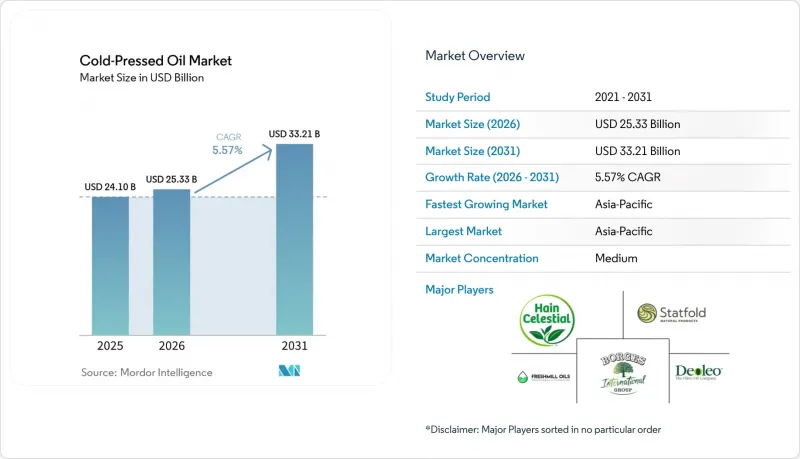
According to Mordor Intelligence, the cold-pressed oil market size was valued at USD 24.10 billion in 2025 to USD 25.33 billion in 2026, and is forecast to reach USD 33.21 billion by 2031 at a 5.57% CAGR during the forecast period (2026-2031).
Global Cold-Pressed Oil Market Trends and Insights
Rising Consumer Preference For Minimally Processed Edible Oils
Consumers are choosing cold-pressed oils due to their perceived health benefits and closer connection to ingredients and processing methods. A 2024 study conducted by the International Journal of Agriculture Extension and Social Development in Hyderabad found that health benefits received a mean score of 4.34 out of 5 as a purchase driver, while 75% of respondents purchased these oils every 10 to 15 days. This pattern indicates that repeat purchasing is becoming established among some households rather than remaining an occasional wellness-driven purchase. As the cold-pressed oil market reaches a wider buyer base, supermarket shelf space and reliable supply are becoming more important. This shift may benefit processors that can maintain quality at scale, while smaller brands may face closer price comparisons in mainstream retail. The category can gain volume through broader availability while becoming more competitive in the middle price range, where buyers still expect a clear difference in quality and processing.
Growing Demand For Functional Foods Rich In Natural Nutrients
Producers increasingly position cold-pressed oils as ingredients that offer nutritional properties in addition to cooking applications. The framework provides producers with a basis for communicating product value when their products meet applicable requirements. This positioning is especially relevant in markets where preventive health considerations influence food purchases. Specialty seed and nut oils can also help producers create a more differentiated product range when they document composition and quality. Therefore, the cold-pressed oil market can support product tiers that differentiate traceable, nutrient-focused formats from standard refined edible oils, while requiring brands to align health-related communication with the evidence and labeling requirements applicable to each product.
High Production Costs Compared To Refined Edible Oils
Cold pressing typically yields less oil from a given quantity of raw material than solvent extraction and heat-based refining. Fresh, high-quality seeds and nuts also carry higher costs, as contamination or poor handling can affect the finished product. These higher costs can limit adoption among price-sensitive households and restrict mass retail penetration in lower-income markets. They can also reduce the funds available to smaller producers for automation, storage, and quality control. Unlike refined oils, cold-pressed oils require careful processing, filtration, and storage to preserve their natural nutrients and oxidative stability, which further increases production and logistics costs. As a result, product consistency may vary, making it more challenging for smaller producers to achieve economies of scale and expand into mainstream retail channels.
Other drivers and restraints analyzed in the detailed report include:
- Increasing Demand For Specialty Culinary Oils In Premium Foodservice
- Product Innovation Through Specialty Seed And Nut-Based Cold-Pressed Oils
- Stringent Labeling And Authenticity Regulations For Virgin And Cold-Pressed Oils
For complete list of drivers and restraints, kindly check the Table Of Contents.
Segment Analysis
Coconut oil accounted for 35.70% of the cold-pressed oil market size in 2025. Its position reflects its widespread use as a household cooking oil in South and Southeast Asia and as a base ingredient in natural personal care products. In India, long-standing food traditions and wellness practices continue to support regular household purchases. Sunflower oil and groundnut oil hold secondary positions in the oil type mix. Rapeseed oil remains relevant in European markets, particularly where local producers sell directly to consumers. This also identifies pumpkin seed, black seed, hemp, and avocado oils as an emerging group within the Others category. These varieties broaden the category beyond staple cooking oils and allow smaller producers to compete more effectively through product identity.
Olive oil is expected to record the highest CAGR, at 6.83%, through 2031 within the oil type segmentation. Its growth is tied to recovering Mediterranean supply and rising demand for traceable, single-origin products. Products with clear varietal and harvest information help consumers and foodservice buyers assess quality more easily. European Union olive oil rules also provide established standards that support category definitions and quality communication. Olive oil producers can use these controls to support a premium retail position when they consistently meet the relevant standards. The cold-pressed oil industry has a wider product base than olive oil alone, but olive oil remains important in setting quality expectations in premium culinary formats.
Complete Report Scope:
- By Oil Type
- Coconut Oil
- Sunflower Oil
- Rapeseed Oil
- Groundnut Oil
- Olive Oil
- Others
- By Nature
- Organic
- Conventional
- By Distribution Channel
- HoReCa
- Retail
- Hypermarkets/Supermarkets
- Convenience/Grocery Stores
- Online Retail Channel
- Other Distribution Channels
- By Geography
- North America
- United States
- Canada
- Mexico
- Rest of North America
- Europe
- Germany
- United Kingdom
- Italy
- France
- Spain
- Netherlands
- Poland
- Belgium
- Sweden
- Rest of Europe
- Asia-Pacific
- China
- India
- Japan
- Australia
- Indonesia
- South Korea
- Thailand
- Singapore
- Rest of Asia-Pacific
- South America
- Brazil
- Argentina
- Colombia
- Chile
- Peru
- Rest of South America
- Middle East and Africa
- South Africa
- Saudi Arabia
- United Arab Emirates
- Nigeria
- Egypt
- Morocco
- Turkey
- Rest of Middle East and Africa
- North America
Geography Analysis
Asia-Pacific accounts for 43.78% of regional revenue in 2025 and is forecast to grow at a CAGR of 6.30% through 2031. The region combines established household consumption in South and Southeast Asia with rising demand for premium oils in urban markets. Indonesia and the Philippines are key sources of coconut oil feedstock, with supply chains serving local food applications and international demand from the personal care market. India remains significant, as traditional oil use is closely linked to cooking and wellness practices.
North America and Europe are the second- and third-largest geographies, respectively, in the supplied research. Clean-label preferences, online sales, and specialty food retail channels support demand in North America. Europe benefits from Mediterranean olive oil production, a strong food culture, and established quality regulations. In addition, rising consumer demand for minimally processed, nutrient-rich edible oils and the growing adoption of organic food products continue to support market growth across both regions.
South America and the Middle East and Africa remain smaller opportunities within the cold-pressed oil market. Brazil's demand for functional foods and Argentina's edible oil production base support regional potential. Chile and Peru offer potential sources for avocado and specialty seed oils. Gulf Cooperation Council markets show demand for imported extra virgin olive oil, while purchasing power constraints and premium product prices limit broader adoption.
- Deoleo S.A.
- Borges International Group
- La Tourangelle
- Statfold Natural Products
- Wilmar International Ltd
- Archer Daniels Midland Company
- Sovena Group
- Salov Group
- Pompeian
- Cobram Estate Olives
- Brightland
- Graza
- Gramiyum Wood Pressed Oils
- Country Life, LLC
- Orgatma
- Sky Organics
- FreshMill Oils
- The Hain Celestial Group
- KLF Nirmal
- Green Gold International Ltd.
Additional Benefits:
- The market estimate (ME) sheet in Excel format
- 3 months of analyst support
TABLE OF CONTENTS
1 INTRODUCTION
- 1.1 Study Assumptions and Market Definition
- 1.2 Scope of the Study
2 RESEARCH METHODOLOGY
3 EXECUTIVE SUMMARY
4 MARKET LANDSCAPE
- 4.1 Market Overview
- 4.2 Market Drivers
- 4.2.1 Rising consumer preference for minimally processed edible oils
- 4.2.2 Product innovation through specialty seed and nut-based cold-pressed oils
- 4.2.3 Plant-based oils in natural personal care
- 4.2.4 Growing demand for functional foods rich in natural nutrients
- 4.2.5 Sustainable, chemical-free extraction methods
- 4.2.6 Increasing demand for specialty culinary oils in premium foodservice
- 4.3 Market Restraints
- 4.3.1 High production costs compared to refined edible oils
- 4.3.2 Limited shelf life without chemical refining
- 4.3.3 Oilseed and nut raw material price volatility
- 4.3.4 Stringent labeling and authenticity regulations for virgin and cold-pressed oils
- 4.4 Consumer Behavior Analysis
- 4.5 Regulatory Outlook
- 4.6 Porter's Five Forces Analysis
- 4.6.1 Threat of New Entrants
- 4.6.2 Bargaining Power of Buyers/Consumers
- 4.6.3 Bargaining Power of Suppliers
- 4.6.4 Threat of Substitute Products
- 4.6.5 Intensity of Competitive Rivalry
5 MARKET SIZE AND GROWTH FORECASTS (VALUE)
- 5.1 By Oil Type
- 5.1.1 Coconut Oil
- 5.1.2 Sunflower Oil
- 5.1.3 Rapeseed Oil
- 5.1.4 Groundnut Oil
- 5.1.5 Olive Oil
- 5.1.6 Others
- 5.2 By Nature
- 5.2.1 Organic
- 5.2.2 Conventional
- 5.3 By Distribution Channel
- 5.3.1 HoReCa
- 5.3.2 Retail
- 5.3.2.1 Hypermarkets/Supermarkets
- 5.3.2.2 Convenience/Grocery Stores
- 5.3.2.3 Online Retail Channel
- 5.3.2.4 Other Distribution Channels
- 5.4 By Geography
- 5.4.1 North America
- 5.4.1.1 United States
- 5.4.1.2 Canada
- 5.4.1.3 Mexico
- 5.4.1.4 Rest of North America
- 5.4.2 Europe
- 5.4.2.1 Germany
- 5.4.2.2 United Kingdom
- 5.4.2.3 Italy
- 5.4.2.4 France
- 5.4.2.5 Spain
- 5.4.2.6 Netherlands
- 5.4.2.7 Poland
- 5.4.2.8 Belgium
- 5.4.2.9 Sweden
- 5.4.2.10 Rest of Europe
- 5.4.3 Asia-Pacific
- 5.4.3.1 China
- 5.4.3.2 India
- 5.4.3.3 Japan
- 5.4.3.4 Australia
- 5.4.3.5 Indonesia
- 5.4.3.6 South Korea
- 5.4.3.7 Thailand
- 5.4.3.8 Singapore
- 5.4.3.9 Rest of Asia-Pacific
- 5.4.4 South America
- 5.4.4.1 Brazil
- 5.4.4.2 Argentina
- 5.4.4.3 Colombia
- 5.4.4.4 Chile
- 5.4.4.5 Peru
- 5.4.4.6 Rest of South America
- 5.4.5 Middle East and Africa
- 5.4.5.1 South Africa
- 5.4.5.2 Saudi Arabia
- 5.4.5.3 United Arab Emirates
- 5.4.5.4 Nigeria
- 5.4.5.5 Egypt
- 5.4.5.6 Morocco
- 5.4.5.7 Turkey
- 5.4.5.8 Rest of Middle East and Africa
- 5.4.1 North America
6 COMPETITIVE LANDSCAPE
- 6.1 Market Concentration
- 6.2 Strategic Moves
- 6.3 Market Positioning Analysis
- 6.4 Company Profiles (includes Global-level Overview, Market-level Overview, Core Segments, Financials (if available), Strategic Information, Market Rank/Share, Products and Services, Recent Developments)
- 6.4.1 Deoleo S.A.
- 6.4.2 Borges International Group
- 6.4.3 La Tourangelle
- 6.4.4 Statfold Natural Products
- 6.4.5 Wilmar International Ltd
- 6.4.6 Archer Daniels Midland Company
- 6.4.7 Sovena Group
- 6.4.8 Salov Group
- 6.4.9 Pompeian
- 6.4.10 Cobram Estate Olives
- 6.4.11 Brightland
- 6.4.12 Graza
- 6.4.13 Gramiyum Wood Pressed Oils
- 6.4.14 Country Life, LLC
- 6.4.15 Orgatma
- 6.4.16 Sky Organics
- 6.4.17 FreshMill Oils
- 6.4.18 The Hain Celestial Group
- 6.4.19 KLF Nirmal
- 6.4.20 Green Gold International Ltd.
7 MARKET OPPORTUNITIES AND FUTURE OUTLOOK

