PUBLISHER: Mordor Intelligence | PRODUCT CODE: 2155577

PUBLISHER: Mordor Intelligence | PRODUCT CODE: 2155577
South America Airport Quick-Service Restaurant - Market Share Analysis, Industry Trends & Statistics, Growth Forecasts (2026 - 2031)
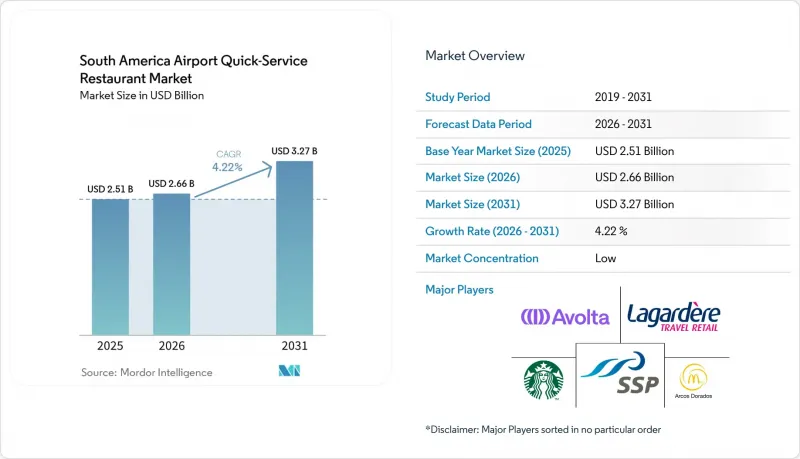
According to Mordor Intelligence, the South America airport quick-service restaurant market size was valued at USD 2.51 billion in 2025 and is forecast to grow from USD 2.66 billion in 2026 to USD 3.27 billion by 2031, at a 4.22% CAGR during the forecast period (2026-2031).
South America Airport Quick-Service Restaurant Market Trends and Insights
Air Passenger Traffic and Flight Frequency Recovery
Air passenger traffic continued to expand across major South American aviation markets in 2025. Brazil transported 129.6 million domestic and international passengers, up 9.4% year over year, while Argentina's airports handled 50.65 million passengers, up 12% from 2024. Argentina also recorded 405,434 aircraft movements, up 9%, indicating higher overall flight activity. Colombia reached a record 57.52 million passengers during the year, with the Bogota-Medellin corridor alone carrying approximately 3.5 million passengers, reflecting strong domestic inter-city demand. Growing passenger volumes and flight activity broaden the potential customer base for terminal food and beverage outlets, supporting demand for quick-service restaurants across major hubs and regional airports in South America.
Narrowbody Fleet Expansion and Network Development
LCCs are adding narrowbody capacity and expanding domestic and regional networks across South America. JetSMART increased its fleet from 40 aircraft in 2024 to 50 in 2025 and expanded routes in markets including Argentina and Colombia, while SKY Airline added four A320neo aircraft in late 2024. Brazil recorded 101.2 million domestic passengers in 2025, up 8.4% year over year. Airport commercial capacity is expanding alongside traffic growth: Santiago Airport announced 41 new commercial outlets for 2025, including 16 food and beverage locations, supported by more than USD 11 million in tenant investment, with another 13 outlets planned for 2026. These developments expand quick-service restaurant opportunities across both major hubs and growing regional airports.
Food, Labor, Logistics, and Cold-chain Costs
Food, labor, and occupancy costs continue to pressure quick-service restaurant operations across South America. Arcos Dorados reported that food and paper costs increased 7.2% in 2025, reaching 36.0% of company-operated restaurant sales. In Brazil, food and paper costs increased 5.4% and reached 36.5% of restaurant sales. Currency movements add further uncertainty, as a portion of restaurant input costs remains exposed to foreign-exchange fluctuations. Labor costs are also affected by wage revisions, including Brazil's increase in the national minimum wage from USD 252 to USD 271 in January 2025. Airport concession structures can add another fixed-cost element: Aena Brasil states that commercial concession payments vary with sales but remain subject to a Minimum Guaranteed Annual amount. These cost pressures can limit margin flexibility for airport quick-service restaurant operators, particularly when passenger traffic or sales soften.
Other drivers and restraints analyzed in the detailed report include:
- Premium, Branded, and Local Food Offerings
- Regional, Dietary-specific, And Sustainable Food Demand
- Airline Margin Pressure and Passenger Demand Volatility
For complete list of drivers and restraints, kindly check the Table Of Contents.
Segment Analysis
Fast food and meals accounted for an estimated 49.20% of South America airport quick-service restaurant revenue in 2025, driven by demand for convenient meal options within terminals. This segment remains the largest revenue stream, as passengers continue to rely on quick, familiar meal formats during airport stays. Bakery and confectionery also maintains an established presence, particularly through compact formats suited to quick purchases. Nanica Brasil entered Sao Paulo Guarulhos International Airport in early 2025 with a Terminal 2 kiosk and two mobile Naniquinha carts serving Terminal 2 departures and Terminal 3 arrivals.
Beverages are forecast to be the fastest-growing food category, expanding at a 5.65% CAGR from 2026 to 2031, outpacing the overall market rate. Coffee and specialty beverage concepts are increasing their airport presence across South America. Starbucks Brasil ended 2025 with 112 coffeehouses after opening a kiosk at Curitiba International Airport in December and planned approximately 30 additional stores across Brazil in 2026. In Peru, Starbucks opened its third outlet at Jorge Chavez International Airport in September 2025. It announced a fourth location at the Peru Plaza mezzanine, highlighting the growing role of branded beverage concepts at high-traffic airports.
Food courts accounted for an estimated 51.55% of South America airport quick-service restaurant revenue in 2025, supported by their ability to concentrate multiple food options in high-passenger-flow areas. New airport developments are combining centralized dining areas with more distributed formats. Lima's new Jorge Chavez terminal includes the 3,300 m2 Nacion Sazon dining hub, while Congonhas is expanding its food and beverage area from 4,720 m2 to 7,050 m2 by 2028, incorporating restaurants, fast-casual concepts, flagship cafes, and premium bars. Avolta also opened its 334 m2 Vista Corona concept at Congonhas in March 2025, combining a full-service restaurant with a Grab & Go section. These developments indicate that traditional food courts are increasingly being complemented by flexible quick-service and hybrid formats.
Airport lounges are forecast to grow at a 5.10% CAGR from 2026 to 2031 as access expands beyond traditional airline lounge memberships. Visa reported a 50% increase in airport lounge benefit usage among Brazilian cardholders in 2025, while Aeropuertos Argentina's VIPCLUB offers memberships, corporate plans, and individual paid passes. At Ezeiza International Airport, Aeropuertos Argentina opened a new 780 m2 VIPCLUB lounge in 2025, featuring an a la carte menu developed by chef Agustin Branas, along with a buffet, premium wine, and cocktail offerings. Aena Brasil is also nearly doubling lounge space at Congonhas, from 3,420 m2 to 6,500 m2 by 2028. These developments support differentiated food service formats across food courts, lounges, and smaller service locations within the South America airport quick-service restaurant market.
Complete Report Scope:
- By Food Type
- Fast Food and Meals
- Beverages
- Bakery and Confectionery
- Other Food Types
- By Location
- Airport Lounges
- Food Courts
- Service Centers
- By Franchise Type
- Branded Chains
- Local Brands
- By Application
- Domestic Airports
- International Airports
- By Geography
- Brazil
- Colombia
- Argentina
- Chile
- Peru
- Venezuela
- Bolivia
- Uruguay
- Rest of South America
List of Companies Covered in this Report:
- Restaurant Brands International, Inc.
- Churromania International Holding LLC
- Domino's Pizza, Inc.
- Frisby S.A. BIC
- G&N Brands SpA
- Arcos Dorados Holdings Inc.
- Starbucks Corporation
- Subway IP LLC
- KFC Corporation
- Avolta AG
- Lagardere Travel Retail SAS
- SSP Group plc
- Duty Free Americas, Inc.
- Global Group Corporation (GGCorp)
- Retail Services S.A.C.
Additional Benefits:
- The market estimate (ME) sheet in Excel format
- 3 months of analyst support
TABLE OF CONTENTS
1 INTRODUCTION
- 1.1 Study Assumptions and Market Definition
- 1.2 Scope of the Study
2 RESEARCH METHODOLOGY
3 EXECUTIVE SUMMARY
4 MARKET LANDSCAPE
- 4.1 Market Overview
- 4.2 Market Drivers
- 4.2.1 Air passenger traffic and flight frequency recovery
- 4.2.2 Narrowbody fleet expansion and network development
- 4.2.3 Premium, branded, and local food offerings
- 4.2.4 Regional, dietary-specific, and sustainable food demand
- 4.2.5 Inflight catering outsourcing
- 4.2.6 Pre-order, personalization, and waste-optimized meals
- 4.3 Market Restraints
- 4.3.1 Food, labor, logistics, and cold-chain costs
- 4.3.2 Airline margin pressure and passenger demand volatility
- 4.3.3 Catering capacity concentration at aviation hubs
- 4.3.4 Food safety, customs, and traceability requirements
- 4.4 Value Chain Analysis
- 4.5 Regulatory Landscape
- 4.6 Technological Outlook
- 4.7 Porter's Five Forces Analysis
- 4.7.1 Bargaining Power of Suppliers
- 4.7.2 Bargaining Power of Buyers
- 4.7.3 Threat of New Entrants
- 4.7.4 Threat of Substitutes
- 4.7.5 Intensity of Competitive Rivalry
5 MARKET SIZE AND GROWTH FORECASTS (VALUE)
- 5.1 By Food Type
- 5.1.1 Fast Food and Meals
- 5.1.2 Beverages
- 5.1.3 Bakery and Confectionery
- 5.1.4 Other Food Types
- 5.2 By Location
- 5.2.1 Airport Lounges
- 5.2.2 Food Courts
- 5.2.3 Service Centers
- 5.3 By Franchise Type
- 5.3.1 Branded Chains
- 5.3.2 Local Brands
- 5.4 By Application
- 5.4.1 Domestic Airports
- 5.4.2 International Airports
- 5.5 By Geography
- 5.5.1 Brazil
- 5.5.2 Colombia
- 5.5.3 Argentina
- 5.5.4 Chile
- 5.5.5 Peru
- 5.5.6 Venezuela
- 5.5.7 Bolivia
- 5.5.8 Uruguay
- 5.5.9 Rest of South America
6 COMPETITIVE LANDSCAPE
- 6.1 Market Concentration
- 6.2 Strategic Moves
- 6.3 Market Share Analysis
- 6.4 Company Profiles (includes Global-level Overview, Market-level Overview, Core Segments, Financials, Strategic Information, Market Rank/Share, Products and Services, and Recent Developments)
- 6.4.1 Restaurant Brands International, Inc.
- 6.4.2 Churromania International Holding LLC
- 6.4.3 Domino's Pizza, Inc.
- 6.4.4 Frisby S.A. BIC
- 6.4.5 G&N Brands SpA
- 6.4.6 Arcos Dorados Holdings Inc.
- 6.4.7 Starbucks Corporation
- 6.4.8 Subway IP LLC
- 6.4.9 KFC Corporation
- 6.4.10 Avolta AG
- 6.4.11 Lagardere Travel Retail SAS
- 6.4.12 SSP Group plc
- 6.4.13 Duty Free Americas, Inc.
- 6.4.14 Global Group Corporation (GGCorp)
- 6.4.15 Retail Services S.A.C.
7 MARKET OPPORTUNITIES AND FUTURE OUTLOOK
- 7.1 White-space and Unmet-Need Assessment

