PUBLISHER: Mordor Intelligence | PRODUCT CODE: 2155622

PUBLISHER: Mordor Intelligence | PRODUCT CODE: 2155622
Singapore Health Insurance - Market Share Analysis, Industry Trends & Statistics, Growth Forecasts (2026 - 2031)
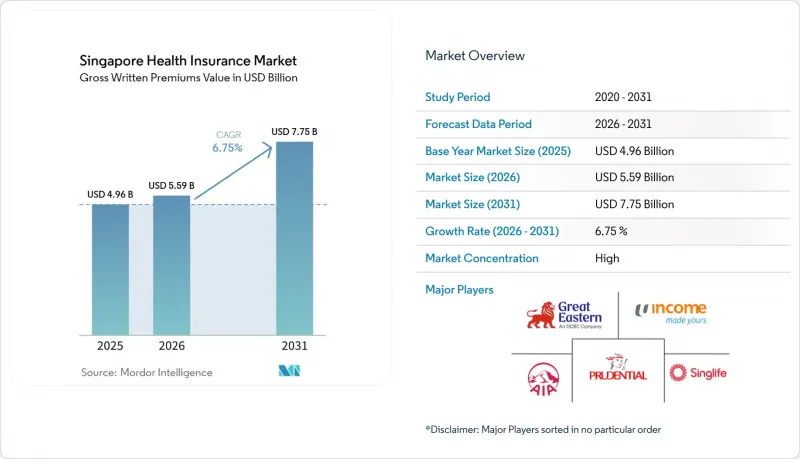
According to Mordor Intelligence, the Singapore health insurance market size in terms of gross written premiums value was valued at USD 4.96 billion in 2025 and is estimated to grow from USD 5.59 billion in 2026 to reach USD 7.75 billion by 2031, at a CAGR of 6.75% during the forecast period (2026-2031).
Singapore Health Insurance Market Trends and Insights
Rising Healthcare Costs and Private Hospital Treatment Expenses
Medical cost inflation reached 16.9% in Singapore in 2026, putting direct pressure on insurers' claims costs and pricing decisions. SingHealth expenditure increased from SGD 4.4 billion (USD 3.26 billion) in 2019 to SGD 6.1 billion (USD 4.51 billion) in 2024, while inpatient care accounted for 63.8% of spending. This pattern makes hospital cover a continuing priority for households, even when premiums rise. Higher treatment bills can reduce insurer margins and lead to narrower coverage designs. They also make supplementary protection more relevant because the financial exposure from hospitalization becomes larger. The Singapore health insurance market must therefore balance affordability with the need to maintain meaningful private hospital protection.
Demand for Integrated Shield Plan and Supplementary Coverage Beyond MediShield Life
The Integrated Shield Plan combines compulsory MediShield Life coverage with private insurance that allows policyholders to select higher ward classes. Around 72% of Singapore's population held an Integrated Shield Plan in the first half of 2025. The revised rider framework took effect in April 2026 and removed coverage of the required deductible for newly sold riders. The annual co-payment cap increased from SGD 3,000 (USD 2,220) to SGD 6,000 (USD 4,440) under the new requirements. These rules limit differentiation based on extensive rider coverage and place greater emphasis on service, provider relationships, and clear plan design. The Singapore health insurance market can gain policyholders when lower-cost riders improve the entry point for buyers who previously reduced coverage.
Rising Premiums and Affordability Pressures for Private Hospital Coverage
Premium affordability continues to limit the breadth of private hospital coverage, despite lower premiums for some new riders. Six of seven Integrated Shield Plan insurers increased rider premiums in 2025 after net claims rose by 9% to 27% in 2024. Five of seven insurers also increased base-plan premiums in 2026, in some cases by double-digit rates. The combined cost of a base plan and rider can still rise for middle-aged and older households. Price-sensitive buyers may move toward restructured hospital plans rather than private hospital coverage. This movement can constrain premium growth at the higher end of the Singapore health insurance market.
Other drivers and restraints analyzed in the detailed report include:
- Aging Population and Growing Chronic Disease Burden
- Demand for Comprehensive Employer-Sponsored Health Benefits
- Escalating Claims Costs and Pressure on Integrated Shield Plan Sustainability
For complete list of drivers and restraints, kindly check the Table Of Contents.
Segment Analysis
Medical expense/hospitalization & surgical held 87.8% of Singapore health insurance market share in 2025, confirming the central role of inpatient cover in the country's insurance system. MediShield Life provides the compulsory foundation, while the Integrated Shield Plan adds private cover for policyholders seeking higher ward options. Around 72% of residents had an Integrated Shield Plan in the first half of 2025, showing the broad reach of hospital protection. Critical illness plans remain a material secondary category because they provide financial support around serious conditions. Hospital cash and disability income products serve income-replacement needs for self-employed people and employees whose group cover does not replace lost earnings.
Long-term care is projected to expand at a 9% CAGR from 2026 to 2031, making it the fastest-growing primary benefit category in the Singapore health insurance market, and according to the Ministry of Health (MOH), Singapore, CareShield Life payout growth doubled from 2% to 4% annually from January 2026. Monthly payouts started at SGD 689 (USD 510) in 2026 and are projected to reach SGD 806 (USD 596) by 2030. A government premium support package exceeding SGD 570 million (USD 422 million) for 2026-2030 is intended to limit premium increases to an average of SGD 38 (USD 28) annually. Supplementary products can address home nursing, rehabilitation, and post-hospital care as the population aged 80 and above expands, supporting growth in the Singapore health insurance market size.
Complete Report Scope:
- By Primary Benefit
- Medical Expense/Hospitalization & Surgical
- Critical Illness
- Hospital Cash
- Disability Income
- Long-Term Care
- By Customer
- Individuals
- Employer Group - SME
- Employer Group - large corporate/MNC
- By Distribution Channel
- Tied/Exclusive Agents
- Independent Financial Advisers
- Insurance Brokers
- Bancassurance
- Direct & Digital Insurer Channels
- By Geography
- Central Region
- East Region
- North Region
- West Region
List of Companies Covered in this Report:
- AIA Singapore
- Great Eastern Singapore
- Prudential Singapore
- Income Insurance
- Singlife
- HSBC Life Singapore
- Raffles Health Insurance
- Manulife Singapore
- Allianz Singapore
- Cigna Healthcare
- Bupa Global
- Chubb Singapore
- AIG Singapore
- Tokio Marine Life Singapore
- FWD Singapore
- Etiqa Singapore
- MSIG Singapore
- Sompo Singapore
- Zurich Singapore
- Liberty Insurance Singapore
Additional Benefits:
- The market estimate (ME) sheet in Excel format
- 3 months of analyst support
TABLE OF CONTENTS
1 INTRODUCTION
- 1.1 Study Assumptions and Market Definition
- 1.2 Scope of the Study
2 RESEARCH METHODOLOGY
3 EXECUTIVE SUMMARY
4 MARKET LANDSCAPE
- 4.1 Market Overview
- 4.2 Market Drivers
- 4.2.1 Rising Healthcare Costs and Private Hospital Treatment Expenses
- 4.2.2 Demand for Integrated Shield Plan and Supplementary Coverage Beyond MediShield Life
- 4.2.3 Ageing Population and Growing Chronic Disease Burden
- 4.2.4 Growing Demand for Comprehensive Employer-Sponsored Health Benefits
- 4.2.5 Mandatory Medical Insurance Requirements for Foreign Workers
- 4.2.6 Growing Demand for Digital and Convenient Healthcare Access
- 4.3 Market Restraints
- 4.3.1 Rising Premiums and Affordability Pressures, Particularly for Private Hospital Coverage
- 4.3.2 Escalating Claims Costs and Pressure on Integrated Shield Plan Sustainability
- 4.3.3 Regulatory Changes Increasing Cost-Sharing and Limiting Extensive Rider Coverage
- 4.3.4 High Dependence on Public Healthcare Coverage, Limiting the Need for Additional Private Insurance
- 4.4 Value Chain Analysis
- 4.4.1 Insurance Underwriting and Risk Carriers
- 4.4.2 Distribution Channels: Financial Advisers, Brokers and Bancassurance Partners
- 4.4.3 Healthcare Delivery and Claims Management Ecosystem
- 4.5 Regulatory Landscape
- 4.5.1 MAS Licensing, Prudential Oversight and Market Conduct Requirements
- 4.5.2 MediShield Life and Integrated Shield Plan Regulatory Framework
- 4.5.3 Integrated Shield Plan Premium Funding, Rider and Cost-Sharing Requirements
- 4.6 Technological Outlook
- 4.6.1 Digital Policy Administration and End-to-End Claims Automation
- 4.6.2 Artificial Intelligence and Advanced Analytics in Underwriting and Claims Management
- 4.6.3 Integration of Digital Health Services and Telemedicine Solutions
- 4.7 Porter's Five Forces Analysis
- 4.7.1 Threat of New Entrants
- 4.7.2 Bargaining Power of Suppliers
- 4.7.3 Bargaining Power of Buyers
- 4.7.4 Threat of Substitutes
- 4.7.5 Competitive Rivalry
5 MARKET SIZE AND GROWTH FORECASTS
- 5.1 By Primary Benefit
- 5.1.1 Medical Expense/Hospitalization & Surgical
- 5.1.2 Critical Illness
- 5.1.3 Hospital Cash
- 5.1.4 Disability Income
- 5.1.5 Long-Term Care
- 5.2 By Customer
- 5.2.1 Individuals
- 5.2.2 Employer Group - SME
- 5.2.3 Employer Group - large corporate/MNC
- 5.3 By Distribution Channel
- 5.3.1 Tied/Exclusive Agents
- 5.3.2 Independent Financial Advisers
- 5.3.3 Insurance Brokers
- 5.3.4 Bancassurance
- 5.3.5 Direct & Digital Insurer Channels
- 5.4 By Geography
- 5.4.1 Central Region
- 5.4.2 East Region
- 5.4.3 North Region
- 5.4.4 West Region
6 COMPETITIVE LANDSCAPE
- 6.1 Market Concentration
- 6.2 Strategic Moves
- 6.3 Market Share Analysis (Top 5-6 players)
- 6.4 Company Profiles (includes Global Level Overview, Market Level Overview, Core Segments, Financials as available, Strategic Information, Market Rank/Share, Products and Services, Recent Developments)
- 6.4.1 AIA Singapore
- 6.4.2 Great Eastern Singapore
- 6.4.3 Prudential Singapore
- 6.4.4 Income Insurance
- 6.4.5 Singlife
- 6.4.6 HSBC Life Singapore
- 6.4.7 Raffles Health Insurance
- 6.4.8 Manulife Singapore
- 6.4.9 Allianz Singapore
- 6.4.10 Cigna Healthcare
- 6.4.11 Bupa Global
- 6.4.12 Chubb Singapore
- 6.4.13 AIG Singapore
- 6.4.14 Tokio Marine Life Singapore
- 6.4.15 FWD Singapore
- 6.4.16 Etiqa Singapore
- 6.4.17 MSIG Singapore
- 6.4.18 Sompo Singapore
- 6.4.19 Zurich Singapore
- 6.4.20 Liberty Insurance Singapore
7 MARKET OPPORTUNITIES AND FUTURE OUTLOOK
- 7.1 White-Space and Unmet-Need Assessment
- 7.1.1 Affordable Senior-Care, Chronic-Disease and Preventive-Care Solutions
- 7.1.2 Flexible and Inclusive Employer Health Plans
- 7.1.3 Integrated Digital Health, Claims and Care Ecosystems
- 7.1.4 Sustainable Medical-Cost Management and Value-Based Care Models

