PUBLISHER: Mordor Intelligence | PRODUCT CODE: 2155645

PUBLISHER: Mordor Intelligence | PRODUCT CODE: 2155645
Methylmalonic Acidemia - Market Share Analysis, Industry Trends & Statistics, Growth Forecasts (2026 - 2031)
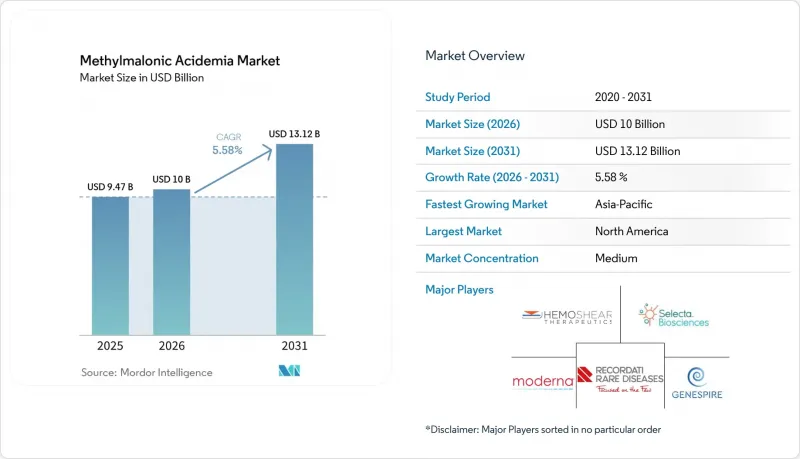
According to Mordor Intelligence, the methylmalonic acidemia market size is projected to be USD 9.47 billion in 2025, USD 10 billion in 2026, and reach USD 13.12 billion by 2031, growing at a CAGR of 5.58% from 2026 to 2031.
Global Methylmalonic Acidemia Market Trends and Insights
Expansion of Newborn Screening Programs
Newborn screening programs are expanding the detection pathway for organic acid disorders. A Xinjiang study screened 108,000 neonates during 2025 and identified methylmalonic acidemia as the most prevalent organic aciduria, at 1 in 21,548 births. The same study reported cblC as the most common subtype among the affected infants. Screening expansion creates work beyond the initial biochemical test because positive cases need a confirmatory biomarker and genetic assessment. This wider testing pathway supports diagnostic activity across the methylmalonic acidemia market.
A retrospective study of 782,930 neonates in Hefei confirmed 34 cases of methylmalonic acidemia in 2026. Its authors recommended MMACHC and MMUT genetic testing within regional screening algorithms. Combining biochemical screening with genetic confirmation can distinguish disease variants before symptoms begin. That distinction can route families to the appropriate care pathway earlier. Providers that offer biochemical, second-tier, and genetic services can participate at several points in the care pathway. This gives them a broader role in the methylmalonic acidemia market than suppliers of a single testing component.
Growth of Disease-Modifying Therapy Research
The methylmalonic acidemia market is moving from dietary and symptomatic management toward programs designed to correct the underlying defect. The U.S. Food and Drug Administration cleared the MMA-101 investigational new drug application in May 2026. The AAV8 program will support a Phase I/II study in MMUT-deficient patients aged 3 to 18 years who receive a single intravenous infusion. This development moved a federally sponsored program into first-in-human clinical testing. It also places greater value on clinical sites able to manage pediatric gene therapy studies.
GENE202 received orphan drug designation from the FDA and European Commission in January 2026. Genespire is developing the program with an immune-shielded lentiviral vector designed to deliver a functional MMUT gene to hepatocytes. In July 2026, the company reported preclinical liver-directed gene transfer data for the program. The methylmalonic acidemia market may increasingly favor programs that demonstrate reliable liver targeting and manage immune response effectively. Orphan drug frameworks in the United States and Europe also provide exclusivity, fee support, and regulatory incentives that lower development risk for sponsors.
Very Small Diagnosed Patient Pool
Isolated MMUT-type methylmalonic acidemia rarely exceeds 1 in 50,000 live births globally. This limited prevalence constrains the number of patients available for treatment and clinical trials. Moderna terminated its mRNA-3705 Phase I/II study in early 2026 after determining that the development design required revision. Small populations make it difficult to recruit enough participants and develop robust comparative evidence. Natural history evidence also takes time to accumulate in an ultra-rare condition. These limits restrain near-term expansion in the methylmalonic acidemia market.
The lack of validated functional endpoints adds a separate obstacle for novel therapy programs. Sponsors often rely on surrogate biomarkers, although their clinical meaning can remain uncertain. The MMA-101 trial design drew on a long-running natural-history study before entering clinical testing. The final SUNRISE Phase I/II report showed technical feasibility for hepatocyte integration but did not establish sufficient clinical efficacy in 4 pediatric participants. Development milestones are therefore likely to center on regulatory designations and early safety findings before later efficacy evidence becomes available.
Other drivers and restraints analyzed in the detailed report include:
- Earlier Diagnosis Through Multiparametric Testing
- Increasing Availability of Specialized Metabolic Care
- High Lifetime Cost of Specialized Care
For complete list of drivers and restraints, kindly check the Table Of Contents.
Segment Analysis
Homocystinuria held 56.43% of disorder-type revenue in 2025. Its larger diagnosed patient pool and a more developed treatment pipeline support this position. Combined methylmalonic aciduria and homocystinuria is forecast to grow at a 7.54% CAGR through 2031. The methylmalonic acidemia market size for combined forms benefits from second-tier screening that identifies mild and late-onset cblC presentations. Italian second-tier testing improved cblC detection performance by lowering the C3 acylcarnitine threshold from 4.5 to 3.5 µmol/L. The revised approach improved case finding without raising false positives in the reported study.
Isolated methylmalonic aciduria remains a focus for gene therapy research because MMUT loss of function has a clear biological basis. Homocystinuria has established recurring demand for specialty nutrition, vitamin B6, and betaine. This difference separates a more established care segment from a higher-risk therapeutic development area within the methylmalonic acidemia industry. Qatar maintained near-100% uptake in its national screening program from 2003 onward. A 2025 study covering 428,881 screened babies identified classical homocystinuria as the most prevalent condition in that setting. A founder effect in the Qatari population contributed to this concentrated disease burden.
Hyperammonemia generated 32.65% of the indication revenue in 2025. Acute metabolic decompensation and the use of nitrogen scavengers sustain this position. Carglumic acid, sodium benzoate, and sodium phenylacetate are used in emergency management. Neurological complications are forecast to grow at a 7.32% CAGR through 2031. The methylmalonic acidemia market responds to growing recognition that neurological injury can persist despite diet-based metabolic stability. This supports the greater need for long-term clinical assessment and care.
Hospital treatment during acute hyperammonemic episodes can be a major cost item in lifetime care. Acute metabolic acidosis, ketosis, hypoglycemia, and neutropenia also require repeated acute-care services. Each indication is smaller individually, but together they support the monitoring role of specialist centers. A 2025 and 2026 pediatric study identified growth and neurodevelopmental abnormalities as central prognostic issues for affected children. Earlier and more complete metabolic control is therefore relevant to both acute and long-term care. This pattern expands care needs beyond medicines used only during crisis events.
Complete Report Scope:
- By Disorder Type
- Isolated Methylmalonic Aciduria
- Homocystinuria
- Combined Methylmalonic Aciduria and Homocystinuria
- By Indication
- Acute Metabolic Acidosis
- Hyperammonemia
- Ketosis
- Hypoglycemia
- Neutropenia
- Neurological Complications
- Other Indications
- By Treatment Type
- Dietary Management and Supplementation
- Antibiotic Therapy
- Enzyme Replacement Therapy
- Gene Therapy
- Hematopoietic Stem Cell Transplantation
- Liver Transplantation
- Combined Liver-Kidney Transplantation
- By Diagnosis Type
- Newborn Screening
- Genetic Testing
- Urine and Blood Tests
- By End User
- Hospitals
- Diagnostic Laboratories
- Homecare Settings
- Other End Users
- Geography
- North America
- United States
- Canada
- Mexico
- Europe
- Germany
- United Kingdom
- France
- Italy
- Spain
- Rest of Europe
- Asia-Pacific
- China
- Japan
- India
- Australia
- South Korea
- Rest of Asia-Pacific
- Middle East and Africa
- GCC
- South Africa
- Rest of Middle East and Africa
- South America
- Brazil
- Argentina
- Rest of South America
- North America
Geography Analysis
North America accounted for 41.65% of revenue in 2025. Established reimbursement for specialty nutrition and a network of metabolic research centers support the region's position. The United States hosts the NIH Clinical Center, where MMA-101 will enroll after its May 2026 IND clearance. This clinical activity supports the region's central role in gene therapy development. Canada contributes through pediatric metabolic programs within children's hospitals. Mexico is expanding urban newborn screening coverage under its national health system.
Europe forms the second major revenue cluster for the methylmalonic acidemia market. Germany, France, Italy, Spain, and the United Kingdom operate national screening programs and specialist metabolic dietetics services. The region's orphan medicine framework can grant up to 10 years of market exclusivity for qualifying therapies. This framework contributes to Europe's attractiveness for clinical-stage programs. It may also shape future reimbursement planning if gene therapies progress. The region also has centralized pathways for metabolic dietetics and specialist follow-up.
Asia-Pacific is forecast to grow at a 6.75% CAGR through 2031. China's screening buildout, disease prevalence, and clinical guidelines support this rate. A 2025 Quanzhou study reported organic acidemia screening findings across 1 in 10,055 neonates and identified methylmalonic acidemia among the common disorders. Japan and South Korea have established specialist systems, while India and Australia are expanding screening and genetic testing capacity. The Middle East, Africa, and South America remain the smallest revenue regions, although consanguinity can increase inherited metabolic disease incidence. Qatar's screening experience shows how a founder effect can create concentrated demand for homocystinuria monitoring and nutrition.
- Ajinomoto Cambrooke, Inc.
- Asklepios BioPharmaceutical, Inc.
- BridgeBio Pharma, Inc.
- CoA Therapeutics, Inc.
- Eurofins
- Genespire S.r.l.
- HemoShear Therapeutics, Inc.
- LabCorp
- Mead Johnson Nutrition
- Moderna
- Nestle
- Nutricia Metabolics
- Revvity, Inc.
- Selecta Biosciences, Inc.
- Thermo Fisher Scientific
- Vitaflo International Ltd.
- Recordati Rare Diseases
- Quest Diagnostics
Additional Benefits:
- The market estimate (ME) sheet in Excel format
- 3 months of analyst support
TABLE OF CONTENTS
1 Introduction
- 1.1 Study Assumptions & Market Definition
- 1.2 Scope Of The Study
2 Research Methodology
3 Executive Summary
4 Market Landscape
- 4.1 Market Overview
- 4.2 Market Drivers
- 4.2.1 Expansion of Newborn Screening Programs
- 4.2.2 Earlier Diagnosis Through Multiparametric Testing
- 4.2.3 Increasing Availability of Specialized Metabolic Care
- 4.2.4 Growth of Disease-Modifying Therapy Research
- 4.2.5 Expansion of Patient Registries and Natural-History Evidence
- 4.3 Market Restraints
- 4.3.1 Very Small Diagnosed Patient Pool
- 4.3.2 High Lifetime Cost of Specialized Care
- 4.3.3 Limited Validated Clinical Endpoints for Novel Therapies
- 4.4 Supply-Chain Analysis
- 4.5 Regulatory Landscape
- 4.6 Porter's Five Forces Analysis
- 4.6.1 Threat Of New Entrants
- 4.6.2 Bargaining Power Of Buyers
- 4.6.3 Bargaining Power Of Suppliers
- 4.6.4 Threat Of Substitutes
- 4.6.5 Competitive Rivalry
5 Market Size & Growth Forecasts (Value, USD)
- 5.1 By Disorder Type
- 5.1.1 Isolated Methylmalonic Aciduria
- 5.1.2 Homocystinuria
- 5.1.3 Combined Methylmalonic Aciduria and Homocystinuria
- 5.2 By Indication
- 5.2.1 Acute Metabolic Acidosis
- 5.2.2 Hyperammonemia
- 5.2.3 Ketosis
- 5.2.4 Hypoglycemia
- 5.2.5 Neutropenia
- 5.2.6 Neurological Complications
- 5.2.7 Other Indications
- 5.3 By Treatment Type
- 5.3.1 Dietary Management and Supplementation
- 5.3.2 Antibiotic Therapy
- 5.3.3 Enzyme Replacement Therapy
- 5.3.4 Gene Therapy
- 5.3.5 Hematopoietic Stem Cell Transplantation
- 5.3.6 Liver Transplantation
- 5.3.7 Combined Liver-Kidney Transplantation
- 5.4 By Diagnosis Type
- 5.4.1 Newborn Screening
- 5.4.2 Genetic Testing
- 5.4.3 Urine and Blood Tests
- 5.5 By End User
- 5.5.1 Hospitals
- 5.5.2 Diagnostic Laboratories
- 5.5.3 Homecare Settings
- 5.5.4 Other End Users
- 5.6 Geography
- 5.6.1 North America
- 5.6.1.1 United States
- 5.6.1.2 Canada
- 5.6.1.3 Mexico
- 5.6.2 Europe
- 5.6.2.1 Germany
- 5.6.2.2 United Kingdom
- 5.6.2.3 France
- 5.6.2.4 Italy
- 5.6.2.5 Spain
- 5.6.2.6 Rest of Europe
- 5.6.3 Asia-Pacific
- 5.6.3.1 China
- 5.6.3.2 Japan
- 5.6.3.3 India
- 5.6.3.4 Australia
- 5.6.3.5 South Korea
- 5.6.3.6 Rest of Asia-Pacific
- 5.6.4 Middle East and Africa
- 5.6.4.1 GCC
- 5.6.4.2 South Africa
- 5.6.4.3 Rest of Middle East and Africa
- 5.6.5 South America
- 5.6.5.1 Brazil
- 5.6.5.2 Argentina
- 5.6.5.3 Rest of South America
- 5.6.1 North America
6 Competitive Landscape
- 6.1 Market Concentration
- 6.2 Market Share Analysis
- 6.3 Company Profiles {(Includes Global Level Overview, Market Level Overview, Core Segments, Financials As Available, Strategic Information, Market Rank/Share For Key Companies, Products & Services, And Recent Developments)}
- 6.3.1 Ajinomoto Cambrooke, Inc.
- 6.3.2 Asklepios BioPharmaceutical, Inc.
- 6.3.3 BridgeBio Pharma, Inc.
- 6.3.4 CoA Therapeutics, Inc.
- 6.3.5 Eurofins Scientific SE
- 6.3.6 Genespire S.r.l.
- 6.3.7 HemoShear Therapeutics, Inc.
- 6.3.8 Labcorp
- 6.3.9 Mead Johnson Nutrition
- 6.3.10 Moderna, Inc.
- 6.3.11 Nestle Health Science
- 6.3.12 Nutricia Metabolics
- 6.3.13 Revvity, Inc.
- 6.3.14 Selecta Biosciences, Inc.
- 6.3.15 Thermo Fisher Scientific Inc.
- 6.3.16 Vitaflo International Ltd.
- 6.3.17 Recordati Rare Diseases
- 6.3.18 Quest Diagnostics Incorporated
7 Market Opportunities & Future Outlook
- 7.1 White-Space & Unmet-Need Assessment

