PUBLISHER: Mordor Intelligence | PRODUCT CODE: 2155672

PUBLISHER: Mordor Intelligence | PRODUCT CODE: 2155672
Open Network Testing and Certification - Market Share Analysis, Industry Trends & Statistics, Growth Forecasts (2026 - 2031)
According to Mordor Intelligence, the open network testing and certification market size is projected to expand from USD 2.43 billion in 2025 to USD 2.91 billion in 2026, and to USD 6.76 billion by 2031, registering a CAGR of 18.36% between 2026 and 2031.
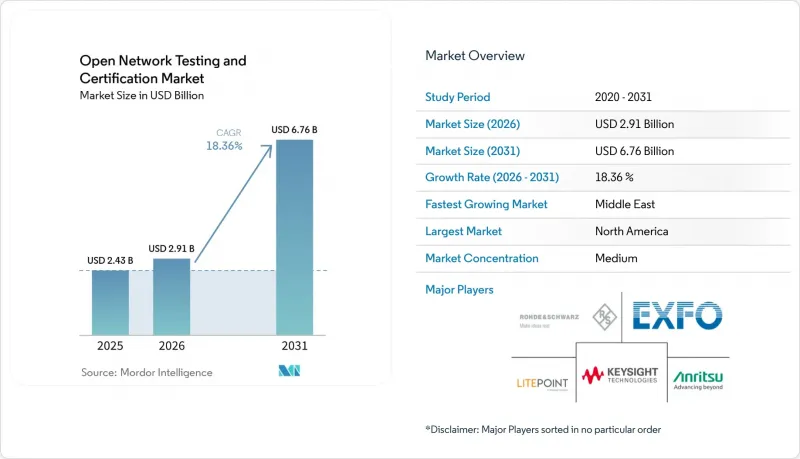
Global Open Network Testing and Certification Market Trends and Insights
O-RAN Standardization and Certification Adoption
The O-RAN Certification and Badging Program uses conformance certificates, interoperability badges, and end-to-end badges to support test-once, deploy-many workflows. This structure is making formal credentials more important in multi-vendor procurement decisions. Japan OTIC awarded Rakuten Symphony conformance certification and an interoperability badge in January 2026, completing all 3 credential classes for the vendor. Repeated credentialing turns isolated lab activity into a repeatable service that laboratories can offer across vendor programs. ETSI formalized the O-RAN R1 interface test specification through its Publicly Available Specification process in February 2026. The open network testing and certification market gains a clearer basis for compliance as those test requirements enter European procurement and technical review processes.
5G and 5G Advanced Network Expansion
5G rollouts require validation from spectrum qualification through radio conformance, fronthaul timing, and feature testing. 5G Advanced adds carrier aggregation, massive MIMO beamforming, and AI-enabled RAN control to the validation workload. The O-RAN Alliance Spring 2026 Global PlugFest included multi-vendor massive MIMO integration and over-the-air testing. Digital Catapult reported that participants completed end-to-end massive MIMO testing at the United Kingdom's first. These activities show that beamforming validation has moved beyond laboratory research into formal interoperability programs. The open network testing and certification market benefits as operators require testing for both radio performance and AI-based network functions.
High Cost of Advanced Test and Measurement Infrastructure
Carrier-grade O-RU test rigs require signal generators, spectrum analyzers, emulators, and often RF-shielded over-the-air chambers. These assets can require several million dollars of investment for a single facility. The U.S. National Telecommunications and Information Administration integrated 3 commercial Open RAN systems into its CRAIN laboratory in 2025. Its work showed the configuration and hardware dependencies involved in establishing a multi-vendor environment. This cost favors vendors with broad instrument portfolios and resources to keep pace with standards releases. It also limits local testing capacity in South America and Africa, where access to Lab-as-a-Service facilities remains constrained.
Other drivers and restraints analyzed in the detailed report include:
- Multi-Vendor Interoperability Risk
- Cloud-Native and Virtualized RAN Validation Demand
- Multi-Domain Integration Complexity
For complete list of drivers and restraints, kindly check the Table Of Contents.
Segment Analysis
Testing Hardware held 44.28% of the offering segment in 2025. Physical RF validation still requires carrier-grade signal generators, O-RU conformance rigs, and spectrum analyzers. Software emulation cannot replace those tools for massive MIMO beam patterns or S-plane timing tolerance checks. Rohde and Schwarz and VIAVI supported the Berlin i14y Lab in its first European O-RAN conformance certification for an indoor O-RU from VVDN Technologies. Their approach paired the R and S SMW200A signal generator with the VIAVI TM500 O-RU Tester. This example shows why instrument quality and software integration remain central to the open network testing and certification market.
Professional Services is projected to grow at a 19.28% CAGR from 2026 to 2031. Operators increasingly use managed programs because experienced Open RAN test engineers are scarce. In the open network testing and certification market, Testing Software provides automation, orchestration, and analytics across the hardware layer. Each new O-RAN specification release adds test cases and requires continuing software updates. The Telecom Infra Project released the Small Cell End-to-End Test Plan Version 2 in 2025 to support validation of disaggregated 5G NR small cells. This standard expansion supports hardware, software, and the open network testing and certification industry services that connect them.
5G Network Deployment accounted for 48.52% of the application-level share in 2025. Operators must qualify radio units, validate fronthaul timing, and complete security assurance before site activation. These activities make deployment testing the core source of demand across the open network testing and certification market. Open RAN Integration testing is becoming a separate budget area as projects move from trials to commercial deployments. Digital twin platforms are being used to support behavioral analysis and identify potential failure conditions before production deployment. This work expands the need for coordinated testing across physical and virtual network components.
Cloud RAN Testing is forecast to grow at a 20.34% CAGR from 2026 to 2031. Carrier migration to containerized RAN creates requirements for Kubernetes validation, infrastructure benchmarking, and distributed-compute behavioral testing. This work differs from conventional radio conformance because performance depends on both software and the underlying compute environment. 4G Network Modernization remains relevant where operators refresh legacy systems using O-RAN-compliant O-eNB equipment. Within the open network testing and certification market, Telecom Equipment Validation also supports supply-chain qualification before equipment reaches field deployment.
Complete Report Scope:
- By Offering
- Testing Hardware
- Testing Software
- Professional Services
- By Application
- 5G Network Deployment
- 4G Network Modernization
- Open RAN Integration
- Telecom Equipment Validation
- Cloud RAN Testing
- Other Applications
- By End User
- Telecom Network Operators
- Network Equipment Manufacturers
- System Integrators
- Certification Laboratories
- By Deployment Model
- Cloud-Based
- On-Premises
- Hybrid
- By Network Architecture
- Virtualized RAN
- Cloud RAN
- Disaggregated RAN
- By Service Type
- Managed Testing
- Consulting
- Integration
- Certification
- By Geography
- North America
- United States
- Canada
- Mexico
- South America
- Brazil
- Argentina
- Rest of South America
- Europe
- Germany
- United Kingdom
- France
- Italy
- Spain
- Russia
- Rest of Europe
- Asia-Pacific
- China
- Japan
- India
- South Korea
- Southeast Asia
- Rest of Asia-Pacific
- Middle East
- Saudi Arabia
- United Arab Emirates
- Turkey
- Rest of Middle East
- Africa
- South Africa
- Nigeria
- Rest of Africa
- North America
Geography Analysis
North America held 37.24% regional share in 2025. The region has a dense concentration of OTIC-qualified laboratories, experienced test engineers, and federal support for open wireless systems. NTIA integrated 3 commercial Open RAN systems into its CRAIN laboratory during 2025. The work produced public multi-vendor integration results and showed the technical demands of carrier-grade configurations. Keysight completed its acquisition of Spirent in October 2025 for GBP 1.16 billion (USD 1.46 billion). The transaction combined design emulation, conformance testing, core-network simulation, live-network service assurance, and related automated workflow capabilities.
Asia-Pacific is a major volume center because of Japan's certification ecosystem, South Korea's 5G Advanced plans, and wider activity across India, China, and Southeast Asia. Japan OTIC issued 2 interoperability badges to NEC's MB5420 radio unit in 2025. NTT EAST published Japan's first disclosed multi-vendor RIC connectivity test in a private 5G setting in March 2026. Europe has 4 qualified OTICs in Berlin, Turin, Madrid, and Paris. The Berlin xG-ALOE Plugfest tested Open RAN components across timing-sensitive networking, sensing, and security domains.
The Middle East is projected to expand at a 20.14% CAGR from 2026 to 2031. GCC operators are moving into commercial Open RAN deployments, creating demand for conformance, timing, and security validation. Zain Kuwait and Parallel Wireless completed a 5G standalone Open RAN proof of concept in February 2025 with download speeds exceeding 1.3 Gbps. Saudi Arabia's TAWAL and Nokia demonstrated a live multi-tenant Open RAN edge-cloud platform in 2025. Limited local OTIC capacity creates an opening for specialized facilities in the region. South America and Africa remain earlier-stage markets because high infrastructure costs and limited engineering capacity constrain local testing.
- Keysight Technologies, Inc.
- Rohde & Schwarz GmbH & Co. KG
- Anritsu Corporation
- EXFO Inc.
- LitePoint Corporation
- Artiza Networks, Inc.
- Teledyne LeCroy, Inc.
- Tektronix, Inc.
- National Instruments Corporation
- Averna Technologies Inc.
- Bird Technologies, Inc.
- CommScope, Inc.
- Radisys Corporation
- VeEX Inc.
- Calnex Solutions plc
- PCTEL, Inc.
Additional Benefits:
- The market estimate (ME) sheet in Excel format
- 3 months of analyst support
TABLE OF CONTENTS
1 INTRODUCTION
- 1.1 Study Assumptions and Market Definition
- 1.2 Scope of the Study
2 RESEARCH METHODOLOGY
3 EXECUTIVE SUMMARY
4 MARKET LANDSCAPE
- 4.1 Market Overview
- 4.2 Impact of Macroeconomic Factors on the Market
- 4.3 Market Drivers
- 4.3.1 O-RAN Standardization and Certification Adoption
- 4.3.2 5G and 5G Advanced Network Expansion
- 4.3.3 Multi-Vendor Interoperability Risk
- 4.3.4 Cloud-Native and Virtualized RAN Validation Demand
- 4.3.5 Operator Demand for Vendor-Neutral Test Once and Deploy Many Workflows
- 4.3.6 AI-Assisted Continuous Testing and Digital Twin Simulation
- 4.4 Market Restraints
- 4.4.1 Multi-Domain Integration Complexity
- 4.4.2 High Cost of Advanced Test and Measurement Infrastructure
- 4.4.3 Evolving O-RAN Specifications and Test Case Volatility
- 4.4.4 Limited Availability of Specialized Open RAN Test Engineering Talent
- 4.5 Industry Value Chain Analysis
- 4.6 Regulatory Landscape
- 4.7 Technological Outlook
- 4.8 Porter's Five Forces Analysis
- 4.8.1 Competitive Rivalry
- 4.8.2 Threat of New Entrants
- 4.8.3 Bargaining Power of Suppliers
- 4.8.4 Bargaining Power of Buyers
- 4.8.5 Threat of Substitutes
5 MARKET SIZE AND GROWTH FORECASTS (VALUE)
- 5.1 By Offering
- 5.1.1 Testing Hardware
- 5.1.2 Testing Software
- 5.1.3 Professional Services
- 5.2 By Application
- 5.2.1 5G Network Deployment
- 5.2.2 4G Network Modernization
- 5.2.3 Open RAN Integration
- 5.2.4 Telecom Equipment Validation
- 5.2.5 Cloud RAN Testing
- 5.2.6 Other Applications
- 5.3 By End User
- 5.3.1 Telecom Network Operators
- 5.3.2 Network Equipment Manufacturers
- 5.3.3 System Integrators
- 5.3.4 Certification Laboratories
- 5.4 By Deployment Model
- 5.4.1 Cloud-Based
- 5.4.2 On-Premises
- 5.4.3 Hybrid
- 5.5 By Network Architecture
- 5.5.1 Virtualized RAN
- 5.5.2 Cloud RAN
- 5.5.3 Disaggregated RAN
- 5.6 By Service Type
- 5.6.1 Managed Testing
- 5.6.2 Consulting
- 5.6.3 Integration
- 5.6.4 Certification
- 5.7 By Geography
- 5.7.1 North America
- 5.7.1.1 United States
- 5.7.1.2 Canada
- 5.7.1.3 Mexico
- 5.7.2 South America
- 5.7.2.1 Brazil
- 5.7.2.2 Argentina
- 5.7.2.3 Rest of South America
- 5.7.3 Europe
- 5.7.3.1 Germany
- 5.7.3.2 United Kingdom
- 5.7.3.3 France
- 5.7.3.4 Italy
- 5.7.3.5 Spain
- 5.7.3.6 Russia
- 5.7.3.7 Rest of Europe
- 5.7.4 Asia-Pacific
- 5.7.4.1 China
- 5.7.4.2 Japan
- 5.7.4.3 India
- 5.7.4.4 South Korea
- 5.7.4.5 Southeast Asia
- 5.7.4.6 Rest of Asia-Pacific
- 5.7.5 Middle East
- 5.7.5.1 Saudi Arabia
- 5.7.5.2 United Arab Emirates
- 5.7.5.3 Turkey
- 5.7.5.4 Rest of Middle East
- 5.7.6 Africa
- 5.7.6.1 South Africa
- 5.7.6.2 Nigeria
- 5.7.6.3 Rest of Africa
- 5.7.1 North America
6 COMPETITIVE LANDSCAPE
- 6.1 Market Concentration
- 6.2 Strategic Moves
- 6.3 Market Share Analysis
- 6.4 Company Profiles (includes Global Level Overview, Market Level Overview, Core Segments, Financials as available, Strategic Information, Market Rank/Share, Products and Services, Recent Developments)
- 6.4.1 Keysight Technologies, Inc.
- 6.4.2 Rohde & Schwarz GmbH & Co. KG
- 6.4.3 Anritsu Corporation
- 6.4.4 EXFO Inc.
- 6.4.5 LitePoint Corporation
- 6.4.6 Artiza Networks, Inc.
- 6.4.7 Teledyne LeCroy, Inc.
- 6.4.8 Tektronix, Inc.
- 6.4.9 National Instruments Corporation
- 6.4.10 Averna Technologies Inc.
- 6.4.11 Bird Technologies, Inc.
- 6.4.12 CommScope, Inc.
- 6.4.13 Radisys Corporation
- 6.4.14 VeEX Inc.
- 6.4.15 Calnex Solutions plc
- 6.4.16 PCTEL, Inc.
7 MARKET OPPORTUNITIES AND FUTURE OUTLOOK
- 7.1 White-Space and Unmet-Need Assessment

