PUBLISHER: Mordor Intelligence | PRODUCT CODE: 2156868

PUBLISHER: Mordor Intelligence | PRODUCT CODE: 2156868
Aviation Insurance - Market Share Analysis, Industry Trends & Statistics, Growth Forecasts (2026 - 2031)
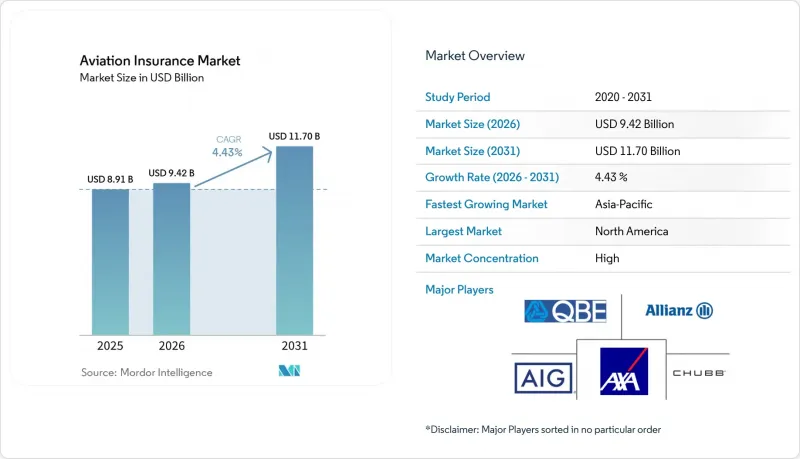
According to Mordor Intelligence, the aviation insurance market size is expected to increase from USD 8.91 billion in 2025 to USD 9.42 billion in 2026 and reach USD 11.70 billion by 2031, growing at a CAGR of 4.43% over 2026-2031.
Global Aviation Insurance Market Trends and Insights
Expanding Commercial Fleets Drive Structural Premium Growth
Fleet expansion creates the most consistent source of demand for the aviation insurance market because each additional aircraft needs hull and liability protection. Airbus forecasts 42,060 new aircraft deliveries over 2026 to 2045, and its global passenger fleet forecast points to a near doubling by 2045. Boeing also expects more than 50,000 commercial aircraft to operate globally over the next 2 decades. Airlines in India, Vietnam, and Indonesia are absorbing large delivery pipelines that will require cover for many years. New aircraft such as the Airbus A321neo and Boeing 787 have higher insured hull values than many aircraft they replace. This combination of more aircraft and larger values supports premium growth even when operating safety remains strong.
Mandatory Liability Frameworks Underpin Structural Demand
Mandatory insurance rules create a baseline of demand that is not dependent on voluntary risk decisions. ICAO revised the Montreal Convention liability limits effective December 28, 2024, raising the Article 21 passenger compensation threshold from 128,821 to 151,880 Special Drawing Rights per passenger. The United Kingdom implemented the revised limits through its 2025 order, while European Union rules set minimum insurance requirements for carriers and operators. United States direct air carriers must also carry aircraft accident liability insurance under 14 CFR Part 205. Higher statutory limits require carriers and lessors to buy larger limits across their operations. China's 2026 low-altitude insurance directive extends this compliance logic to unmanned aircraft, with mandatory UAV liability insurance targeted by 2027.
Structural MRO Cost Inflation Persistently Widens the Loss Gap
Maintenance, repair, and overhaul costs remain a major constraint on underwriting results in the aviation insurance market. Rising labor rates, repair costs, original equipment manufacturer charges, and aircraft-on-ground expenses raise the amount insurers must pay after a claim. The cost challenge is more structural than cyclical because supply-chain constraints and shortages of skilled labor affect several repair categories at the same time. Higher repair bills make it harder for insurers to maintain adequate pricing on older policies. The Allianz Risk Barometer 2026 identified cyber incidents as the aviation sector's leading business risk at 45%, adding another exposure that standard hull and liability policies were not built to address. Insurers are becoming more selective where loss costs rise faster than premiums.
Other drivers and restraints analyzed in the detailed report include:
- Rising Aircraft Asset Values Amplify the Per-Policy Premium Base
- Expansion of Aircraft Leasing and Aviation Financing Activities
- Reinsurance Selectivity Constrains Capacity for Catastrophic Risks
For complete list of drivers and restraints, kindly check the Table Of Contents.
Segment Analysis
Aviation operating and premises liability held 34.5% of the aviation insurance market share in 2025. The segment covers third-party bodily injury and property damage exposures for commercial carriers, airports, and ground-handling businesses. These risks are material because a single event can involve passengers, property owners, contractors, and multiple legal jurisdictions. United States litigation exposure has increased the importance of carefully structured liability limits. Aviation products liability is projected to grow at a 5.3% CAGR from 2026 to 2031. Its growth reflects larger exposures for aircraft manufacturers, engine suppliers, and component makers operating across global supply chains.
The November 2025 UPS Flight 2976 crash in Kentucky illustrated how a major event can lead to claims involving several aerospace companies[4]. Hull and physical damage remains a visible part of the aviation insurance market size because it responds directly to aircraft loss and damage. Composite airframes and newer systems can increase insured values and repair complexity. Aviation war and allied perils experienced soft conditions during much of 2026 because capacity was available, although Middle East tensions led to more selective terms for regional exposures. Other specialty cover includes contingent liability, loss of license, and satellite risks. These products remain smaller but become more relevant as aviation businesses diversify their operations and risk transfer needs.
Complete Report Scope:
- By Coverage Type
- Hull and Physical Damage
- Aviation Operating and Premises Liability
- Aviation Products Liability
- Aviation War and Allied Perils
- Other Specialty
- By End User
- Airlines and Commercial Operators
- General and Business Aviation Operators
- Aviation Products Liability Insureds
- Aircraft Lessors and Financiers
- Airports and Aviation Infrastructure
- By Distribution Channel
- Open-Market Broker Placement
- Delegated Authority
- Direct
- By Geography
- North America
- United States
- Canada
- Mexico
- South America
- Brazil
- Argentina
- Rest of South America
- Europe
- United Kingdom
- Germany
- France
- Italy
- Spain
- Rest of Europe
- Asia-Pacific
- China
- Japan
- India
- South Korea
- Australia
- Indonesia
- Thailand
- Malaysia
- Singapore
- Vietnam
- Rest of Asia-Pacific
- Middle East and Africa
- Saudi Arabia
- United Arab Emirates
- Turkey
- South Africa
- Egypt
- Rest of Middle East and Africa
- North America
Geography Analysis
North America held 53.6% of the global total in 2025. The region combines a large aircraft fleet with a demanding liability environment and a significant base of lessors, manufacturers, airlines, and general aviation operators. United States social inflation and large court awards raise the cost of liability claims. These factors support demand for high limits but can also raise premiums for riskier accounts. Canada and Mexico add demand through low-cost carrier growth and general aviation activity. AIG issued more than 570 local aviation policies in 2025 across more than 32 territories, showing the international reach needed by multinational aviation clients.
Europe is an institutional center for the aviation insurance market, with Lloyd's of London and major insurers such as Allianz Commercial, AXA XL, and HDI Global. European Union insurance requirements provide a common compliance framework for air carriers and aircraft operators. Asia-Pacific is projected to grow at a 6.9% CAGR from 2026 to 2031. Fleet expansion in China, India, Vietnam, Indonesia, and Malaysia supports the region's longer-term demand profile. Allianz Jio Reinsurance Limited began underwriting in India in March 2026 after receiving IRDAI authorization, increasing domestic reinsurance capacity. China's low-altitude policy direction also supports the development of UAV liability insurance.
South America, the Middle East, and Africa have smaller aviation insurance market size levels, but their risk profiles differ significantly. Brazil supports South American demand through domestic air travel, while several neighboring markets remain at earlier stages of insurance penetration. The Middle East and Africa are more exposed to geopolitical and war-risk volatility. The IUAI's 2026 survey found that 79 of 106 respondents ranked geopolitical instability as their greatest threat. Middle East airline renewals faced capacity restrictions and additional war-risk premiums following the escalation of regional conflict. CG Re launched a dedicated aviation insurance and reinsurance practice for African carriers and airports in March 2026, indicating early development of domestic capacity.
- Allianz Commercial
- American International Group (AIG)
- AXA XL
- Chubb
- QBE Insurance Group
- Global Aerospace
- Starr Insurance
- Tokio Marine HCC
- Sompo International
- Old Republic Aerospace
- Berkshire Hathaway Specialty Insurance
- Great American Insurance Group
- HDI Global
- Beazley
- Munich Re
- Swiss Re Corporate Solutions
- Aviation Insurance Company (AIC)
- Avemco Insurance Company
- USAIG
Additional Benefits:
- The market estimate (ME) sheet in Excel format
- 3 months of analyst support
TABLE OF CONTENTS
1 INTRODUCTION
- 1.1 Study Assumptions and Market Definition
- 1.2 Scope of the Study
2 RESEARCH METHODOLOGY
3 EXECUTIVE SUMMARY
4 MARKET LANDSCAPE
- 4.1 Market Overview
- 4.2 Market Drivers
- 4.2.1 Expansion of Global Commercial Aircraft Fleet and Flight Activity
- 4.2.2 Mandatory Aviation Liability and Insurance Requirements
- 4.2.3 Growth in Insured Aircraft, Engines and Aviation Asset Values
- 4.2.4 Expansion of Aircraft Leasing and Aviation Financing Activities
- 4.2.5 Emergence of New Insurable Risks from Drones, eVTOL and Advanced Air Mobility
- 4.2.6 Increasing Adoption of Data-Driven Aviation Risk Assessment and Specialized Insurance Solutions
- 4.3 Market Restraints
- 4.3.1 Rising Aviation Claim Severity and Loss Costs
- 4.3.2 Limited Reinsurance Capacity for High-Severity and Catastrophic Aviation Risks
- 4.3.3 Premium Volatility and Increasing Cost of Aviation Insurance Coverage
- 4.3.4 Limited Historical Loss Data for Emerging Aviation Technologies
- 4.4 Value Chain Analysis
- 4.4.1 Aviation Insureds and Risk Originators
- 4.4.2 Insurance Brokers, MGAs and Aviation Underwriters
- 4.4.3 Reinsurers and Risk Capital Providers
- 4.5 Regulatory Landscape
- 4.5.1 Aviation Liability and Mandatory Insurance Requirements
- 4.5.2 Regional and Emerging Aviation Risk Regulations
- 4.5.3 Sanctions, War-Risk and Compliance Requirements
- 4.6 Technological Outlook
- 4.6.1 AI and Advanced Data Analytics for Underwriting
- 4.6.2 Connected Aircraft Data and Predictive Risk Management
- 4.6.3 Emerging Aviation Risk and Cyber Risk Modeling
- 4.7 Porter's Five Forces Analysis
- 4.7.1 Threat of New Entrants
- 4.7.2 Bargaining Power of Suppliers
- 4.7.3 Bargaining Power of Buyers
- 4.7.4 Threat of Substitutes
- 4.7.5 Intensity of Competitive Rivalry
5 MARKET SIZE AND GROWTH FORECASTS
- 5.1 By Coverage Type
- 5.1.1 Hull and Physical Damage
- 5.1.2 Aviation Operating and Premises Liability
- 5.1.3 Aviation Products Liability
- 5.1.4 Aviation War and Allied Perils
- 5.1.5 Other Specialty
- 5.2 By End User
- 5.2.1 Airlines and Commercial Operators
- 5.2.2 General and Business Aviation Operators
- 5.2.3 Aviation Products Liability Insureds
- 5.2.4 Aircraft Lessors and Financiers
- 5.2.5 Airports and Aviation Infrastructure
- 5.3 By Distribution Channel
- 5.3.1 Open-Market Broker Placement
- 5.3.2 Delegated Authority
- 5.3.3 Direct
- 5.4 By Geography
- 5.4.1 North America
- 5.4.1.1 United States
- 5.4.1.2 Canada
- 5.4.1.3 Mexico
- 5.4.2 South America
- 5.4.2.1 Brazil
- 5.4.2.2 Argentina
- 5.4.2.3 Rest of South America
- 5.4.3 Europe
- 5.4.3.1 United Kingdom
- 5.4.3.2 Germany
- 5.4.3.3 France
- 5.4.3.4 Italy
- 5.4.3.5 Spain
- 5.4.3.6 Rest of Europe
- 5.4.4 Asia-Pacific
- 5.4.4.1 China
- 5.4.4.2 Japan
- 5.4.4.3 India
- 5.4.4.4 South Korea
- 5.4.4.5 Australia
- 5.4.4.6 Indonesia
- 5.4.4.7 Thailand
- 5.4.4.8 Malaysia
- 5.4.4.9 Singapore
- 5.4.4.10 Vietnam
- 5.4.4.11 Rest of Asia-Pacific
- 5.4.5 Middle East and Africa
- 5.4.5.1 Saudi Arabia
- 5.4.5.2 United Arab Emirates
- 5.4.5.3 Turkey
- 5.4.5.4 South Africa
- 5.4.5.5 Egypt
- 5.4.5.6 Rest of Middle East and Africa
- 5.4.1 North America
6 COMPETITIVE LANDSCAPE
- 6.1 Market Concentration
- 6.2 Strategic Moves
- 6.3 Market Share Analysis (Top 5-6 players)
- 6.4 Company Profiles (includes Global Level Overview, Market Level Overview, Core Segments, Financials as available, Strategic Information, Market Rank/Share, Products and Services, Recent Developments)
- 6.4.1 Allianz Commercial
- 6.4.2 American International Group (AIG)
- 6.4.3 AXA XL
- 6.4.4 Chubb
- 6.4.5 QBE Insurance Group
- 6.4.6 Global Aerospace
- 6.4.7 Starr Insurance
- 6.4.8 Tokio Marine HCC
- 6.4.9 Sompo International
- 6.4.10 Old Republic Aerospace
- 6.4.11 Berkshire Hathaway Specialty Insurance
- 6.4.12 Great American Insurance Group
- 6.4.13 HDI Global
- 6.4.14 Beazley
- 6.4.15 Munich Re
- 6.4.16 Swiss Re Corporate Solutions
- 6.4.17 Aviation Insurance Company (AIC)
- 6.4.18 Avemco Insurance Company
- 6.4.19 USAIG
7 MARKET OPPORTUNITIES AND FUTURE OUTLOOK
- 7.1 White-Space and Unmet-Need Assessment
- 7.1.1 Parametric Cover for Weather and Operational Disruption
- 7.1.2 Specialized Cyber Insurance for Connected Aircraft and Drones
- 7.1.3 Integrated Insurance Solutions for eVTOL and Advanced Air Mobility
- 7.1.4 Political-Risk and Asset-Recovery Cover for Aircraft Lessors
- 7.2 Future Product and Underwriting Outlook
- 7.2.1 Expansion of Parametric and Event-Based Aviation Insurance
- 7.2.2 AI and Data-Driven Underwriting and Dynamic Pricing
- 7.2.3 Specialized Coverage for Emerging Aviation Technologies
- 7.3 Strategic Priorities for Insurers, Brokers and Reinsurers
- 7.3.1 Expand Capacity for Emerging and High-Severity Aviation Risks
- 7.3.2 Strengthen Data, Analytics and Risk-Modeling Capabilities
- 7.3.3 Develop Specialized Products and Risk-Sharing Partnerships

