PUBLISHER: Mordor Intelligence | PRODUCT CODE: 2156877

PUBLISHER: Mordor Intelligence | PRODUCT CODE: 2156877
General Aviation Insurance - Market Share Analysis, Industry Trends & Statistics, Growth Forecasts (2026 - 2031)
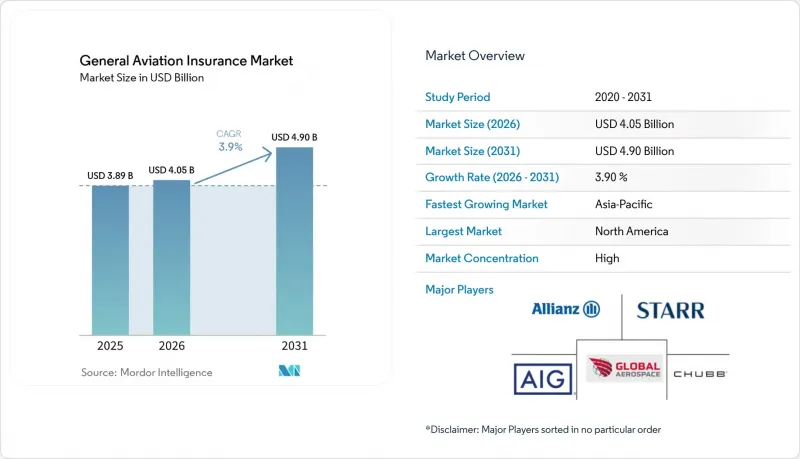
According to Mordor Intelligence, the general aviation insurance market size is projected to be USD 3.89 billion in 2025, USD 4.05 billion in 2026, and reach USD 4.90 billion by 2031, growing at a CAGR of 3.9% from 2026 to 2031.
Global General Aviation Insurance Market Trends and Insights
Growth in the Global General Aviation Fleet and Flight Activity
The general aviation insurance market benefits directly when more aircraft enter service and fly more often. GAMA reported 3,230 airplane shipments in 2025, a 2.2% increase from 2024, while 877 aircraft were shipped in the first quarter of 2026. More aircraft create additional demand for hull, liability, and specialty protection across owner and operator categories. Higher utilization also increases the number of operating exposures that policies must cover. The move toward fractional ownership and charter flying adds a changing pattern of liability exposure because activity is spread across multiple users and aircraft. ICAO safety planning and its expanded safety management requirements bring more operators within a formal regulatory framework, supporting the need for operating liability coverage.
Rising Business Aviation and High-Value Private Aircraft Utilization
The general aviation insurance market is supported by demand for business aircraft and high-value private aircraft. GAMA recorded 854 business jet deliveries in 2025, the highest level since 2009, while total airplane billings reached USD 31 billion. New deliveries have a greater mix of long-range and ultra-long-range aircraft, which raises insured hull values. Higher flight activity in corporate and fractional fleets also increases the number of liability events that insurers must consider. Fractional programs require policy structures that can account for multiple ownership interests and changing use patterns. Growth in Latin America and Africa adds cross-border liability considerations for policy forms that were historically designed around North American operations.
Escalating Aircraft Repair and Maintenance Costs
Rising maintenance and repair costs constrain profitable underwriting in the general aviation insurance market. Composite repairs, specialized tools, constrained parts supply, and limited maintenance labor can increase the cost and duration of a claim. Longer aircraft-on-ground periods can also increase consequential costs under relevant hull policies. These conditions make it harder for insurers to offer coverage at rates that reflect the full cost of repair. Operators may respond to higher premiums by reducing limits or accepting higher deductibles. The pressure, therefore, affects both insurer margins and the willingness of some operators to buy broad coverage.
Other drivers and restraints analyzed in the detailed report include:
- Increasing Aircraft Replacement Costs and Insured Asset Values
- Liability Protection Requirements and Heightened Risk Management Needs
- High-Severity Liability and Aircraft Loss Exposure
For complete list of drivers and restraints, kindly check the Table Of Contents.
Segment Analysis
Hull and physical damage captured 49.18% of the general aviation insurance market share in 2025, making it the leading product category. Its leadership reflects the importance of protecting aircraft assets with high replacement values. Agreed-value structures link premiums to the value established for the aircraft rather than to depreciated value, allowing higher aircraft values to be reflected in renewal premiums. GAMA's 2025 billings of USD 35.7 billion indicate that the fleet continues to receive higher-value aircraft. Composite airframes and advanced systems also increase the cost of many repairs.
The general aviation insurance market size for operating liability is projected to grow at a 4.57% CAGR between 2026 and 2031, faster than the overall market. Commercial activity, fractional programs, and air-taxi services are expanding the number of operators with third-party liability exposure. Specialty and ancillary products address related needs such as loss of license, airport liability, hangar-keeper protection, and war risk. Demand for these policies rises as operations become more complex, rather than only as fleet counts rise. The faster growth of liability coverage indicates that liability accumulation is increasing relative to asset-value growth in the general aviation insurance industry.
Complete Report Scope:
- By Product Type
- Hull and Physical Damage
- Operating Liability
- Specialty and Ancillary
- By End User
- Private and Recreational Owners
- Corporate and Business Aviation Operators
- Commercial GA Operators
- Training, FBO and GA Service Operators
- Government and Public-Service Operators
- By Distribution Channel
- Broker-mediated Open Market
- Delegated Authority
- Direct
- By Geography
- North America
- United States
- Canada
- Mexico
- South America
- Brazil
- Argentina
- Rest of South America
- Europe
- United Kingdom
- Germany
- France
- Italy
- Spain
- Rest of Europe
- Asia-Pacific
- China
- Japan
- India
- South Korea
- Australia
- Indonesia
- Thailand
- Malaysia
- Singapore
- Vietnam
- Rest of Asia-Pacific
- Middle East and Africa
- Saudi Arabia
- United Arab Emirates
- Turkey
- South Africa
- Egypt
- Rest of Middle East and Africa
- North America
Geography Analysis
North America accounted for 79.32% of the general aviation insurance market share in 2025, making it the dominant regional market. The region benefits from the largest registered civil aircraft fleet and a mature insurance and broker network. The United States FAA registry contained 296,986 crewed civil aircraft as of July 2026. North American business aviation flight activity grew 4.3% year over year in July 2026, while fractional providers recorded 10% growth. Canada adds helicopter-intensive resource and utility operations, while Mexico is expanding its private aviation infrastructure. Europe remains the second-largest geographic bloc, supported by EASA standards and access to Lloyd's specialist capacity. European flight activity declined 1.2% year over year in July 2026, largely in large-cabin jets, indicating a temporary period of softer activity.
The Asia-Pacific general aviation insurance market size is projected to grow at a 7.87% CAGR between 2026 and 2031, the fastest rate among geographic segments. Growth is linked to fleet expansion, a wider base of high-net-worth operators, and deeper aviation ecosystems across China, India, Southeast Asia, and Australia. Business jet departures in the region grew 4.2% in 2025, with Southeast Asia, India, and Australia showing faster growth than North Asia. China's low-altitude economy includes general aviation, unmanned aircraft, and urban air mobility activity. The Civil Aviation Administration of China valued this economy at CNY 670 billion (USD 93 billion) in 2024 and indicated a trajectory toward CNY 3.5 trillion (USD 507 billion) by 2035. China's revised Civil Aviation Law took effect in July 2026 and is expected to clarify third-party liability responsibilities. India requires hull and liability coverage for licensed general aviation operators, while its insurance capacity continues to rely heavily on international reinsurance markets.
South America, the Middle East, and Africa represent smaller but strategically relevant premium bases. Latin American business jet departures increased 8.9% on a trailing 12-month basis through mid-2026, led by Brazil and Colombia. Brazil combines domestic insurers with international placements, while its reliance on reinsurance limits the depth of locally available specialty capacity. The Middle East includes high-value corporate fleets that require specialist capacity. In Africa, humanitarian, agricultural, mining-support, and corporate aircraft have distinct risk profiles and smaller premium pools. African business jet departures grew 10.1% on a trailing 12-month basis through mid-2026. As operators mature and awareness of coverage needs increases, these regions can contribute more to the general aviation insurance market.
- Starr Insurance
- AIG
- Global Aerospace
- AXA XL
- Allianz Commercial
- Chubb
- Old Republic Aerospace
- QBE
- Sompo International
- Tokio Marine HCC
- Great American Insurance Group
- Berkshire Hathaway Specialty Insurance
- United States Aviation Underwriters (USAIG)
- Avemco Insurance Company
- Aerospace Insurance Managers
- Munich Re
- Swiss Re Corporate Solutions
- Lockton
- Aon
- WTW
Additional Benefits:
- The market estimate (ME) sheet in Excel format
- 3 months of analyst support
TABLE OF CONTENTS
1 INTRODUCTION
- 1.1 Study Assumptions and Market Definition
- 1.2 Scope of the Study
2 RESEARCH METHODOLOGY
3 EXECUTIVE SUMMARY
4 MARKET LANDSCAPE
- 4.1 Market Overview
- 4.2 Market Drivers
- 4.2.1 Growth in the Global General Aviation Fleet and Flight Activity
- 4.2.2 Rising Business Aviation and High-Value Private Aircraft Utilization
- 4.2.3 Increasing Aircraft Replacement Costs and Insured Asset Values
- 4.2.4 Liability Protection Requirements and Heightened Risk Management Needs
- 4.2.5 Expansion of Commercial and Specialized General Aviation Operations
- 4.2.6 Digitalization of General Aviation Risk Assessment and Underwriting
- 4.3 Market Restraints
- 4.3.1 Escalating Aircraft Repair and Maintenance Costs
- 4.3.2 High-Severity Liability and Aircraft Loss Exposure
- 4.3.3 Limited Specialist Underwriting Capacity for Complex General Aviation Risks
- 4.3.4 Insurance Affordability Pressures from Rising Premiums and Deductibles
- 4.4 Supply-Chain Analysis
- 4.4.1 General Aviation Aircraft Owners and Operators
- 4.4.2 Aviation Insurance Distribution and Underwriting Network
- 4.4.3 Insurance Capacity, Reinsurance, and Claims-Service Providers
- 4.5 Regulatory Landscape
- 4.5.1 ICAO Standards and National General Aviation Safety Regulations
- 4.5.2 Aircraft Registration, Airworthiness, Operator Compliance, and Pilot Licensing
- 4.5.3 Liability Insurance, Cross-Border Operations, and Jurisdiction-Specific Requirements
- 4.6 Technological Outlook
- 4.6.1 Flight Data, Utilization Analytics, and Digital Underwriting
- 4.6.2 AI and Advanced Analytics in Risk Selection and Claims Management
- 4.6.3 Aircraft Health Monitoring and Predictive Maintenance Data
- 4.7 Porter's Five Forces Analysis
- 4.7.1 Threat of New Entrants
- 4.7.2 Bargaining Power of Suppliers
- 4.7.3 Bargaining Power of Buyers
- 4.7.4 Threat of Substitutes
- 4.7.5 Intensity of Competitive Rivalry
5 MARKET SIZE AND GROWTH FORECASTS
- 5.1 By Product Type
- 5.1.1 Hull and Physical Damage
- 5.1.2 Operating Liability
- 5.1.3 Specialty and Ancillary
- 5.2 By End User
- 5.2.1 Private and Recreational Owners
- 5.2.2 Corporate and Business Aviation Operators
- 5.2.3 Commercial GA Operators
- 5.2.4 Training, FBO and GA Service Operators
- 5.2.5 Government and Public-Service Operators
- 5.3 By Distribution Channel
- 5.3.1 Broker-mediated Open Market
- 5.3.2 Delegated Authority
- 5.3.3 Direct
- 5.4 By Geography
- 5.4.1 North America
- 5.4.1.1 United States
- 5.4.1.2 Canada
- 5.4.1.3 Mexico
- 5.4.2 South America
- 5.4.2.1 Brazil
- 5.4.2.2 Argentina
- 5.4.2.3 Rest of South America
- 5.4.3 Europe
- 5.4.3.1 United Kingdom
- 5.4.3.2 Germany
- 5.4.3.3 France
- 5.4.3.4 Italy
- 5.4.3.5 Spain
- 5.4.3.6 Rest of Europe
- 5.4.4 Asia-Pacific
- 5.4.4.1 China
- 5.4.4.2 Japan
- 5.4.4.3 India
- 5.4.4.4 South Korea
- 5.4.4.5 Australia
- 5.4.4.6 Indonesia
- 5.4.4.7 Thailand
- 5.4.4.8 Malaysia
- 5.4.4.9 Singapore
- 5.4.4.10 Vietnam
- 5.4.4.11 Rest of Asia-Pacific
- 5.4.5 Middle East and Africa
- 5.4.5.1 Saudi Arabia
- 5.4.5.2 United Arab Emirates
- 5.4.5.3 Turkey
- 5.4.5.4 South Africa
- 5.4.5.5 Egypt
- 5.4.5.6 Rest of Middle East and Africa
- 5.4.1 North America
6 COMPETITIVE LANDSCAPE
- 6.1 Market Concentration
- 6.2 Strategic Moves
- 6.3 Market Share Analysis (Top 5-6 players)
- 6.4 Company Profiles (includes Global Level Overview, Market Level Overview, Core Segments, Financials as available, Strategic Information, Market Rank/Share, Products and Services, Recent Developments)
- 6.4.1 Starr Insurance
- 6.4.2 AIG
- 6.4.3 Global Aerospace
- 6.4.4 AXA XL
- 6.4.5 Allianz Commercial
- 6.4.6 Chubb
- 6.4.7 Old Republic Aerospace
- 6.4.8 QBE
- 6.4.9 Sompo International
- 6.4.10 Tokio Marine HCC
- 6.4.11 Great American Insurance Group
- 6.4.12 Berkshire Hathaway Specialty Insurance
- 6.4.13 United States Aviation Underwriters (USAIG)
- 6.4.14 Avemco Insurance Company
- 6.4.15 Aerospace Insurance Managers
- 6.4.16 Munich Re
- 6.4.17 Swiss Re Corporate Solutions
- 6.4.18 Lockton
- 6.4.19 Aon
- 6.4.20 WTW
7 MARKET OPPORTUNITIES AND FUTURE OUTLOOK
- 7.1 White-Space and Unmet-Need Assessment
- 7.1.1 Affordable and Flexible Coverage for Lower-Value and Light General Aviation Aircraft
- 7.1.2 Digital and Usage-Based Insurance for Variable Flight Activity
- 7.1.3 Expanded Coverage for Connected Aircraft and Emerging Operational Risks
- 7.2 Future Underwriting Models
- 7.2.1 Usage- and Flight-Activity-Based Underwriting
- 7.2.2 Data-Driven Safety and Pilot Risk Assessment
- 7.2.3 Continuous Aircraft and Operational Risk Monitoring
- 7.3 Five-Year Strategic Outlook
- 7.3.1 Increasing Demand for Data-Driven and More Granular General Aviation Underwriting
- 7.3.2 Greater Product Flexibility and Segmentation Across General Aviation Risk Profiles
- 7.3.3 Continued Pressure to Balance Insurance Affordability with Rising Claims Costs

