PUBLISHER: Mordor Intelligence | PRODUCT CODE: 2156889

PUBLISHER: Mordor Intelligence | PRODUCT CODE: 2156889
South America Stevedoring and Marine Cargo Handling - Market Share Analysis, Industry Trends & Statistics, Growth Forecasts (2026 - 2031)
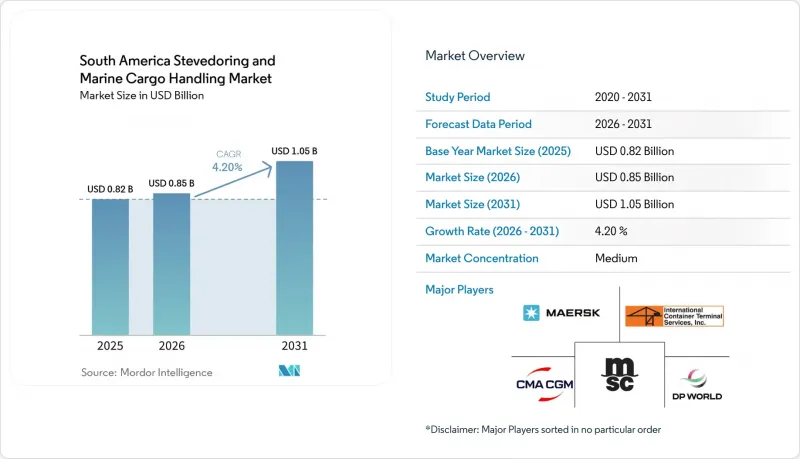
According to Mordor Intelligence, the South America stevedoring and Marine Cargo Handling Market size was valued at USD 0.82 billion in 2025 and is estimated to grow from USD 0.85 billion in 2026 to reach USD 1.05 billion by 2031, at a CAGR of 4.20% during the forecast period (2026-2031).
South America Stevedoring and Marine Cargo Handling Market Trends and Insights
Expansion of Brazil's Dry Bulk and Agricultural Export Flows
Brazil's export growth is changing, with stevedoring demand concentrated across South America. Brazilian ports handled 1.4 billion tonnes of waterborne cargo in 2025, and soybean volumes reached 139.7 million tonnes, up 14% from the preceding year. The Northern Arc corridor handled more than 50% of Brazil's crop shipments, which shifted grain activity away from the traditional Santos and Paranagua axis. This shift divided equipment and berth investment between northern export corridors and the established southeastern gateways, helping operators serve harvest flows without relying on a single corridor. The Port of Itaqui handled 16.5 million metric tonnes in the first half of 2026, and soybeans represented more than 51% of this volume. The Paranagua Moegao grain terminal received BRL 1.1 billion (USD 211.75 million) in investment and was designed to load 8,000 tonnes of soybeans per hour at full capacity.
Containerization of Intra South American and Asia South American Trade
Container volumes are rising faster than total cargo volumes at several South American gateways. Trade with Asia is increasing demand for dedicated container services at origin terminals. The cargo mix is broadening beyond conventional commodities to include frozen meat, reefer fruit, auto parts, and e-commerce goods. Each cargo type has different storage, handling, temperature control, and release requirements, which require closer coordination between berth planners, yard teams, truck operators, and customs processes. The South America stevedoring and marine cargo handling market benefits as terminals add services for higher-value and time-sensitive cargo. This transition makes equipment reliability, gate processing, and consistent vessel schedules more important for operators.
Port Congestion and Hinterland Bottlenecks
Port congestion reduces the useful capacity of existing berths during harvest peaks. Road bottlenecks between inland production areas and transshipment points limit terminal investment benefits and affect vessel schedules, truck movements, yard availability, and export commitments. Santos also faced a delay in planned channel deepening after a court suspended a dredging contract awarded in 2025. ANTAQ turnaround frameworks increasingly place financial responsibility for congestion-related demurrage on terminal operators. That pressure encourages investment in faster operations but can increase costs for medium-sized concessionaires. These limits remain material to the South America stevedoring and marine cargo handling market because terminal upgrades cannot solve inland transport constraints by themselves.
Other drivers and restraints analyzed in the detailed report include:
- Port Modernization and Private Terminal Concessions
- E-Commerce and Time-Sensitive Cargo Requirements
- High Capital Intensity and Equipment Synchronization Gaps
For complete list of drivers and restraints, kindly check the Table Of Contents.
Segment Analysis
Stevedoring accounted for 46.24% of the South America stevedoring and marine cargo handling market share in 2025, making it the largest service category. The market share held by this service reflected the continued importance of vessel loading and unloading. Labor-intensive activity remained important at many ports because commercial-scale automation was limited. Other services included mooring, pilotage, and towage. These activities maintained steady demand because organized ports require certified service provision. Nearshoring-related freight, e-commerce imports, and agricultural logistics supported demand beyond the quay.
Cargo handling and transportation is the fastest-growing service, with a projected CAGR of 4.54% through 2031. CMA CGM completed its acquisition of Santos Brasil in April 2025, integrating Tecon Santos into its port and logistics operations. The acquisition showed how global carriers were bringing stevedoring and cargo handling into broader logistics offerings. The South America stevedoring and marine cargo handling market faced greater competition for major accounts and premium terminal capacity as carriers expanded their asset base.
Complete Report Scope:
- By Service
- Stevedoring
- Cargo Handling and Transportation
- Other Services
- By Cargo Type
- Dry Bulk Cargo
- Liquid Bulk Cargo
- Containerized Cargo
- Breakbulk and General Cargo
- Ro-Ro and Project Cargo
- By End Use
- Agriculture, Fishing, and Forestry
- Construction
- Manufacturing
- Oil and Gas, Mining and Quarrying
- Wholesale and Retail Trade
- Others
- By Country
- Argentina
- Brazil
- Chile
- Colombia
- Peru
- Rest of South America
List of Companies Covered in this Report:
- A.P. Moller - Maersk
- DP World
- International Container Terminal Services, Inc.
- Terminal Investment Limited Sarl
- CMA CGM S.A.
- MSC Mediterranean Shipping Company S.A.
- Hapag-Lloyd AG
- SSA Marine
- Sociedad Portuaria Regional de Cartagena S.A. (SPRC)
- Portonave S.A.
- Wilson Sons S.A.
- SAAM Terminals
- Neltume Ports
- Ultramar
- Puerto Central S.A.
- Terminal Internacional del Sur S.A.
- Yilport Puerto Bolivar
- Contecon Guayaquil S.A.
- Montecon S.A.
Additional Benefits:
- The market estimate (ME) sheet in Excel format
- 3 months of analyst support
TABLE OF CONTENTS
1 INTRODUCTION
- 1.1 Study Assumptions and Market Definition
- 1.2 Scope of the Study
2 RESEARCH METHODOLOGY
3 EXECUTIVE SUMMARY
4 MARKET LANDSCAPE
- 4.1 Market Overview
- 4.2 Key Macroeconomic Factors (GDP, Inflation, International Trades etc.) and their Impact on the Market
- 4.3 Market Drivers
- 4.3.1 Expansion of Brazil's Dry Bulk and Agricultural Export Flows
- 4.3.2 Containerization of Intra-South American and Asia-South America Trade
- 4.3.3 Port Modernization and Private Terminal Concessions
- 4.3.4 E-Commerce and Time-Sensitive Cargo Requirements
- 4.3.5 Nearshoring and Commodity Corridor Reconfiguration
- 4.3.6 Chokepoint Diversification and Pacific-South Atlantic Connectivity
- 4.4 Market Restraints
- 4.4.1 Port Congestion and Hinterland Bottlenecks
- 4.4.2 High Capital Intensity and Equipment Synchronization Gaps
- 4.4.3 Panama Canal and Weather-Related Routing Volatility
- 4.4.4 Uneven Digital and Regulatory Interoperability
- 4.5 Value and Supply-Chain Analysis
- 4.6 Regulatory Framework
- 4.7 Technological Outlook
- 4.8 Porter's Five Forces Analysis
- 4.8.1 Threat of New Entrants
- 4.8.2 Bargaining Power of Suppliers
- 4.8.3 Bargaining Power of Buyers
- 4.8.4 Threat of Substitutes
- 4.8.5 Competitive Rivalry
- 4.9 Impact of Geopolitical Events on the Market
5 MARKET SIZE AND GROWTH FORECASTS (Value, USD)
- 5.1 By Service
- 5.1.1 Stevedoring
- 5.1.2 Cargo Handling and Transportation
- 5.1.3 Other Services
- 5.2 By Cargo Type
- 5.2.1 Dry Bulk Cargo
- 5.2.2 Liquid Bulk Cargo
- 5.2.3 Containerized Cargo
- 5.2.4 Breakbulk and General Cargo
- 5.2.5 Ro-Ro and Project Cargo
- 5.3 By End Use
- 5.3.1 Agriculture, Fishing, and Forestry
- 5.3.2 Construction
- 5.3.3 Manufacturing
- 5.3.4 Oil and Gas, Mining and Quarrying
- 5.3.5 Wholesale and Retail Trade
- 5.3.6 Others
- 5.4 By Country
- 5.4.1 Argentina
- 5.4.2 Brazil
- 5.4.3 Chile
- 5.4.4 Colombia
- 5.4.5 Peru
- 5.4.6 Rest of South America
6 COMPETITIVE LANDSCAPE
- 6.1 Market Concentration
- 6.2 Key Strategic Moves
- 6.3 Market Share Analysis
- 6.4 Company Profiles (includes Global Level Overview, Market Level Overview, Core Segments, Financials as available, Strategic Information, Geographic Coverage, Products and Services, Recent Developments)
- 6.4.1 A.P. Moller - Maersk
- 6.4.2 DP World
- 6.4.3 International Container Terminal Services, Inc.
- 6.4.4 Terminal Investment Limited Sarl
- 6.4.5 CMA CGM S.A.
- 6.4.6 MSC Mediterranean Shipping Company S.A.
- 6.4.7 Hapag-Lloyd AG
- 6.4.8 SSA Marine
- 6.4.9 Sociedad Portuaria Regional de Cartagena S.A. (SPRC)
- 6.4.10 Portonave S.A.
- 6.4.11 Wilson Sons S.A.
- 6.4.12 SAAM Terminals
- 6.4.13 Neltume Ports
- 6.4.14 Ultramar
- 6.4.15 Puerto Central S.A.
- 6.4.16 Terminal Internacional del Sur S.A.
- 6.4.17 Yilport Puerto Bolivar
- 6.4.18 Contecon Guayaquil S.A.
- 6.4.19 Montecon S.A.
7 MARKET OPPORTUNITIES AND FUTURE OUTLOOK
- 7.1 White-Space and Unmet-Need Assessment

