PUBLISHER: Mordor Intelligence | PRODUCT CODE: 2156960

PUBLISHER: Mordor Intelligence | PRODUCT CODE: 2156960
White-Light Interferometry Systems - Market Share Analysis, Industry Trends & Statistics, Growth Forecasts (2026 - 2031)
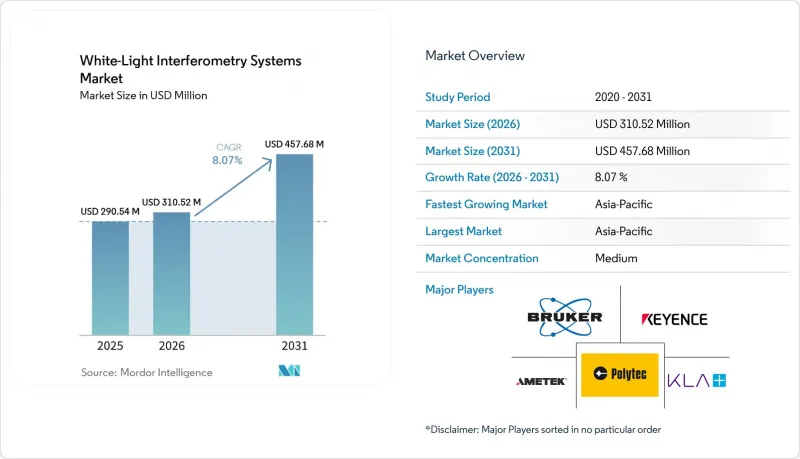
According to Mordor Intelligence, the white-light interferometry systems market size was valued at USD 290.54 million in 2025 and is estimated to expand from USD 310.52 million in 2026 to reach USD 457.68 million by 2031, at a CAGR of 8.07% during the forecast period (2026-2031).
Global White-Light Interferometry Systems Market Trends and Insights
Advanced Semiconductor Node Migration
The shift toward 2 nm and smaller process nodes is increasing the need for surface measurement tools. Gate-all-around nanosheet designs add stacked structures and backside power delivery features. These features require non-destructive characterization during repeated process qualification cycles. TSMC reported that its N2 node had 1.5 times more tape-outs than its 3 nm predecessor by mid-2025. Each tape-out can add further surface characterization work before volume production. Coherence scanning interferometry can measure complex vertical structures without contacting the wafer. The white-light interferometry systems market therefore benefits from node complexity, even when wafer unit growth is less pronounced.
Expansion of Wafer-Level Packaging and MEMS Manufacturing
Wafer-level packaging and MEMS production are raising measurement requirements for inline surface tools. Hybrid bonding depends on tightly controlled copper pad topography before wafers are joined. A 2025 study reported a 0.79 nm standard deviation across 20 consecutive WLI measurements on hybrid bonding copper-pad surfaces. The study found stronger performance than confocal laser scanning microscopy on the tested specimens. Copper dishing limits in HBM hybrid bonding can fall below 1 nm. Non-contact interferometry can confirm compliance without creating surface damage. This requirement supports wider use of WLI in packaging lines and MEMS manufacturing.
High Capital Expenditure for Advanced WLI Systems
Production-grade WLI systems can cost low single-digit USD millions per tool. This investment level concentrates purchases among large fabs and outsourced semiconductor assembly and test providers. Smaller manufacturers and research institutions can face more difficult purchase decisions. The barrier is most visible in South America, Southeast Asia, and Africa. Sub-micron interferometric objectives can also cost tens of thousands of USD. Custom optical designs can lengthen delivery schedules for emerging process requirements. Modular platforms help customers add capability in stages, but they do not remove the initial capital threshold in the white-light interferometry systems market.
Other drivers and restraints analyzed in the detailed report include:
- Demand for Non-Contact Nanometer-Scale Surface Measurement
- Integration of Inline Metrology With Automated Production
- Competition From Confocal, Focus-Variation, and Atomic Force Microscopy
For complete list of drivers and restraints, kindly check the Table Of Contents.
Segment Analysis
Benchtop and Laboratory Systems held 46.83% of product-type revenue in 2025. Their role remains important for recipe development, failure analysis, and material qualification. These systems can use configurable objectives and vibration-isolated stages. They also provide large working envelopes for varied samples. Fab research centers use them for process development before manufacturing release. Floor-Standing Systems serve heavy samples and large-format inspection tasks. Aerospace parts and precision optics require stable scan paths during these measurements. Portable and Handheld Systems remain a smaller category for field quality audits.
Inline and On-Machine Systems are projected to expand at an 8.46% CAGR through 2031. The white-light interferometry systems market size for this category benefits from shorter feedback loops on production lines. A 2025 study demonstrated active wavefront-compensatory coherence scanning interferometry on buried microstructures. It achieved 0.95 µm lateral resolution below encapsulating layers between 100 µm and 300 µm thick. The approach supports inspection of encapsulated MEMS and stacked-die structures. Zygo introduced its ZeGage Pro with SureScan vibration resistance for floor-level installation. This design addresses a practical barrier in high-vibration production areas. Automotive stamping and medical implant inspection can also use portable systems for periodic quality checks.
Coherence Scanning Interferometry held 44.67% of technology revenue in 2025. This method covers a wide range of surfaces in the white-light interferometry systems market. It is used for MEMS membranes, semiconductor interconnects, optical flats, and bearing races. Its vertical range supports applications with different material surfaces and feature heights. Vertical Scanning Interferometry retains an important role in smooth optical surface measurement. Phase-Shifting Interferometry supports laser optics and telescope mirror qualification. Low-Coherence Thickness Measurement serves transparent thin-film stacks. These methods remain complementary within laboratory and production workflows.
AI-Enabled Interferometric Analysis is projected to expand at an 8.37% CAGR through 2031. The white-light interferometry systems market size for AI-supported tools reflects demand for faster processing without lower spatial resolution. A 2025 study found that algorithmic signal processing reduced WLI measurement time on wafer-scale high-aspect-ratio structures. The study preserved the required spatial resolution. Software can allow similar hardware to serve higher-value applications. This reduces upgrade costs for installed systems. Vendors have shifted more development resources toward analytics platforms since 2025. AI-assisted recipe optimization is becoming more common in new system releases.
Complete Report Scope:
- By Product Type
- Benchtop and Laboratory Systems
- Floor-Standing Systems
- Inline and On-Machine Systems
- Portable and Handheld Systems
- By Technology
- Coherence Scanning Interferometry
- Vertical Scanning Interferometry
- Phase-Shifting Interferometry
- Low-Coherence Thickness Measurement
- AI-Enabled Interferometric Analysis
- By Application
- Surface Roughness and Texture Measurement
- Step Height and Depth Measurement
- Flatness, Form, and Parallelism Measurement
- Thin-Film and Coating Thickness Measurement
- Wafer, TSV, TGV, and Advanced Packaging Inspection
- Defect Review and Failure Analysis
- Other Applications
- By End-User Industry
- Semiconductor and Electronics
- Precision Manufacturing
- Automotive and Aerospace
- Medical Devices and Life Sciences
- Optics and Photonics
- Research and Academia
- Other End-User Industry
- By Geography
- North America
- United States
- Canada
- Mexico
- South America
- Brazil
- Argentina
- Rest of South America
- Europe
- Germany
- United Kingdom
- France
- Italy
- Spain
- Rest of Europe
- Asia-Pacific
- China
- Japan
- India
- South Korea
- ASEAN
- Rest of Asia-Pacific
- Middle East and Africa
- Middle East
- Saudi Arabia
- United Arab Emirates
- Turkey
- Rest of the Middle East
- Africa
- South Africa
- Nigeria
- Rest of Africa
- Middle East
- North America
Geography Analysis
Asia-Pacific held 41.86% of global revenue in 2025. The region is projected to expand at an 8.59% CAGR through 2031. This represented the largest white-light interferometry systems market share and the highest regional growth rate. Taiwan supports demand through 2 nm foundry ramp-ups. South Korea supports demand through HBM and hybrid bonding quality control. China is increasing domestic semiconductor equipment development. Japan remains relevant for automotive MEMS, optical systems, and equipment sub-assembly verification. These markets combine leading-edge manufacturing with a growing need for packaging inspection.
North America was the second-largest geography in 2025. Advanced packaging investments at TSMC Arizona and Intel facilities support regional equipment demand. Defense and aerospace programs also require precision optics manufacturing. These applications need high-precision surface and form measurement. Europe concentrates demand in Germany, the Netherlands, and France. Germany combines precision instrument suppliers with automotive Tier-1 manufacturing. The Netherlands benefits from optical metrology demand tied to the ASML supply chain. France benefits from semiconductor research activity around CEA-Leti.
South America, the Middle East and Africa, and the rest of Asia-Pacific form smaller demand pools. Brazil leads South American demand through automotive component manufacturing. Saudi Arabia and the UAE are investing in advanced manufacturing capability. Early WLI installations support aerospace maintenance, repair, and overhaul metrology laboratories. African demand is concentrated in academic institutions and South Africa's engineering metrology sector. New fab investments under the Chips and Science Act and the European Chips Act can support equipment demand in Arizona, Germany, and Japan. The white-light interferometry systems market has opportunities where new facilities need qualified process control tools.
- AMETEK, Inc.
- Bruker Corporation
- KLA Corporation
- Keyence Corporation
- Polytec GmbH
- Mitutoyo Corporation
- Carl Zeiss AG
- Nikon Corporation
- Sensofar Metrology, S.L.
- Alicona Imaging GmbH
- Taylor Hobson Ltd
- Zygo Corporation
- Mahr GmbH
- HORIBA, Ltd.
- Renishaw plc
- Hexagon AB
- FARO Technologies, Inc.
- Nikon Metrology NV
- Leica Microsystems GmbH
- Olympus Corporation
Additional Benefits:
- The market estimate (ME) sheet in Excel format
- 3 months of analyst support
TABLE OF CONTENTS
1 INTRODUCTION
- 1.1 Study Assumptions and Market Definition
- 1.2 Scope of the Study
2 RESEARCH METHODOLOGY
3 EXECUTIVE SUMMARY
4 MARKET LANDSCAPE
- 4.1 Market Overview
- 4.2 Market Drivers
- 4.2.1 Advanced Semiconductor Node Migration
- 4.2.2 Expansion of Wafer-Level Packaging and MEMS Manufacturing
- 4.2.3 Demand for Non-Contact Nanometer-Scale Surface Measurement
- 4.2.4 Integration of Inline Metrology With Automated Production
- 4.2.5 AI-Assisted Defect Classification and Recipe Optimization
- 4.2.6 Distributed Calibration Data for Cross-Site Metrology Consistency
- 4.3 Market Restraints
- 4.3.1 High Capital Expenditure for Advanced WLI Systems
- 4.3.2 Competition From Confocal, Focus-Variation, and Atomic Force Microscopy
- 4.3.3 Vibration Sensitivity in Production Environments
- 4.3.4 Shortage of Certified Reference Artifacts and Interferometric Objectives
- 4.4 Impact of Macroeconomic Factors on the Market
- 4.5 Industry Value Chain Analysis
- 4.6 Regulatory Landscape
- 4.7 Technological Outlook
- 4.8 Porter's Five Forces Analysis
- 4.8.1 Bargaining Power of Suppliers
- 4.8.2 Bargaining Power of Buyers
- 4.8.3 Threat of New Entrants
- 4.8.4 Threat of Substitutes
- 4.8.5 Competitive Rivalry
5 MARKET SIZE AND GROWTH FORECASTS (VALUE)
- 5.1 By Product Type
- 5.1.1 Benchtop and Laboratory Systems
- 5.1.2 Floor-Standing Systems
- 5.1.3 Inline and On-Machine Systems
- 5.1.4 Portable and Handheld Systems
- 5.2 By Technology
- 5.2.1 Coherence Scanning Interferometry
- 5.2.2 Vertical Scanning Interferometry
- 5.2.3 Phase-Shifting Interferometry
- 5.2.4 Low-Coherence Thickness Measurement
- 5.2.5 AI-Enabled Interferometric Analysis
- 5.3 By Application
- 5.3.1 Surface Roughness and Texture Measurement
- 5.3.2 Step Height and Depth Measurement
- 5.3.3 Flatness, Form, and Parallelism Measurement
- 5.3.4 Thin-Film and Coating Thickness Measurement
- 5.3.5 Wafer, TSV, TGV, and Advanced Packaging Inspection
- 5.3.6 Defect Review and Failure Analysis
- 5.3.7 Other Applications
- 5.4 By End-User Industry
- 5.4.1 Semiconductor and Electronics
- 5.4.2 Precision Manufacturing
- 5.4.3 Automotive and Aerospace
- 5.4.4 Medical Devices and Life Sciences
- 5.4.5 Optics and Photonics
- 5.4.6 Research and Academia
- 5.4.7 Other End-User Industry
- 5.5 By Geography
- 5.5.1 North America
- 5.5.1.1 United States
- 5.5.1.2 Canada
- 5.5.1.3 Mexico
- 5.5.2 South America
- 5.5.2.1 Brazil
- 5.5.2.2 Argentina
- 5.5.2.3 Rest of South America
- 5.5.3 Europe
- 5.5.3.1 Germany
- 5.5.3.2 United Kingdom
- 5.5.3.3 France
- 5.5.3.4 Italy
- 5.5.3.5 Spain
- 5.5.3.6 Rest of Europe
- 5.5.4 Asia-Pacific
- 5.5.4.1 China
- 5.5.4.2 Japan
- 5.5.4.3 India
- 5.5.4.4 South Korea
- 5.5.4.5 ASEAN
- 5.5.4.6 Rest of Asia-Pacific
- 5.5.5 Middle East and Africa
- 5.5.5.1 Middle East
- 5.5.5.1.1 Saudi Arabia
- 5.5.5.1.2 United Arab Emirates
- 5.5.5.1.3 Turkey
- 5.5.5.1.4 Rest of the Middle East
- 5.5.5.2 Africa
- 5.5.5.2.1 South Africa
- 5.5.5.2.2 Nigeria
- 5.5.5.2.3 Rest of Africa
- 5.5.5.1 Middle East
- 5.5.1 North America
6 COMPETITIVE LANDSCAPE
- 6.1 Market Concentration
- 6.2 Strategic Moves
- 6.3 Market Share Analysis
- 6.4 Company Profiles (includes Global Level Overview, Market Level Overview, Core Segments, Financials as available, Strategic Information, Market Rank/Share, Products and Services, Recent Developments)
- 6.4.1 AMETEK, Inc.
- 6.4.2 Bruker Corporation
- 6.4.3 KLA Corporation
- 6.4.4 Keyence Corporation
- 6.4.5 Polytec GmbH
- 6.4.6 Mitutoyo Corporation
- 6.4.7 Carl Zeiss AG
- 6.4.8 Nikon Corporation
- 6.4.9 Sensofar Metrology, S.L.
- 6.4.10 Alicona Imaging GmbH
- 6.4.11 Taylor Hobson Ltd
- 6.4.12 Zygo Corporation
- 6.4.13 Mahr GmbH
- 6.4.14 HORIBA, Ltd.
- 6.4.15 Renishaw plc
- 6.4.16 Hexagon AB
- 6.4.17 FARO Technologies, Inc.
- 6.4.18 Nikon Metrology NV
- 6.4.19 Leica Microsystems GmbH
- 6.4.20 Olympus Corporation
7 MARKET OPPORTUNITIES AND FUTURE OUTLOOK
- 7.1 White-Space and Unmet-Need Assessment

