PUBLISHER: Mordor Intelligence | PRODUCT CODE: 2156968

PUBLISHER: Mordor Intelligence | PRODUCT CODE: 2156968
Lignin-Based Resins - Market Share Analysis, Industry Trends & Statistics, Growth Forecasts (2026 - 2031)
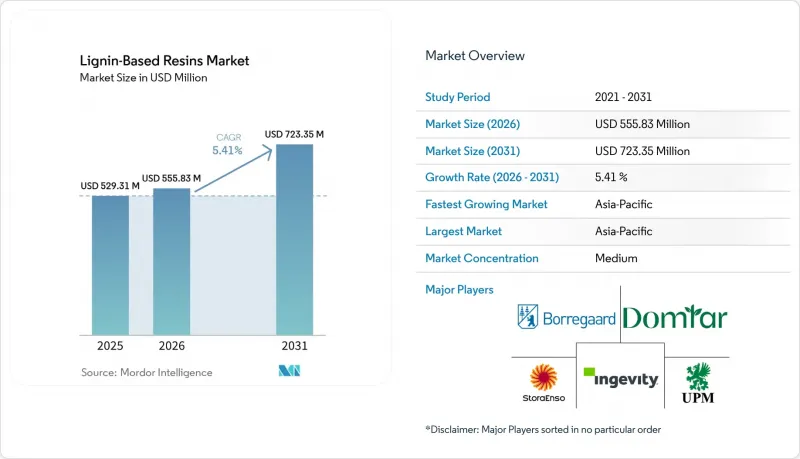
According to Mordor Intelligence, the Lignin-Based resins market size was valued at USD 529.31 million in 2025 and is estimated to grow from USD 555.83 million in 2026 to USD 723.35 million by 2031, at a CAGR of 5.41% during the forecast period (2026-2031).
Global Lignin-Based Resins Market Trends and Insights
Formaldehyde and Volatile Organic Compound (VOC) Compliance Pull
Tighter formaldehyde emission standards are the most immediate driver of demand in the lignin-based resins market. The U.S. EPA's December 2024 risk determination increased the compliance exposure associated with conventional formaldehyde systems, encouraging composite wood manufacturers to consider lower-emission alternatives before further measures take effect. Registration, Evaluation, Authorization and Restriction of Chemicals (REACH) Annex XVII requirements and the Construction Products Regulation are supporting specification changes among European medium-density fiberboard (MDF), plywood, and oriented strand board producers. China's VOC discharge permitting and its dual-carbon agenda are also affecting procurement decisions at urea-formaldehyde resin plants serving the lignin-based resins market. Furniture exporters in Vietnam and Thailand must meet requirements set by North American and European retailers, thereby extending demand beyond the jurisdictions that originally set the rules. In June 2026, Ahlstrom expanded its European production of filtration media, replacing 30% of fossil-based phenolic resin with lignin and reducing formaldehyde-curing emissions by 40-70%.
Corporate Demand for Renewable and Low-Carbon Resins
Scope 3 accountability is influencing sourcing decisions by construction, automotive, and consumer goods companies in the lignin-based resins market. Brand owners increasingly request Environmental Product Declarations that show resin bio-content, creating an advantage for formulations that use renewable inputs. Resin formulators supplying these buyers also require lignin suppliers to demonstrate stable bio-carbon content through verifiable testing. This requirement favors suppliers with controlled fractionation processes and consistent production practices. UPM Biochemicals has positioned its BioPiva kraft lignin as a renewable input for adhesives and resin systems, reflecting demand for higher-purity lignin grades. Over the medium term, the European Commission's Chemicals Strategy for Sustainability could translate these preferences into green public procurement criteria for infrastructure projects.
Feedstock and Chemical-Structure Variability
Lignin structure varies by feedstock species, pulping method, extraction process, and season, creating a restraint on the lignin-based resins market. Lignin grades from the same facility can differ in phenolic hydroxyl content, molecular-weight distribution, and sulfur levels. These differences affect cure behavior and the mechanical properties of finished resins. The German Bioeconomy Deep Dive identified the lack of standard lignin quality parameters and grading systems as a major barrier to wider industrial use. This issue is especially significant in the Asia-Pacific region, where panel producers may source lignin from eucalyptus, bamboo, and mixed hardwood feedstocks. No published ISO standard specifically covers resin-grade lignin, so supplier qualification remains a time-consuming bilateral process.
Other drivers and restraints analyzed in the detailed report include:
- Abundant Pulp-Industry Lignin Feedstock
- Expansion of Bio-Based Adhesives and Composites
- Limited Commercial-Scale Valorization Infrastructure
For complete list of drivers and restraints, kindly check the Table Of Contents.
Segment Analysis
Phenolic resins accounted for 57.45% of the lignin-based resins market share in 2025, supported by their compatibility with industrial hot-press systems for plywood, oriented strand board, and laminated veneer lumber. Lignin-phenol-formaldehyde systems enable direct partial replacement of fossil phenol in existing production infrastructure, reducing the capital requirements of converting to bio-based formulations. Polyurethane resins remain a smaller segment, but kraft lignin polyols are being evaluated as replacements for petroleum-derived polyols in rigid insulation and flexible seating foams. A 2026 study reported that lignin polyols, used at 20-30% substitution, achieved compressive strength profiles comparable to those of polyurethane formulations.
Epoxy resins are the fastest-growing resin type, with the lignin-based resins market size for this segment forecast to grow at a 5.84% CAGR from 2026 to 2031. This growth reflects interest in bio-based and bisphenol A (BPA)-free alternatives as regulatory attention on BPA increases. Research on lignin-derived epoxy systems has shown that engineered lignin oligomers can approach the thermomechanical performance benchmarks of commercial diglycidyl ether of bisphenol A (DGEBA). In June 2025, Sumitomo Bakelite commercially launched a solid Novolac-type lignin-modified phenolic resin for automotive foundry and friction-material applications. Other resin types, including acrylic-modified and thermoset blends, remain concentrated in specialty coating and electronics applications.
Complete Report Scope:
- By Resin Type
- Phenolic Resins
- Epoxy Resins
- Polyurethane Resins
- Other Resin Types
- By Lignin Source
- Kraft Lignin
- Lignosulfonates
- Organosolv Lignin
- Other Lignin Sources
- By Application
- Wood Adhesives and Binders
- Coatings
- Composites
- Foams and Insulation
- Plastics and Polymer Blends
- Other Applications
- By Geography
- Asia-Pacific
- China
- India
- Japan
- South Korea
- Rest of Asia-Pacific
- North America
- United States
- Canada
- Mexico
- Europe
- Germany
- United Kingdom
- France
- Italy
- Rest of Europe
- South America
- Brazil
- Argentina
- Rest of South America
- Middle East and Africa
- Saudi Arabia
- South Africa
- Rest of Middle East and Africa
- Asia-Pacific
Geography Analysis
Asia-Pacific accounted for 39.76% of revenue in 2025 and is projected to record the highest regional CAGR of 6.04% through 2031. China is the central demand market due to its large wood-based panel industry and GB 18580 ENF emission thresholds, while India's plywood and MDF producers are qualifying lignin-phenolic adhesives as a compliant and cost-competitive alternative to conventional urea-formaldehyde systems. South Korea's automotive sector is evaluating lignin-derived composite precursors for lightweight structural components. Vietnam and Thailand are adopting lignin adhesive systems as furniture and panel exporters respond to retailer compliance requirements. In September 2024, Suzano introduced Ecolig eucalyptus kraft lignin to the Chinese market, adding a regional alternative to Scandinavian kraft lignin supply.
North America and Europe form the innovation-intensive tier of the lignin-based resins market. US composite wood regulations set formaldehyde emission limits and create a compliance-driven opportunity for lignin-phenolic systems. Canada's Kraft pulping base provides feedstock security for regional resin producers, while Borregaard, Stora Enso, and Sodra have invested in Scandinavian supply to support access to higher-purity lignin in Europe. REACH, the Construction Products Regulation, and the Chemicals Strategy for Sustainability support demand for bio-based alternatives. According to the German Bioeconomy Deep Dive, Germany has more than 15 large pulp and paper mills and more than 40 specialty chemical manufacturers exploring lignin-based adhesives and coatings.
South America, the Middle East, and Africa hold emerging positions in the lignin-based resins market. Brazil's eucalyptus kraft pulp sector provides low-sulfur lignin suited to resin applications, while domestic construction and panel production provide demand outlets. Argentina's medium-density fiberboard (MDF) producers increasingly serve export markets that require compliance documentation, while Saudi Arabia's Vision 2030 program and South Africa's forestry sector represent longer-term opportunities. Limited extraction and refining infrastructure, restricted pulp capacity, import dependence, and fewer direct regulatory mandates continue to constrain adoption across the Middle East and Africa.
- Borregaard AS
- Domsjo Fabriker
- Domtar Corporation
- FPInnovations
- GreenValue Enterprises LLC
- Ingevity Corporation
- Lignin Industries AB
- Lignolix
- MetGen
- Metsa Group
- NIPPON PAPER INDUSTRIES CO., LTD.
- Sappi Limited
- Stora Enso
- Suzano
- UPM
Additional Benefits:
- The market estimate (ME) sheet in Excel format
- 3 months of analyst support
TABLE OF CONTENTS
1 Introduction
- 1.1 Study Assumptions and Market Definition
- 1.2 Scope of the Study
2 Research Methodology
3 Executive Summary
4 Market Landscape
- 4.1 Market Overview
- 4.2 Market Drivers
- 4.2.1 Formaldehyde and VOC Compliance Pull
- 4.2.2 Corporate Demand for Renewable and Low-Carbon Resins
- 4.2.3 Abundant Pulp-Industry Lignin Feedstock
- 4.2.4 Expansion of Bio-Based Adhesives and Composites
- 4.2.5 Consistent, Application-Ready Kraft Lignin Grades
- 4.3 Market Restraints
- 4.3.1 Feedstock and Chemical-Structure Variability
- 4.3.2 Limited Commercial-Scale Valorization Infrastructure
- 4.3.3 Batch Qualification Friction in Existing Resin Lines
- 4.4 Value Chain Analysis
- 4.5 Porter's Five Forces Analysis
- 4.5.1 Bargaining Power of Suppliers
- 4.5.2 Bargaining Power of Buyers
- 4.5.3 Threat of New Entrants
- 4.5.4 Threat of Substitutes
- 4.5.5 Competitive Rivalry
5 Market Size and Growth Forecasts (Value)
- 5.1 By Resin Type
- 5.1.1 Phenolic Resins
- 5.1.2 Epoxy Resins
- 5.1.3 Polyurethane Resins
- 5.1.4 Other Resin Types
- 5.2 By Lignin Source
- 5.2.1 Kraft Lignin
- 5.2.2 Lignosulfonates
- 5.2.3 Organosolv Lignin
- 5.2.4 Other Lignin Sources
- 5.3 By Application
- 5.3.1 Wood Adhesives and Binders
- 5.3.2 Coatings
- 5.3.3 Composites
- 5.3.4 Foams and Insulation
- 5.3.5 Plastics and Polymer Blends
- 5.3.6 Other Applications
- 5.4 By Geography
- 5.4.1 Asia-Pacific
- 5.4.1.1 China
- 5.4.1.2 India
- 5.4.1.3 Japan
- 5.4.1.4 South Korea
- 5.4.1.5 Rest of Asia-Pacific
- 5.4.2 North America
- 5.4.2.1 United States
- 5.4.2.2 Canada
- 5.4.2.3 Mexico
- 5.4.3 Europe
- 5.4.3.1 Germany
- 5.4.3.2 United Kingdom
- 5.4.3.3 France
- 5.4.3.4 Italy
- 5.4.3.5 Rest of Europe
- 5.4.4 South America
- 5.4.4.1 Brazil
- 5.4.4.2 Argentina
- 5.4.4.3 Rest of South America
- 5.4.5 Middle East and Africa
- 5.4.5.1 Saudi Arabia
- 5.4.5.2 South Africa
- 5.4.5.3 Rest of Middle East and Africa
- 5.4.1 Asia-Pacific
6 Competitive Landscape
- 6.1 Market Concentration
- 6.2 Strategic Moves
- 6.3 Market Share (%)/Ranking Analysis
- 6.4 Company Profiles (includes Global Overview, Market Overview, Core Segments, Financials as available, Strategic Information, Products and Services, and Recent Developments)
- 6.4.1 Borregaard AS
- 6.4.2 Domsjo Fabriker
- 6.4.3 Domtar Corporation
- 6.4.4 FPInnovations
- 6.4.5 GreenValue Enterprises LLC
- 6.4.6 Ingevity Corporation
- 6.4.7 Lignin Industries AB
- 6.4.8 Lignolix
- 6.4.9 MetGen
- 6.4.10 Metsa Group
- 6.4.11 NIPPON PAPER INDUSTRIES CO., LTD.
- 6.4.12 Sappi Limited
- 6.4.13 Stora Enso
- 6.4.14 Suzano
- 6.4.15 UPM
7 Market Opportunities and Future Outlook
- 7.1 White-Space and Unmet-Need Assessment

