PUBLISHER: Mordor Intelligence | PRODUCT CODE: 2156976

PUBLISHER: Mordor Intelligence | PRODUCT CODE: 2156976
Continuous Authentication - Market Share Analysis, Industry Trends & Statistics, Growth Forecasts (2026 - 2031)
According to Mordor Intelligence, the continuous authentication market size was valued at USD 2.16 billion in 2025 and estimated to grow from USD 2.53 billion in 2026 to reach USD 6.33 billion by 2031, at a CAGR of 20.13% during the forecast period 2026-2031.
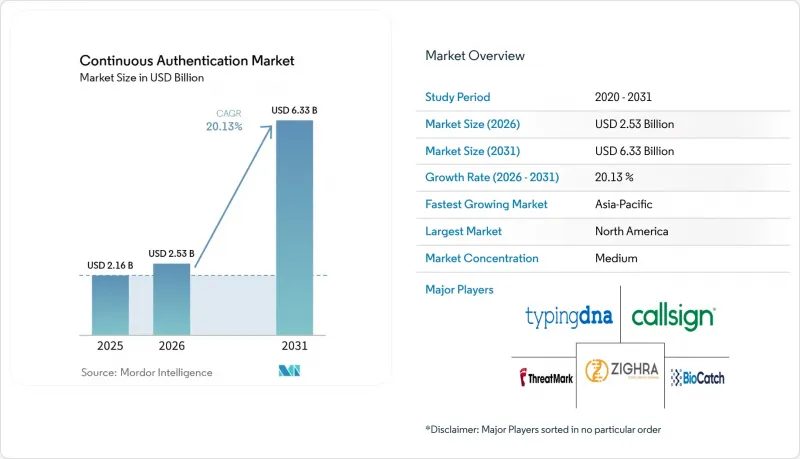
Global Continuous Authentication Market Trends and Insights
Escalation of Account Takeover and Session Hijacking
Account takeover has become easier to scale through automated credential attacks. LexisNexis Risk Solutions recorded a 1.2% overall account takeover attack rate in 2025, up 89% from the prior year. Its data also showed that e-commerce login attack rates rose from 3.4% to 10.8% in 2025. Proofpoint found that 59% of accounts affected by successful takeover had multifactor authentication enabled at the time of compromise. This gap directs security spending toward controls that assess behavior during an active session. The continuous authentication market, therefore, has a clear role where a login check alone cannot identify a change in user behavior. The same issue applies to token replay and remote session handoffs, because the session may appear valid even after credentials are compromised. Enterprises can use behavioral deviations during transactions, changes in mouse movement, unusual typing cadence, or shifts in device context to determine whether a session should continue. This expands the practical value of a control from preventing unauthorized entry to detecting misuse after entry.
Expansion of Zero-Trust Security Architectures
Zero-trust architecture requires organizations to verify users and devices throughout access activity. NIST SP 1800-35 identifies continuous verification of user identity as part of a zero-trust implementation approach. This approach moves continuous authentication from an optional feature to a component of identity architecture. It also provides security teams with a framework for connecting behavior-based checks to network segmentation and access policies. Federal contractors and critical infrastructure operators have a further reason to align their security programs with recognized government guidance. The continuous authentication market can benefit as more organizations move from initial multifactor authentication deployments toward mature zero-trust environments. Continuous identity checks can be integrated into access requests, network segments, and policy decisions rather than running as a separate security process. This matters to organizations that need to protect sensitive applications without requiring every user to complete a disruptive challenge. It also supports a more consistent security model across remote employees, contractors, and third-party users.
Privacy, Consent, and Biometric Data Governance
Behavioral biometric deployments must account for privacy and consent obligations across jurisdictions. The European Commission describes biometric data processed to uniquely identify a person as a special category of personal data under Article 9 of the General Data Protection Regulation. Data minimization and purpose limitation can affect what signals a platform collects and where it processes them. Different rules in Europe and the United States make a single consent process difficult for multinational deployments. A 2025 Scientific Reports paper described a federated biometric authentication approach using differential privacy and homomorphic encryption. The continuous authentication market must balance stronger detection models with designs that reduce exposure of sensitive behavioral information. Cloud-based services can face added scrutiny when behavioral information is processed across borders or combined across institutions. On-device and federated approaches can limit raw data movement, although they may reduce access to the broad signal pools that support model performance. Providers must also explain how consent is obtained, how long information is kept, and how a user can exercise applicable privacy rights.
Other drivers and restraints analyzed in the detailed report include:
- Growth of Digital Banking and High-Risk Online Transactions
- Regulatory Demand for Risk-Based Authentication
- Integration Complexity Across Legacy Authentication Stacks
For complete list of drivers and restraints, kindly check the Table Of Contents.
Segment Analysis
Software held 69.73% of revenue in 2025, making it the largest component of the continuous authentication market. Software platforms can be delivered through cloud services without a dedicated hardware installation. Financial institutions use these tools to assess behavioral signals across a growing number of customer sessions. Broader enrollment can improve the value of a platform's historical behavior patterns. This creates switching costs where models are connected to several applications and operational workflows. The segment also supports frequent model updates as fraud tactics and digital channels change, while shared operating data can help providers refine detection methods across different banking and commerce environments. Buyers also value centralized administration because policies, reporting rules, and risk thresholds can be changed without replacing a physical authentication system.
Services are projected to grow at a CAGR of 26.38% through 2031. Service work includes integration, model calibration, managed operations, and support for security documentation. Larger deployments often need testing against the customer's specific applications before a multiyear software agreement is signed. BioCatch introduced Connect 2.0 in 2025 with the Align SDK and BioCatch Link integration tool. The company reported 60% annual recurring revenue growth in its midmarket partner channel during 2025 and added more than 70 community banks and credit unions through a single platform. The difference between tailored enterprise work and automated onboarding will shape how component providers serve smaller buyers.
Cloud held 61.74% of the continuous authentication market share in 2025. It provides the capacity to process large volumes of session telemetry across multiple customer channels. Cloud deployment also fits identity orchestration models used in zero-trust programs. The continuous authentication market size for cloud deployments is projected to grow at a CAGR of 25.89% through 2031. This combination of the largest share and fastest growth reflects continued adoption across an undeployed enterprise base. Cloud systems can also simplify access to centralized updates and threat intelligence.
On-premises installations remain relevant in government and critical infrastructure settings. Data sovereignty requirements and isolated networks can limit the use of externally hosted behavioral processing. NIST SP 1800-35 includes architectures that accommodate on-premises analytics within hybrid identity environments. Hybrid deployments can allow banks to process latency-sensitive signals locally and use cloud systems for broader fraud analysis. A 2025 Sensors study demonstrated continuous authentication on resource-constrained devices through biometric and environmental signal fusion. These approaches show why deployment choices will remain linked to privacy, connectivity, and operational requirements. Edge and device-based processing can be useful where a customer needs rapid decisions or cannot send sensitive data to a central environment. They may also add governance work because security teams must manage policies across a wider set of endpoints.
Complete Report Scope:
- By Component
- Software
- Services
- By Deployment Mode
- Cloud
- On-Premises
- Hybrid
- By Authentication Method
- Behavioral Biometrics
- Physiological Biometrics
- Device, Session, and Environmental Intelligence
- Multisignal Continuous Authentication
- By Organization Size
- Large Enterprises
- Small and Medium-Sized Enterprises
- By Industry Vertical
- Government and Public Administration
- Retail and E-Commerce
- Transportation and Logistics
- Energy and Utilities
- IT and Telecommunication
- Media and Entertainment
- Banking, Financial Services, and Insurance (BFSI)
- Healthcare and Life Sciences
- Other Industry Verticals
- By Geography
- North America
- United States
- Canada
- Mexico
- South America
- Brazil
- Argentina
- Rest of South America
- Europe
- Germany
- United Kingdom
- France
- Italy
- BENELUX
- Rest of Europe
- Asia-Pacific
- China
- Japan
- India
- South Korea
- Australia
- Rest of Asia-Pacific
- Middle East and Africa
- Middle East
- United Arab Emirates
- Saudi Arabia
- Rest of Middle East
- Africa
- South Africa
- Nigeria
- Egypt
- Rest of Africa
- Middle East
- North America
Geography Analysis
North America held 36.43% of the continuous authentication market share in 2025. The region has early-adopter financial institutions, a large digital banking base, and strong demand for enterprise cybersecurity. Federal Financial Institutions Examination Council guidance has supported layered approaches to authentication in online banking. The United States accounts for much of the region's demand because its organizations process high volumes of digital transactions. A multiyear deployment of device intelligence and real-time risk scoring across retail, commercial, and wealth operations also reflected growing interest among Canadian banks in these capabilities. Mexico offers a developing opportunity as mobile banking and fintech services expand.
Europe remained the second-largest regional market. Its financial institutions operate within a detailed framework for strong customer authentication and operational resilience. The European Banking Authority's position on behavioral data for strong customer authentication provides a regulatory basis for these implementations. DORA has been applied since January 2025 and requires strong authentication mechanisms as part of information and communication technology risk management. The United Kingdom, Germany, France, and the Netherlands host many European enterprise deployments. Privacy-by-design approaches also matter in the region because data minimization shapes behavioral data architectures.
Asia-Pacific is projected to grow at a CAGR of 26.71% in the continuous authentication market through 2031. Expansion in digital financial services and smartphone use is increasing the number of high-frequency identity interactions. Government digital identity programs in India, South Korea, and Singapore provide a broader foundation for secure online services. NEC developed biometric digital signature technology in February 2025 that enabled facial authentication without storing or transmitting facial information. South America is led by Brazil, where instant payment activity has increased the need for real-time fraud controls. BioCatch launched BioCatch Trust Argentina in 2025 as an interbank behavior and device-based fraud intelligence-sharing network. The Middle East and Africa have early demand in the UAE and Saudi Arabia, while telecom distribution provides an entry route in the Gulf Cooperation Council countries.
- BioCatch Ltd.
- ThreatMark s.r.o.
- Callsign Inc.
- TypingDNA Inc.
- Zighra Inc.
- BehavioSec AB
- SecuredTouch Ltd.
- Plurilock Security Inc.
- Neuro-ID, Inc.
- AimBrain Solutions Ltd.
- FST Biometrics Ltd.
- ID R&D Inc.
- LoginID Inc.
- XTN Cognitive Security
- Unbotify Ltd.
- Nethone Sp. z o.o.
- DataVisor, Inc.
- Featurespace Limited
- SardineAI Corp.
- Celebrus Technologies plc
- InnaIT Ltd.
- Neomia SAS
- Hummingbirds AI, Inc.
- Realeyes Data Services Ltd.
- Smart Eye AB
- Shufti Pro Limited
Additional Benefits:
- The market estimate (ME) sheet in Excel format
- 3 months of analyst support
TABLE OF CONTENTS
1 INTRODUCTION
- 1.1 Study Assumptions and Market Definition
- 1.2 Scope of the Study
2 RESEARCH METHODOLOGY
3 EXECUTIVE SUMMARY
4 MARKET LANDSCAPE
- 4.1 Market Overview
- 4.2 Market Drivers
- 4.2.1 Escalation of Account Takeover and Session Hijacking
- 4.2.2 Expansion of Zero-Trust Security Architectures
- 4.2.3 Growth of Digital Banking and High-Risk Online Transactions
- 4.2.4 Regulatory Demand for Risk-Based Authentication
- 4.2.5 Post-Login Remote-Access and Session-Handoff Detection
- 4.2.6 Privacy-Preserving On-Device Behavioral Models
- 4.3 Market Restraints
- 4.3.1 Privacy, Consent, and Biometric Data Governance
- 4.3.2 Integration Complexity Across Legacy Authentication Stacks
- 4.3.3 Behavioral Drift and False-Positive Exposure
- 4.3.4 Limited Detection of Generative-AI and Deepfake Behavioral Spoofing
- 4.4 Impact of Macroeconomic Factors
- 4.5 Value and Supply-Chain Analysis
- 4.6 Regulatory Landscape
- 4.7 Technological Outlook
- 4.8 Porter's Five Forces Analysis
- 4.8.1 Threat of New Entrants
- 4.8.2 Bargaining Power of Suppliers
- 4.8.3 Bargaining Power of Buyers
- 4.8.4 Threat of Substitutes
- 4.8.5 Competitive Rivalry
5 MARKET SIZE AND GROWTH FORECASTS (VALUE)
- 5.1 By Component
- 5.1.1 Software
- 5.1.2 Services
- 5.2 By Deployment Mode
- 5.2.1 Cloud
- 5.2.2 On-Premises
- 5.2.3 Hybrid
- 5.3 By Authentication Method
- 5.3.1 Behavioral Biometrics
- 5.3.2 Physiological Biometrics
- 5.3.3 Device, Session, and Environmental Intelligence
- 5.3.4 Multisignal Continuous Authentication
- 5.4 By Organization Size
- 5.4.1 Large Enterprises
- 5.4.2 Small and Medium-Sized Enterprises
- 5.5 By Industry Vertical
- 5.5.1 Government and Public Administration
- 5.5.2 Retail and E-Commerce
- 5.5.3 Transportation and Logistics
- 5.5.4 Energy and Utilities
- 5.5.5 IT and Telecommunication
- 5.5.6 Media and Entertainment
- 5.5.7 Banking, Financial Services, and Insurance (BFSI)
- 5.5.8 Healthcare and Life Sciences
- 5.5.9 Other Industry Verticals
- 5.6 By Geography
- 5.6.1 North America
- 5.6.1.1 United States
- 5.6.1.2 Canada
- 5.6.1.3 Mexico
- 5.6.2 South America
- 5.6.2.1 Brazil
- 5.6.2.2 Argentina
- 5.6.2.3 Rest of South America
- 5.6.3 Europe
- 5.6.3.1 Germany
- 5.6.3.2 United Kingdom
- 5.6.3.3 France
- 5.6.3.4 Italy
- 5.6.3.5 BENELUX
- 5.6.3.6 Rest of Europe
- 5.6.4 Asia-Pacific
- 5.6.4.1 China
- 5.6.4.2 Japan
- 5.6.4.3 India
- 5.6.4.4 South Korea
- 5.6.4.5 Australia
- 5.6.4.6 Rest of Asia-Pacific
- 5.6.5 Middle East and Africa
- 5.6.5.1 Middle East
- 5.6.5.1.1 United Arab Emirates
- 5.6.5.1.2 Saudi Arabia
- 5.6.5.1.3 Rest of Middle East
- 5.6.5.2 Africa
- 5.6.5.2.1 South Africa
- 5.6.5.2.2 Nigeria
- 5.6.5.2.3 Egypt
- 5.6.5.2.4 Rest of Africa
- 5.6.5.1 Middle East
- 5.6.1 North America
6 COMPETITIVE LANDSCAPE
- 6.1 Market Concentration
- 6.2 Strategic Moves
- 6.3 Market Share Analysis
- 6.4 Company Profiles (includes Global Level Overview, Market Level Overview, Core Segments, Financials as available, Strategic Information, Market Rank/Share, Products and Services, Recent Developments)
- 6.4.1 BioCatch Ltd.
- 6.4.2 ThreatMark s.r.o.
- 6.4.3 Callsign Inc.
- 6.4.4 TypingDNA Inc.
- 6.4.5 Zighra Inc.
- 6.4.6 BehavioSec AB
- 6.4.7 SecuredTouch Ltd.
- 6.4.8 Plurilock Security Inc.
- 6.4.9 Neuro-ID, Inc.
- 6.4.10 AimBrain Solutions Ltd.
- 6.4.11 FST Biometrics Ltd.
- 6.4.12 ID R&D Inc.
- 6.4.13 LoginID Inc.
- 6.4.14 XTN Cognitive Security
- 6.4.15 Unbotify Ltd.
- 6.4.16 Nethone Sp. z o.o.
- 6.4.17 DataVisor, Inc.
- 6.4.18 Featurespace Limited
- 6.4.19 SardineAI Corp.
- 6.4.20 Celebrus Technologies plc
- 6.4.21 InnaIT Ltd.
- 6.4.22 Neomia SAS
- 6.4.23 Hummingbirds AI, Inc.
- 6.4.24 Realeyes Data Services Ltd.
- 6.4.25 Smart Eye AB
- 6.4.26 Shufti Pro Limited
7 MARKET OPPORTUNITIES AND FUTURE OUTLOOK
- 7.1 White-Space and Unmet-Need Assessment

