PUBLISHER: Mordor Intelligence | PRODUCT CODE: 2156995

PUBLISHER: Mordor Intelligence | PRODUCT CODE: 2156995
Presentation Attack Detection - Market Share Analysis, Industry Trends & Statistics, Growth Forecasts (2026 - 2031)
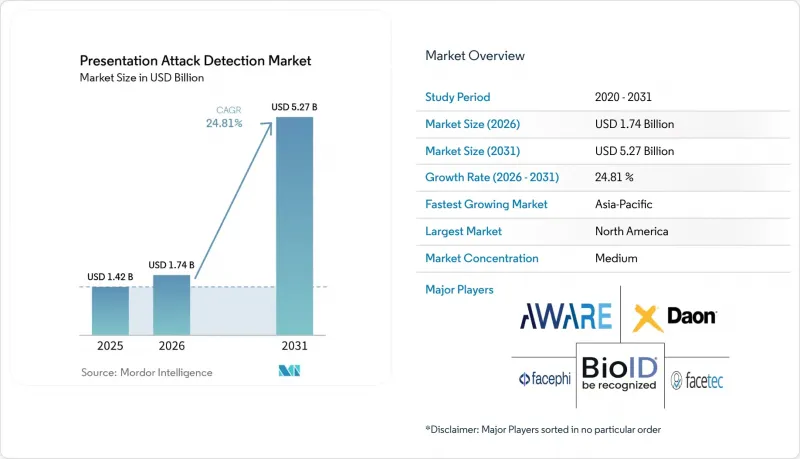
According to Mordor Intelligence, the presentation attack detection market size is projected to expand from USD 1.42 billion in 2025 and USD 1.74 billion in 2026 to USD 5.27 billion by 2031, registering a CAGR of 24.81% between 2026 to 2031.
Global Presentation Attack Detection Market Trends and Insights
Expansion of Remote Identity Verification and Digital Onboarding
Remote identity verification is moving from a differentiator for fintech providers to basic infrastructure across financial services, healthcare, and government services. This shift creates demand for the presentation attack detection market that does not depend only on changes in reported fraud events. NIST Special Publication 800-63-4 requires presentation-attack and injection-attack detection controls for federally compliant credential service providers in the United States. The requirement makes biometric liveness a procurement consideration for organizations pursuing Identity Assurance Level 2 or 3 services. The eIDAS 2.0 rollout has created a parallel requirement for member states to provide digital identity wallets that meet the High assurance level. These requirements extend liveness controls to wallet issuance programs that previously had no separate requirement for presentation attack detection.
Rising Biometric Fraud, Deepfake, and Replay Attack Incidence
The presentation attack detection market is responding to attacks that differ from the risks addressed by earlier biometric systems. Deepfake injection attacks route synthetic video into an authentication workflow instead of placing a false image or mask in front of a camera. The World Economic Forum documented a 783% increase in deepfake injection attacks in 2024 in its Cybercrime Atlas. The Federal Trade Commission reported USD 12.5 billion in total fraud losses during 2024, including USD 2.95 billion from imposter scams. This environment means that a face-matching result alone cannot establish that a video stream came from a genuine live sensor. Organizations are therefore using combinations of capture-point detection, injection detection, and device-integrity checks.
Privacy, Consent, and Biometric Data Governance Concerns
Biometric templates cannot be replaced after compromise, unlike passwords. This makes data handling a central issue for buyers in the presentation attack detection market. The EU AI Act classifies certain biometric identification systems as high-risk and requires conformity assessments, database registration, and post-market monitoring. These obligations can lengthen buying cycles and increase compliance work for enterprises. Illinois BIPA and related laws in Texas and Washington have also increased exposure for organizations that process biometric data without explicit consent. Vendors with on-device, hybrid, or private-cloud products can address data residency needs while preserving the performance required for liveness detection.
Other drivers and restraints analyzed in the detailed report include:
- Regulatory Adoption of Biometric Presentation Attack Detection Standards
- Growth of Frictionless Authentication in Payments and Financial Services
- False Rejection and Demographic Performance Risk
For complete list of drivers and restraints, kindly check the Table Of Contents.
Segment Analysis
Software held 58.49% of the presentation attack detection market share in 2025. Software-based products can use cameras already installed in customer devices, branch networks, and enterprise environments, avoiding the procurement cycle for new sensors. They can receive model updates soon after providers identify a new attack instrument or a change in attacker behavior. This capability gives software suppliers a faster response cycle than products that depend on replacing dedicated hardware across many locations. Cloud delivery strengthens this approach because updated detection models can be distributed without changes to physical devices, local installations, or customer hardware inventories.
Services are projected to record a 27.18% CAGR from 2026 to 2031. Managed operations, integration support, red-team assessments, API orchestration, and ongoing configuration assistance are included in this category. Organizations often need help connecting liveness tools with identity proofing, fraud monitoring, account opening, and customer onboarding processes. They must also manage requirements associated with ISO/IEC 30107-3, CEN/TS 18099, NIST guidance, and FIDO certification. Demand for services reflects the continuing management requirements of multi-standard and multi-vendor deployments, rather than simply a lack of maturity in software products. Service providers must also help customers establish escalation procedures, testing plans, and ownership between fraud, identity, security, and customer operations teams, because live performance affects each of these functions.
Capture-point presentation attack detection held 48.97% of the presentation attack detection market in 2025. This layer addresses printed photographs, display replays, and 3D masks that an attacker presents to a physical camera during enrollment or authentication. Financial institutions, public agencies, and consumer identity providers have used these controls for many years in remote and in-person identity workflows. Its established deployment base supports its position as the largest protection layer because physical spoofing remains a relevant risk for camera-based verification. Digital injection and capture-channel protection addresses synthetic content sent through virtual cameras, USB cameras, function hooks, or other software routes. This method can bypass capture-point controls because the physical camera is never involved in creating the video stream. These controls still have a necessary role in a layered design, since a system that only checks software-channel integrity would not identify a physical artifact shown to a genuine camera.
Integrated PAD and injection-detection solutions are projected to grow at a 28.43% CAGR through 2031. These products combine camera-facing liveness checks with protection against manipulated video entering the authentication software channel. The design responds to the growing importance of deepfake injection attacks in the presentation attack detection market and the need to protect both attack surfaces. The World Economic Forum reported that deepfake injection attacks increased 783% in 2024. A single integrated supplier can reduce the operational burden of managing separate contracts, evaluations, certification paths, and incident-response procedures. Aware reported zero successful injection exploits across 600 attempts in its May 2026 BixeLab evaluation aligned with CEN/TS 18099:2024. The result also shows why buyers are asking for testing evidence that reflects virtual camera, rooted-device, and other injection conditions, rather than relying only on legacy physical-spoofing test results.
Complete Report Scope:
- By Offering
- Software
- Hardware
- Services
- By Protection Layer
- Capture-Point Presentation Attack Detection
- Digital Injection and Capture-Channel Protection
- Integrated PAD and Injection-Detection Solutions
- By Deployment
- Cloud
- On-Premises
- Hybrid
- By Organization Size
- Large Enterprises
- Small and Medium-Sized Enterprises
- By End User
- Banking, Financial Services, and Insurance (BFSI)
- Government and Public Administration
- Healthcare and Life Sciences
- Retail and E-Commerce
- IT and Telecommunications
- Transportation and Logistics
- Media and Entertainment
- Other End Users
- By Geography
- North America
- United States
- Canada
- Mexico
- South America
- Brazil
- Argentina
- Colombia
- Rest of South America
- Europe
- United Kingdom
- Germany
- France
- Italy
- Spain
- Russia
- Rest of Europe
- Asia-Pacific
- China
- India
- Japan
- South Korea
- Singapore
- Indonesia
- Australia
- Rest of Asia-Pacific
- Middle East
- United Arab Emirates
- Saudi Arabia
- Israel
- Turkey
- Rest of Middle East
- Africa
- South Africa
- Nigeria
- Egypt
- Rest of Africa
- North America
Geography Analysis
North America held 38.53% of global revenue in 2025. The region is supported by U.S. federal identity guidance and a large population of financial institutions operating at higher assurance levels. NIST Special Publication 800-63-4 requires presentation and injection attack controls for federally compliant credential services. The United States leads regional demand through financial compliance programs and identity assurance infrastructure. Canada adds procurement activity through its Digital Identity Program and provincial electronic identity work. State biometric privacy laws also shape product design because enterprise buyers need data minimization, encryption, and consent records.
Europe is being shaped by the EU AI Act and eIDAS 2.0 digital wallet requirements. The EU AI Act establishes obligations for high-risk biometric systems, including conformity assessment and post-market monitoring. eIDAS 2.0 requires member states to provide digital wallets at the High assurance level. The United Kingdom, Germany, and France remain the largest national markets in the region. France's France 2030 program funded CLR Labs in January 2026 for work related to biometric and digital identity standardization. This investment supports the development of ISO/IEC 25456 for injection attack detection and can influence future supplier qualification.
Asia-Pacific is projected to grow at a 27.61% CAGR from 2026 to 2031. India's Aadhaar system supports demand across banking, telecommunications, and public services because it operates at very large biometric identity scale. China published GB/T 47519-2026 in April 2026 and is aligning domestic biometric deployment with international standards. South Korea's July 2026 SIM registration change added a telecommunications use case for liveness verification. Japan, Singapore, Indonesia, and Australia contribute through digital identity reform and financial-sector KYC modernization. South America offers demand led by Brazil's financial technology sector, while Colombia and Argentina are expanding digital inclusion programs. The Middle East is led by the United Arab Emirates and Saudi Arabia through national digital identity programs, and Africa has early-stage demand tied to SIM registration and KYC policy discussions. Interpol reported AI involvement in 55% of reported African cybercrimes during 2025 and noted deepfake incidents rose sevenfold between Q2 and Q4 2024.
- Aware, Inc.
- BioID GmbH
- Daon, Inc.
- Facephi Biometria, S.A.
- FaceTec, Inc.
- FPT Information System Corporation
- IDEMIA Identity and Security France S.A.S.
- Identomat Inc.
- Innovatrics, s.r.o.
- iProov Limited
- Jumio Corporation
- Keyless Technologies Limited
- Mitek Systems, Inc.
- NEC Corporation
- Onfido Limited, an Entrust company
- Paravision, Inc.
- Precise Biometrics AB
- Regula Forensics, Inc.
- ROC Technologies, Inc.
- SenseTime Group Inc.
- Shufti Pro Ltd.
- Sumsub
- TECH5 Group
- Thales Digital Identity and Security S.A.S.
- Veridas Digital Authentication Solutions, S.L.
- Veriff OU
Additional Benefits:
- The market estimate (ME) sheet in Excel format
- 3 months of analyst support
TABLE OF CONTENTS
1 INTRODUCTION
- 1.1 Study Assumptions and Market Definition
- 1.2 Scope of the Study
2 RESEARCH METHODOLOGY
3 EXECUTIVE SUMMARY
4 MARKET LANDSCAPE
- 4.1 Market Overview
- 4.2 Market Drivers
- 4.2.1 Expansion of Remote Identity Verification and Digital Onboarding
- 4.2.2 Rising Biometric Fraud, Deepfake, and Replay Attack Incidence
- 4.2.3 Regulatory Adoption of Biometric Presentation Attack Detection Standards
- 4.2.4 Growth of Frictionless Authentication in Payments and Financial Services
- 4.2.5 Camera and Sensor Improvements Enabling On-Device PAD
- 4.2.6 Reusable PAD APIs for Digital Identity Platforms and Developer Ecosystems
- 4.3 Market Restraints
- 4.3.1 Privacy, Consent, and Biometric Data Governance Concerns
- 4.3.2 False Rejection and Demographic Performance Risk
- 4.3.3 Adversarial Adaptation to Publicly Disclosed Detection Methods
- 4.3.4 Fragmented Certification Interpretation Across Deployment Jurisdictions
- 4.4 Value and Supply-Chain Analysis
- 4.5 Regulatory Landscape
- 4.6 Technological Outlook
- 4.7 Impact of Macroeconomic Factors
- 4.8 Porter's Five Forces Analysis
- 4.8.1 Bargaining Power of Suppliers
- 4.8.2 Bargaining Power of Buyers
- 4.8.3 Threat of New Entrants
- 4.8.4 Threat of Substitutes
- 4.8.5 Competitive Rivalry
5 MARKET SIZE AND GROWTH FORECASTS (VALUE)
- 5.1 By Offering
- 5.1.1 Software
- 5.1.2 Hardware
- 5.1.3 Services
- 5.2 By Protection Layer
- 5.2.1 Capture-Point Presentation Attack Detection
- 5.2.2 Digital Injection and Capture-Channel Protection
- 5.2.3 Integrated PAD and Injection-Detection Solutions
- 5.3 By Deployment
- 5.3.1 Cloud
- 5.3.2 On-Premises
- 5.3.3 Hybrid
- 5.4 By Organization Size
- 5.4.1 Large Enterprises
- 5.4.2 Small and Medium-Sized Enterprises
- 5.5 By End User
- 5.5.1 Banking, Financial Services, and Insurance (BFSI)
- 5.5.2 Government and Public Administration
- 5.5.3 Healthcare and Life Sciences
- 5.5.4 Retail and E-Commerce
- 5.5.5 IT and Telecommunications
- 5.5.6 Transportation and Logistics
- 5.5.7 Media and Entertainment
- 5.5.8 Other End Users
- 5.6 By Geography
- 5.6.1 North America
- 5.6.1.1 United States
- 5.6.1.2 Canada
- 5.6.1.3 Mexico
- 5.6.2 South America
- 5.6.2.1 Brazil
- 5.6.2.2 Argentina
- 5.6.2.3 Colombia
- 5.6.2.4 Rest of South America
- 5.6.3 Europe
- 5.6.3.1 United Kingdom
- 5.6.3.2 Germany
- 5.6.3.3 France
- 5.6.3.4 Italy
- 5.6.3.5 Spain
- 5.6.3.6 Russia
- 5.6.3.7 Rest of Europe
- 5.6.4 Asia-Pacific
- 5.6.4.1 China
- 5.6.4.2 India
- 5.6.4.3 Japan
- 5.6.4.4 South Korea
- 5.6.4.5 Singapore
- 5.6.4.6 Indonesia
- 5.6.4.7 Australia
- 5.6.4.8 Rest of Asia-Pacific
- 5.6.5 Middle East
- 5.6.5.1 United Arab Emirates
- 5.6.5.2 Saudi Arabia
- 5.6.5.3 Israel
- 5.6.5.4 Turkey
- 5.6.5.5 Rest of Middle East
- 5.6.6 Africa
- 5.6.6.1 South Africa
- 5.6.6.2 Nigeria
- 5.6.6.3 Egypt
- 5.6.6.4 Rest of Africa
- 5.6.1 North America
6 COMPETITIVE LANDSCAPE
- 6.1 Market Concentration
- 6.2 Strategic Moves
- 6.3 Market Share Analysis
- 6.4 Company Profiles (includes Global Level Overview, Market Level Overview, Core Segments, Financials as available, Strategic Information, Market Rank/Share, Products and Services, Recent Developments)
- 6.4.1 Aware, Inc.
- 6.4.2 BioID GmbH
- 6.4.3 Daon, Inc.
- 6.4.4 Facephi Biometria, S.A.
- 6.4.5 FaceTec, Inc.
- 6.4.6 FPT Information System Corporation
- 6.4.7 IDEMIA Identity and Security France S.A.S.
- 6.4.8 Identomat Inc.
- 6.4.9 Innovatrics, s.r.o.
- 6.4.10 iProov Limited
- 6.4.11 Jumio Corporation
- 6.4.12 Keyless Technologies Limited
- 6.4.13 Mitek Systems, Inc.
- 6.4.14 NEC Corporation
- 6.4.15 Onfido Limited, an Entrust company
- 6.4.16 Paravision, Inc.
- 6.4.17 Precise Biometrics AB
- 6.4.18 Regula Forensics, Inc.
- 6.4.19 ROC Technologies, Inc.
- 6.4.20 SenseTime Group Inc.
- 6.4.21 Shufti Pro Ltd.
- 6.4.22 Sumsub
- 6.4.23 TECH5 Group
- 6.4.24 Thales Digital Identity and Security S.A.S.
- 6.4.25 Veridas Digital Authentication Solutions, S.L.
- 6.4.26 Veriff OU
7 MARKET OPPORTUNITIES AND FUTURE OUTLOOK
- 7.1 White-Space and Unmet-Need Assessment

