PUBLISHER: Mordor Intelligence | PRODUCT CODE: 2157010

PUBLISHER: Mordor Intelligence | PRODUCT CODE: 2157010
Hot Rolled Coil Steel - Market Share Analysis, Industry Trends & Statistics, Growth Forecasts (2026 - 2031)
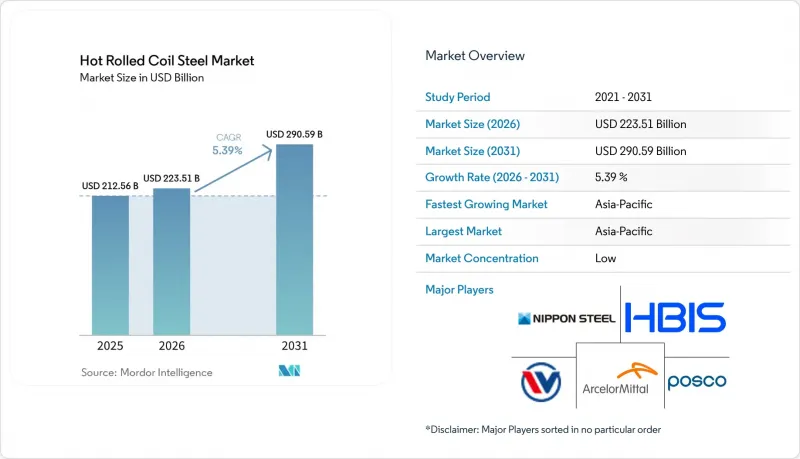
According to Mordor Intelligence, the hot rolled coil steel market size was valued at USD 212.56 billion in 2025 and is estimated to grow from USD 223.51 billion in 2026 to reach USD 290.59 billion by 2031, at a CAGR of 5.39% during the forecast period (2026-2031).
Global Hot Rolled Coil Steel Market Trends and Insights
Infrastructure Renewal and Public-Utility Modernization
Public infrastructure spending is supporting demand in economies that account for a large share of global hot rolled coil consumption. India's crude steelmaking capacity reached 222 million tons per annum (MTPA) by June 2026, while the National Steel Policy targets 300 MTPA by 2030. Finished steel consumption in India grew by 8.3% in the April to June 2026 quarter, driven by progress in roads, ports, railways, and housing programs. Data centers and related digital infrastructure are adding steel requirements beyond conventional construction. Saudi Arabia's Vision 2030-linked steel demand grew 11.5% in 2025, supported by advances in transport, urban, and energy projects.
Automotive Lightweighting and Electric Vehicle Production
The automotive transition is increasing demand for specialty hot rolled coil grades rather than reducing steel's role in vehicle production. Electric vehicles accounted for 15% of U.S. light-vehicle output in 2025, driving demand for battery enclosures, motor housings, and underbody parts. Aluminum megacasting remains selective due to high capital requirements, manufacturing risk, and a demanding learning curve. Advanced high-strength steel retains a cost-and-performance advantage in crash-critical chassis and underbody components. Hyundai Steel completed the development of third-generation advanced high-strength steel in February 2026 and is conducting customer trials. Thirteen of 18 major automakers had low-carbon steel procurement policies in place in 2026, supporting demand for traceable and certified coil.
Iron Ore, Coking Coal, Scrap, and Energy Price Volatility
Raw material costs are compressing producer margins across the hot rolled coil steel market. Premium hard coking coal averaged USD 236 per metric ton FOB Australia in the first seven months of 2026, up 25% year over year. A fatal mine accident in Shanxi idled 50 metric tons per annum (MTPA) of domestic Chinese supply, while labor negotiations at Port Hedland tightened seaborne supply conditions. Fitch raised its 2026 coking coal forecast to USD 220 per metric ton and projected iron ore to average USD 100 per dry metric ton. Chinese integrated producers can absorb shocks more readily than independent mills due to scale, policy support, and access to domestic ore. Mill outages, allocation risk, and extended lead times add further short-term pressure in North America and Europe.
Other drivers and restraints analyzed in the detailed report include:
- Manufacturing Expansion and Industrial Equipment Demand
- Energy-Transition Infrastructure and Grid Investment
- Substitution by Aluminum, Composites, and Engineered Wood
For complete list of drivers and restraints, kindly check the Table Of Contents.
Segment Analysis
Grades greater than 3 mm held 66.43% of the hot rolled coil steel market in 2025. Their application in structural beams, heavy plate, wind-tower sections, and industrial machinery supports this position. Construction and infrastructure projects in India, ASEAN, Saudi Arabia, and North America provide consistent demand for this category. Heavy-gauge grades also meet the material requirements of utility and renewable energy infrastructure. Their broad base of applications gives producers a relatively stable source of output.
Grades of 3 mm or less are used in automotive stamping, light fabrication, and appliance manufacturing. These products allow material savings and precision forming where heavier coil is less suitable. The European Commission's Implementing Regulation 2026/1963 takes effect on October 1, 2026, requiring country-of-melt-and-pour evidence for imported steel. From October 1, 2027, this evidence requirement becomes mandatory in all cases. Grades greater than 3 mm are forecast to grow at a 5.67% CAGR through 2031. Documentation requirements are likely to favor mills with established EN 10204-compliant quality systems.
Complete Report Scope:
- By Thickness
- Less Than or Equal to 3 mm
- Greater Than 3 mm
- By Steel Grade
- Low-Carbon Steel
- Medium-Carbon Steel
- High-Carbon Steel
- Others
- By End-User Industry
- Construction and Infrastructure
- Oil and Gas
- Automotive
- Industrial Machinery and Equipment
- Other End Uses
- By Geography
- Asia-Pacific
- China
- India
- Japan
- South Korea
- ASEAN Countries
- Rest of Asia-Pacific
- North America
- United States
- Canada
- Mexico
- Europe
- Germany
- United Kingdom
- France
- Italy
- NORDIC Countries
- Russia
- Rest of Europe
- South America
- Brazil
- Argentina
- Rest of South America
- Middle East and Africa
- Saudi Arabia
- South Africa
- Rest of Middle East and Africa
- Asia-Pacific
Geography Analysis
Asia-Pacific accounted for 52.17% of the hot rolled coil steel market share in 2025 and is projected to grow at a 6.14% CAGR through 2031. India's finished steel consumption grew 8.3% in the April to June 2026 quarter, while capacity reached 222 million tons per annum (MTPA). China's hot rolled coil capacity reached 410 million tons by the end of 2025, up from 300 million tons in 2020. China exported 119 million tons of steel in 2025, an increase of 7.5%, and early-2026 free-on-board (FOB) hot-rolled coil prices were USD 460 per ton. Vietnam's crude steel output grew 27.2% in May 2026, reflecting its expanding manufacturing role.
North America and Europe are undergoing a structural transition. Infrastructure spending, a recovery in residential construction, and additions to electric arc furnaces are reshaping the U.S. supply position. In January 2026, U.S. hot rolled coil prices were more than twice Chinese prices, while European Union prices were 50% higher. The European Union Carbon Border Adjustment Mechanism became fully operational in January 2026, raising the effective cost of carbon-intensive imported coil and favoring domestic or low-carbon supply.
Brazil's infrastructure activity and Argentina's resource projects support regional demand, although imports continue to pressure local mills. Africa recorded 16.1% growth in steel demand in 2025, while the Middle East recorded 6.4% growth. Egypt's flat steel consumption is forecast to grow 1.8% in 2026, supported by the 900 MW Ras Shokeir offshore wind project. XinFeng Steel is pursuing a USD 10 billion integrated complex in Egypt's Suez Canal Economic Zone with a capacity of 10 MTPA. These developments indicate the region's shift from import dependence toward greater domestic production.
- Ansteel Group Corporation Limited
- ARCELORMITTAL
- BAOWU Metal
- Cleveland-Cliffs Inc.
- HBIS GROUP
- Hyundai Steel
- JFE Steel Corporation
- JSW Steel
- NIPPON STEEL CORPORATION
- Nucor Corporation
- POSCO
- Shagang Group
- Shougang Group
- Steel Dynamics
- Tata Steel
Additional Benefits:
- The market estimate (ME) sheet in Excel format
- 3 months of analyst support
TABLE OF CONTENTS
1 Introduction
- 1.1 Study Assumptions and Market Definition
- 1.2 Scope of the Study
2 Research Methodology
3 Executive Summary
4 Market Landscape
- 4.1 Market Overview
- 4.2 Market Drivers
- 4.2.1 Infrastructure Renewal and Public-Utility Modernization
- 4.2.2 Automotive Lightweighting and Electric Vehicle Production
- 4.2.3 Manufacturing Expansion and Industrial Equipment Demand
- 4.2.4 Energy-Transition Infrastructure and Grid Investment
- 4.2.5 Application-Specific Certification and Traceability Requirements
- 4.3 Market Restraints
- 4.3.1 Iron Ore, Coking Coal, Scrap and Energy Price Volatility
- 4.3.2 Substitution by Aluminum, Composites and Engineered Wood
- 4.3.3 Mill Outages, Allocation Risk and Extended Lead Times
- 4.4 Value Chain Analysis
- 4.5 Porter's Five Forces Analysis
- 4.5.1 Bargaining Power of Suppliers
- 4.5.2 Bargaining Power of Buyers
- 4.5.3 Threat of New Entrants
- 4.5.4 Threat of Substitutes
- 4.5.5 Competitive Rivalry
5 Market Size and Growth Forecasts (Value)
- 5.1 By Thickness
- 5.1.1 Less Than or Equal to 3 mm
- 5.1.2 Greater Than 3 mm
- 5.2 By Steel Grade
- 5.2.1 Low-Carbon Steel
- 5.2.2 Medium-Carbon Steel
- 5.2.3 High-Carbon Steel
- 5.2.4 Others
- 5.3 By End-User Industry
- 5.3.1 Construction and Infrastructure
- 5.3.2 Oil and Gas
- 5.3.3 Automotive
- 5.3.4 Industrial Machinery and Equipment
- 5.3.5 Other End Uses
- 5.4 By Geography
- 5.4.1 Asia-Pacific
- 5.4.1.1 China
- 5.4.1.2 India
- 5.4.1.3 Japan
- 5.4.1.4 South Korea
- 5.4.1.5 ASEAN Countries
- 5.4.1.6 Rest of Asia-Pacific
- 5.4.2 North America
- 5.4.2.1 United States
- 5.4.2.2 Canada
- 5.4.2.3 Mexico
- 5.4.3 Europe
- 5.4.3.1 Germany
- 5.4.3.2 United Kingdom
- 5.4.3.3 France
- 5.4.3.4 Italy
- 5.4.3.5 NORDIC Countries
- 5.4.3.6 Russia
- 5.4.3.7 Rest of Europe
- 5.4.4 South America
- 5.4.4.1 Brazil
- 5.4.4.2 Argentina
- 5.4.4.3 Rest of South America
- 5.4.5 Middle East and Africa
- 5.4.5.1 Saudi Arabia
- 5.4.5.2 South Africa
- 5.4.5.3 Rest of Middle East and Africa
- 5.4.1 Asia-Pacific
6 Competitive Landscape
- 6.1 Market Concentration
- 6.2 Strategic Moves
- 6.3 Market Share (%)/Ranking Analysis
- 6.4 Company Profiles (includes Global Overview, Market Overview, Core Segments, Financials as available, Strategic Information, Products and Services, and Recent Developments)
- 6.4.1 Ansteel Group Corporation Limited
- 6.4.2 ARCELORMITTAL
- 6.4.3 BAOWU Metal
- 6.4.4 Cleveland-Cliffs Inc.
- 6.4.5 HBIS GROUP
- 6.4.6 Hyundai Steel
- 6.4.7 JFE Steel Corporation
- 6.4.8 JSW Steel
- 6.4.9 NIPPON STEEL CORPORATION
- 6.4.10 Nucor Corporation
- 6.4.11 POSCO
- 6.4.12 Shagang Group
- 6.4.13 Shougang Group
- 6.4.14 Steel Dynamics
- 6.4.15 Tata Steel
7 Market Opportunities and Future Outlook
- 7.1 White-Space and Unmet-Need Assessment

