PUBLISHER: Mordor Intelligence | PRODUCT CODE: 2157019

PUBLISHER: Mordor Intelligence | PRODUCT CODE: 2157019
Indonesia Refrigerated Trucking - Market Share Analysis, Industry Trends & Statistics, Growth Forecasts (2026 - 2031)
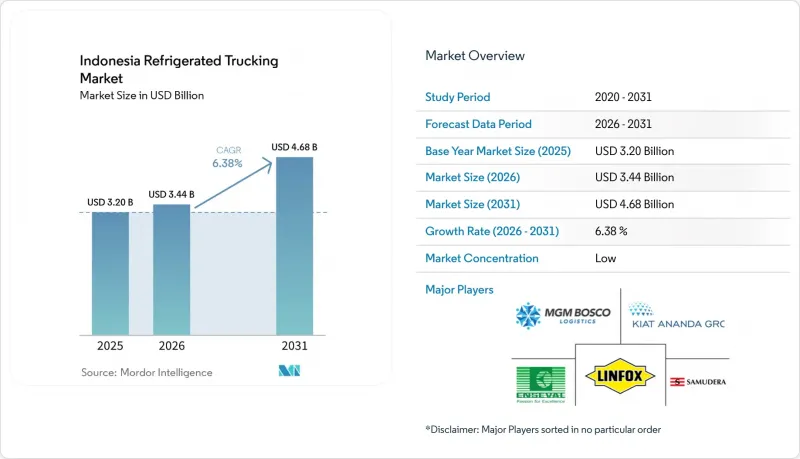
According to Mordor Intelligence, the Indonesia refrigerated trucking market size was valued at USD 3.20 billion in 2025, and is estimated to grow from USD 3.44 billion in 2026 to reach USD 4.68 billion by 2031, at a CAGR of 6.38% during the forecast period (2026-2031).
Indonesia Refrigerated Trucking Market Trends and Insights
Expansion Of Organized Retail, E-Commerce Grocery, And Multi-Temperature Last-Mile Delivery
Organized retail is increasing the number of locations that need to receive fresh, chilled, and frozen products on a regular schedule. Dark stores and micro-fulfillment sites require several replenishment runs each day, rather than the weekly bulk deliveries used in traditional distribution. This operating pattern supports shared refrigerated capacity and makes LTL services more relevant to the Indonesia refrigerated trucking market. Minimarket networks also require controlled handling for fresh and chilled products as their coverage extends into secondary cities. The demand for multi-temperature delivery adds pressure on operators to deploy vehicles that can protect different cargo conditions in one route. Small food producers can use outsourced refrigerated transport instead of carrying the capital cost of dedicated fleets, which broadens the customer base for established logistics providers.
Growth In Seafood, Meat, Poultry, And Frozen-Food Distribution
Seafood, meat, poultry, and frozen food create a steady volume base for the Indonesia refrigerated trucking market because these products depend on temperature control from collection through delivery. The Ministry of Marine Affairs and Fisheries is strengthening cold-storage information systems to support fisheries downstream activities and more integrated handling. The National Fish Logistics and Traceability System, known as Stelina, is formalizing documentation through seafood supply chains from 2026. The ministry has also stated that cold-chain facilities are being integrated across fishing-village locations, which can create demand for links between collection points, storage sites, and urban buyers. Slurry ice at fishing villages can preserve catch quality at the point of landing, leaving refrigerated transport as the next required connection in the chain. Frozen food also benefits from the growing demand for processed and convenience products in urban retail channels.
High Fleet Acquisition, Maintenance, Energy, And Skills Costs
High acquisition costs remain a central barrier for the Indonesia refrigerated trucking market, especially for smaller logistics operators. Refrigerated vehicles require specialized bodies, refrigeration units, monitoring equipment, and preventive maintenance that dry-cargo fleets do not need. Imported parts add cost and can lengthen repair cycles when equipment fails outside major service centers. Fuel use and refrigeration energy costs are more difficult to manage where grid reliability is weak, and operators depend on generator support. GDP-related handling requirements also add recurring costs for calibration, temperature records, and driver training. MGM Bosco Logistics received an IDR 720 billion (USD 41 million) financing facility in June 2026 to support fleet acquisition, cold-storage construction, and national expansion, illustrating the scale of capital required for integrated cold-chain growth.
Other drivers and restraints analyzed in the detailed report include:
- Pharmaceutical And Vaccine Cold-Chain Expansion
- Government-Led Cold-Chain Modernization And Food-Producer Outsourcing
- Archipelagic Transshipment And Uneven Road Infrastructure
For complete list of drivers and restraints, kindly check the Table Of Contents.
Segment Analysis
Meats, poultry, fish, and seafood held 42.25% of the Indonesia refrigerated trucking market share in 2025, while healthcare and pharmaceutical is forecast to grow at 8.23% CAGR through 2031, the fastest rate among application segments. The meats, poultry, fish, and seafood segment reflects the importance of protein distribution in domestic food supply chains and the large volume of seafood moving from coastal processing areas. Formal traceability and cold-chain handling can bring cargo that previously moved through informal channels into temperature-controlled networks. Fisheries collection points, cold storage, wholesalers, and retailers all need transport links that preserve product condition. This need makes protein cargo a foundational source of utilization for the Indonesia refrigerated trucking market. The segment also supports regular short-haul deliveries to supermarkets, wet-market suppliers, restaurants, and foodservice customers.
The Indonesia refrigerated trucking market size for this application benefits from requirements for validated temperature handling and recorded delivery conditions. Vaccine, biologic, and specialty medicine shipments frequently require smaller, multi-stop routes to hospitals, clinics, and distributors. The same monitoring equipment used for these contracts can improve the service standard of food and dairy routes. Dairy and Frozen Dessert Products, Horticultural Products, and Processed Food Products form another layer of demand through retail replenishment. Other Applications include chemicals, floriculture, and cosmetics, where controlled conditions can become necessary when product specifications or compliance requirements require them.
Full-truckload held 64.78% of the Indonesia refrigerated trucking market share in 2025, while less-than-truckload is expected to advance at 7.65% CAGR through 2031. FTL is preferred by high-volume shippers, such as food manufacturers, fisheries exporters, and supermarket chains, operating regular routes between production sites and distribution centers. Full vehicle utilization spreads refrigeration, fuel, and maintenance costs across larger shipments, improving cost efficiency. Its suitability for planned line-haul operations and predictable delivery schedules is expected to sustain FTL's leading market position.
The Indonesia refrigerated trucking market size for LTL is supported by online grocery replenishment, smaller producers, and pharmaceutical deliveries that need multiple drops. Shared capacity helps producers use professional refrigerated transport without committing to a full vehicle. Multi-temperature scheduling becomes important because each route can carry products with different handling needs. Pharmaceutical shipments often use smaller consignments across hospitals and clinics, which is consistent with a multi-drop model. Operators that improve load consolidation, routing, and temperature visibility can compete more effectively as this model scales.
Complete Report Scope:
- By Application
- Horticultural Products
- Dairy and Frozen Dessert Products
- Meats, Poultry, Fish, and Seafood
- Processed Food Products
- Healthcare and Pharmaceutical
- Other Applications
- By Truckload Specification
- Full-Truckload (FTL)
- Less-than-Truckload (LTL)
- By Containerization
- Containerized
- Non-Containerized
- By Distance
- Long Haul
- Short Haul
- By Destination
- Domestic
- Cross-border
- By Temperature Type
- Chilled (0-5 °C)
- Frozen (-20-0 °C)
- Ambient
- Deep-Frozen / Ultra-Low (Less than -20 °C)
- By Region
- Java (Jakarta & BOD)
- Sumatra
- Kalimantan
- Sulawesi
- Bali and Nusa Tenggara
- Papua Region and Maluku Islands
List of Companies Covered in this Report:
- Kiat Ananda Group
- PT Linfox Logistics Indonesia
- MGM Bosco Logistics
- Samudera Indonesia Group / Adib Cold Logistics
- PT Enseval Putera Megatrading Tbk
- DHL Group
- PT YCH Indonesia
- PT Mitsubishi Logistics Indonesia
- PT Yusen Logistics Indonesia
- WET Logistics / PT Wahana Enviromate Trustindo
- Coldspace
- VITRANS / PT Selaras Mandiri Raya Trans
- AntarEs / PT Agung Solusi Dingin
- Giant Transporter Indonesia
- NX Group / PT NX Lemo Indonesia Logistik
- PT Anugerah Pharmindo Lestari
- Truckinc Logistik Indonesia
- Coolkas
- PT Superkul Amerta Indonesia
- PT Bahari Trans Logistik
- PT Samudra Jaya Cakra
- PT Talenta Gelora Serafim
Additional Benefits:
- The market estimate (ME) sheet in Excel format
- 3 months of analyst support
TABLE OF CONTENTS
1 INTRODUCTION
- 1.1 Study Assumptions and Market Definition
- 1.2 Scope of the Study
2 RESEARCH METHODOLOGY
3 EXECUTIVE SUMMARY
- 3.1 Market Size, Growth, and Forecast Outlook
- 3.2 Key Demand Drivers and Cold Chain Trends
- 3.3 Regional Reefer Corridors and Demand Concentration
- 3.4 Competitive Landscape and Leading Refrigerated Trucking Providers
4 MARKET LANDSCAPE
- 4.1 Market Overview and Importance of Refrigerated Trukcing Transport
- 4.2 Market Drivers
- 4.2.1 Expansion of Organized Retail and E-Commerce Grocery
- 4.2.2 Growth in Seafood, Meat, Poultry, and Frozen-Food Distribution
- 4.2.3 Pharmaceutical and Vaccine Cold-Chain Expansion
- 4.2.4 Government-Led Cold-Chain and Fisheries Logistics Modernization
- 4.2.5 Multi-Temperature Last-Mile Delivery Demand
- 4.2.6 Cold-Chain Outsourcing by Small and Medium-Sized Food Producers
- 4.3 Market Restraints
- 4.3.1 High Fleet Acquisition and Refrigeration Maintenance Costs
- 4.3.2 Archipelagic Transshipment and Uneven Road Infrastructure
- 4.3.3 Electricity Reliability and Refrigeration Energy Costs
- 4.3.4 Shortage of Trained Reefer Drivers and Technicians
- 4.4 Value Chain Structure and Supply Dynamics Analysis
- 4.5 Regulatory Framework for Temperature-Controlled Freight Operations
- 4.6 Technology Adoption in Refrigerated Fleet Management
- 4.7 Refrigerated Trucking Pricing and Freight Rate Analysis
- 4.8 Fuel Prices and Refrigerated Transport Cost Implications
- 4.9 Cold Chain Network and Reefer Route Analysis
- 4.10 Refrigerated Truck Fleet Availability and Capacity Trends
- 4.11 Porter's Five Forces Analysis
- 4.11.1 Threat of New Entrants
- 4.11.2 Bargaining Power of Buyers and Consumers
- 4.11.3 Bargaining Power of Suppliers
- 4.11.4 Threat of Substitute Services
- 4.11.5 Intensity of Competitive Rivalry
- 4.12 Impact of Geo-Political Events on Supply Chain Shifts
5 MARKET SIZE AND GROWTH FORECASTS
- 5.1 By Application
- 5.1.1 Horticultural Products
- 5.1.2 Dairy and Frozen Dessert Products
- 5.1.3 Meats, Poultry, Fish, and Seafood
- 5.1.4 Processed Food Products
- 5.1.5 Healthcare and Pharmaceutical
- 5.1.6 Other Applications
- 5.2 By Truckload Specification
- 5.2.1 Full-Truckload (FTL)
- 5.2.2 Less-than-Truckload (LTL)
- 5.3 By Containerization
- 5.3.1 Containerized
- 5.3.2 Non-Containerized
- 5.4 By Distance
- 5.4.1 Long Haul
- 5.4.2 Short Haul
- 5.5 By Destination
- 5.5.1 Domestic
- 5.5.2 Cross-border
- 5.6 By Temperature Type
- 5.6.1 Chilled (0-5 °C)
- 5.6.2 Frozen (-20-0 °C)
- 5.6.3 Ambient
- 5.6.4 Deep-Frozen / Ultra-Low (Less than -20 °C)
- 5.7 By Region
- 5.7.1 Java (Jakarta & BOD)
- 5.7.2 Sumatra
- 5.7.3 Kalimantan
- 5.7.4 Sulawesi
- 5.7.5 Bali and Nusa Tenggara
- 5.7.6 Papua Region and Maluku Islands
6 COMPETITIVE LANDSCAPE
- 6.1 Market Concentration
- 6.2 Strategic Moves
- 6.3 Market Share Analysis
- 6.4 Company Profiles (includes Global Level Overview, Market Level Overview, Core Segments, Financials as available, Strategic Information, Geographic Coverage, Products and Services, Recent Developments)
- 6.4.1 Kiat Ananda Group
- 6.4.2 PT Linfox Logistics Indonesia
- 6.4.3 MGM Bosco Logistics
- 6.4.4 Samudera Indonesia Group / Adib Cold Logistics
- 6.4.5 PT Enseval Putera Megatrading Tbk
- 6.4.6 DHL Group
- 6.4.7 PT YCH Indonesia
- 6.4.8 PT Mitsubishi Logistics Indonesia
- 6.4.9 PT Yusen Logistics Indonesia
- 6.4.10 WET Logistics / PT Wahana Enviromate Trustindo
- 6.4.11 Coldspace
- 6.4.12 VITRANS / PT Selaras Mandiri Raya Trans
- 6.4.13 AntarEs / PT Agung Solusi Dingin
- 6.4.14 Giant Transporter Indonesia
- 6.4.15 NX Group / PT NX Lemo Indonesia Logistik
- 6.4.16 PT Anugerah Pharmindo Lestari
- 6.4.17 Truckinc Logistik Indonesia
- 6.4.18 Coolkas
- 6.4.19 PT Superkul Amerta Indonesia
- 6.4.20 PT Bahari Trans Logistik
- 6.4.21 PT Samudra Jaya Cakra
- 6.4.22 PT Talenta Gelora Serafim
7 MARKET OPPORTUNITIES AND FUTURE OUTLOOK
- 7.1 White-Space Opportunities and Unmet Cold Chain Needs
- 7.2 High-Potential End-User and Regional Growth Opportunities
- 7.3 Strategic Growth Priorities Across Refrigerated Trucking Ecosystem
- 7.4 Future Market Outlook and Emerging Demand Pockets
8 APPENDIX

