PUBLISHER: Mordor Intelligence | PRODUCT CODE: 2157034

PUBLISHER: Mordor Intelligence | PRODUCT CODE: 2157034
Cash Management Services - Market Share Analysis, Industry Trends & Statistics, Growth Forecasts (2026 - 2031)
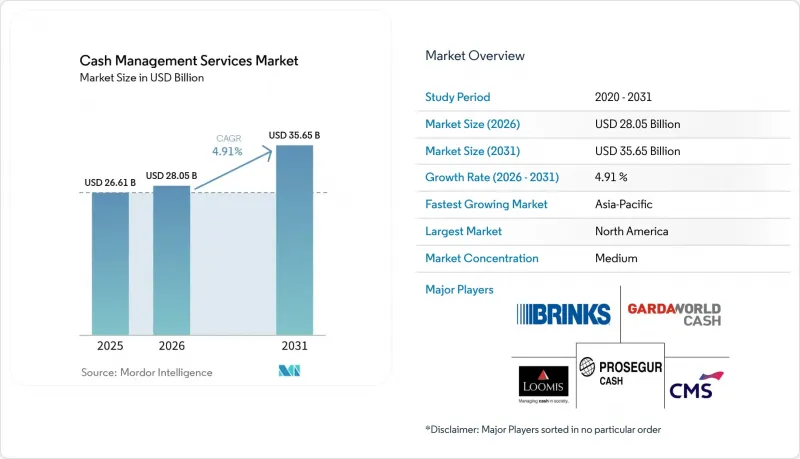
According to Mordor Intelligence, the cash management services market size is expected to grow from USD 26.61 billion in 2025 to USD 28.05 billion in 2026, and is forecast to reach USD 35.65 billion by 2031, at a 4.91% CAGR over 2026-2031.
Global Cash Management Services Market Trends and Insights
Bank and Retail Cash-Handling Outsourcing
Outsourcing has become a longer-term operating choice for banks and organized retailers that want specialist support for cash operations. The change is widening contracts beyond transportation to include ATM management, cash processing, reporting, and service-level commitments. CMS Info Systems began a 10-year integrated cash solutions contract for approximately 5,000 State Bank of India ATMs in January 2026. The contract value was INR 1,000 crore (USD 119 million), marking the company's first direct, large-scale public-sector bank outsourcing award. CMS Info Systems also shifted more of its FY26 business toward fixed-fee contracts, reducing reliance on transaction volumes while offering banks planned uptime and cash availability.
Brink's announced an agreement to acquire NCR Atleos for USD 6.6 billion in February 2026. The proposed combination would bring cash logistics together with a global ATM installed base and an ATM-as-a-Service platform. This approach shows why the cash management services market is moving toward bundled contracts with operational and technology components. In the cash management services market, these arrangements can provide customers with a single provider for service continuity, accountability, and cash visibility. They can also give providers more stable revenue than individual pickup assignments. The opportunity is strongest for operators that can manage liability while supporting large, distributed client networks.
Cash Circulation Resilience in Emerging Markets
In the cash management services market, digital payments and cash use continued to expand simultaneously across several emerging economies. In India, currency in circulation maintained a year-over-year growth trajectory, even as UPI transaction values continued to reach new monthly highs. This trend highlights the continued importance of cash in the economy despite the rapid adoption of digital payment methods. As a result, cash collection, distribution, verification, sorting, and replenishment services remain essential for banks, financial institutions, retailers, and other merchants. The coexistence of cash and digital payments also makes cash demand patterns more complex and difficult to predict across rural, semi-urban, and urban locations.
The Reserve Bank of India produces 28-30 billion banknotes each year across 6 denominations. India had 176 billion notes in circulation, which creates a large recurring requirement for secure movement and processing. Prosegur Cash recorded 21.7% organic revenue expansion in Asia-Pacific during 2025, its strongest regional outcome. Its Transformation Products revenue in the region increased 53.9%, supported by provisional credit and cash automation services. The cash management services market has room for well-capitalized providers that can make lower-density routes viable through effective route planning and scalable operating models.
Structural Decline in Cash Usage in Mature Economies
Lower cash transaction frequency in mature economies reduces demand for traditional cash-in-transit routes. Bank branch consolidation also reduces the number of locations requiring regular collection, replenishment, or vault services. This pressure is most visible where digital payment adoption is high, and cash volumes per stop are declining. Providers in these areas face a more difficult route-density equation. They also face more customer pressure on pricing when clients have fewer physical locations to support.
In the cash management services market, the restraint does not eliminate the need for cash services; it shifts where value is created. Cash management services market providers can reduce their exposure to individual-trip billing by offering cash-under-management and subscription arrangements. They can also combine cash services with ATM management, automation, and reporting. This helps preserve revenue as pickup frequency declines. The cash management services market remains exposed when traditional route economics do not support the fleet and security resources required. Operators with diversified service portfolios are better placed to maintain customer relevance in lower-volume environments.
Other drivers and restraints analyzed in the detailed report include:
- Smart Safe and Cash-Recycling Adoption
- ATM Network Optimization and Managed Services
- High Insurance, Security, and Fleet Operating Costs
For complete list of drivers and restraints, kindly check the Table Of Contents.
Segment Analysis
Cash collection and processing held 40.37% of global demand in 2025. Its position reflected recurring reconciliation needs at bank branches, supermarkets, and fuel retail sites. These customers require secure collection, verification, transport, and deposit handling. The segment's scale depends on recurring operating volume rather than on price alone. Cash management services market providers compete on route density, processing accuracy, custody controls, and the speed of bank credit. ATM replenishment and cash supply to bank branches remain important where banks operate extensive ATM and branch networks.
Smart Safe-as-a-Service is projected to expand at a 5.91% CAGR from 2026 to 2031. The cash management services market size for this service is supported by a subscription model that replaces customer-owned equipment with ongoing managed support. The model can provide real-time cash visibility and provisional credit before physical collection occurs. Sesami's Casey's deployment showed how a connected smart safe network can reduce idle balances and unnecessary collections. Maintenance and managed services also benefit, as banks prefer defined uptime commitments to maintaining all ATM engineering capabilities internally. The service mix increasingly rewards providers that combine reliable field operations with useful data and clear performance reporting.
Banking and financial institutions accounted for 46.29% of demand in 2025. Their position reflected ATM networks, vault requirements, and complex cash supply chains. Large banking contracts often involve specialized operational controls and multi-year service commitments. These characteristics can make supplier changes more difficult once a program is fully deployed. CMS Info Systems' 10-year contract for approximately 5,000 State Bank of India ATMs illustrates the extended commitments that can arise from outsourced cash operations.
Government and public sector services are projected to expand at a 5.89% CAGR through 2031. Public agencies handle cash through tax collection, transit operations, state-owned retail, and local service locations. The New Hampshire Liquor Commission's 2026 procurement required smart safe systems, armored transport, and real-time cash-status reporting for 65 stores. Organized retail remains an important customer group because it seeks lower cash shrinkage and fewer collection visits. Hospitality demand is more seasonal and is concentrated around tourist locations across Europe, the Middle East, and Southeast Asia. Fuel retailers and industrial parks also handle substantial daily cash volumes in locations with less developed payment infrastructure.
Complete Report Scope:
- By Service Type
- ATM Replenishment
- Cash Collection and Processing
- Cash Supply to Bank Branches
- Maintenance and Managed Services
- Smart Safe-as-a-Service
- By End-User Industry
- Retail - Organised
- BFSI
- Hospitality
- Government and Public Sector
- Petrochemicals and Industrial Parks
- By Provider Type
- Commercial Banks
- Cash-in-Transit Companies
- Independent Service Vendors / Technology Providers
- By Cash Handling Technology
- Cash Recycler ATMs
- Smart Safes and Cash Deposit Machines
- Banknote Sorters and Validators
- RFID-Based Sealed Cash Bags
- By Cash Volume Band
- High-Volume Sites
- Mid-Volume Sites
- Low-Volume Sites
- By Geography
- North America
- United States
- Canada
- Mexico
- South America
- Brazil
- Argentina
- Rest of South America
- Europe
- Germany
- United Kingdom
- France
- Italy
- Spain
- Rest of Europe
- Asia-Pacific
- China
- Japan
- India
- South Korea
- ASEAN
- Rest of Asia-Pacific
- Middle East and Africa
- Middle East
- Saudi Arabia
- United Arab Emirates
- Rest of the Middle East
- Africa
- South Africa
- Nigeria
- Rest of Africa
- Middle East
- North America
Geography Analysis
North America held 26.14% of global demand in 2025. The region's position rests on extensive ATM networks, organized retail density, and mature outsourced vault and cash-in-transit services. Digital payment use and branch consolidation are placing pressure on conventional cash routes. At the same time, customers still require secure ATM replenishment, cash processing, and accountable service continuity. Brink's announced its planned acquisition of NCR Atleos for USD 6.6 billion in February 2026. The proposal would combine cash-handling operations with ATM servicing, owned ATMs, and ATM-as-a-Service capabilities.
South America is a key location for provider expansion where cash remains important in retail payments. Loomis announced a tender offer for Hermes Transportes Blindados in Peru in May 2026. The transaction had an enterprise value of SEK 4 billion (USD 381 million), and involved a company with a 50% market share in Peru and 3,200 employees. Loomis also agreed to acquire Transportadora del Interior in Argentina for SEK 180 million (USD 17 million). Europe has a mixed outlook, with highly digital Nordic markets alongside cash-intensive Southern and Eastern European economies. Prosegur Cash recorded 1.5% organic revenue growth in Europe in 2025, while Transformation Products accounted for 33% of European sales.
Asia-Pacific is projected to expand at a 5.93% CAGR from 2026 to 2031. Regional demand is supported by large currency volumes and changing patterns across India and Southeast Asia. India's physical currency volumes remain high even as digital payments continue to rise. CMS Info Systems reduced servicing costs by 10% within 6 months through machine-learning-based route optimization. Japan supports mature cash-recycling and cash-in-transit contracts because of its ATM density. South Korea and ASEAN countries, including Thailand, Vietnam, and Indonesia, are increasing the adoption of smart safes as organized retail develops. The Middle East and Africa are supported by strong cash flows from retail, hospitality, and petrochemicals in Gulf Cooperation Council countries, while fragmented infrastructure in South Africa and Nigeria supports longer-term service and automation opportunities.
- The Brink's Company
- Loomis AB
- GardaWorld Cash Services
- Prosegur Cash
- Euronet Worldwide
- CMS Info Systems Ltd.
- Linfox Armaguard Pty Ltd
- Security and Intelligence Services India Limited
- Transguard Group
- Cash Logistik Security AG
- Cennox
- Sectran Security, Inc.
- Titan Security Group
- General Secure Logistic Services
- AXIOM Armored
- Cash Connect
- Radiant Cash Management Services Limited
- AGS Transact Technologies Ltd.
- NCR Atleos
- Diebold Nixdorf, Incorporated
- Glory Global Solutions Limited
- Giesecke+Devrient GmbH
- Hyosung TNS Inc.
- Malca-Amit Group
- Dunbar Armored, Inc.
Additional Benefits:
- The market estimate (ME) sheet in Excel format
- 3 months of analyst support
TABLE OF CONTENTS
1 INTRODUCTION
- 1.1 Study Assumptions and Market Definition
- 1.2 Scope of the Study
2 RESEARCH METHODOLOGY
3 EXECUTIVE SUMMARY
4 MARKET LANDSCAPE
- 4.1 Market Overview
- 4.2 Impact of Macroeconomic Factors on the Market
- 4.3 Market Drivers
- 4.3.1 Bank and Retail Cash-Handling Outsourcing
- 4.3.2 Cash Circulation Resilience in Emerging Markets
- 4.3.3 Smart Safe and Cash-Recycling Adoption
- 4.3.4 ATM Network Optimization and Managed Services
- 4.3.5 AI-Enabled Cash Forecasting and Route Optimization
- 4.3.6 Same-Day Value and Real-Time Cash Visibility
- 4.4 Market Restraints
- 4.4.1 Structural Decline in Cash Usage in Mature Economies
- 4.4.2 High Insurance, Security, and Fleet Operating Costs
- 4.4.3 Regulatory and Liability Burden for Physical Cash Movement
- 4.4.4 Fragmented Data Standards Across Banks, Retailers, and Service Providers
- 4.5 Industry Value Chain Analysis
- 4.6 Regulatory Landscape
- 4.7 Technological Outlook
- 4.8 Porter's Five Forces Analysis
- 4.8.1 Threat of New Entrants
- 4.8.2 Bargaining Power of Suppliers
- 4.8.3 Bargaining Power of Buyers
- 4.8.4 Threat of Substitutes
- 4.8.5 Rivalry Among Existing Competitors
5 MARKET SIZE AND GROWTH FORECASTS (VALUE)
- 5.1 By Service Type
- 5.1.1 ATM Replenishment
- 5.1.2 Cash Collection and Processing
- 5.1.3 Cash Supply to Bank Branches
- 5.1.4 Maintenance and Managed Services
- 5.1.5 Smart Safe-as-a-Service
- 5.2 By End-User Industry
- 5.2.1 Retail - Organised
- 5.2.2 BFSI
- 5.2.3 Hospitality
- 5.2.4 Government and Public Sector
- 5.2.5 Petrochemicals and Industrial Parks
- 5.3 By Provider Type
- 5.3.1 Commercial Banks
- 5.3.2 Cash-in-Transit Companies
- 5.3.3 Independent Service Vendors / Technology Providers
- 5.4 By Cash Handling Technology
- 5.4.1 Cash Recycler ATMs
- 5.4.2 Smart Safes and Cash Deposit Machines
- 5.4.3 Banknote Sorters and Validators
- 5.4.4 RFID-Based Sealed Cash Bags
- 5.5 By Cash Volume Band
- 5.5.1 High-Volume Sites
- 5.5.2 Mid-Volume Sites
- 5.5.3 Low-Volume Sites
- 5.6 By Geography
- 5.6.1 North America
- 5.6.1.1 United States
- 5.6.1.2 Canada
- 5.6.1.3 Mexico
- 5.6.2 South America
- 5.6.2.1 Brazil
- 5.6.2.2 Argentina
- 5.6.2.3 Rest of South America
- 5.6.3 Europe
- 5.6.3.1 Germany
- 5.6.3.2 United Kingdom
- 5.6.3.3 France
- 5.6.3.4 Italy
- 5.6.3.5 Spain
- 5.6.3.6 Rest of Europe
- 5.6.4 Asia-Pacific
- 5.6.4.1 China
- 5.6.4.2 Japan
- 5.6.4.3 India
- 5.6.4.4 South Korea
- 5.6.4.5 ASEAN
- 5.6.4.6 Rest of Asia-Pacific
- 5.6.5 Middle East and Africa
- 5.6.5.1 Middle East
- 5.6.5.1.1 Saudi Arabia
- 5.6.5.1.2 United Arab Emirates
- 5.6.5.1.3 Rest of the Middle East
- 5.6.5.2 Africa
- 5.6.5.2.1 South Africa
- 5.6.5.2.2 Nigeria
- 5.6.5.2.3 Rest of Africa
- 5.6.5.1 Middle East
- 5.6.1 North America
6 COMPETITIVE LANDSCAPE
- 6.1 Market Concentration
- 6.2 Strategic Moves
- 6.3 Market Share Analysis
- 6.4 Company Profiles (includes Global Level Overview, Market Level Overview, Core Segments, Financials as available, Strategic Information, Market Rank/Share, Products and Services, Recent Developments)
- 6.4.1 The Brink's Company
- 6.4.2 Loomis AB
- 6.4.3 GardaWorld Cash Services
- 6.4.4 Prosegur Cash
- 6.4.5 Euronet Worldwide
- 6.4.6 CMS Info Systems Ltd.
- 6.4.7 Linfox Armaguard Pty Ltd
- 6.4.8 Security and Intelligence Services India Limited
- 6.4.9 Transguard Group
- 6.4.10 Cash Logistik Security AG
- 6.4.11 Cennox
- 6.4.12 Sectran Security, Inc.
- 6.4.13 Titan Security Group
- 6.4.14 General Secure Logistic Services
- 6.4.15 AXIOM Armored
- 6.4.16 Cash Connect
- 6.4.17 Radiant Cash Management Services Limited
- 6.4.18 AGS Transact Technologies Ltd.
- 6.4.19 NCR Atleos
- 6.4.20 Diebold Nixdorf, Incorporated
- 6.4.21 Glory Global Solutions Limited
- 6.4.22 Giesecke+Devrient GmbH
- 6.4.23 Hyosung TNS Inc.
- 6.4.24 Malca-Amit Group
- 6.4.25 Dunbar Armored, Inc.
7 MARKET OPPORTUNITIES AND FUTURE OUTLOOK
- 7.1 White-Space and Unmet-Need Assessment

