PUBLISHER: Mordor Intelligence | PRODUCT CODE: 2157038

PUBLISHER: Mordor Intelligence | PRODUCT CODE: 2157038
Kubernetes Admission Control - Market Share Analysis, Industry Trends & Statistics, Growth Forecasts (2026 - 2031)
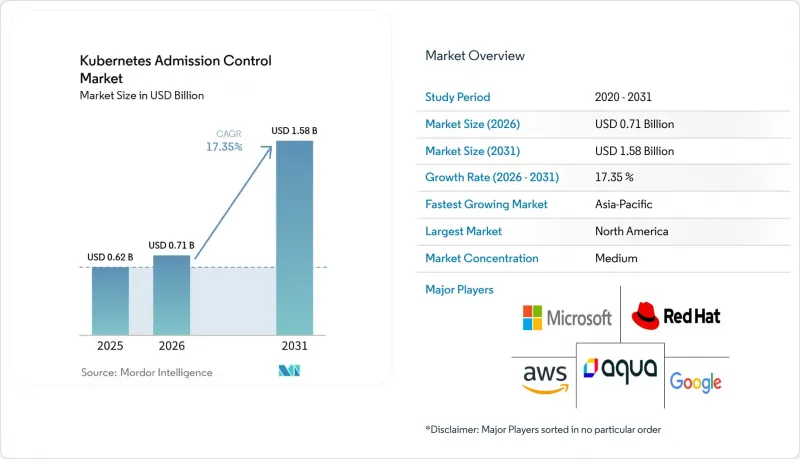
According to Mordor Intelligence, the kubernetes admission control market size was valued at USD 0.62 billion in 2025 and USD 0.71 billion in 2026 and is projected to reach USD 1.58 billion by 2031, growing at a CAGR of 17.35% during 2026-2031.
Global Kubernetes Admission Control Market Trends and Insights
Enterprise Kubernetes and Multi-Cluster Expansion
Kubernetes adoption has reached a point where enterprise platform teams need consistent controls at deployment. The CNCF reported that 82% of container users ran Kubernetes in production in 2025, compared with 66% in 2023, and 98% of respondents used cloud-native techniques in some form. The same survey found that 66% of organizations hosting generative AI models used Kubernetes for some or all inference workloads. Each production cluster has an API server, so inconsistent admission policies can leave gaps between environments. The Kubernetes admission control market is therefore moving toward centralized policy administration for multi-cluster estates. Nirmata introduced Runtime for Kyverno in August 2026 to extend policy decisions to process execution, file access, and egress control for AI workloads.
Regulatory and Software Supply Chain Compliance
Software supply chain security is becoming a legal and audit issue for organizations that deploy regulated applications. NIST SP 800-218 provides the Secure Software Development Framework that federal software suppliers use to structure secure development practices. CISA's Secure Software Development Attestation Form requires software producers to attest to secure development practices for covered federal software. The SLSA specification gives organizations a framework for evaluating software supply chain integrity. Admission policies can turn signed-image and provenance requirements into deployment controls that cannot be bypassed in routine workflows. This demand shifts vendor selection toward long-term support, verified images, and automated compliance evidence in the Kubernetes admission control market. Compliance automation is becoming a central purchasing requirement in the Kubernetes admission control market.
Admission Latency and Control Plane Availability Risk
Admission webhooks run synchronously with API server requests, so a timeout can delay deployments across a cluster. A fail-open configuration can permit an unintended deployment, while a fail-closed configuration can halt delivery when the webhook is unavailable. This concern is pronounced in high-throughput BFSI and e-commerce environments. Kubernetes v1.36 introduced manifest-based admission control as an alpha feature, allowing policies to load from files at API server startup. In-process policy enforcement reduces external call overhead, but cannot conduct external registry checks or custom API calls. Organizations with detailed governance needs must therefore retain hybrid designs that balance availability, latency, and policy depth in the Kubernetes admission control market.
Other drivers and restraints analyzed in the detailed report include:
- Shift-Left DevSecOps and Policy as Code Adoption
- Cloud-Native Workload and Image Risk Escalation
- Shortage of Policy Engineering Skills
For complete list of drivers and restraints, kindly check the Table Of Contents.
Segment Analysis
Software held 58.42% of the Kubernetes admission control market size in 2025. Enterprises often begin with a defined and auditable policy enforcement product before entering managed service contracts. The software segment includes commercial distributions of Kyverno, OPA Gatekeeper, other policy engines, and controllers integrated into managed Kubernetes platforms. Enterprise distributions provide support commitments, validated policy packs, and hardened images. These characteristics suit buyers who need predictable governance within regulated deployment processes.
Services are projected to record the highest component CAGR at 19.68% through 2031. Organizations with many clusters need help developing policy libraries, migrating clusters, managing exceptions, and collecting compliance evidence across cloud, on-premises, and edge estates. Nirmata launched Runtime for Kyverno in August 2026, extending policy enforcement to runtime controls for process activity, file access, and network egress. Nirmata also made Nirmata Enterprise for Kyverno available through AWS Marketplace in May 2025. These developments show how software distribution and recurring governance support can operate together in the Kubernetes admission control industry.
Cloud represented 62.39% of the Kubernetes admission control market size in 2026. It is also projected to be the fastest-growing deployment model, at a 22.43% CAGR through 2031. Managed Kubernetes services embed admission capabilities within their platform layers. Google Kubernetes Engine offers Binary Authorization and Policy Controller, Azure Kubernetes Service offers Azure Policy, and AWS environments support admission controller integrations. These native options can create switching costs and direct policy spending toward cloud-managed operations.
On-premises deployment remains important in data-sovereign, regulated, and air-gapped settings where public cloud migration is limited by policy, data residency, or operational constraints. Kubernetes v1.36 introduced manifest-based admission control to define webhooks and CEL policies as files loaded at API server startup. This design limits the ability of a cluster administrator to remove critical policy configurations through the API. Defense, energy, and public-sector users can apply this feature where tamper resistance and local control are priorities. The Kubernetes admission control market, therefore, includes both cloud-led growth and sustained on-premises governance needs.
Complete Report Scope:
- By Component
- Software
- Services
- By Deployment
- Cloud
- On-premises
- By Organization Size
- Large Enterprises
- Small and Medium Enterprises
- By Industry Vertical
- Government and Public Administration
- Industrial Manufacturing
- Retail and E-Commerce
- Transportation and Logistics
- Energy and Utilities
- Oil and Gas
- IT and Telecommunication
- Media and Entertainment
- Education and Research Institutions
- Healthcare and Life Sciences
- Banking, Financial Services, and Insurance (BFSI)
- Other Industry Verticals
- By Geography
- North America
- United States
- Canada
- Mexico
- South America
- Brazil
- Argentina
- Rest of South America
- Europe
- Germany
- United Kingdom
- France
- Italy
- Spain
- Rest of Europe
- Asia-Pacific
- China
- Japan
- India
- South Korea
- Australia
- Rest of Asia-Pacific
- Middle East
- Saudi Arabia
- United Arab Emirates
- Rest of Middle East
- Africa
- South Africa
- Nigeria
- Rest of Africa
- North America
Geography Analysis
North America held 43.71% of the Kubernetes admission control market share in 2025. The United States has a high concentration of cloud-native enterprise infrastructure and federal supply chain requirements. Executive Order 14028 directed federal action to improve software supply chain security, and CISA established an attestation process for secure software development practices. These requirements support spending by federal contractors, defense technology firms, healthcare technology organizations, and banks with regulated products. Nirmata Enterprise for Kyverno became available on AWS Marketplace in May 2025, shortening the route from open-source trial to contracted support for AWS-focused organizations.
Europe accounts for a significant share of global demand in the Kubernetes admission control market. The EU Cyber Resilience Act and GDPR are making component attestation and workload placement more relevant to enterprise governance. Germany, the United Kingdom, and France lead adoption across financial services, automotive manufacturing, and public administration. Red Hat found that 64% of survey respondents expected the EU Cyber Resilience Act to influence cloud-native security investments within the following year. Spain, Italy, and other European countries are at earlier stages but operate within a more harmonized regulatory environment.
Asia-Pacific is projected to be the fastest-growing region at a 21.56% CAGR through 2031. China, Japan, South Korea, India, and Australia are expanding cloud-native operations while regulatory frameworks become more formal. Singapore's Cyber Security Agency published a Kubernetes security advisory in 2026, providing security guidance for organizations operating container environments. China's Graded Protection 2.0 Level 3 requirements support admission controls and audit logging for containerized financial and government applications. South America, the Middle East, and Africa remain earlier-stage regions, while sovereign cloud programs in Saudi Arabia and the United Arab Emirates create demand for air-gapped policy evidence automation. These conditions broaden the geographic opportunity for the Kubernetes admission control market and support demand within it.
- Aqua Security Software Ltd.
- Amazon Web Services, Inc.
- Microsoft Corporation
- Google LLC
- Red Hat, Inc.
- SUSE LLC
- Styra, Inc.
- Nirmata, Inc.
- Sysdig, Inc.
- Palo Alto Networks, Inc.
- Snyk Limited
- Fairwinds Ops, Inc.
- Mirantis, Inc.
- D2iQ, Inc.
- VMware LLC
- Broadcom Inc.
- Tigera, Inc.
- HashiCorp, Inc.
- Veeam Software Group GmbH
- Pure Storage, Inc.
- Spectro Cloud, Inc.
- SUSE Security Admission Controller
- Kyverno Project
- Open Policy Agent Project
- Gatekeeper Project
- Kubewarden Project
- IBM Corporation
Additional Benefits:
- The market estimate (ME) sheet in Excel format
- 3 months of analyst support
TABLE OF CONTENTS
1 INTRODUCTION
- 1.1 Study Assumptions and Market Definition
- 1.2 Scope of the Study
2 RESEARCH METHODOLOGY
3 EXECUTIVE SUMMARY
4 MARKET LANDSCAPE
- 4.1 Market Overview
- 4.2 Market Drivers
- 4.2.1 Enterprise Kubernetes and Multi-Cluster Expansion
- 4.2.2 Regulatory and Software-Supply-Chain Compliance
- 4.2.3 Shift-Left DevSecOps and Policy-as-Code Adoption
- 4.2.4 Cloud-Native Workload and Image Risk Escalation
- 4.2.5 In-Process CEL Policy Adoption in Kubernetes
- 4.2.6 Policy Evidence Automation for Air-Gapped and Sovereign Clusters
- 4.3 Market Restraints
- 4.3.1 Admission-Latency and Control-Plane Availability Risk
- 4.3.2 Shortage of Policy Engineering Skills
- 4.3.3 Policy-Engine and Language Fragmentation
- 4.3.4 False Positives and Exception Sprawl in High-Velocity Delivery
- 4.4 Impact of Macroeconomic Factors
- 4.5 Value / Supply-Chain Analysis
- 4.6 Regulatory Landscape
- 4.6.1 Software Supply-Chain Security and Provenance
- 4.6.2 Data Protection, Residency, and Sector Controls
- 4.6.3 Critical Infrastructure and Government Requirements
- 4.7 Technological Outlook
- 4.7.1 Validating Admission Webhooks
- 4.7.2 Mutating Admission Webhooks
- 4.7.3 ValidatingAdmissionPolicy and CEL
- 4.7.4 WebAssembly Policy Runtimes
- 4.7.5 Image Signature and Attestation Verification
- 4.7.6 Policy Decision Logging and Audit Analytics
- 4.8 Porter's Five Forces Analysis
- 4.8.1 Threat of New Entrants
- 4.8.2 Bargaining Power of Suppliers
- 4.8.3 Bargaining Power of Buyers
- 4.8.4 Threat of Substitutes
- 4.8.5 Competitive Rivalry
5 MARKET SIZE AND GROWTH FORECASTS (VALUE)
- 5.1 By Component
- 5.1.1 Software
- 5.1.2 Services
- 5.2 By Deployment
- 5.2.1 Cloud
- 5.2.2 On-premises
- 5.3 By Organization Size
- 5.3.1 Large Enterprises
- 5.3.2 Small and Medium Enterprises
- 5.4 By Industry Vertical
- 5.4.1 Government and Public Administration
- 5.4.2 Industrial Manufacturing
- 5.4.3 Retail and E-Commerce
- 5.4.4 Transportation and Logistics
- 5.4.5 Energy and Utilities
- 5.4.6 Oil and Gas
- 5.4.7 IT and Telecommunication
- 5.4.8 Media and Entertainment
- 5.4.9 Education and Research Institutions
- 5.4.10 Healthcare and Life Sciences
- 5.4.11 Banking, Financial Services, and Insurance (BFSI)
- 5.4.12 Other Industry Verticals
- 5.5 By Geography
- 5.5.1 North America
- 5.5.1.1 United States
- 5.5.1.2 Canada
- 5.5.1.3 Mexico
- 5.5.2 South America
- 5.5.2.1 Brazil
- 5.5.2.2 Argentina
- 5.5.2.3 Rest of South America
- 5.5.3 Europe
- 5.5.3.1 Germany
- 5.5.3.2 United Kingdom
- 5.5.3.3 France
- 5.5.3.4 Italy
- 5.5.3.5 Spain
- 5.5.3.6 Rest of Europe
- 5.5.4 Asia-Pacific
- 5.5.4.1 China
- 5.5.4.2 Japan
- 5.5.4.3 India
- 5.5.4.4 South Korea
- 5.5.4.5 Australia
- 5.5.4.6 Rest of Asia-Pacific
- 5.5.5 Middle East
- 5.5.5.1 Saudi Arabia
- 5.5.5.2 United Arab Emirates
- 5.5.5.3 Rest of Middle East
- 5.5.6 Africa
- 5.5.6.1 South Africa
- 5.5.6.2 Nigeria
- 5.5.6.3 Rest of Africa
- 5.5.1 North America
6 COMPETITIVE LANDSCAPE
- 6.1 Market Concentration
- 6.2 Strategic Moves
- 6.3 Market Share Analysis
- 6.4 Company Profiles (includes Global Level Overview, Market Level Overview, Core Segments, Financials as available, Strategic Information, Market Rank/Share, Products and Services, Recent Developments)
- 6.4.1 Aqua Security Software Ltd.
- 6.4.2 Amazon Web Services, Inc.
- 6.4.3 Microsoft Corporation
- 6.4.4 Google LLC
- 6.4.5 Red Hat, Inc.
- 6.4.6 SUSE LLC
- 6.4.7 Styra, Inc.
- 6.4.8 Nirmata, Inc.
- 6.4.9 Sysdig, Inc.
- 6.4.10 Palo Alto Networks, Inc.
- 6.4.11 Snyk Limited
- 6.4.12 Fairwinds Ops, Inc.
- 6.4.13 Mirantis, Inc.
- 6.4.14 D2iQ, Inc.
- 6.4.15 VMware LLC
- 6.4.16 Broadcom Inc.
- 6.4.17 Tigera, Inc.
- 6.4.18 HashiCorp, Inc.
- 6.4.19 Veeam Software Group GmbH
- 6.4.20 Pure Storage, Inc.
- 6.4.21 Spectro Cloud, Inc.
- 6.4.22 SUSE Security Admission Controller
- 6.4.23 Kyverno Project
- 6.4.24 Open Policy Agent Project
- 6.4.25 Gatekeeper Project
- 6.4.26 Kubewarden Project
- 6.4.27 IBM Corporation
7 MARKET OPPORTUNITIES AND FUTURE OUTLOOK
- 7.1 White-Space and Unmet-Need Assessment
- 7.1.1 Unified Multi-Cluster Admission Policy Management
- 7.1.2 AI-Assisted Kubernetes Policy Generation and Optimization
- 7.1.3 Runtime-Aware Admission Control
- 7.1.4 Identity- and Context-Aware Admission Policies
- 7.1.5 Continuous Compliance and Self-Healing Policy Enforcement
- 7.1.6 Admission Control for Emerging Kubernetes Workloads
- 7.1.7 Low-Latency, In-Process Admission Enforcement

