PUBLISHER: Mordor Intelligence | PRODUCT CODE: 2157044

PUBLISHER: Mordor Intelligence | PRODUCT CODE: 2157044
Cloud Incident Response Services - Market Share Analysis, Industry Trends & Statistics, Growth Forecasts (2026 - 2031)
According to Mordor Intelligence, the cloud incident response services market size is projected to expand from USD 4.21 billion in 2025 and USD 4.94 billion in 2026 to USD 12.02 billion by 2031, registering a CAGR of 19.46% between 2026 to 2031.
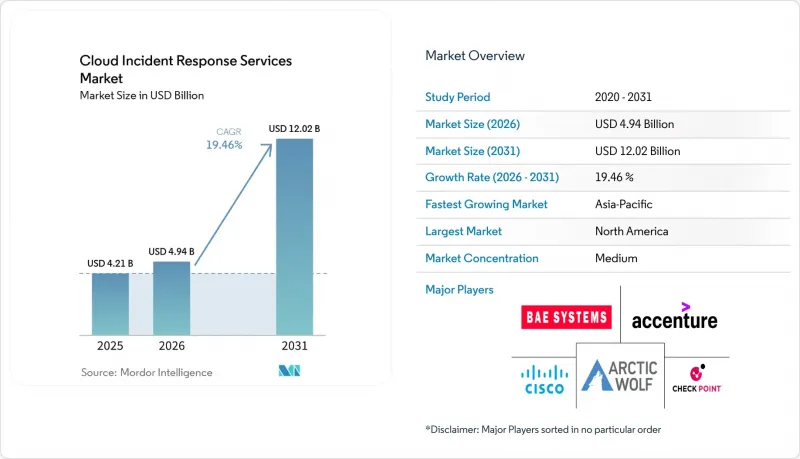
Global Cloud Incident Response Services Market Trends and Insights
Rising Cloud Identity and API Abuse
Identity-related investigations are taking a larger share of response retainer budgets because cloud breaches often begin with compromised credentials or permissions. Identity controls influence access throughout the attack path, so response teams must examine them beyond the first point of entry. Compromised accounts can allow an attacker to use ordinary cloud services while avoiding attention from controls that rely on unfamiliar behavior. Response teams must reconstruct consent chains, token histories, service-account privilege paths, and changes to access policies. That work requires specialists who understand how identity is implemented across cloud platforms and connected applications. The cloud incident response services market favors providers with dedicated cloud identity forensic skills instead of general response playbooks adapted from on-premises environments.
AI-Accelerated Attacker Tradecraft
AI became part of operational attack activity during 2025, which changed the time available for investigation and containment. Google Mandiant identified PROMPTFLUX in June 2025, a tool that queried the Gemini API to rewrite its VBScript source code regularly and create polymorphic behavior. Attack automation can reduce the time between access, lateral movement, and data theft. It also makes repeated variations of malicious activity harder to detect with static rules alone. These conditions increase the need for automated triage that can act before analysts review each alert. They increase demand for response providers that connect detection and containment in a single operating model.
Evidence Gaps From Logging Misconfiguration
Cloud response depends on complete telemetry, yet logging configurations often leave important evidence unavailable at the time of an investigation. Palo Alto Networks reported that attackers exploited misconfigured access and identity controls in nearly half of the cloud breaches covered by its 2025 global incident response report. Organizations may limit detailed API logging to control storage costs, but this can remove the records needed to establish an attacker's path and the scope of a breach. Default settings can be particularly inadequate for container and serverless workloads, where event volumes are high and retention periods may be short. Retainers and automated playbooks cannot replace source information that was never captured. This constraint can reduce the effectiveness of the cloud incident response services market for organizations that have not prepared their logging environment.
Other drivers and restraints analyzed in the detailed report include:
- Regulatory and Cyber-Insurance Response Obligations
- Multi-Cloud and Ephemeral Workload Complexity
- Data Sovereignty and Cross-Border Evidence Restrictions
For complete list of drivers and restraints, kindly check the Table Of Contents.
Segment Analysis
Managed detection and response is projected to expand at a 23.17% CAGR during 2026-2031, making it the fastest-growing service type. Its retainer model combines continuous monitoring, threat hunting, and response execution under one agreement. This structure avoids procurement delays that can occur when a buyer seeks emergency assistance after a breach. CrowdStrike introduced Agentic MDR in March 2026, combining autonomous AI agents with Falcon Complete analysts to automate high-friction security work. The offering reflects the growing value placed on a closer connection between detection and containment. The cloud incident response services market size for managed detection and response is supported by organizations that cannot maintain their own round-the-clock threat intelligence and response teams.
Containment and mitigation accounted for 32.86% of service-type spending in 2025, the largest share of Cloud incident response services within this segmentation. Stopping the spread of an incident remains the immediate operating priority after a breach is confirmed. Investigation and digital forensics commonly follow containment because responders need to establish what occurred and preserve evidence. Remediation and recovery then focus on restoring services, correcting controls, and reducing the chance of recurrence. Other service configurations include cloud identity retainers and outcome-based arrangements. The service mix, therefore, reflects the order in which many organizations manage a cloud security incident.
Public cloud held 54.29% of deployment-context spending in 2025 and is projected to expand at a 22.86% CAGR during 2026-2031. This position reflects the concentration of enterprise workloads and security events in public cloud platforms. AWS, Microsoft Azure, and Google Cloud provide telemetry that specialized response platforms are increasingly designed to collect and analyze. CrowdStrike extended its real-time cloud detection and response capabilities to Google Cloud in April 2026. The expansion supports a unified response across distributed environments. Public cloud, therefore, holds the leading market share in cloud incident response services for the deployment context.
Private, hybrid, and multi-cloud environments require different evidence collection methods and responder expertise. Hybrid deployments require teams to correlate on-premises and cloud records that may use different schemas and retention periods. Multi-cloud estates add identity and permission challenges because accounts and tokens can span cloud boundaries. IBM found that hybrid and multi-cloud breaches took longer to identify and contain than breaches in a single environment. Organizations are investing in automated evidence preservation to capture the volatile state before scaling policies remove affected instances. These conditions keep specialized deployment knowledge important across the cloud incident response services market.
Complete Report Scope:
- By Service Type
- Investigation and Digital Forensics
- Containment and Mitigation
- Remediation and Recovery
- Managed Detection and Response
- Other Service Types
- By Cloud Environment
- Public Cloud
- Private Cloud
- Hybrid Cloud
- Multi-Cloud
- By Organization Size
- Large Enterprises
- Small and Medium Enterprises
- By Industry Vertical
- Government and Public Administration
- Industrial Manufacturing
- Retail and E-Commerce
- Transportation and Logistics
- Energy and Utilities
- Oil and Gas
- IT and Telecommunication
- Media and Entertainment
- Education and Research Institutions
- Healthcare and Life Sciences
- Banking, Financial Services, and Insurance (BFSI)
- Other Industry Verticals
- By Geography
- North America
- United States
- Canada
- Mexico
- South America
- Brazil
- Argentina
- Rest of South America
- Europe
- Germany
- United Kingdom
- France
- Italy
- Spain
- Rest of Europe
- Asia-Pacific
- China
- Japan
- India
- South Korea
- Australia
- Rest of Asia-Pacific
- Middle East
- Saudi Arabia
- United Arab Emirates
- Rest of Middle East
- Africa
- South Africa
- Nigeria
- Rest of Africa
- North America
Geography Analysis
North America held 36.74% of the global cloud incident response services market in 2025, the largest regional share. Enterprise cloud adoption, established provider networks, and response-readiness spending underpin its position. SEC cybersecurity disclosure requirements have increased board attention to materiality assessments and prepared response programs. Canada's privacy framework and Mexico's focus on digital infrastructure security extend demand beyond the United States. Buyers increasingly seek pre-arranged response support instead of emergency sourcing after an event.
Asia-Pacific is forecast to expand at a 24.63% CAGR during 2026-2031, the fastest regional rate. Cloud adoption and government cybersecurity requirements are expanding the need for prepared response services across the region. India's data protection framework and global delivery centers increase the importance of handling sensitive multinational information. Singapore and Australia are also influencing procurement through cloud configuration and breach-response requirements. Providers that can support local evidence residency and regulatory response are well placed to serve this regional demand.
Europe is shaped by DORA, NIS2, and GDPR requirements, especially in financial centers across Germany, the United Kingdom, France, and Benelux. South America is developing from a smaller base, with demand in Brazil and Argentina centered on financial institutions and government entities. Saudi Arabia and the United Arab Emirates have increased incident-planning requirements for critical infrastructure operators. South Africa and Nigeria lead African adoption among financial services and telecommunications firms, although provider availability and specialized skills limit near-term progress.
- Accenture plc
- Arctic Wolf Networks, Inc.
- BAE Systems plc
- Check Point Software Technologies Ltd.
- Cisco Systems, Inc.
- CrowdStrike Holdings, Inc.
- Deloitte Touche Tohmatsu Limited
- Ernst & Young Global Limited
- Google LLC, Mandiant
- International Business Machines Corporation
- Kaspersky Lab
- KPMG International Limited
- Microsoft Corporation
- NCC Group plc
- NTT DATA Corporation
- Optiv Security Inc.
- Palo Alto Networks, Inc.
- PricewaterhouseCoopers International Limited
- Rapid7, Inc.
- Secureworks Corp.
- SentinelOne, Inc.
- Sophos Limited
Additional Benefits:
- The market estimate (ME) sheet in Excel format
- 3 months of analyst support
TABLE OF CONTENTS
1 INTRODUCTION
- 1.1 Study Assumptions and Market Definition
- 1.2 Scope of the Study
2 RESEARCH METHODOLOGY
3 EXECUTIVE SUMMARY
4 MARKET LANDSCAPE
- 4.1 Market Overview
- 4.2 Market Drivers
- 4.2.1 Rising Cloud Identity and API Abuse
- 4.2.2 Multi-Cloud and Ephemeral Workload Complexity
- 4.2.3 Regulatory and Cyber-Insurance Response Obligations
- 4.2.4 Shortage of Specialized Cloud Forensics Talent
- 4.2.5 AI-Accelerated Attacker Tradecraft
- 4.2.6 Machine-Readable Evidence and Automated Containment
- 4.3 Market Restraints
- 4.3.1 Evidence Gaps From Logging Misconfiguration
- 4.3.2 Data Sovereignty and Cross-Border Evidence Restrictions
- 4.3.3 Fragmented Tooling and Shared-Responsibility Ambiguity
- 4.3.4 Ephemeral Workload Volatility During Investigation
- 4.4 Impact of Macroeconomic Factors
- 4.4.1 Enterprise Security-Budget Prioritization
- 4.4.2 Cyber-Insurance Pricing and Retention Changes
- 4.4.3 IT Modernization and Cloud Spending Cycles
- 4.5 Value / Supply-Chain Analysis
- 4.6 Regulatory Landscape
- 4.6.1 NIST SP 800-61 and NIST Cybersecurity Framework
- 4.6.2 ISO/IEC 27001, SOC 2 and CIS Controls
- 4.6.3 GDPR, CCPA/CPRA and Regional Privacy Requirements
- 4.6.4 NIS2, DORA and Sectoral ICT-Resilience Rules
- 4.6.5 HIPAA, PCI DSS, SEC Disclosure and Breach-Notification Clocks
- 4.6.6 Evidence Residency, Legal Holds and Cross-Border Transfer
- 4.7 Technological Outlook
- 4.7.1 Cloud-Native Forensics and API-Based Evidence Collection
- 4.7.2 Identity, Entitlement and Token Forensics
- 4.7.3 Container, Kubernetes and Serverless Investigation
- 4.7.4 AI-Assisted Triage and Timeline Reconstruction
- 4.7.5 Automated Isolation, Credential Revocation and Key Rotation
- 4.7.6 Immutable Evidence Lockers and Cryptographic Integrity
- 4.7.7 Cloud Sandboxes, Digital Twins and Deception
- 4.8 Porter's Five Forces Analysis
- 4.8.1 Threat of New Entrants
- 4.8.2 Bargaining Power of Suppliers
- 4.8.3 Bargaining Power of Buyers
- 4.8.4 Threat of Substitutes
- 4.8.5 Competitive Rivalry
5 MARKET SIZE AND GROWTH FORECASTS (VALUE)
- 5.1 By Service Type
- 5.1.1 Investigation and Digital Forensics
- 5.1.2 Containment and Mitigation
- 5.1.3 Remediation and Recovery
- 5.1.4 Managed Detection and Response
- 5.1.5 Other Service Types
- 5.2 By Cloud Environment
- 5.2.1 Public Cloud
- 5.2.2 Private Cloud
- 5.2.3 Hybrid Cloud
- 5.2.4 Multi-Cloud
- 5.3 By Organization Size
- 5.3.1 Large Enterprises
- 5.3.2 Small and Medium Enterprises
- 5.4 By Industry Vertical
- 5.4.1 Government and Public Administration
- 5.4.2 Industrial Manufacturing
- 5.4.3 Retail and E-Commerce
- 5.4.4 Transportation and Logistics
- 5.4.5 Energy and Utilities
- 5.4.6 Oil and Gas
- 5.4.7 IT and Telecommunication
- 5.4.8 Media and Entertainment
- 5.4.9 Education and Research Institutions
- 5.4.10 Healthcare and Life Sciences
- 5.4.11 Banking, Financial Services, and Insurance (BFSI)
- 5.4.12 Other Industry Verticals
- 5.5 By Geography
- 5.5.1 North America
- 5.5.1.1 United States
- 5.5.1.2 Canada
- 5.5.1.3 Mexico
- 5.5.2 South America
- 5.5.2.1 Brazil
- 5.5.2.2 Argentina
- 5.5.2.3 Rest of South America
- 5.5.3 Europe
- 5.5.3.1 Germany
- 5.5.3.2 United Kingdom
- 5.5.3.3 France
- 5.5.3.4 Italy
- 5.5.3.5 Spain
- 5.5.3.6 Rest of Europe
- 5.5.4 Asia-Pacific
- 5.5.4.1 China
- 5.5.4.2 Japan
- 5.5.4.3 India
- 5.5.4.4 South Korea
- 5.5.4.5 Australia
- 5.5.4.6 Rest of Asia-Pacific
- 5.5.5 Middle East
- 5.5.5.1 Saudi Arabia
- 5.5.5.2 United Arab Emirates
- 5.5.5.3 Rest of Middle East
- 5.5.6 Africa
- 5.5.6.1 South Africa
- 5.5.6.2 Nigeria
- 5.5.6.3 Rest of Africa
- 5.5.1 North America
6 COMPETITIVE LANDSCAPE
- 6.1 Market Concentration
- 6.2 Strategic Moves
- 6.3 Market Share Analysis
- 6.4 Company Profiles (includes Global Level Overview, Market Level Overview, Core Segments, Financials as available, Strategic Information, Market Rank/Share, Products and Services, Recent Developments)
- 6.4.1 Accenture plc
- 6.4.2 Arctic Wolf Networks, Inc.
- 6.4.3 BAE Systems plc
- 6.4.4 Check Point Software Technologies Ltd.
- 6.4.5 Cisco Systems, Inc.
- 6.4.6 CrowdStrike Holdings, Inc.
- 6.4.7 Deloitte Touche Tohmatsu Limited
- 6.4.8 Ernst & Young Global Limited
- 6.4.9 Google LLC, Mandiant
- 6.4.10 International Business Machines Corporation
- 6.4.11 Kaspersky Lab
- 6.4.12 KPMG International Limited
- 6.4.13 Microsoft Corporation
- 6.4.14 NCC Group plc
- 6.4.15 NTT DATA Corporation
- 6.4.16 Optiv Security Inc.
- 6.4.17 Palo Alto Networks, Inc.
- 6.4.18 PricewaterhouseCoopers International Limited
- 6.4.19 Rapid7, Inc.
- 6.4.20 Secureworks Corp.
- 6.4.21 SentinelOne, Inc.
- 6.4.22 Sophos Limited
7 MARKET OPPORTUNITIES AND FUTURE OUTLOOK
- 7.1 White-Space and Unmet-Need Assessment
- 7.1.1 Cloud Evidence Residency as a Managed Service
- 7.1.2 Identity-Centric Retainers for Multi-Cloud Estates
- 7.1.3 Incident Response for Containers and Serverless Workloads
- 7.1.4 Outcome-Based Pricing Linked to Containment and Recovery
- 7.1.5 Regional-Language and In-Country Response Coverage
- 7.1.6 Cloud Incident Readiness for Small and Medium Enterprises

