PUBLISHER: Mordor Intelligence | PRODUCT CODE: 2157045

PUBLISHER: Mordor Intelligence | PRODUCT CODE: 2157045
North America AIOps For Telecom Networks - Market Share Analysis, Industry Trends & Statistics, Growth Forecasts (2026 - 2031)
According to Mordor Intelligence, the North America AIOps for Telecom Networks Market size is expected to grow from USD 1.60 billion in 2025 to USD 1.82 billion in 2026, and is forecast to reach USD 3.43 billion by 2031, at a 13.51% CAGR over 2026-2031.
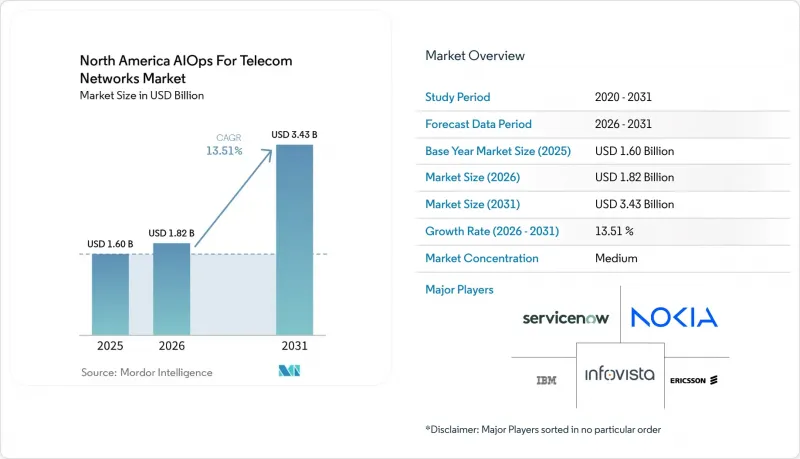
North America AIOps For Telecom Networks Market Trends and Insights
Rising 5G, Edge, and Network-Slicing Complexity
5G standalone networks add operational complexity that was not present in earlier network generations. Each active slice can carry separate service-level thresholds, performance indicators, and fault-isolation boundaries. A slice-aware topology also changes the relationship between radio, transport, and core events. This makes event correlation more difficult for platforms trained mainly on flat-network data. The NGMN Alliance has recommended purpose-built reasoning agents for these environments in its work on agentic AI for autonomous mobile networks. Nokia presented an agentic AI-powered 5G-Advanced network slicing solution with AWS at MWC 2026, linking MantaRay SMO to cloud-based AI capabilities for live network operations.
Demand for Real-Time Network Visibility and Predictive Assurance
North American operators are moving beyond monitoring isolated performance indicators. They increasingly need to assess customer experience outcomes alongside control-plane and user-plane telemetry. The TM Forum framework places user experience degradation at the center of closed-loop remediation. That approach requires data collection systems that can ingest information from many network elements with limited delay. Deutsche Telekom reported that its MINDR platform, built with Google Cloud technologies, triggered more than 100 autonomous remediation actions in its first month of live operations after its November 2025 launch. The company also reported that the platform reduced management time for major events from hours to 1 minute.
High Integration Costs Across Legacy OSS, BSS, and Network Domains
Legacy operations and business support systems remain a major obstacle to wider AIOps adoption. Many operators still rely on point-to-point integrations that become harder to manage when products, systems, or acquired assets are added. Migrating critical customer and network data also raises service continuity concerns. The TM Forum Open Digital Architecture provides a common direction, but moving from proprietary data models takes time and careful planning. AIOps projects can therefore face lengthy preparation before a unified telemetry stream is available for model training. The resulting delay is especially difficult for vendors that lack broad systems integration capabilities.
Other drivers and restraints analyzed in the detailed report include:
- Pressure to Reduce NOC OPEX and Mean Time to Resolution
- Growth of Cloud-Native, Multi-Vendor, and Hybrid Telecom Infrastructure
- Data Quality, Interoperability, and Telemetry Standardization Gaps
For complete list of drivers and restraints, kindly check the Table Of Contents.
Segment Analysis
Platforms held 67.21% of regional revenue in 2025. Their lead reflects the needs of large carriers that require integrated ingestion, event correlation, topology awareness, and closed-loop automation. Replacing a correlation engine can be difficult when it has been trained on years of carrier-specific telemetry. That accumulated training data can reinforce switching costs for established providers. Platforms also include network-specific operating logic that general IT operations tools do not inherently provide. Nokia updated its Autonomous Networks Suite at DTW26 in June 2026 and released an Autonomous Networks Agent Library.
Services are projected to expand at a 16.19% CAGR from 2026 to 2031. It is the fastest-expanding offering type in the North America AIOps for Telecom Networks market. Operators increasingly procure managed support for defined activities such as fault resolution in 5G standalone core networks or predictive radio-frequency optimization. This model allows carriers to retain broader platform control while drawing on specialist support for model development and maintenance. It can also help organizations keep control of sensitive operational data. IBM and ServiceNow expanded their collaboration in June 2026 to combine AI, data, and automation capabilities for enterprise operations. The arrangement reflects demand for services that bring operational tools together without requiring every operator to build the full capability internally.
Cloud-based deployment accounted for 51.59% of regional revenue in 2025 and is projected to expand at a 16.70% CAGR from 2026 to 2031. It allows operators to scale model training and inference as telemetry volumes rise with denser 5G networks. This reduces the need to build and maintain dedicated on-premises computing capacity for every workload. Cloud environments can also support distributed data collection and faster software updates. These capabilities support near-real-time decisions for monitored network events. The North America AIOps for Telecom Networks market benefits when cloud tools can be used alongside established operational controls.
On-premises deployment remains relevant for federal networks and regulated carriers with data residency or network isolation requirements. Hybrid designs can keep sensitive processing and inference local while connecting suitable management functions to hosted environments. This approach helps operators avoid a hard transition from existing systems. Infovista introduced VistAI in January 2026 with cloud-hosted and on-premises deployment options for automated assurance and testing products. This flexibility allows the North America AIOps for Telecom Networks market to serve both cloud-focused and compliance-led deployment needs.
Complete Report Scope:
- By Offering
- Platforms
- Services
- By Deployment Model
- On-Premises
- Cloud-Based
- By Organization Size
- Large Enterprises
- Small and Medium-Sized Enterprises
- By Application
- Network Performance Management
- Fault and Incident Management
- Network Security Management
- Customer Experience Management
- Infrastructure Management
- Application Performance Analysis
- Other Applications
- By End-User
- Mobile Network Operators
- Fixed and Broadband Operators
- Integrated Communication Service Providers
- Other End-Users
- By Country
- United States
- Canada
- Mexico
List of Companies Covered in this Report:
- Nokia Corporation
- Telefonaktiebolaget LM Ericsson
- Cisco Systems, Inc.
- Broadcom Inc.
- Juniper Networks, Inc.
- Hewlett Packard Enterprise Company
- IBM Corporation
- VIAVI Solutions Inc.
- NETSCOUT SYSTEMS, INC.
- Infovista SAS
- RADCOM Ltd.
- Infosys Limited
- ServiceNow, Inc.
- NVIDIA Corporation
- Amdocs Limited
- Netcracker Technology Corporation
- Mavenir Systems, Inc.
- Selector Software, Inc. (Selector AI)
- NetAI Inc.
- Spirent Communications plc
Additional Benefits:
- The market estimate (ME) sheet in Excel format
- 3 months of analyst support
TABLE OF CONTENTS
1 INTRODUCTION
- 1.1 Study Assumptions and Market Definition
- 1.2 Scope of the Study
2 RESEARCH METHODOLOGY
3 EXECUTIVE SUMMARY
4 MARKET LANDSCAPE
- 4.1 Market Overview
- 4.2 Market Drivers
- 4.2.1 Rising 5G, Edge, and Network-Slicing Complexity
- 4.2.2 Demand for Real-Time Network Visibility and Predictive Assurance
- 4.2.3 Pressure to Reduce NOC OPEX and Mean Time to Resolution
- 4.2.4 Growth of Cloud-Native, Multi-Vendor, and Hybrid Telecom Infrastructure
- 4.2.5 Telecom-Specific Digital Twins for Capacity and Incident Decisions
- 4.2.6 Deterministic Graph-Based Root-Cause Analysis for Alarm Storms
- 4.3 Market Restraints
- 4.3.1 High Integration Costs Across Legacy OSS, BSS, and Network Domains
- 4.3.2 Data Quality, Interoperability, and Telemetry Standardization Gaps
- 4.3.3 Shortage of Telecom AIOps, Data Engineering, and Automation Skills
- 4.3.4 Risk of Automated Change Propagation Across Interdependent Network Layers
- 4.4 Industry Value-Chain Analysis
- 4.5 Regulatory Landscape
- 4.6 Technological Outlook
- 4.7 Porter's Five Forces Analysis
- 4.7.1 Bargaining Power of Suppliers
- 4.7.2 Bargaining Power of Buyers
- 4.7.3 Threat of New Entrants
- 4.7.4 Threat of Substitutes
- 4.7.5 Competitive Rivalry
- 4.8 Impact of Macroeconomic Factors on the Market
5 MARKET SIZE AND GROWTH FORECASTS (VALUE)
- 5.1 By Offering
- 5.1.1 Platforms
- 5.1.2 Services
- 5.2 By Deployment Model
- 5.2.1 On-Premises
- 5.2.2 Cloud-Based
- 5.3 By Organization Size
- 5.3.1 Large Enterprises
- 5.3.2 Small and Medium-Sized Enterprises
- 5.4 By Application
- 5.4.1 Network Performance Management
- 5.4.2 Fault and Incident Management
- 5.4.3 Network Security Management
- 5.4.4 Customer Experience Management
- 5.4.5 Infrastructure Management
- 5.4.6 Application Performance Analysis
- 5.4.7 Other Applications
- 5.5 By End-User
- 5.5.1 Mobile Network Operators
- 5.5.2 Fixed and Broadband Operators
- 5.5.3 Integrated Communication Service Providers
- 5.5.4 Other End-Users
- 5.6 By Country
- 5.6.1 United States
- 5.6.2 Canada
- 5.6.3 Mexico
6 COMPETITIVE LANDSCAPE
- 6.1 Market Concentration
- 6.2 Strategic Moves
- 6.3 Market Share Analysis
- 6.4 Company Profiles (includes Global Level Overview, Market Level Overview, Core Segments, Financials as available, Strategic Information, Market Rank/Share, Products and Services, Recent Developments)
- 6.4.1 Nokia Corporation
- 6.4.2 Telefonaktiebolaget LM Ericsson
- 6.4.3 Cisco Systems, Inc.
- 6.4.4 Broadcom Inc.
- 6.4.5 Juniper Networks, Inc.
- 6.4.6 Hewlett Packard Enterprise Company
- 6.4.7 IBM Corporation
- 6.4.8 VIAVI Solutions Inc.
- 6.4.9 NETSCOUT SYSTEMS, INC.
- 6.4.10 Infovista SAS
- 6.4.11 RADCOM Ltd.
- 6.4.12 Infosys Limited
- 6.4.13 ServiceNow, Inc.
- 6.4.14 NVIDIA Corporation
- 6.4.15 Amdocs Limited
- 6.4.16 Netcracker Technology Corporation
- 6.4.17 Mavenir Systems, Inc.
- 6.4.18 Selector Software, Inc. (Selector AI)
- 6.4.19 NetAI Inc.
- 6.4.20 Spirent Communications plc
7 MARKET OPPORTUNITIES AND FUTURE OUTLOOK
- 7.1 White-Space and Unmet-Need Assessment

