PUBLISHER: Mordor Intelligence | PRODUCT CODE: 2157047

PUBLISHER: Mordor Intelligence | PRODUCT CODE: 2157047
Europe AIOps For Telecom Networks - Market Share Analysis, Industry Trends & Statistics, Growth Forecasts (2026 - 2031)
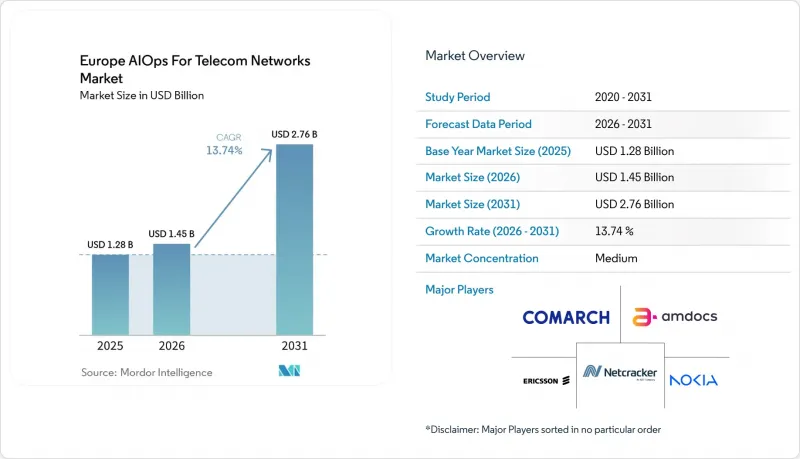
According to Mordor Intelligence, the Europe AIOps for Telecom Networks Market size was valued at USD 1.28 billion in 2025 and is estimated to grow from USD 1.45 billion in 2026 to reach USD 2.76 billion by 2031, at a CAGR of 13.74% during the forecast period (2026-2031).
Europe AIOps For Telecom Networks Market Trends and Insights
5G and Multi-Vendor Network Complexity Accelerates Platform Adoption
The Europe AIOps for telecom networks market is benefiting from 5G standalone deployments, which increase the number of system operators to be managed. A metropolitan 5G radio access network can use separate vendors for radio, distributed, centralized, and core network functions. Each system produces telemetry with different schemas, update cycles, and operational priorities. Older operations support systems were designed for more centralized and single-vendor environments. AIOps platforms can correlate these data streams across network domains and help operators identify related events sooner. O-RAN Alliance specifications, including the E2 interface and xApp framework, provide integration points for third-party applications, although commercial Open RAN deployments still require substantial systems integration for closed-loop control.
Pressure to Reduce Network Operations Costs and Mean Time to Resolution
European telecom operators are prioritizing lower network operating costs as revenue per user remains constrained and 5G expenses rise. Deutsche Telekom launched its RAN Guardian Agent in Germany in November 2025 to support major event management. The company reported that the system reduced major event management time from hours to 1 minute. It also triggered more than 100 remediation actions during Christmas market events in its first production month. These operating outcomes explain that the European AIOps for telecom networks market is attracting attention from operators seeking to reduce manual intervention. NIS2 reporting requirements also underscore the value of prompt fault detection, as affected operators must provide an early warning within 24 hours and a final report within 72 hours.
Legacy OSS Data Silos and Integration Complexity Constrain Cross-Domain AI Effectiveness
Data availability remains a fundamental challenge for the European AIOps market for telecom networks. Many European operators use vendor-specific and domain-isolated management systems developed over 10 to 20 years. These systems were not designed to share telemetry across radio, transport, core, and service layers. Preparing data for AI requires ingestion, normalization, and federation before models can provide dependable results. Incomplete or fragmented telemetry can increase false alarms and observability costs, weakening the operational case for deployment. This burden is greater for mid-sized operators that do not have the integration budgets available to Tier-1 peers, creating a clear difference in adoption capacity.
Other drivers and restraints analyzed in the detailed report include:
- Demand for Predictive Network Assurance and Customer Experience Management Reshapes Buying Criteria
- Expansion of Autonomous Network and Closed-Loop Standards Establishes Demand
- Cybersecurity, Privacy, and AI Governance Requirements Create Compliance Overhead
For complete list of drivers and restraints, kindly check the Table Of Contents.
Segment Analysis
Platforms held 64.88% of the European AIOps for telecom networks market in 2025. Large Tier-1 operators had embedded platform licenses in their operations support systems for several years. These agreements established platforms as core infrastructure for assurance and automation workloads. Services are projected to expand at a 16.08% CAGR through 2031. This rate indicates a stronger demand for managed services, professional services, and systems integration. Regional operators often prefer contracts that transfer implementation responsibility to an experienced provider.
The Europe AIOps for telecom networks market is seeing this preference most clearly in Southern and Eastern Europe. Many operators in these markets have limited in-house AI engineering resources and must manage legacy operations systems at the same time. Outcome-based delivery can reduce the risks associated with a major platform implementation and provide operators with access to specialized integration support. It can also connect implementation work with defined operational outcomes, rather than leaving the operator to assemble separate tools and services. Nokia introduced Autonomous Network Fabric in 2025 and expanded cloud delivery options with Google Cloud. It shows that vendors are combining software platforms with operational services rather than presenting them as separate choices. For the European AIOps for telecom networks market, this delivery approach can make adoption practical where operators need technical support alongside automation software.
On-Premises deployments accounted for 58.25% of the Europe AIOps for telecom networks market size in 2025. Data sovereignty requirements have supported this position among European Tier-1 operators. Certain closed-loop radio functions also require very low latency, which public cloud endpoints may not consistently provide. Cloud-Based deployments are projected to expand at a 17.21% CAGR through 2031. The fastest progress is occurring in non-real-time network analytics, planning, customer experience, and energy management functions.
Public cloud environments provide scalable computing resources and prebuilt AI tools for these less time-sensitive use cases. Nokia scheduled its Assurance Center as a software-as-a-service offering on Google Cloud Marketplace for September 2026. Ericsson launched Agentic rApp as a Service on AWS Marketplace in February 2026. Both offerings show that established telecom suppliers view cloud delivery as an important route for new deployments. At the same time, EU AI Act obligations and NIS2 data-residency expectations are supporting hybrid and sovereign cloud designs. These designs allow workloads to operate closer to network data while retaining some benefits of cloud deployment. This balance matters in the European AIOps for telecom networks market because real-time control requirements vary significantly across network functions and operator environments.
Complete Report Scope:
- By Offering
- Platforms
- Services
- By Deployment Model
- On-Premises
- Cloud-Based
- By Organization Size
- Large Enterprises
- Small and Medium-Sized Enterprises
- By Application
- Network Performance Management
- Fault and Incident Management
- Network Security Management
- Customer Experience Management
- Infrastructure Management
- Application Performance Analysis
- Other Applications
- By End-User
- Mobile Network Operators
- Fixed and Broadband Operators
- Integrated Communication Service Providers
- Other End-Users
- By Country
- United Kingdom
- Germany
- France
- Spain
- Italy
- Rest of Europe
List of Companies Covered in this Report:
- Amdocs Limited
- Telefonaktiebolaget LM Ericsson
- Nokia Corporation
- Netcracker Technology Corporation
- International Business Machines Corporation
- ServiceNow, Inc.
- Infovista SAS
- OpenText Corporation
- Elisa Corporation (Polystar)
- Cisco Systems, Inc.
- Juniper Networking (Hewlett Packard Enterprise Company)
- RADCOM Ltd.
- MyCom OSI
- Google LLC (Google Cloud)
- Microsoft Corporation
- Oracle Corporation
- VIAVI Solutions Inc.
- Comarch S.A.
Additional Benefits:
- The market estimate (ME) sheet in Excel format
- 3 months of analyst support
TABLE OF CONTENTS
1 INTRODUCTION
- 1.1 Study Assumptions and Market Definition
- 1.2 Scope of the Study
2 RESEARCH METHODOLOGY
3 EXECUTIVE SUMMARY
4 MARKET LANDSCAPE
- 4.1 Market Overview
- 4.2 Market Drivers
- 4.2.1 5G and Multi-Vendor Network Complexity
- 4.2.2 Pressure to Reduce Network Operations Costs and Mean Time to Resolution
- 4.2.3 Demand for Predictive Network Assurance and Customer Experience Management
- 4.2.4 Expansion of Autonomous Network and Closed-Loop Standards
- 4.2.5 Telemetry-to-Action Gaps in Disaggregated Open RAN
- 4.2.6 Energy-Aware Closed-Loop Network Optimization
- 4.3 Market Restraints
- 4.3.1 Legacy OSS Data Silos and Integration Complexity
- 4.3.2 Cybersecurity, Privacy and AI Governance Requirements
- 4.3.3 Model Drift Across Vendor-Specific Network States
- 4.3.4 Human Accountability for Autonomous Remediation
- 4.4 Industry Value-Chain Analysis
- 4.5 Regulatory Landscape
- 4.6 Technological Outlook
- 4.7 Porter's Five Forces Analysis
- 4.7.1 Bargaining Power of Suppliers
- 4.7.2 Bargaining Power of Buyers
- 4.7.3 Threat of New Entrants
- 4.7.4 Threat of Substitutes
- 4.7.5 Competitive Rivalry
- 4.8 Impact of Macroeconomic Factors on the Market
5 MARKET SIZE AND GROWTH FORECASTS (VALUE)
- 5.1 By Offering
- 5.1.1 Platforms
- 5.1.2 Services
- 5.2 By Deployment Model
- 5.2.1 On-Premises
- 5.2.2 Cloud-Based
- 5.3 By Organization Size
- 5.3.1 Large Enterprises
- 5.3.2 Small and Medium-Sized Enterprises
- 5.4 By Application
- 5.4.1 Network Performance Management
- 5.4.2 Fault and Incident Management
- 5.4.3 Network Security Management
- 5.4.4 Customer Experience Management
- 5.4.5 Infrastructure Management
- 5.4.6 Application Performance Analysis
- 5.4.7 Other Applications
- 5.5 By End-User
- 5.5.1 Mobile Network Operators
- 5.5.2 Fixed and Broadband Operators
- 5.5.3 Integrated Communication Service Providers
- 5.5.4 Other End-Users
- 5.6 By Country
- 5.6.1 United Kingdom
- 5.6.2 Germany
- 5.6.3 France
- 5.6.4 Spain
- 5.6.5 Italy
- 5.6.6 Rest of Europe
6 COMPETITIVE LANDSCAPE
- 6.1 Market Concentration
- 6.2 Strategic Moves
- 6.3 Market Share Analysis
- 6.4 Company Profiles (includes Global Level Overview, Market Level Overview, Core Segments, Financials as available, Strategic Information, Market Rank/Share, Products and Services, Recent Developments)
- 6.4.1 Amdocs Limited
- 6.4.2 Telefonaktiebolaget LM Ericsson
- 6.4.3 Nokia Corporation
- 6.4.4 Netcracker Technology Corporation
- 6.4.5 International Business Machines Corporation
- 6.4.6 ServiceNow, Inc.
- 6.4.7 Infovista SAS
- 6.4.8 OpenText Corporation
- 6.4.9 Elisa Corporation (Polystar)
- 6.4.10 Cisco Systems, Inc.
- 6.4.11 Juniper Networking (Hewlett Packard Enterprise Company)
- 6.4.12 RADCOM Ltd.
- 6.4.13 MyCom OSI
- 6.4.14 Google LLC (Google Cloud)
- 6.4.15 Microsoft Corporation
- 6.4.16 Oracle Corporation
- 6.4.17 VIAVI Solutions Inc.
- 6.4.18 Comarch S.A.
7 MARKET OPPORTUNITIES AND FUTURE OUTLOOK
- 7.1 White-Space and Unmet-Need Assessment

