PUBLISHER: Mordor Intelligence | PRODUCT CODE: 2157057

PUBLISHER: Mordor Intelligence | PRODUCT CODE: 2157057
Architectural Window Films - Market Share Analysis, Industry Trends & Statistics, Growth Forecasts (2026 - 2031)
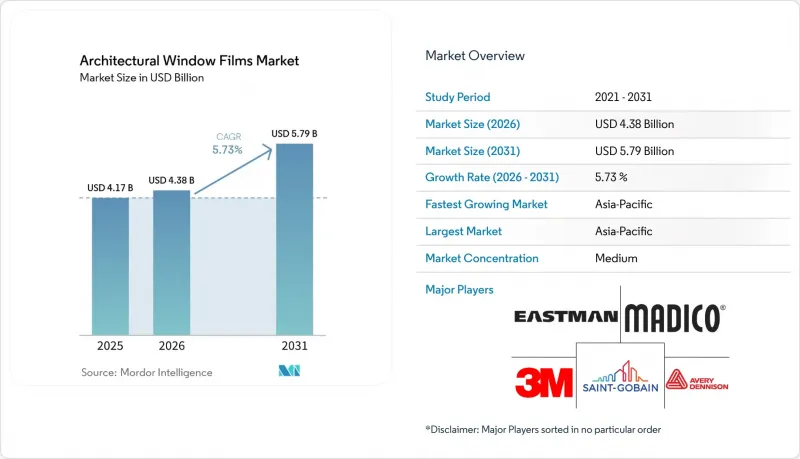
According to Mordor Intelligence, the architectural window films market size was valued at USD 4.17 billion in 2025 and is estimated to grow from USD 4.38 billion in 2026 to reach USD 5.79 billion by 2031, at a CAGR of 5.73% during the forecast period (2026-2031).
Global Architectural Window Films Market Trends and Insights
Energy-Efficient Building Retrofits and Cooling-Load Reduction
Building envelope efficiency is increasingly linked to formal energy-performance requirements in major jurisdictions. The United Kingdom's Minimum Energy Efficiency Standards (MEES) framework requires qualifying non-domestic properties over 1,000 square meters to achieve Energy Performance Certificate (EPC) Band B by 2031. This requirement makes retrofit measures more relevant to landlords managing older commercial assets. The architectural window films market benefits because films can reduce solar heat gain without altering the building structure or requiring full replacement of the existing glazing system. A 2026 peer-reviewed study found that a spectrally selective polymer nanocomposite film reduced the maximum interior temperature by 10.2°C and saved 33.1-37.1 MJ of annual cooling energy per square meter in tropical and arid settings, where technical requirements shape product selection and installation planning. As heating systems become more electric, passive control of solar gain becomes more relevant during periods of high thermal load.
Commercial Glass-Facade and Sustainable-Building Adoption
Curtain-wall and full-glass designs remain common in new commercial properties because they increase daylight and improve the visual character of buildings, while operating costs and indoor conditions remain central to project decisions. These designs also create larger exposed glazing areas and higher cooling loads, giving the architectural window films market relevance beyond visual building upgrades. Solar-control films can be added after construction while maintaining product compatibility and qualified installation standards. Green-building programs in Asia and the Gulf are increasing demand for products with documented solar-heat-gain performance in projects that require clear evidence of expected outcomes. In 2025, the Indian Green Building Council certified more than 11.8 billion square feet of commercial space, creating a broad base for performance-focused retrofits where solar exposure and interior conditions are material operating concerns. Suppliers that provide certified Solar Heat Gain Coefficient (SHGC) and total solar energy rejection data are better positioned for specification-led projects and can help owners address practical performance needs across existing building stock.
Premium Material and Installation Cost
The installed cost of basic solar-control film is materially lower than that of premium nano-ceramic systems in projects that require clear evidence of expected performance. This cost difference limits adoption in markets where owners prioritize a short capital payback period and where solar exposure and interior conditions are material operating concerns. Lower-cost dyed polyester products may lose color stability and infrared performance within 5-7 years, which commercial buyers weigh alongside installed cost. Replacement needs can weaken lifecycle value calculations for property managers, particularly in projects subject to formal approval or review. Lower labor costs in some emerging economies can reduce the gap in total installed cost. Still, they do not eliminate the material premium associated with ceramic products, thereby keeping the focus on measurable building performance. Building managers also require credible energy-price forecasts, glazing records, and thermal-load modeling to assess premium film over a 7-15-year service life, as project teams seek upgrades that avoid the disruption and cost of glass replacement.
Other drivers and restraints analyzed in the detailed report include:
- UV, Glare, and Interior-Fade Protection
- Security, Safety, and Post-Breakage Containment Requirements
- Glass Compatibility and Thermal-Stress Specification Risk
For complete list of drivers and restraints, kindly check the Table Of Contents.
Segment Analysis
Sun control films accounted for 48.12% of the architectural window film market share in 2025. Their dominance reflects their role in energy-compliance retrofits for commercial and residential properties, addressing solar heat gain and HVAC load reduction alongside visual building upgrades. Building owners typically prioritize solar-control products because they deliver measurable reductions in cooling costs, particularly in high-solar-load locations. Ceramic nanoparticle formulations are gaining importance in this category, as they can achieve total solar energy rejection above 55% without metal layers that may interfere with indoor signal propagation. Commercial buyers evaluate these products based on performance records and installed cost. Decorative films represent another product type, used for privacy, branding, and interior design in retail, corporate, and healthcare spaces. These films offer a lower-cost alternative to replacement glass, partition systems, and frosted glazing, with demand tied to commercial fit-out and renovation activity.
Security and safety films are the fastest-growing product type, with a projected CAGR of 6.34% from 2026 to 2031. Public buildings, educational facilities, healthcare settings, and government sites are increasing their use of post-breakage containment products. Compliance requirements make safety film a more durable purchase category than aesthetic upgrades, without requiring full glazing replacement. Privacy films are also incorporating Polymer Dispersed Liquid Crystal (PDLC) smart-film technology for switchable opacity. Smart-film installed pricing declined 30-40% over the five years before 2026, broadening its use in mid-range institutional refits. Other products include anti-graffiti coatings and UV-filter films for laboratories and photosensitive manufacturing settings. These specialized products serve applications where performance requirements reduce direct price competition. Overall, product demand is shifting toward higher-specification films as energy and safety requirements reduce the viability of undifferentiated products in projects where energy use, occupant comfort, and asset protection are evaluated together.
Complete Report Scope:
- By Product Type
- Sun Control Films
- Decorative Films
- Security and Safety Films
- Privacy Films
- Other Products
- By Material
- Polyester
- Ceramic
- Metalized
- Other Materials
- By Application
- Commercial Buildings
- Residential Buildings
- Other Applications
- By Geography
- Asia-Pacific
- China
- India
- Japan
- South Korea
- ASEAN Countries
- Rest of Asia-Pacific
- North America
- United States
- Canada
- Mexico
- Europe
- Germany
- United Kingdom
- France
- Italy
- NORDIC Countries
- Russia
- Rest of Europe
- South America
- Brazil
- Argentina
- Rest of South America
- Middle East and Africa
- Saudi Arabia
- South Africa
- Rest of Middle East and Africa
- Asia-Pacific
Geography Analysis
Asia-Pacific held 46.08% of revenue in 2025 and is forecast to grow at a 6.41% CAGR through 2031. China is the region's largest national market, supported by green-building standards, expanding high-rise commercial space, and stronger enforcement of solar-heat-gain requirements. Ceramic products are gaining value share as project teams seek verified performance to meet demanding commercial specifications. India is the fastest-growing major country, supported by commercial real estate expansion and a certified green-building stock exceeding 11.8 billion square feet in 2025. Avery Dennison's 2026 Clima launch reflects suppliers' interest in India's hot-climate construction base and its wide retrofit opportunity. Vietnam, Indonesia, and the Philippines offer further potential through exposure to tropical climates, young building stock, and expanding commercial real estate pipelines.
North America and Europe are the second- and third-largest revenue geographies for the architectural window films market. In the United States, American Society of Heating, Refrigerating and Air-Conditioning Engineers (ASHRAE) 90.1 updates and state-level rules in California, Florida, and Texas support investment in improved fenestration performance, while Arizona utility rebates can improve project access for facility managers. Canada's demand follows provincial energy-efficiency programs and federal net-zero building commitments. Mexico is gaining momentum as glass-facade construction expands in Monterrey, Mexico City, and Guadalajara. Germany and France are Europe's largest commercial markets, while Nordic countries favor insulating films that retain winter heat. The United Kingdom's Minimum Energy Efficiency Standards (MEES) 2031 requirements are generating specification activity for solar-control and insulating combinations in mixed-use and multi-let commercial portfolios.
South America, the Middle East, and Africa are smaller revenue geographies but offer favorable project conditions for the architectural window films market. Brazil is moving from commodity retrofits to spectrally selective film in Sao Paulo, Rio de Janeiro, and Curitiba as building certifications gain traction in commercial real estate. In Saudi Arabia, extreme solar exposure creates opportunities for large glass-facade retrofits, including a documented application in Riyadh covering 15,000 square meters. South Africa relies mainly on commercial retrofit activity in Johannesburg and Cape Town, with additional demand from mining-sector facilities requiring glare and UV control. Urban construction across Africa and certified building-performance requirements in the GCC provide separate sources of demand within the MEA region.
- 3M
- Armolan
- Avery Dennison Corporation
- Eastman Chemical Company
- Garware Hi-Tech Films
- Global Hi-Tech Films
- Huper Optik USA
- Johnson Window Films, Inc.
- LINTEC Corporation
- Madico, Inc.
- Reflectiv
- Saint-Gobain
- SOLAR CONTROL FILMS INC
- Toray Industries, Inc.
- XPEL
Additional Benefits:
- The market estimate (ME) sheet in Excel format
- 3 months of analyst support
TABLE OF CONTENTS
1 Introduction
- 1.1 Study Assumptions and Market Definition
- 1.2 Scope of the Study
2 Research Methodology
3 Executive Summary
4 Market Landscape
- 4.1 Market Overview
- 4.2 Market Drivers
- 4.2.1 Energy-Efficient Building Retrofits and Cooling-Load Reduction
- 4.2.2 Commercial Glass-Facade and Sustainable-Building Adoption
- 4.2.3 UV, Glare and Interior-Fade Protection
- 4.2.4 Security, Safety and Post-Breakage Containment Requirements
- 4.2.5 Qualification of Low-Outgassing Films in Life-Science Facilities
- 4.3 Market Restraints
- 4.3.1 Premium Material and Installation Cost
- 4.3.2 Glass Compatibility and Thermal-Stress Specification Risk
- 4.3.3 Installer Skill, Warranty and Performance-Verification Gaps
- 4.4 Value and Supply-Chain Analysis
- 4.5 Porter's Five Forces Analysis
- 4.5.1 Bargaining Power of Suppliers
- 4.5.2 Bargaining Power of Buyers
- 4.5.3 Threat of New Entrants
- 4.5.4 Threat of Substitutes
- 4.5.5 Competitive Rivalry
5 Market Size And Growth Forecasts (Value)
- 5.1 By Product Type
- 5.1.1 Sun Control Films
- 5.1.2 Decorative Films
- 5.1.3 Security and Safety Films
- 5.1.4 Privacy Films
- 5.1.5 Other Products
- 5.2 By Material
- 5.2.1 Polyester
- 5.2.2 Ceramic
- 5.2.3 Metalized
- 5.2.4 Other Materials
- 5.3 By Application
- 5.3.1 Commercial Buildings
- 5.3.2 Residential Buildings
- 5.3.3 Other Applications
- 5.4 By Geography
- 5.4.1 Asia-Pacific
- 5.4.1.1 China
- 5.4.1.2 India
- 5.4.1.3 Japan
- 5.4.1.4 South Korea
- 5.4.1.5 ASEAN Countries
- 5.4.1.6 Rest of Asia-Pacific
- 5.4.2 North America
- 5.4.2.1 United States
- 5.4.2.2 Canada
- 5.4.2.3 Mexico
- 5.4.3 Europe
- 5.4.3.1 Germany
- 5.4.3.2 United Kingdom
- 5.4.3.3 France
- 5.4.3.4 Italy
- 5.4.3.5 NORDIC Countries
- 5.4.3.6 Russia
- 5.4.3.7 Rest of Europe
- 5.4.4 South America
- 5.4.4.1 Brazil
- 5.4.4.2 Argentina
- 5.4.4.3 Rest of South America
- 5.4.5 Middle East and Africa
- 5.4.5.1 Saudi Arabia
- 5.4.5.2 South Africa
- 5.4.5.3 Rest of Middle East and Africa
- 5.4.1 Asia-Pacific
6 Competitive Landscape
- 6.1 Market Concentration
- 6.2 Strategic Moves
- 6.3 Market Share (%)/Ranking Analysis
- 6.4 Company Profiles (includes Global Overview, Market Overview, Core Segments, Financials as available, Strategic Information, Products and Services, and Recent Developments)
- 6.4.1 3M
- 6.4.2 Armolan
- 6.4.3 Avery Dennison Corporation
- 6.4.4 Eastman Chemical Company
- 6.4.5 Garware Hi-Tech Films
- 6.4.6 Global Hi-Tech Films
- 6.4.7 Huper Optik USA
- 6.4.8 Johnson Window Films, Inc.
- 6.4.9 LINTEC Corporation
- 6.4.10 Madico, Inc.
- 6.4.11 Reflectiv
- 6.4.12 Saint-Gobain
- 6.4.13 SOLAR CONTROL FILMS INC
- 6.4.14 Toray Industries, Inc.
- 6.4.15 XPEL
7 Market Opportunities and Future Outlook
- 7.1 White-Space and Unmet-Need Assessment

