PUBLISHER: Mordor Intelligence | PRODUCT CODE: 2157108

PUBLISHER: Mordor Intelligence | PRODUCT CODE: 2157108
Indonesia Fourth-party Logistics (4PL) - Market Share Analysis, Industry Trends & Statistics, Growth Forecasts (2026 - 2031)
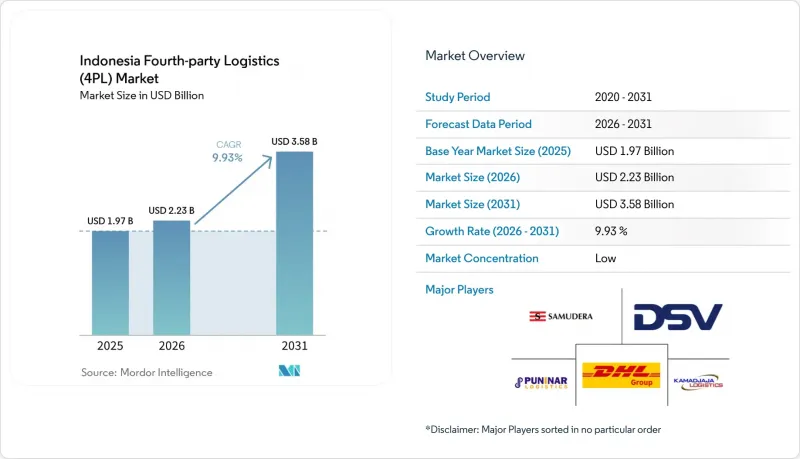
According to Mordor Intelligence, the Indonesia fourth-party logistics (4PL) market size was valued at USD 1.97 billion in 2025 and is estimated to grow from USD 2.23 billion in 2026 to reach USD 3.58 billion by 2031, at a CAGR of 9.93% during the forecast period 2026-2031.
Indonesia's geography creates coordination needs across more than 17,000 islands, where a single carrier relationship often cannot manage end-to-end movement. This report is Segmented by Operating Model (LLP, Solution Integrator, Digital Platform 4PL), by End-User Industry (FMCG, Retail and E-Commerce, Fashion, Technology and Electronics, Refrigerated and Pharma, and More), by Enterprise Size (SMEs, Large Enterprises), and by Region (Java, Sumatra, Kalimantan, Sulawesi, Bali and Nusa Tenggara, Papua and Maluku). The Market Forecasts are Provided in Terms of Value (USD).
Indonesia Fourth-party Logistics (4PL) Market Trends and Insights
E-Commerce Complexity Increasing Demand for Integrated 4PL Services
Indonesia's e-commerce GMV reached USD 71 billion in 2025 and grew 14% from the prior year. The country had 800,000 active online sellers in 2025 after a 75% increase, while video commerce recorded 2.6 billion transactions after 90% growth. These volumes require order management, routing, returns handling, and carrier coordination across many individual sellers. The Indonesia fourth-party logistics (4PL) market can serve this need, where merchants use more than 1 carrier and need a common operating layer. Digital platform providers can make these services more accessible to smaller sellers than conventional full-service arrangements.
Logistics Digitalization Accelerating End-to-End Supply Chain Orchestration
The National Logistics Ecosystem covers 55 ports and 12 airports in 2026, according to Indonesia's customs authority. The program reduces processing time by 73% and logistics costs by 17% at covered locations. These results strengthen the case for shared data and coordinated shipment management. The Indonesia fourth-party logistics (4PL) market can use greater system connectivity to support control-tower services at a lower operating cost. In September 2026, Telkomsel introduced a smart warehouse pilot that improved picking performance by 25% and reduced preparation time from 4 hours to 3 hours.
Fragmented Inter-Island Infrastructure Increasing Transshipment Complexity
Indonesia's logistics costs represented 14.3% of GDP in 2025, compared with an 8% average in developed economies. Feeder shipping frequency, roll-on and roll-off capacity, and shallow ports can raise transit time in Eastern Indonesia. These conditions add cost and uncertainty to a multi-carrier service agreement. The Indonesia fourth-party logistics (4PL) market remains more established in Java and Sumatra because those locations have stronger logistics infrastructure. The same gap can restrict providers from extending a consistent operating model into Papua, Maluku, outer Kalimantan, and Nusa Tenggara.
Other drivers and restraints analyzed in the detailed report include:
- Manufacturing Localization Expanding Complex Multi-Industry Logistics Requirements
- Real-Time Visibility Demand Driving Control-Tower Adoption
- Data Interoperability Issues Hindering Integrated 4PL Platforms
For complete list of drivers and restraints, kindly check the Table Of Contents.
Segment Analysis
Lead logistics provider (LLP) accounted for 42.85% of the Indonesia fourth-party logistics (4PL) market share in 2025, while digital platform 4PL is forecast to record a 16.32% CAGR from 2026 to 2031. The LLP model appeals to multinational clients seeking one accountable coordinator for complex supply chains, offering defined service levels, compliance support, and a clear escalation structure. Automotive manufacturers, pharmaceutical companies, and industrial groups commonly require this level of coordination across multiple suppliers, carriers, and islands.
Digital platform 4PL is gaining relevance among customers seeking supply chain visibility and coordination without adopting a full-scope outsourcing model. Waresix's listed subsidiary, PT BSA Logistics Indonesia, reported 42.6% revenue growth in H1 2026, highlighting the expansion of digitally enabled logistics operations. Flexible minimum volumes and connected workflows can also help digital platforms serve mid-market customers. As a result, Indonesia's 4PL industry accommodates distinct customer requirements through LLP and digital operating models, with each model addressing different levels of supply chain control and outsourcing.
Complete Report Scope:
- By Operating Model
- Lead Logistics Provider (LLP)
- Solution Integrator
- Digital Platform 4PL
- By End-User Industry
- FMCG
- Retail and E-commerce
- Fashion and Lifestyle
- Technology and Electronics
- Refrigerated and Pharma
- Automotive and Mobility
- Industrial Manufacturing
- Others
- By Enterprise Size
- Small and Medium Enterprises
- Large Enterprises
- By Region
- Java (Jakarta and BOD)
- Sumatra
- Kalimantan
- Sulawesi
- Bali and Nusa Tenggara
- Papua Region and Maluku Islands
List of Companies Covered in this Report:
- DHL Group
- Kuehne+Nagel International AG
- DSV A/S
- A.P. Moller - Maersk A/S
- CEVA Logistics
- GEODIS
- NX Group
- Rhenus Group
- Toll Group
- PSA BDP
- Puninar Logistics
- Expeditors International
- Kintetsu World Express (Including APL Logistics)
- Yusen Logistics Co., Ltd.
- CJ Logistics Corporation
- LOGISTEED, Ltd.
- PT Samudera Indonesia Tbk
- PT Catur Aman Sentosa
- Janio
- Waresix
- EnviLog
- PT Makmur Berkat Solusi
Additional Benefits:
- The market estimate (ME) sheet in Excel format
- 3 months of analyst support
TABLE OF CONTENTS
1 INTRODUCTION
- 1.1 Study Assumptions and Market Definition
- 1.2 Scope of the Study
2 RESEARCH METHODOLOGY
3 EXECUTIVE SUMMARY
- 3.1 Market Size, Growth, and Forecast Outlook
- 3.2 Key Demand Drivers and 4PL Market Trends
- 3.3 Major Logistics Networks and Demand Concentration
- 3.4 Competitive Landscape and Leading 4PL Providers
4 MARKET LANDSCAPE
- 4.1 Market Overview and Importance of 4PL
- 4.2 Market Drivers
- 4.2.1 E-Commerce Complexity Increasing Demand for Integrated 4PL Services
- 4.2.2 Logistics Digitalization Accelerating End-to-End Supply Chain Orchestration
- 4.2.3 Manufacturing Localization Expanding Complex Multi-Industry Logistics Requirements
- 4.2.4 Real-Time Visibility Demand Driving Control-Tower Adoption
- 4.2.5 Healthcare Compliance Increasing Specialized Supply Chain Management Demand
- 4.2.6 Multi-Island Networks Increasing Optimization and Backhaul Coordination Needs
- 4.3 Market Restraints
- 4.3.1 Fragmented Inter-Island Infrastructure Increasing Transshipment Complexity
- 4.3.2 Data Interoperability Issues Hindering Integrated 4PL Platforms
- 4.3.3 Limited Analytics Talent Constraining Advanced Orchestration Capabilities
- 4.3.4 Strategic Control Concerns Limiting 4PL Outsourcing Adoption
- 4.4 Value Chain Structure and 4PL Service Flow Analysis
- 4.5 Regulatory Framework and 4PL Compliance Requirements Analysis
- 4.6 Technology Adoption and Supply Chain Digitalization Analysis
- 4.7 Transportation and Warehousing Investment Trend Analysis
- 4.8 Domestic and Cross-Border Cargo Flow Complexity Assessment
- 4.9 Regional Logistics Investment and Network Expansion Analysis
- 4.10 Porter's Five Forces Analysis
- 4.10.1 Threat of New Entrants
- 4.10.2 Bargaining Power of Buyers
- 4.10.3 Bargaining Power of Suppliers
- 4.10.4 Threat of Substitute Services
- 4.10.5 Intensity of Competitive Rivalry
- 4.11 Impact of Geo-Political Events on Supply Chain Shifts
5 MARKET SIZE AND GROWTH FORECASTS
- 5.1 By Operating Model
- 5.1.1 Lead Logistics Provider (LLP)
- 5.1.2 Solution Integrator
- 5.1.3 Digital Platform 4PL
- 5.2 By End-User Industry
- 5.2.1 FMCG
- 5.2.2 Retail and E-commerce
- 5.2.3 Fashion and Lifestyle
- 5.2.4 Technology and Electronics
- 5.2.5 Refrigerated and Pharma
- 5.2.6 Automotive and Mobility
- 5.2.7 Industrial Manufacturing
- 5.2.8 Others
- 5.3 By Enterprise Size
- 5.3.1 Small and Medium Enterprises
- 5.3.2 Large Enterprises
- 5.4 By Region
- 5.4.1 Java (Jakarta and BOD)
- 5.4.2 Sumatra
- 5.4.3 Kalimantan
- 5.4.4 Sulawesi
- 5.4.5 Bali and Nusa Tenggara
- 5.4.6 Papua Region and Maluku Islands
6 COMPETITIVE LANDSCAPE
- 6.1 Market Concentration
- 6.2 Strategic Moves
- 6.3 Market Share Analysis
- 6.4 Company Profiles (includes Global Level Overview, Market Level Overview, Core Segments, Financials as available, Strategic Information, Geographic Coverage, Products and Services, Recent Developments)
- 6.4.1 DHL Group
- 6.4.2 Kuehne+Nagel International AG
- 6.4.3 DSV A/S
- 6.4.4 A.P. Moller - Maersk A/S
- 6.4.5 CEVA Logistics
- 6.4.6 GEODIS
- 6.4.7 NX Group
- 6.4.8 Rhenus Group
- 6.4.9 Toll Group
- 6.4.10 PSA BDP
- 6.4.11 Puninar Logistics
- 6.4.12 Expeditors International
- 6.4.13 Kintetsu World Express (Including APL Logistics)
- 6.4.14 Yusen Logistics Co., Ltd.
- 6.4.15 CJ Logistics Corporation
- 6.4.16 LOGISTEED, Ltd.
- 6.4.17 PT Samudera Indonesia Tbk
- 6.4.18 PT Catur Aman Sentosa
- 6.4.19 Janio
- 6.4.20 Waresix
- 6.4.21 EnviLog
- 6.4.22 PT Makmur Berkat Solusi
7 MARKET OPPORTUNITIES AND FUTURE OUTLOOK
- 7.1 White-Space Opportunities and Unmet 4PL Service Needs
- 7.2 High-Potential End-User Segments and Growth Opportunities
- 7.3 Strategic Growth Priorities Across 4PL Ecosystem
- 7.4 Future Market Outlook and Emerging Demand Pockets
8 APPENDIX

