PUBLISHER: Mordor Intelligence | PRODUCT CODE: 2157113

PUBLISHER: Mordor Intelligence | PRODUCT CODE: 2157113
ASEAN Metal Forming Equipment - Market Share Analysis, Industry Trends & Statistics, Growth Forecasts (2026 - 2031)
According to Mordor Intelligence, the ASEAN metal forming equipment market size was USD 0.63 billion in 2025 and is estimated to grow from USD 0.66 billion in 2026 to reach USD 0.83 billion by 2031, at a CAGR of 4.53% during the forecast period (2026-2031).
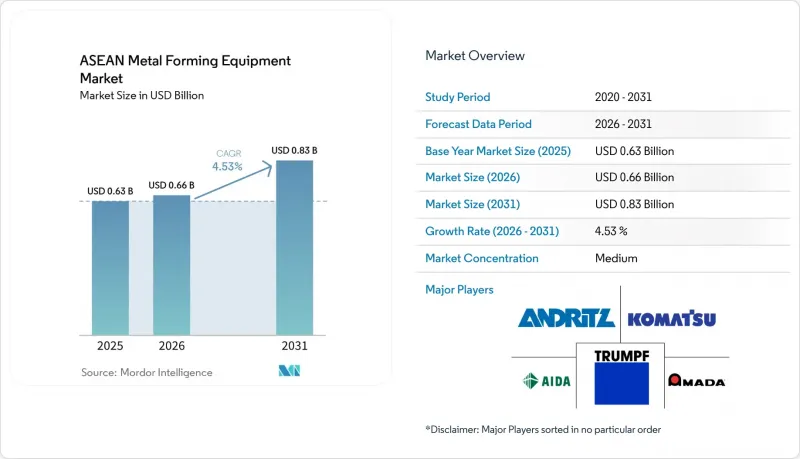
Manufacturing investment moving into Southeast Asia is expanding demand for new press shops, stamping lines, and precision forging cells. This report is Segmented by Equipment Type (Press Machines, Press Brakes, and More), by Forming Process (Stamping, Deep Drawing, Bending, and More), by Material (Carbon Steel, Stainless Steel, Aluminum, Copper), by End-Use Industry (Automotive, Aerospace, and More), and by Geography (Thailand, Vietnam, Indonesia, Malaysia, and More). The Market Forecasts are Provided in Terms of Value (USD).
ASEAN Metal Forming Equipment Market Trends and Insights
China Plus One Manufacturing Diversification and FDI
Manufacturing investment moving from China continues to create new equipment demand across the ASEAN metal forming equipment market. UNCTAD reported that ASEAN manufacturing FDI rose nearly 150% to USD 44 billion in the latest reporting period. New industrial sites normally need press shops, stamping lines, and forging cells before production can begin. Malaysia, Vietnam, Thailand, and Indonesia have attracted different manufacturing activities, including automotive, electronics, semiconductor, and EV-related projects. This mix spreads equipment demand across several production activities instead of tying it to one customer sector. It also gives suppliers an opportunity to match machine specifications with country-level production needs and localized service requirements.
EV and Hybrid Vehicle Component Localization
EV and hybrid production is creating demand for locally formed battery enclosures, motor housings, and structural body parts in the ASEAN metal forming equipment market. Thailand's EV3.0 and EV3.5 programs require eligible manufacturers to pair imported vehicle volumes with domestic production. That requirement extends to local stamping and forming suppliers as vehicle producers build regional component capability. Thailand approved EEC Phase 2 in March 2026, committing USD 15 billion over 5 years, with EV and battery manufacturing receiving the largest allocation. High-tonnage servo presses, hydroforming equipment, and aluminum deep-draw systems are relevant because EV components need programmable force and close dimensional control. The program pipeline supports investment in both new equipment and upgrades to existing automotive lines.
High Capital Cost and Extended Payback Periods
Advanced servo presses, CNC hydraulic press brakes, and precision forging lines require sizable upfront commitments for the region's smaller fabricators. Credit access and collateral requirements remain material barriers for manufacturing SMEs in Southeast Asia. Loan terms of 3 to 5 years may not align with the longer payback periods associated with specialized forming systems. Smaller firms also face higher real estate and utility pressure when large greenfield projects compete for industrial capacity. Machinery duty exemptions can lower costs for eligible large projects, but they do not remove conventional financing constraints for many mid-sized shops. This leaves OEM-linked suppliers better able to upgrade while independent firms continue using equipment beyond preferred replacement periods.
Other drivers and restraints analyzed in the detailed report include:
- Electronics and Semiconductor Capacity Expansion
- Automation to Offset Skilled-Labor Constraints
- Import Dependence and Equipment-Logistics Exposure
For complete list of drivers and restraints, kindly check the Table Of Contents.
Segment Analysis
Press machines accounted for 46.8% of the ASEAN metal forming equipment market size in 2025. They support blanking, progressive stamping, and transfer-press work for automotive bodies, electronics chassis, and general fabrication. Programmable stroke profiles can reduce springback in advanced high-strength steel and aluminum components. That capability suits vehicle localization programs and electronics quality requirements. Mechanical presses retain a substantial installed base in Thailand and Indonesia because older automotive tooling was designed for standard stroke parameters. Tightening tolerance requirements are encouraging replacement with servo and CNC-controlled systems. Hydraulic presses remain important for forging, pre-forming, deep drawing, and hydroforming work. Their programmable force control is valuable where forming conditions matter more than the higher cycle rates of mechanical presses.
Servo presses are the fastest-growing technology variant within the equipment category, with a 6.21% CAGR forecast through 2031. Press brakes and bending machines form the second-largest equipment subcategory. Vietnamese and Malaysian fabricators are increasingly considering servo-electric variants for lower operating costs and simpler maintenance than hydraulic systems. Forging equipment is gaining relevance as defense programs seek more domestic structural component production. Hydroforming equipment and extrusion presses have smaller installed bases, but EV battery cases and lightweight structural parts support their stronger growth outlook. The ASEAN metal forming equipment industry also needs wire, tube, and profile-forming systems for specialized applications. AIDA introduced its BEX Series for fuel-cell bipolar plate separators in 2024, with capacities from 8,000 kN to 16,000 kN. The product shows how suppliers are adapting their equipment portfolios for hydrogen and electrified vehicle subsystems. These applications place greater value on process control and component consistency than on standard high-volume forming alone.
Stamping and punching held 39.6% of the ASEAN metal forming equipment market share in 2025. Its cost efficiency at scale and fit with progressive-die automation make it central to ASEAN automotive, electronics, and appliance production. EV programs use hydroformed members for battery enclosures, roof rails, and control-arm subframes. The process forms complex shapes with fewer secondary welds. This can improve structural integrity and reduce part counts in suitable applications. Deep drawing remains relevant for food equipment, medical devices, and semiconductor tooling. These applications benefit from the region's stainless-steel processing requirements.
Hydroforming is the fastest-growing process, with a 5.72% CAGR forecast through 2031. Bending supports broad demand from fabrication, HVAC, and electronics-rack production. CNC press brakes are replacing manual folding machines in Vietnam and Indonesia as labor cost advantages narrow and export quality requirements rise. Hot forging and precision cold forging are gaining attention in automotive powertrain components and defense hardware. Regional suppliers are seeking to produce parts that were previously purchased from Japan, China, and Europe. Rolling and roll forming serve infrastructure, renewable-energy installations, structural steel, and solar mounting systems in Indonesia and Malaysia. Extrusion remains smaller than the dominant processes, but aluminum vehicle chassis components and heat-sink profiles are supporting further adoption. Process selection in the ASEAN metal forming equipment market, therefore, follows both end-product geometry and the required quality level. It also reflects the availability of experienced operators, dies, and local service support.
Complete Report Scope:
- By Equipment Type
- Press Machines
- Mechanical Presses
- Hydraulic Presses
- Servo Presses
- Other General-Purpose Presses
- Press Brakes and Bending Machines
- Hydraulic Press Brakes
- Servo / Electric Press Brakes
- Mechanical Press Brakes
- Other Bending Machines
- Forging Equipment
- Forging Presses
- Forging Hammers
- Upsetting and Heading Machines
- Other Forging Equipment
- Roll Forming and Plate/Profile Rolling Equipment
- Roll Forming Machines
- Plate Rolling Machines
- Section and Profile Rolling Machines
- Other Secondary Rolling/Forming Equipment
- Wire, Tube and Profile Forming Equipment
- Wire and Bar Drawing/Forming Equipment
- Tube Forming and Bending Equipment
- Profile Forming Equipment
- Extrusion Presses
- Hydroforming Equipment
- Other Metal Forming Equipment
- Press Machines
- By Forming Process
- Stamping and Punching
- Deep Drawing
- Bending
- Forging
- Rolling and Roll Forming
- Extrusion
- Hydroforming
- Other Forming Processes
- By Material Formed
- Carbon and Low-Alloy Steel
- Stainless Steel
- Aluminum and Aluminum Alloys
- Copper and Copper Alloys
- Titanium, Nickel and Other Non-Ferrous Metals
- Other Materials
- By End-Use Industry
- Automotive and Transportation
- Aerospace and Defense
- Industrial Machinery and Capital Equipment
- Metal Products and Fabrication
- Electrical and Electronics
- Construction and Infrastructure
- Energy and Power
- Consumer Appliances and Durable Goods
- Medical and Precision Manufacturing
- Other End-Use Industries
- By Geography
- Thailand
- Vietnam
- Indonesia
- Malaysia
- Philippines
- Singapore
- Rest of ASEAN
List of Companies Covered in this Report:
- AIDA Engineering Ltd.
- AMADA CO., LTD.
- ANDRITZ Schuler Group
- TRUMPF SE + Co. KG
- Komatsu Industries (Thailand) Co., Ltd.
- Fagor Arrasate S. Coop.
- JIER Machine-Tool Group Co., Ltd.
- Mitsubishi Heavy Industries, Ltd.
- Prima Industrie S.p.A.
- Salvagnini Italia S.p.A.
- LVD Company NV
- Bystronic AG
- DMG MORI CO., LTD.
- Hyundai WIA Corp.
- FANUC CORPORATION
- Yangli Group Corporation Ltd.
- Accurl CNC Machine (Anhui) Manufactory Co., Ltd.
- AAPICO Hitech Public Company Limited
- Interplex Holdings Pte. Ltd.
- THACO INDUSTRIES
Additional Benefits:
- The market estimate (ME) sheet in Excel format
- 3 months of analyst support
TABLE OF CONTENTS
1 INTRODUCTION
- 1.1 Study Assumptions and Market Definition
- 1.2 Scope of the Study
2 RESEARCH METHODOLOGY
3 EXECUTIVE SUMMARY
4 MARKET LANDSCAPE
- 4.1 Market Overview
- 4.2 Market Drivers
- 4.2.1 China Plus One Manufacturing Diversification and FDI
- 4.2.2 EV and Hybrid Vehicle Component Localization
- 4.2.3 Electronics and Semiconductor Capacity Expansion
- 4.2.4 Automation to Offset Skilled-Labor Constraints
- 4.2.5 Demand for High-Speed, High-Precision Forming
- 4.2.6 Regional Service and Export Hub Development
- 4.3 Market Restraints
- 4.3.1 High Capital Cost and Extended Payback Periods
- 4.3.2 Import Dependence and Equipment-Logistics Exposure
- 4.3.3 Volatile Automotive and Construction Cycles
- 4.3.4 Limited Local Tool-and-Die and Controls Talent
- 4.4 Value and Supply-Chain Analysis
- 4.4.1 Structural Materials and Machine Components
- 4.4.2 Drives, Hydraulics, Motors and Controls
- 4.4.3 Tooling and Die Ecosystem
- 4.4.4 Metal Forming Equipment Manufacturers
- 4.4.5 Automation and System Integrators
- 4.4.6 Distribution and Dealer Network
- 4.4.7 Service, Retrofit and Lifecycle Support
- 4.5 Regulatory Landscape
- 4.5.1 Industrial Safety and Machine-Guarding Requirements
- 4.5.2 Energy-Efficiency and Environmental Requirements
- 4.5.3 ASEAN Trade, Customs, and Rules-of-Origin Considerations
- 4.5.4 Country-Level Investment Incentives and Local-Content Policies
- 4.6 Technological Outlook
- 4.6.1 CNC Press Brakes and Automated Bending Systems
- 4.6.2 Robotic Bending, Transfer and Coil-Feed Automation
- 4.6.3 Punch-Laser and Multi-Function Metal Forming Systems
- 4.6.4 Digital Twins, Press Simulation and Offline Programming
- 4.6.5 IoT-Based Equipment Monitoring and Predictive Maintenance
- 4.6.6 Energy-Efficient Drives and Hydraulic Systems
- 4.6.7 AI-Assisted Process and Die-Change Optimization
- 4.7 Impact Assessment of Geopolitical Events on the Market
5 MARKET SIZE AND GROWTH FORECASTS
- 5.1 By Equipment Type
- 5.1.1 Press Machines
- 5.1.1.1 Mechanical Presses
- 5.1.1.2 Hydraulic Presses
- 5.1.1.3 Servo Presses
- 5.1.1.4 Other General-Purpose Presses
- 5.1.2 Press Brakes and Bending Machines
- 5.1.2.1 Hydraulic Press Brakes
- 5.1.2.2 Servo / Electric Press Brakes
- 5.1.2.3 Mechanical Press Brakes
- 5.1.2.4 Other Bending Machines
- 5.1.3 Forging Equipment
- 5.1.3.1 Forging Presses
- 5.1.3.2 Forging Hammers
- 5.1.3.3 Upsetting and Heading Machines
- 5.1.3.4 Other Forging Equipment
- 5.1.4 Roll Forming and Plate/Profile Rolling Equipment
- 5.1.4.1 Roll Forming Machines
- 5.1.4.2 Plate Rolling Machines
- 5.1.4.3 Section and Profile Rolling Machines
- 5.1.4.4 Other Secondary Rolling/Forming Equipment
- 5.1.5 Wire, Tube and Profile Forming Equipment
- 5.1.5.1 Wire and Bar Drawing/Forming Equipment
- 5.1.5.2 Tube Forming and Bending Equipment
- 5.1.5.3 Profile Forming Equipment
- 5.1.6 Extrusion Presses
- 5.1.7 Hydroforming Equipment
- 5.1.8 Other Metal Forming Equipment
- 5.1.1 Press Machines
- 5.2 By Forming Process
- 5.2.1 Stamping and Punching
- 5.2.2 Deep Drawing
- 5.2.3 Bending
- 5.2.4 Forging
- 5.2.5 Rolling and Roll Forming
- 5.2.6 Extrusion
- 5.2.7 Hydroforming
- 5.2.8 Other Forming Processes
- 5.3 By Material Formed
- 5.3.1 Carbon and Low-Alloy Steel
- 5.3.2 Stainless Steel
- 5.3.3 Aluminum and Aluminum Alloys
- 5.3.4 Copper and Copper Alloys
- 5.3.5 Titanium, Nickel and Other Non-Ferrous Metals
- 5.3.6 Other Materials
- 5.4 By End-Use Industry
- 5.4.1 Automotive and Transportation
- 5.4.2 Aerospace and Defense
- 5.4.3 Industrial Machinery and Capital Equipment
- 5.4.4 Metal Products and Fabrication
- 5.4.5 Electrical and Electronics
- 5.4.6 Construction and Infrastructure
- 5.4.7 Energy and Power
- 5.4.8 Consumer Appliances and Durable Goods
- 5.4.9 Medical and Precision Manufacturing
- 5.4.10 Other End-Use Industries
- 5.5 By Geography
- 5.5.1 Thailand
- 5.5.2 Vietnam
- 5.5.3 Indonesia
- 5.5.4 Malaysia
- 5.5.5 Philippines
- 5.5.6 Singapore
- 5.5.7 Rest of ASEAN
6 COMPETITIVE LANDSCAPE
- 6.1 Market Concentration
- 6.2 Strategic Moves
- 6.3 Market Share Analysis
- 6.4 Company Profiles (includes Global Level Overview, Market Level Overview, Core Segments, Financials as available, Strategic Information, Products and Services, Recent Developments)
- 6.4.1 AIDA Engineering Ltd.
- 6.4.2 AMADA CO., LTD.
- 6.4.3 ANDRITZ Schuler Group
- 6.4.4 TRUMPF SE + Co. KG
- 6.4.5 Komatsu Industries (Thailand) Co., Ltd.
- 6.4.6 Fagor Arrasate S. Coop.
- 6.4.7 JIER Machine-Tool Group Co., Ltd.
- 6.4.8 Mitsubishi Heavy Industries, Ltd.
- 6.4.9 Prima Industrie S.p.A.
- 6.4.10 Salvagnini Italia S.p.A.
- 6.4.11 LVD Company NV
- 6.4.12 Bystronic AG
- 6.4.13 DMG MORI CO., LTD.
- 6.4.14 Hyundai WIA Corp.
- 6.4.15 FANUC CORPORATION
- 6.4.16 Yangli Group Corporation Ltd.
- 6.4.17 Accurl CNC Machine (Anhui) Manufactory Co., Ltd.
- 6.4.18 AAPICO Hitech Public Company Limited
- 6.4.19 Interplex Holdings Pte. Ltd.
- 6.4.20 THACO INDUSTRIES
7 MARKET OPPORTUNITIES AND FUTURE OUTLOOK
- 7.1 White-Space and Unmet-Need Assessment
- 7.1.1 Affordable Servo and Robotic Retrofit Packages for SMEs
- 7.1.2 ASEAN-Wide Spare-Parts and Service Coverage
- 7.1.3 High-Strength-Steel and Aluminum Forming Capability
- 7.1.4 Local Tooling, Die, and Process-Engineering Ecosystems
- 7.1.5 Battery-Case and EV Structural-Part Forming
- 7.1.6 Energy-Efficient Press Replacement and Lifecycle Services

