PUBLISHER: Mordor Intelligence | PRODUCT CODE: 2157121

PUBLISHER: Mordor Intelligence | PRODUCT CODE: 2157121
Europe Metal Forming Equipment - Market Share Analysis, Industry Trends & Statistics, Growth Forecasts (2026 - 2031)
According to Mordor Intelligence, the Europe metal forming equipment market size was USD 7.24 billion in 2025 and is projected to grow from USD 7.58 billion in 2026 to reach USD 9.27 billion by 2031, growing at a CAGR of 4.09% from 2026 to 2031.
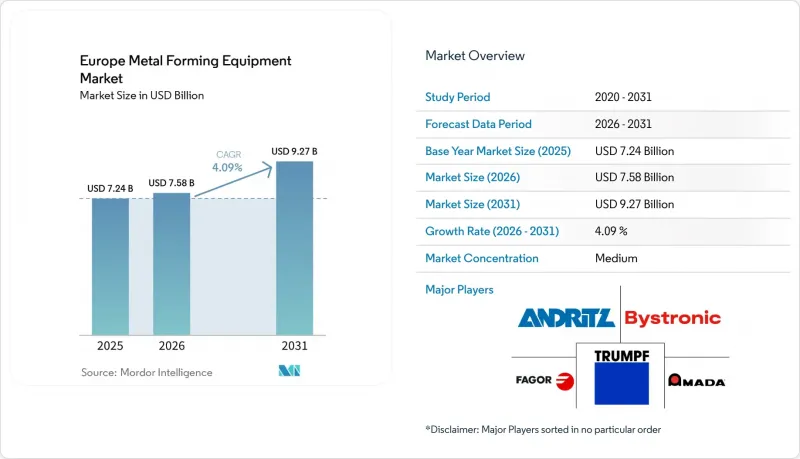
Demand is supported by the retooling of press shops for electrified vehicle platforms, higher defense procurement, and industrial capacity investment closer to European end markets. This report is Segmented by Equipment Type (Press Machines, Press Brakes, and More), by Forming Process (Stamping, Deep Drawing, Bending, and More), by Material (Carbon Steel, Stainless Steel, Aluminum, Copper), by End-Use Industry (Automotive, Aerospace, and More), and by Geography (Thailand, Vietnam, Indonesia, Malaysia, and More). The Market Forecasts are Provided in Terms of Value (USD).
Europe Metal Forming Equipment Market Trends and Insights
Electric Vehicle, Battery, and Lightweight-Component Manufacturing
Battery enclosure production needs deep-draw and servo transfer presses that can hold wall planarity deviations within +-0.2 mm. Conventional hydraulic lines cannot consistently maintain those tolerances at high production speeds. Aluminum body-in-white stampings also need equipment that can manage springback in high-strength alloys. The European Commission Innovation Fund provided EUR 852 million (USD 1,002.2 million) for 6 battery manufacturing projects, supporting 56 GWh of annual capacity additions and an estimated 91 million tons of lifetime CO2 reduction. ANDRITZ Schuler commissioned a 1.5 GW, 22-meter automated line for cylindrical EV booster cells for a German premium automaker in January 2026. The project places the Europe metal forming equipment market closer to battery production infrastructure as vehicle manufacturers expand electrified platforms.
Industry 4.0, Robotics and Connected Press Shops
European press shops increased their use of in-die sensors, vision inspection, and connected predictive maintenance systems during 2025. OEM traceability requirements and the cost of preventing die damage support this equipment investment. ANDRITZ Schuler uses its Metris Visual Die Protection system at the Smart Press Shop joint venture with Porsche in Halle, where cameras and real-time image processing identify foreign objects, cracks, and scrap accumulation before tools are damaged. A survey of more than 300 machine builders found that 79% considered skills shortages to have a significant or very significant operational impact. Automation can reduce reliance on controls engineers during startup and changeovers. Connected equipment also supports software and data services that strengthen supplier relationships across the Europe metal forming equipment market.
Energy-Price Volatility and Carbon-Compliance Costs
Energy costs remain a direct concern for European forming operations and their capital spending decisions. The European Commission reported that industrial electricity and gas prices in the EU remained 2 to 4 times higher than those of the bloc's principal trading partners, despite falling below their 2022 and 2023 peaks. The cost difference weakens returns from hot forging, aluminum extrusion, and conventional hydraulic presses. Emissions Trading System allowance costs also weigh on operators using older equipment without energy-recovery drives. Larger Tier 1 suppliers can justify servo-electric upgrades that cut electricity consumption by 70% to 85% per cycle. Smaller fabricators often delay replacement decisions because energy-price volatility makes the payback period less predictable in the Europe metal forming equipment market.
Other drivers and restraints analyzed in the detailed report include:
- Aerospace, Defense, and Renewable-Energy Manufacturing
- European Nearshoring and Industrial Resilience Investment
- High Capital Costs, Skills Gaps, and Imported Component Exposure
For complete list of drivers and restraints, kindly check the Table Of Contents.
Segment Analysis
Press machines accounted for 43.5% of the Europe metal forming equipment market share in 2025. Their installed base serves automotive stamping, appliance production, and structural fabrication. Their lower energy use and compatibility with in-die sensors support a faster pace. ANDRITZ Schuler introduced next-generation HFA fineblanking presses in January 2026 with servo-controlled hydraulic pump drives and double-digit energy-efficiency improvements.
Servo presses are forecast to grow at a 6.1% CAGR from 2026 to 2031. The launch shows that established hydraulic equipment is being upgraded with electrified controls rather than being replaced in every application. This approach can retain the mechanical value of a press while improving its operating profile and data capabilities. MSV Metal Studenka launched a CZK 280 million robotic forging line in May 2025, increasing annual capacity from 14,000 tons to more than 18,000 tons. Breitenfeld Edelstahl commissioned a new 40MN forging press in 2026. These projects show continued demand for heavy-duty systems alongside more flexible press technologies. They also demonstrate that investment decisions differ by component size, production volume, and the material being formed. The Europe metal forming equipment market continues to reward suppliers that combine equipment durability, automation, and lower operating costs.
Stamping and punching held 32.5% of the Europe metal forming equipment market size in 2025. Automotive producers rely on high-speed sheet metal stamping for body panels and structural closures. The process supports hollow components with complex geometries, including drive shafts, instrument panel carriers, and aircraft sub-frame tubes. It also delivers wall-thickness uniformity that multi-step stamping cannot reproduce.
Hydroforming is forecast to grow at a 5.8% CAGR between 2026 and 2031. Servo-electric bending systems can reduce energy use by 70% to 85% per cycle compared with hydraulic alternatives. Fraunhofer IWU modernized its hydroforming test facility in Chemnitz in October 2025 to reduce energy costs. This focus reflects the operational pressure on high-pressure forming equipment. Demand is moving toward precision processes for EV and aerospace applications. That movement raises the equipment value required for each unit of metal processed in the Europe metal forming equipment market. Buyers increasingly assess process capability and quality control alongside nominal throughput.
Complete Report Scope:
- By Equipment Type
- Press Machines
- Mechanical Presses
- Hydraulic Presses
- Servo Presses
- Other General-Purpose Presses
- Press Brakes and Bending Machines
- Hydraulic Press Brakes
- Servo / Electric Press Brakes
- Mechanical Press Brakes
- Other Bending Machines
- Forging Equipment
- Forging Presses
- Forging Hammers
- Upsetting and Heading Machines
- Other Forging Equipment
- Roll Forming and Plate/Profile Rolling Equipment
- Roll Forming Machines
- Plate Rolling Machines
- Section and Profile Rolling Machines
- Other Secondary Rolling/Forming Equipment
- Wire, Tube and Profile Forming Equipment
- Wire and Bar Drawing/Forming Equipment
- Tube Forming and Bending Equipment
- Profile Forming Equipment
- Extrusion Presses
- Hydroforming Equipment
- Other Metal Forming Equipment
- Press Machines
- By Forming Process
- Stamping and Punching
- Deep Drawing
- Bending
- Forging
- Rolling and Roll Forming
- Extrusion
- Hydroforming
- Other Forming Processes
- By Material Formed
- Carbon and Low-Alloy Steel
- Stainless Steel
- Aluminum and Aluminum Alloys
- Copper and Copper Alloys
- Titanium, Nickel and Other Non-Ferrous Metals
- Other Materials
- By End-Use Industry
- Automotive and Transportation
- Aerospace and Defense
- Industrial Machinery and Capital Equipment
- Metal Products and Fabrication
- Electrical and Electronics
- Construction and Infrastructure
- Energy and Power
- Consumer Appliances and Durable Goods
- Medical and Precision Manufacturing
- Other End-Use Industries
- By Geography
- Germany
- Italy
- France
- Spain
- Austria
- United Kingdom
- Rest of Europe
List of Companies Covered in this Report:
- ANDRITZ Schuler Group
- TRUMPF SE + Co. KG
- AMADA Co., Ltd.
- Bystronic AG
- Fagor Arrasate S. Coop.
- Prima Industrie S.p.A.
- Salvagnini Italia S.p.A.
- LVD Company nv
- BLM GROUP
- Danobatgroup
- KUKA AG
- FANUC Europe Corporation
- ABB Ltd.
- GROB-WERKE GmbH & Co. KG
- Dimeco Alipresse
- Gasparini S.p.A.
- Faccin S.p.A.
- Ermaksan Makina Sanayi ve Ticaret A.S.
- PWO AG
- Gestamp Automocion, S.A.
- Benteler International AG
- CIE Automotive, S.A.
- Quintus Technologies AB
Additional Benefits:
- The market estimate (ME) sheet in Excel format
- 3 months of analyst support
TABLE OF CONTENTS
1 INTRODUCTION
- 1.1 Study Assumptions and Market Definition
- 1.2 Scope of the Study
2 RESEARCH METHODOLOGY
3 EXECUTIVE SUMMARY
4 MARKET LANDSCAPE
- 4.1 Market Overview
- 4.2 Market Drivers
- 4.2.1 Electric Vehicle, Battery and Lightweight-Component Manufacturing
- 4.2.2 Industry 4.0, Robotics and Connected Press Shops
- 4.2.3 Aerospace, Defense and Renewable-Energy Manufacturing
- 4.2.4 European Nearshoring and Industrial Resilience Investment
- 4.2.5 Retrofit Demand from Aging Hydraulic and Mechanical Press Fleets
- 4.2.6 Digital Traceability Requirements for High-Value Formed Components
- 4.3 Market Restraints
- 4.3.1 Energy-Price Volatility and Carbon-Compliance Costs
- 4.3.2 High Capital Costs and Delayed SME Investment
- 4.3.3 Skilled-Operator and Controls-Engineering Shortages
- 4.3.4 Dependence on Imported Motion-Control and Precision Components
- 4.4 Value and Supply-Chain Analysis
- 4.4.1 Raw Materials and Critical Components
- 4.4.2 Machine Design and Engineering
- 4.4.3 Press, Bending and Forming-System Manufacturing
- 4.4.4 Automation, Robotics and Material Handling Integration
- 4.4.5 Distribution, System Integration and Installation
- 4.4.6 Spare Parts, Tooling and Lifecycle Services
- 4.5 Regulatory Landscape
- 4.5.1 EU Machinery Regulation and Product-Conformity Requirements
- 4.5.2 CE Marking, Safety and Functional-Safety Requirements
- 4.5.3 Industrial Emissions, Energy Efficiency and Carbon Reporting
- 4.5.4 Worker Safety, Noise, Guarding and Ergonomic Requirements
- 4.5.5 Data Governance and Cybersecurity for Connected Equipment
- 4.6 Technological Outlook
- 4.6.1 Servo-Electric and Hybrid Press Architectures
- 4.6.2 Fiber Laser, CNC and Multi-Axis Forming Integration
- 4.6.3 Robotics, Vision Inspection and In-Die Sensing
- 4.6.4 Digital Twins, Predictive Maintenance and Remote Monitoring
- 4.6.5 Energy Monitoring and Regenerative Drives
- 4.7 Impact Assessment of Geopolitical Events on the Market
5 MARKET SIZE AND GROWTH FORECASTS
- 5.1 By Equipment Type
- 5.1.1 Press Machines
- 5.1.1.1 Mechanical Presses
- 5.1.1.2 Hydraulic Presses
- 5.1.1.3 Servo Presses
- 5.1.1.4 Other General-Purpose Presses
- 5.1.2 Press Brakes and Bending Machines
- 5.1.2.1 Hydraulic Press Brakes
- 5.1.2.2 Servo / Electric Press Brakes
- 5.1.2.3 Mechanical Press Brakes
- 5.1.2.4 Other Bending Machines
- 5.1.3 Forging Equipment
- 5.1.3.1 Forging Presses
- 5.1.3.2 Forging Hammers
- 5.1.3.3 Upsetting and Heading Machines
- 5.1.3.4 Other Forging Equipment
- 5.1.4 Roll Forming and Plate/Profile Rolling Equipment
- 5.1.4.1 Roll Forming Machines
- 5.1.4.2 Plate Rolling Machines
- 5.1.4.3 Section and Profile Rolling Machines
- 5.1.4.4 Other Secondary Rolling/Forming Equipment
- 5.1.5 Wire, Tube and Profile Forming Equipment
- 5.1.5.1 Wire and Bar Drawing/Forming Equipment
- 5.1.5.2 Tube Forming and Bending Equipment
- 5.1.5.3 Profile Forming Equipment
- 5.1.6 Extrusion Presses
- 5.1.7 Hydroforming Equipment
- 5.1.8 Other Metal Forming Equipment
- 5.1.1 Press Machines
- 5.2 By Forming Process
- 5.2.1 Stamping and Punching
- 5.2.2 Deep Drawing
- 5.2.3 Bending
- 5.2.4 Forging
- 5.2.5 Rolling and Roll Forming
- 5.2.6 Extrusion
- 5.2.7 Hydroforming
- 5.2.8 Other Forming Processes
- 5.3 By Material Formed
- 5.3.1 Carbon and Low-Alloy Steel
- 5.3.2 Stainless Steel
- 5.3.3 Aluminum and Aluminum Alloys
- 5.3.4 Copper and Copper Alloys
- 5.3.5 Titanium, Nickel and Other Non-Ferrous Metals
- 5.3.6 Other Materials
- 5.4 By End-Use Industry
- 5.4.1 Automotive and Transportation
- 5.4.2 Aerospace and Defense
- 5.4.3 Industrial Machinery and Capital Equipment
- 5.4.4 Metal Products and Fabrication
- 5.4.5 Electrical and Electronics
- 5.4.6 Construction and Infrastructure
- 5.4.7 Energy and Power
- 5.4.8 Consumer Appliances and Durable Goods
- 5.4.9 Medical and Precision Manufacturing
- 5.4.10 Other End-Use Industries
- 5.5 By Geography
- 5.5.1 Germany
- 5.5.2 Italy
- 5.5.3 France
- 5.5.4 Spain
- 5.5.5 Austria
- 5.5.6 United Kingdom
- 5.5.7 Rest of Europe
6 COMPETITIVE LANDSCAPE
- 6.1 Market Concentration
- 6.2 Strategic Moves
- 6.3 Market Share Analysis
- 6.4 Company Profiles (includes Global Level Overview, Market Level Overview, Core Segments, Financials as available, Strategic Information, Products and Services, Recent Developments)
- 6.4.1 ANDRITZ Schuler Group
- 6.4.2 TRUMPF SE + Co. KG
- 6.4.3 AMADA Co., Ltd.
- 6.4.4 Bystronic AG
- 6.4.5 Fagor Arrasate S. Coop.
- 6.4.6 Prima Industrie S.p.A.
- 6.4.7 Salvagnini Italia S.p.A.
- 6.4.8 LVD Company nv
- 6.4.9 BLM GROUP
- 6.4.10 Danobatgroup
- 6.4.11 KUKA AG
- 6.4.12 FANUC Europe Corporation
- 6.4.13 ABB Ltd.
- 6.4.14 GROB-WERKE GmbH & Co. KG
- 6.4.15 Dimeco Alipresse
- 6.4.16 Gasparini S.p.A.
- 6.4.17 Faccin S.p.A.
- 6.4.18 Ermaksan Makina Sanayi ve Ticaret A.S.
- 6.4.19 PWO AG
- 6.4.20 Gestamp Automocion, S.A.
- 6.4.21 Benteler International AG
- 6.4.22 CIE Automotive, S.A.
- 6.4.23 Quintus Technologies AB
7 MARKET OPPORTUNITIES AND FUTURE OUTLOOK
- 7.1 White-Space and Unmet-Need Assessment
- 7.1.1 Retrofit-as-a-Service for Small and Mid-Sized Manufacturers
- 7.1.2 Low-Energy Forming Solutions for High-Cost Electricity Markets
- 7.1.3 Integrated Forming Cells for Battery Enclosures
- 7.1.4 Workforce-Light Operation and Remote Commissioning
- 7.1.5 Circularity and Re-Manufacturing of Press Components

