PUBLISHER: Mordor Intelligence | PRODUCT CODE: 2163331

PUBLISHER: Mordor Intelligence | PRODUCT CODE: 2163331
International Payments - Market Share Analysis, Industry Trends & Statistics, Growth Forecasts (2026 - 2031)
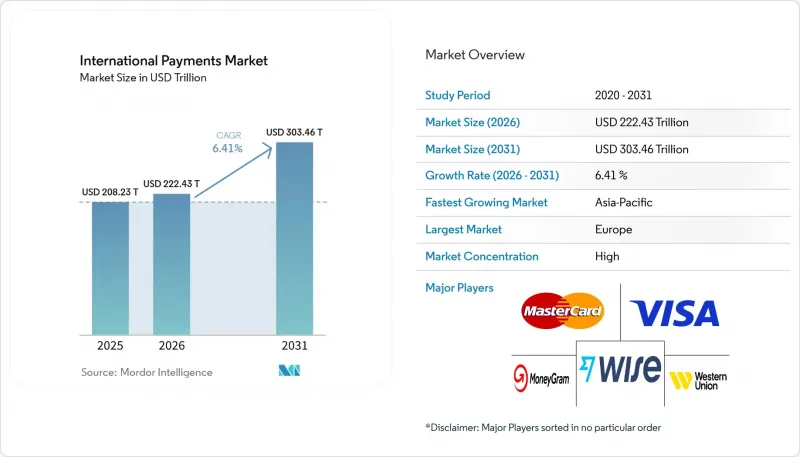
According to Mordor Intelligence, the international payments market size was valued at USD 208.2 trillion in 2025 and is estimated to grow from USD 222.4 trillion in 2026 to reach USD 303.5 trillion by 2031, at a CAGR of 6.4% during the forecast period (2026-2031).
Global International Payments Market Trends and Insights
Real-Time Cross-Border Payment Demand Reshapes Trade Settlement
Demand for near-instant settlement has moved beyond consumer remittances and into trade finance. The international payments market is responding to this demand with linked instant-payment systems. More than 80 countries had deployed domestic fast-payment systems, and cross-border links between those systems exceeded 500 in 2025. The European Central Bank found that linking fast-payment systems can increase bilateral trade by 4%. SWIFT reported that 80% of cross-border payment travel time occurs after a payment leaves its network, during processing by the beneficiary institution. Bank of America announced in June 2026 a real-time solution that connects SPEI in Mexico, Faster Payments in the United Kingdom, and UPI in India, showing why last-mile interoperability has become a central area of competition.
Embedded International Payments Deepen in Digital Commerce
The integration of cross-border payments into software platforms, marketplaces, and SaaS tools is widening the group of firms that compete for transaction revenue. Worldpay reported broad embedded-finance adoption among global e-commerce merchants in 2026, with more merchants using platform-native payment layers instead of separate gateways. This model allows platforms to retain foreign exchange income, float, and transaction data that formerly stayed with specialist payment providers. The international payments market is thus becoming more dependent on software distribution and local acquiring capabilities. Providers are building services that combine account holding, acquiring, and foreign exchange conversion in one API layer. Merchants need localized methods, currencies, and payment confirmation when they sell across borders.
Fragmented Global Regulatory and Compliance Frameworks
Fragmented regulation remains a persistent constraint on the international payments market because each corridor can involve separate licensing, data, and conduct rules. The Financial Stability Board issued recommendations in December 2024 for a more consistent approach to regulating bank and nonbank providers, but national adoption schedules continue to differ. Japan's amended Payments Settlement Act took effect in 2026 and treats some cross-border collection agency services as foreign exchange transactions that require money transfer registration. The EU Instant Payments Regulation offers a more common rulebook, although its receiving mandate for several non-eurozone countries began only on April 9, 2026. Large banks can spread legal and systems costs across more corridors, while smaller providers face a higher cost per transaction. This difference can slow entry in lower-volume routes even where there is clear demand for faster payments.
Other drivers and restraints analyzed in the detailed report include:
- Cost Transparency and FX Visibility Drive Competitive Differentiation
- API-Enabled Infrastructure and Alternative Settlement Networks
- Escalating Fraud, AML, and Sanctions Compliance Risks
For complete list of drivers and restraints, kindly check the Table Of Contents.
Segment Analysis
B2B cross-border payments accounted for 67.1% of the international payments market share in 2025, making it the core transaction type for trade settlement, supply-chain finance, and corporate treasury activity. This part of the international payments market remains central to global trade operations. Large enterprises and financial institutions continue to use bank-led correspondent networks for high-value transfers where controls and credit arrangements matter. The international payments industry still relies on this structure because direct account relationships remain valuable. Smaller businesses are shifting more quickly to providers that offer local account details, direct payment-system access, transparent foreign exchange pricing, and simpler reconciliation.
C2B cross-border payments are forecast to be the fastest-growing transaction type, with a 9.8% CAGR from 2026 to 2031. Its growth comes from consumers in Asia-Pacific and South America purchasing digital services and goods from merchants in Europe and North America. Cross-border UPI transactions rose 20-fold to more than 755,000 in India's fiscal year 2025 and reached 601,000 during the first 4 months of fiscal year 2026. By then, India had expanded UPI acceptance to 7 countries. B2C supports e-commerce and international payroll, while C2C remains important for remittances and may be an early setting for stablecoin use.
Bank transfers held 56.6% of the international payments market share in 2025, reflecting their role in wholesale, interbank, and corporate settlement. Correspondent banking remains important for high-value payments where participants need established credit and liquidity arrangements. Cards and digital wallets remain important for C2B and C2C activity, while local acquiring and wallet integrations reduce dependence on a single card network.
Real-time payments and account-to-account transfers are projected to grow at an 11.3% CAGR through 2031, the highest rate among the payment methods. Their expansion changes the service mix within the international payments market. Their use is supported by regulation and demand for immediate confirmation. SEPA Instant Credit Transfer volumes rose from 16% of credit transfers in the second half of 2024 to 35% in the first quarter of 2026. Lower infrastructure charges place pressure on revenue per payment. Incumbents must invest in the new rails while revising pricing models that were designed for slower processes.
Complete Report Scope:
- By Transaction Type
- B2B Cross-Border Payments
- B2C Cross-Border Payments
- C2C Cross-Border Payments
- C2B Cross-Border Payments
- By Payment Method
- Bank Transfers
- Cards
- Digital Wallets
- Real-Time Payments and Account-to-Account Payments
- Other Payment Methods
- By End User
- Large Enterprises
- Small and Medium Enterprises
- Financial Institutions
- Individual Consumers
- By Industry Vertical
- Retail and E-Commerce
- BFSI
- Manufacturing
- IT and Telecommunications
- Travel and Hospitality
- Media and Entertainment
- Other Industry Verticals
- By Geography
- North America
- United States
- Canada
- Mexico
- South America
- Brazil
- Argentina
- Rest of South America
- Europe
- United Kingdom
- Germany
- France
- Italy
- Spain
- Rest of Europe
- Asia-Pacific
- China
- Japan
- India
- South Korea
- Australia
- Indonesia
- Thailand
- Malaysia
- Singapore
- Vietnam
- Rest of Asia-Pacific
- Middle East and Africa
- Saudi Arabia
- United Arab Emirates
- Turkey
- South Africa
- Egypt
- Rest of Middle East and Africa
- North America
Geography Analysis
Europe held 31.6% of the international payments market share in 2025, supported by SEPA, intra-regional trade, and established wholesale hubs in the United Kingdom, Germany, and France. SEPA Instant Credit Transfer represented 35% of total credit transfers in the first quarter of 2026. Wero and national account-to-account systems such as Bizum, Blik, and Bancomat are strengthening domestic-first options for retail flows. The international payments market in Europe is moving toward closer interoperability between instant-payment systems. EU rules will also affect how nonbank providers build compliance and settlement operations across the region.
North America generates the second-largest share of international payment flows, with the United States remaining central to USD settlement for corporate and consumer transfers. The USD accounted for more than 50% of SWIFT international payment value in 2025, its highest share since SWIFT changed its methodology in mid-2023. Canada's planned real-time system could create a domestic rail that later supports connections to the United States. Mexico's SPEI system has strategic importance for corporate and remittance payments along the U.S.-Mexico corridor. Bank of America's June 2026 announcement connected this corridor to other fast-payment systems. South America has a smaller absolute role, but Brazil's Pix provides a large domestic base for potential bilateral links with trade partners. The international payments market can grow where mature domestic systems gain practical cross-border interoperability.
Asia-Pacific is forecast to grow at an 8.9% CAGR through 2031, giving the region the fastest expansion among geographic areas in the international payments market. Its domestic payment links give the international payments market a wider base for regional connectivity. Retail cross-border outflows from the region reached USD 13.5 trillion in 2025 and are forecast to reach USD 24 trillion by 2033. China's CIPS processed CNY 175.49 trillion, equivalent to USD 24.45 trillion, in 2024 and expanded its participant institutions to 1,683 by May 2025, while India's UPI-Singapore PayNow link supports remittances, merchant payments, and travel spending. Africa's payment traffic grew by more than 8% annually on average between 2018 and 2024, with the United Arab Emirates and Saudi Arabia acting as important hubs for South Asia remittances and intra-GCC corporate flows.
- Visa Inc.
- Mastercard Incorporated
- PayPal Holdings, Inc.
- Wise PLC
- Western Union Holdings, Inc.
- MoneyGram International, Inc.
- Stripe, Inc.
- JPMorgan Chase and Co.
- Citigroup Inc.
- HSBC Holdings PLC
- Barclays PLC
- Standard Chartered PLC
- BNP Paribas SA
- Deutsche Bank AG
- The Bank of New York Mellon Corporation
- Revolut Ltd
- Airwallex Pty Ltd
- Ant Group Co., Ltd
- Worldpay, LLC
- Adyen N.V.
Additional Benefits:
- The market estimate (ME) sheet in Excel format
- 3 months of analyst support
TABLE OF CONTENTS
1 INTRODUCTION
- 1.1 Study Assumptions and Market Definition
- 1.2 Scope of the Study
2 RESEARCH METHODOLOGY
3 EXECUTIVE SUMMARY
4 MARKET LANDSCAPE
- 4.1 Market Overview
- 4.2 Market Drivers
- 4.2.1 Real-Time Cross-Border Payment Demand Across Global Trade and Commerce Flows
- 4.2.2 Expansion of Embedded International Payments Across Digital Commerce Ecosystems
- 4.2.3 Increasing Demand for Cost Transparency, FX Visibility, and Payment Traceability
- 4.2.4 Adoption of API-Enabled Payment Infrastructure and Alternative Settlement Networks
- 4.2.5 Growth of Cross-Border Payouts Supporting Global Workforce and Creator Economies
- 4.2.6 Rising Enterprise Adoption of Multi-Currency Treasury and Liquidity Solutions
- 4.3 Market Restraints
- 4.3.1 Fragmented Global Regulatory and Compliance Frameworks
- 4.3.2 Foreign Exchange Volatility and Pricing Pressure
- 4.3.3 Escalating Fraud, AML, and Sanctions Compliance Risks
- 4.3.4 Dependence on Legacy Correspondent Banking Networks for Certain Corridors
- 4.4 Value Chain Analysis
- 4.5 Regulatory Landscape
- 4.6 Technological Outlook
- 4.7 Customer Behavior Analysis
- 4.8 Cross-Border Payment Corridor Dynamics
- 4.9 Remittance and Merchant Payout Flow Analysis
- 4.10 Stablecoin and Tokenized Settlement Assessment
- 4.11 Porter's Five Forces Analysis
- 4.11.1 Threat of New Entrants
- 4.11.2 Bargaining Power of Suppliers
- 4.11.3 Bargaining Power of Buyers
- 4.11.4 Threat of Substitutes
- 4.11.5 Intensity of Competitive Rivalry
5 MARKET SIZE AND GROWTH FORECASTS
- 5.1 By Transaction Type
- 5.1.1 B2B Cross-Border Payments
- 5.1.2 B2C Cross-Border Payments
- 5.1.3 C2C Cross-Border Payments
- 5.1.4 C2B Cross-Border Payments
- 5.2 By Payment Method
- 5.2.1 Bank Transfers
- 5.2.2 Cards
- 5.2.3 Digital Wallets
- 5.2.4 Real-Time Payments and Account-to-Account Payments
- 5.2.5 Other Payment Methods
- 5.3 By End User
- 5.3.1 Large Enterprises
- 5.3.2 Small and Medium Enterprises
- 5.3.3 Financial Institutions
- 5.3.4 Individual Consumers
- 5.4 By Industry Vertical
- 5.4.1 Retail and E-Commerce
- 5.4.2 BFSI
- 5.4.3 Manufacturing
- 5.4.4 IT and Telecommunications
- 5.4.5 Travel and Hospitality
- 5.4.6 Media and Entertainment
- 5.4.7 Other Industry Verticals
- 5.5 By Geography
- 5.5.1 North America
- 5.5.1.1 United States
- 5.5.1.2 Canada
- 5.5.1.3 Mexico
- 5.5.2 South America
- 5.5.2.1 Brazil
- 5.5.2.2 Argentina
- 5.5.2.3 Rest of South America
- 5.5.3 Europe
- 5.5.3.1 United Kingdom
- 5.5.3.2 Germany
- 5.5.3.3 France
- 5.5.3.4 Italy
- 5.5.3.5 Spain
- 5.5.3.6 Rest of Europe
- 5.5.4 Asia-Pacific
- 5.5.4.1 China
- 5.5.4.2 Japan
- 5.5.4.3 India
- 5.5.4.4 South Korea
- 5.5.4.5 Australia
- 5.5.4.6 Indonesia
- 5.5.4.7 Thailand
- 5.5.4.8 Malaysia
- 5.5.4.9 Singapore
- 5.5.4.10 Vietnam
- 5.5.4.11 Rest of Asia-Pacific
- 5.5.5 Middle East and Africa
- 5.5.5.1 Saudi Arabia
- 5.5.5.2 United Arab Emirates
- 5.5.5.3 Turkey
- 5.5.5.4 South Africa
- 5.5.5.5 Egypt
- 5.5.5.6 Rest of Middle East and Africa
- 5.5.1 North America
6 COMPETITIVE LANDSCAPE
- 6.1 Market Concentration
- 6.2 Strategic Moves
- 6.3 Market Share Analysis (Top 5-6 Players)
- 6.4 Company Profiles (includes Global Level Overview, Market Level Overview, Core Segments, Financials as available, Strategic Information, Market Rank/Share, Products and Services, Recent Developments)
- 6.4.1 Visa Inc.
- 6.4.2 Mastercard Incorporated
- 6.4.3 PayPal Holdings, Inc.
- 6.4.4 Wise PLC
- 6.4.5 Western Union Holdings, Inc.
- 6.4.6 MoneyGram International, Inc.
- 6.4.7 Stripe, Inc.
- 6.4.8 JPMorgan Chase and Co.
- 6.4.9 Citigroup Inc.
- 6.4.10 HSBC Holdings PLC
- 6.4.11 Barclays PLC
- 6.4.12 Standard Chartered PLC
- 6.4.13 BNP Paribas SA
- 6.4.14 Deutsche Bank AG
- 6.4.15 The Bank of New York Mellon Corporation
- 6.4.16 Revolut Ltd
- 6.4.17 Airwallex Pty Ltd
- 6.4.18 Ant Group Co., Ltd
- 6.4.19 Worldpay, LLC
- 6.4.20 Adyen N.V.
7 MARKET OPPORTUNITIES AND FUTURE OUTLOOK
- 7.1 White Space and Unmet Need Assessment
- 7.2 High-Growth Corridor Opportunities
- 7.3 SME and Platform-Native Cross-Border Payments Opportunity
- 7.4 Embedded FX and Treasury Automation Opportunity
- 7.5 Stablecoin-Enabled Settlement Opportunity
- 7.6 Instant Cross-Border Payout Opportunity

