PUBLISHER: Mordor Intelligence | PRODUCT CODE: 2163342

PUBLISHER: Mordor Intelligence | PRODUCT CODE: 2163342
South America Automotive Parts Magnesium Die Casting - Market Share Analysis, Industry Trends & Statistics, Growth Forecasts (2026 - 2031)
According to Mordor Intelligence, the South America automotive parts magnesium die casting market size was valued at USD 0.35 billion in 2025, and is expected to reach USD 0.37 billion in 2026, and is projected to reach USD 0.51 billion by 2031 at a CAGR of 6.51% during the forecast period (2026-2031).
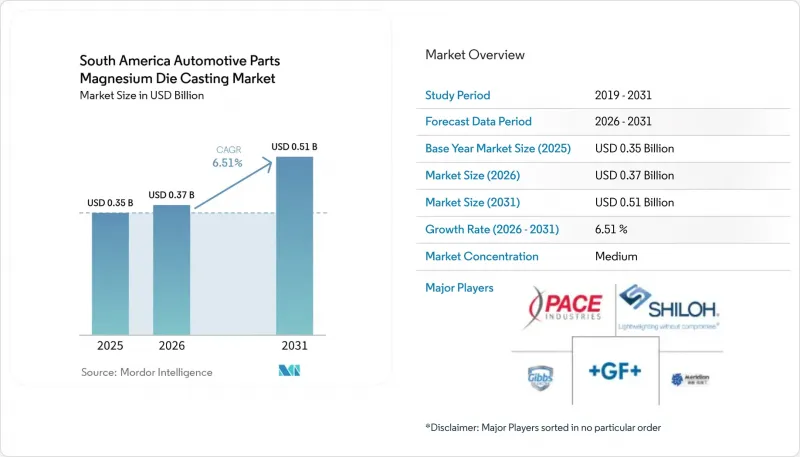
South America Automotive Parts Magnesium Die Casting Market Trends and Insights
Rapid EV Production Ramp-Up Requiring Magnesium Housings & Cooling Plates
In Ramos Arizpe, Saltillo, and Sao Paulo, battery-electric vehicle lines require motor housings, cooling plates, and battery-tray frames. These components demand high thermal conductivity and minimal mass. Magnesium alloys AE42 and WE43 provide superior conductivity while achieving significant weight reduction compared to aluminum 6061. Magna's structural-parts plant in Coahuila, with a substantial investment, and Nemak's facility within the Blazer EV line, are already supplying vacuum-cast inverter casings to General Motors in Texas. This collaboration has notably reduced lead times from several weeks to just over a week. In Brazil, domestic magnesium smelters produce a considerable amount annually. This output plays a crucial role in stabilizing feedstock prices and mitigating fluctuations from the Chinese spot market . Additionally, R&D grants, part of the Mover Program, are supporting large-part casting pilots. These pilots have successfully met stringent yield-strength tests, a critical requirement for crash structures.
Lightweighting Mandates For CO2 & Fuel-Economy Compliance
In response to tightening CO2 regulations in Brazil, automakers are shifting from aluminum to magnesium alloys to significantly reduce component weight. Brazil's Mover Program offers tax credits for parts containing a substantial proportion of recycled material, highlighting magnesium's advantages, including low remelting energy requirements and high recyclability. Similarly, the regulations, aligned with U.S. CAFE standards, are prompting OEMs such as General Motors to establish lightweight EV platforms in Guanajuato and Coahuila. This shift is increasing demand for die-cast steering columns, seat frames, and cross-car beams. USMCA local-content thresholds further increase the importance of regionally sourced magnesium components. In addition, certification requirements under Official Mexican Standards limit competition from lower-cost imports. With compliance deadlines approaching, OEMs are finalizing purchasing commitments, supporting investments in new high-pressure die-casting (HPDC) capacity.
Volatile Imported Magnesium Prices
China dominates the global primary magnesium market, supplying the vast majority of the demand. In recent years, production curtailments in China have significantly driven up prices, marking a substantial increase compared to previous levels. While Brazil's smelting base caters to a portion of the demand, neighboring Argentina and Chile rely heavily on imports. These imports face lengthy shipping delays and high tariffs, adding to the challenges. Additionally, currency fluctuations in the region further exacerbate cost pressures. Without regional hedging tools, die casters are forced to make spot purchases, which can experience significant fluctuations over short periods, thereby squeezing contract profit margins.
Other drivers and restraints analyzed in the detailed report include:
- Near-Shoring of US OEM Supply Chains into South American Nations Stimulates HPDC Capacity
- High-Vacuum Structural Casting Unlocks Large Body Parts
- Competition From Mature Aluminum HPDC Solutions
For complete list of drivers and restraints, kindly check the Table Of Contents.
Segment Analysis
Vacuum die casting is on course for a 7.55% CAGR to 2031, driven by battery platforms that need porosity-free castings for crash-critical body parts. The South American automotive parts magnesium die casting market size for vacuum systems is expected to expand as pressure die casting, although still holding 61.32% of the 2025 share, reaches strength limits for new giga-castings. Vacuum presses in Nemak's Coahuila plant deliver 250 MPa yield strength, enabling single-piece rear underbodies for General Motors EV programs and justifying the price premiums.
Pressure die casting remains preferred for high-volume housings, where 90-second cycles cut costs, but gravity and squeeze die casting maintain niche roles for thick-section or near-net-shape parts. Retrofitting Sao Paulo plants with vacuum pumps qualifies them for recycled-content credits under Brazil's Mover Program, while near-shoring boom steers fresh capital straight into vacuum-ready cells. Suppliers without the technology risk are relegated to seat frames and non-structural brackets, thereby shrinking their addressable share of the South American automotive parts magnesium die-casting market.
Driveline and powertrain castings led 2025 revenue at 34.46%, yet body and chassis components will pace the market with a 7.53% CAGR through 2031. Chevrolet Blazer EV models now feature rear battery-tray frames that are significantly lighter when crafted from magnesium instead of aluminum, boosting their range noticeably. As a result, the market share for magnesium die casting in structural body parts within South America's automotive sector is witnessing an annual uptick, driven by OEMs' focus on enhancing range and ensuring crashworthiness.
As hybrid and fully electric BEV platforms gain momentum, traditional ICE-related castings like oil pans and valve covers are becoming obsolete. This shift redirects production capacity towards components such as battery trays, shock towers, and B-pillars. Additionally, interior structures, notably instrument-panel beams, are seeing increased demand. This is largely because magnesium components are achieving mandated weight-saving thresholds, thereby unlocking valuable tax credits in Brazil. Furthermore, electrical components, especially inverter housings, are on the rise due to vacuum die casting's ability to ensure leak-proof enclosures.
Complete Report Scope:
- By Production Process
- Pressure Die Casting
- Vacuum Die Casting
- Gravity Die Casting
- Squeeze Die Casting
- By Application
- Driveline & Powertrain
- Interior & Exterior
- Electrical & Electronics
- Body & Chassis
- Wheel & Tires
- Other Types
- By Propulsion
- Internal Combustion Engine
- Battery-Electric Vehicle
- Hybrid Electric Vehicle
- Plug-in Hybrid Electric Vehicle
- Fuel-Cell Electric Vehicle
- By Vehicle Type
- Passenger Car
- Commercial Vehicle
- By Sales Channel
- Original Equipment Manufacturer (OEM)
- Aftermarket
- By Country
- Brazil
- Argentina
- Chile
- Peru
- Rest of South America
List of Companies Covered in this Report:
- Nemak, S.A.B. de C.V.
- Meridian Lightweight Technologies
- George Fischer AG
- Dynacast (Form Technologies)
- Pace Industries
- Ryobi Die Casting
- Magna International (Cosma)
- Gibbs Die Casting Group
- Rima Industrial
- Iochpe-Maxion
- Montupet (Linamar)
- Sundaram-Clayton
- CIE Automotive
- Teksid
- Dynacast Brazil
- Shiloh Industries Inc.
Additional Benefits:
- The market estimate (ME) sheet in Excel format
- 3 months of analyst support
TABLE OF CONTENTS
1 Introduction
- 1.1 Study Assumptions & Market Definition
- 1.2 Scope of the Study
2 Research Methodology
3 Executive Summary
4 Market Landscape
- 4.1 Market Overview
- 4.2 Market Drivers
- 4.2.1 Rapid EV Production Ramp-up Requiring Magnesium Housings & Cooling Plates
- 4.2.2 Lightweighting Mandates for Co2 & Fuel-Economy Compliance
- 4.2.3 Near-Shoring Of US OEM Supply Chains into South American Nations Stimulates HPDC Capacity
- 4.2.4 High-Vacuum Structural Casting Unlocks Large Body Parts
- 4.2.5 Brazilian Fiscal Incentives for Weight-Reduction Technologies
- 4.2.6 Emerging Closed-Loop Scrap Feedstock Networks in Latam
- 4.3 Market Restraints
- 4.3.1 Volatile Imported Magnesium Prices
- 4.3.2 Competition from Mature Aluminum HPDC Solutions
- 4.3.3 Scarce Primary Mg Smelting Capacity in Latam
- 4.3.4 Stringent Safety Rules for Mg Dust & Fire Hazards
- 4.4 Value / Supply-Chain Analysis
- 4.5 Regulatory Landscape
- 4.6 Technological Outlook
- 4.7 Porter's Five Forces Analysis
- 4.7.1 Bargaining Power of Suppliers
- 4.7.2 Bargaining Power of Buyers
- 4.7.3 Threat of New Entrants
- 4.7.4 Threat of Substitutes
- 4.7.5 Competitive Rivalry
5 Market Size & Growth Forecasts (Value (USD))
- 5.1 By Production Process
- 5.1.1 Pressure Die Casting
- 5.1.2 Vacuum Die Casting
- 5.1.3 Gravity Die Casting
- 5.1.4 Squeeze Die Casting
- 5.2 By Application
- 5.2.1 Driveline & Powertrain
- 5.2.2 Interior & Exterior
- 5.2.3 Electrical & Electronics
- 5.2.4 Body & Chassis
- 5.2.5 Wheel & Tires
- 5.2.6 Other Types
- 5.3 By Propulsion
- 5.3.1 Internal Combustion Engine
- 5.3.2 Battery-Electric Vehicle
- 5.3.3 Hybrid Electric Vehicle
- 5.3.4 Plug-in Hybrid Electric Vehicle
- 5.3.5 Fuel-Cell Electric Vehicle
- 5.4 By Vehicle Type
- 5.4.1 Passenger Car
- 5.4.2 Commercial Vehicle
- 5.5 By Sales Channel
- 5.5.1 Original Equipment Manufacturer (OEM)
- 5.5.2 Aftermarket
- 5.6 By Country
- 5.6.1 Brazil
- 5.6.2 Argentina
- 5.6.3 Chile
- 5.6.4 Peru
- 5.6.5 Rest of South America
6 Competitive Landscape
- 6.1 Market Concentration
- 6.2 Strategic Moves
- 6.3 Market Share Analysis
- 6.4 Company Profiles (includes Global Level Overview, Market Level Overview, Core Segments, Financials as Available, Strategic Information, Market Rank/Share for Key Companies, Products and Services, SWOT Analysis, and Recent Developments)
- 6.4.1 Nemak, S.A.B. de C.V.
- 6.4.2 Meridian Lightweight Technologies
- 6.4.3 George Fischer AG
- 6.4.4 Dynacast (Form Technologies)
- 6.4.5 Pace Industries
- 6.4.6 Ryobi Die Casting
- 6.4.7 Magna International (Cosma)
- 6.4.8 Gibbs Die Casting Group
- 6.4.9 Rima Industrial
- 6.4.10 Iochpe-Maxion
- 6.4.11 Montupet (Linamar)
- 6.4.12 Sundaram-Clayton
- 6.4.13 CIE Automotive
- 6.4.14 Teksid
- 6.4.15 Dynacast Brazil
- 6.4.16 Shiloh Industries Inc.
7 Market Opportunities & Future Outlook
- 7.1 White-space & Unmet-Need Assessment

