PUBLISHER: Mordor Intelligence | PRODUCT CODE: 2184621

PUBLISHER: Mordor Intelligence | PRODUCT CODE: 2184621
Automotive Die Casting Lubricants - Market Share Analysis, Industry Trends & Statistics, Growth Forecasts (2026 - 2031)
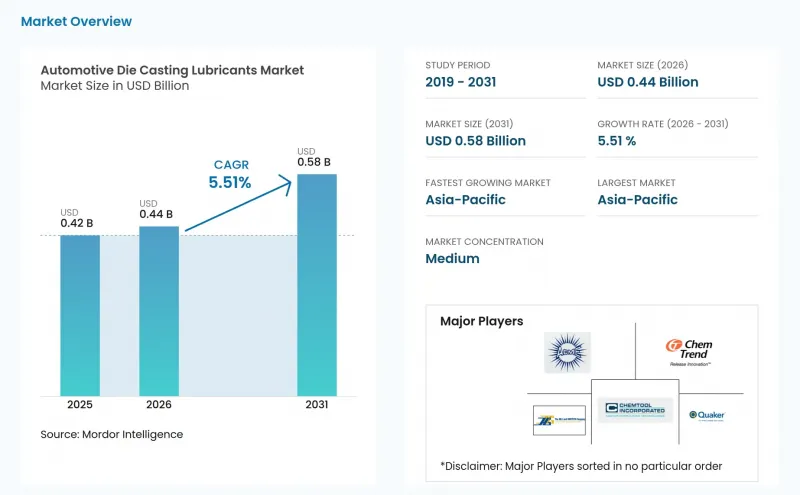
According to Mordor Intelligence, the automotive die casting lubricants market size was valued at USD 0.42 billion in 2025, is expected to reach USD 0.44 billion in 2026, and is projected to reach USD 0.58 billion by 2031, at a CAGR of 5.51% during the forecast period (2025-2030).
Global Automotive Die Casting Lubricants Market Trends and Insights
Rapid Growth of Asia-Pacific Die-Casting Hubs
Wencan has made a significant investment in its Chongqing plant, equipping it with advanced presses specifically designed for Changan Deepal's battery trays. This operation requires a substantial volume of humidity-tolerant, water-based lubricants annually to ensure optimal performance. In India, the government's Production-Linked Incentive (PLI) scheme is fostering notable capacity growth, with major players like Tata and Mahindra focusing on localizing electric vehicle components. In Thailand, the approval of large-scale die-casting projects aimed at serving Japanese original equipment manufacturers (OEMs) has prompted Quaker Houghton to establish a dedicated technology center in Bangkok.
High-Pressure and Giga-Casting Adoption
Guangdong Hongtu has embarked on a significant venture, deploying multiple high-capacity presses. These presses are set to produce structural components for Xpeng and Li Auto. Once fully operational, the facility will utilize a substantial amount of lubricant annually. In a parallel move, Ryobi made a considerable investment in a high-capacity line dedicated to Toyota's BEV cross-members. This line is further enhanced with Quaker Houghton's minimum-quantity-lubrication (MQL) package. Meanwhile, graphite-boron-nitride hybrids have secured a notable share in the giga-casting lubricant blend, due to their resilience, enduring extensive usage at high die temperatures. Linamar's large-scale plant in Pune underscores a significant trend: mega-casting is now transitioning to mass-market EVs, priced within an affordable range, expanding beyond just premium models.
Raw-Material Price Volatility
In 2024, prices for synthetic esters and surfactants experienced a significant increase, despite a decline in LME aluminum prices, which put pressure on supplier margins. A sharp rise in palm-derived surfactants occurred when Indonesia restricted exports, leading to a greater reliance on more expensive synthetic alternatives. Smaller formulators in India and Mexico, lacking hedging tools, faced revenue losses to maintain contracts. At the same time, a depreciation of the Yuan increased the landed cost of European lubricants, prompting China to accelerate its transition to domestic blends. These market fluctuations are encouraging a shift towards vertical integration and a preference for lightweight inventory models.
Other drivers and restraints analyzed in the detailed report include:
- EV and Lightweighting Push
- Stricter VOC and ESG Regulations
- EV Power-Unit Simplification (Fewer Cast Parts)
For complete list of drivers and restraints, kindly check the Table Of Contents.
Segment Analysis
Oil-based grades are forecast to expand at a 6.55% CAGR, outpacing the overall Automotive Die Foundries operating presses with significant tonnage rely on these chemistries to maintain film integrity at high temperatures, a critical zone where water tends to evaporate prematurely. Toyota's Tahara knuckle line has adopted semi-permanent graphite or boron-nitride coatings, applied periodically, resulting in a substantial extension of die life and a notable reduction in tooling costs. Notably, solvent products enjoy exemptions from the EU 2024/1785 and California Rule 1171 regulations.
Water-based lubricants retain a cost edge at USD 3.80/kg versus USD 6.20 for oil-based lubricants and dominate sub-3,500 ton presses, producing housings and mounts, with a share of 35.47% in 2025. Quaker Houghton's electrostatic delivery closes some performance gaps, enabling water-based use up to 5,000 tons, yet giga-press dominance ensures oil-based share growth. Bio-feedstock adoption quickens: Henkel's rapeseed-ester Bonderite line now appears on Tesla and GM-approved lists, turning ESG compliance into a ticket-to-play.
Aluminum accounted for 56.71% of the Automotive Die Casting Lubricants market size in 2025. Its recycling compatibility with EU circular economy quotas and weight advantage over steel sustains its leadership. High-silicon Al-Si casting alloys enable Volvo's EX90 rear floor to drop 68 spot welds.
Magnesium's 6.53% CAGR stems from Chinese EV makers using front-end modules to offset battery mass; BYD's Han saved 4.2 kg per beam. Fire-risk mitigation requires a significant investment in inert-atmosphere casting lines, which slows Western uptake; however, SF6-free cover gases improve safety compliance. Zinc remains niche for trim where surface finish trumps weight, but its share falls as sub-USD 30,000 EVs strip decorative content.
Complete Report Scope:
- By Product Type
- Water-Based Lubricants
- Oil-Based Lubricants
- Semi-Permanent Lubricants
- Solvent-Based Lubricants
- By Application
- Aluminum Die Casting
- Magnesium Die Casting
- Zinc Die Casting
- By End Use
- Passenger Vehicles
- Commercial Vehicles
- By Functional Use
- Die Slick
- Plunger Slick
- Ladle Slick
- Assembly Slick
- Others
- By Geography
- North America
- United States
- Canada
- Rest of North America
- South America
- Brazil
- Argentina
- Rest of South America
- Europe
- Germany
- United Kingdom
- France
- Italy
- Spain
- Rest of Europe
- Asia-Pacific
- China
- India
- Japan
- South Korea
- Rest of Asia-Pacific
- Middle East and Africa
- United Arab Emirates
- Saudi Arabia
- South Africa
- Turkey
- Rest of Middle East and Africa
- North America
Geography Analysis
The Asia-Pacific region held a 45.55% market share of the Automotive Die Casting Lubricants market in 2025 and is expected to post a 8.59% CAGR from 2026 to 2031. China alone poured millions of tons of die-castings, three-fifths of which were for autos, as BYD, Nio, and Xpeng accelerated giga-casting to cut model launch cycles to 18 months . Meanwhile, Japan's Ryobi, with its advanced production line, is directly feeding Toyota's battery electric vehicle (BEV) production. South Korea's E-GMP program is integrating multiple mega-castings per vehicle, sourced domestically. In India, several projects backed by the Production-Linked Incentive (PLI) scheme, which involves substantial investment, are enabling local lubricant blending at a significantly lower cost than imports.
North America is witnessing a surge in reshoring activities. Notably, Tesla's Texas facility stands out as the region's largest consumer, utilizing a substantial volume of lubricants annually. In a strategic move, Mino, Form Technologies, and Eck Industries have collectively invested significantly to boost their capacity by a considerable amount. Meanwhile, Mexico's Guanajuato hub is playing a pivotal role, servicing major automotive players like GM's Ultium and Ford's F-150 Lightning. On the other hand, Canadian suppliers are channeling a significant investment towards battery housings, showcasing a clear pivot in their focus.
Europe grapples with challenges, notably soaring energy prices and the impending solvent phase-out. In a testament to regional collaboration, Germany's Baden-Wurttemberg cluster is supplying a notable volume annually of water-based products to Volkswagen's Zwickau EV plant. Stellantis has made strategic moves by localizing battery trays in both Lombardy and Piedmont, resulting in a notable growth in output. Spain's Catalonia die casters have invested substantially in press upgrades for the Cupra brand. Meanwhile, the UK is enforcing local-content regulations, mandating that a significant portion of parts be of UK origin in a post-Brexit landscape. South America, though still a niche player, is on an upward trajectory.
- Henkel AG & Co. KGaA
- Chem-Trend L.P.
- Quaker Houghton Inc.
- MORESCO Corporation
- FUCHS Lubritech GmbH
- The Hill and Griffith Company
- Geiger + Co. Schmierstoff-Chemie GmbH
- Ultraseal India Pvt. Ltd.
- Acme Refining
- CHEMTOOL Incorporated
- Condat Group
- Hardcastle Petrofer Pvt. Ltd.
- Sunocs LLC
- J&S Chemical Corporation
- Lubgraf Synoils Pvt. Ltd.
- Munch Chemie International
- Falcon Industrial Inc.
- Tower Metalworking Fluids
- Applied Material Solutions
- Daeho Industries Ltd.
- Thermal-Lube Inc.
Additional Benefits:
- The market estimate (ME) sheet in Excel format
- 3 months of analyst support
TABLE OF CONTENTS
1 Introduction
- 1.1 Study Assumptions & Market Definition
- 1.2 Scope of the Study
2 Research Methodology
3 Executive Summary
4 Market Landscape
- 4.1 Market Overview
- 4.2 Market Drivers
- 4.2.1 Rapid Growth of Asia-Pacific Die-Casting Hubs
- 4.2.2 High-Pressure & Giga-Casting Adoption
- 4.2.3 EV & Lightweighting Push
- 4.2.4 Stricter VOC / ESG Regulations
- 4.2.5 Shift to Water-Free Electrostatic Lubricants
- 4.2.6 Smart-Factory Dispensing & Monitoring
- 4.3 Market Restraints
- 4.3.1 Raw-Material Price Volatility
- 4.3.2 EV Power-Unit Simplification (fewer cast parts)
- 4.3.3 Thermal-Management Limits for Water-Based Fluids
- 4.3.4 Skills Gap in Lubricant Optimization
- 4.4 Value / Supply-Chain Analysis
- 4.5 Regulatory Landscape
- 4.6 Technological Outlook
- 4.7 Porter's Five Forces Analysis
- 4.7.1 Threat of New Entrants
- 4.7.2 Bargaining Power of Suppliers
- 4.7.3 Bargaining Power of Buyers
- 4.7.4 Threat of Substitutes
- 4.7.5 Intensity of Rivalry
5 Market Size & Growth Forecasts (Value (USD))
- 5.1 By Product Type
- 5.1.1 Water-Based Lubricants
- 5.1.2 Oil-Based Lubricants
- 5.1.3 Semi-Permanent Lubricants
- 5.1.4 Solvent-Based Lubricants
- 5.2 By Application
- 5.2.1 Aluminum Die Casting
- 5.2.2 Magnesium Die Casting
- 5.2.3 Zinc Die Casting
- 5.3 By End Use
- 5.3.1 Passenger Vehicles
- 5.3.2 Commercial Vehicles
- 5.4 By Functional Use
- 5.4.1 Die Slick
- 5.4.2 Plunger Slick
- 5.4.3 Ladle Slick
- 5.4.4 Assembly Slick
- 5.4.5 Others
- 5.5 By Geography
- 5.5.1 North America
- 5.5.1.1 United States
- 5.5.1.2 Canada
- 5.5.1.3 Rest of North America
- 5.5.2 South America
- 5.5.2.1 Brazil
- 5.5.2.2 Argentina
- 5.5.2.3 Rest of South America
- 5.5.3 Europe
- 5.5.3.1 Germany
- 5.5.3.2 United Kingdom
- 5.5.3.3 France
- 5.5.3.4 Italy
- 5.5.3.5 Spain
- 5.5.3.6 Rest of Europe
- 5.5.4 Asia-Pacific
- 5.5.4.1 China
- 5.5.4.2 India
- 5.5.4.3 Japan
- 5.5.4.4 South Korea
- 5.5.4.5 Rest of Asia-Pacific
- 5.5.5 Middle East and Africa
- 5.5.5.1 United Arab Emirates
- 5.5.5.2 Saudi Arabia
- 5.5.5.3 South Africa
- 5.5.5.4 Turkey
- 5.5.5.5 Rest of Middle East and Africa
- 5.5.1 North America
6 Competitive Landscape
- 6.1 Market Concentration
- 6.2 Strategic Moves
- 6.3 Market Share Analysis
- 6.4 Company Profiles (includes Global Level Overview, Market Level Overview, Core Segments, Financials as Available, Strategic Information, Market Rank/Share for Key Companies, Products and Services, SWOT Analysis, and Recent Developments)
- 6.4.1 Henkel AG & Co. KGaA
- 6.4.2 Chem-Trend L.P.
- 6.4.3 Quaker Houghton Inc.
- 6.4.4 MORESCO Corporation
- 6.4.5 FUCHS Lubritech GmbH
- 6.4.6 The Hill and Griffith Company
- 6.4.7 Geiger + Co. Schmierstoff-Chemie GmbH
- 6.4.8 Ultraseal India Pvt. Ltd.
- 6.4.9 Acme Refining
- 6.4.10 CHEMTOOL Incorporated
- 6.4.11 Condat Group
- 6.4.12 Hardcastle Petrofer Pvt. Ltd.
- 6.4.13 Sunocs LLC
- 6.4.14 J&S Chemical Corporation
- 6.4.15 Lubgraf Synoils Pvt. Ltd.
- 6.4.16 Munch Chemie International
- 6.4.17 Falcon Industrial Inc.
- 6.4.18 Tower Metalworking Fluids
- 6.4.19 Applied Material Solutions
- 6.4.20 Daeho Industries Ltd.
- 6.4.21 Thermal-Lube Inc.
7 Market Opportunities & Future Outlook
- 7.1 White-Space & Unmet-Need Assessment

