PUBLISHER: Mordor Intelligence | PRODUCT CODE: 2163393

PUBLISHER: Mordor Intelligence | PRODUCT CODE: 2163393
Merchant Cash Advance Debt Settlement - Market Share Analysis, Industry Trends & Statistics, Growth Forecasts (2026 - 2031)
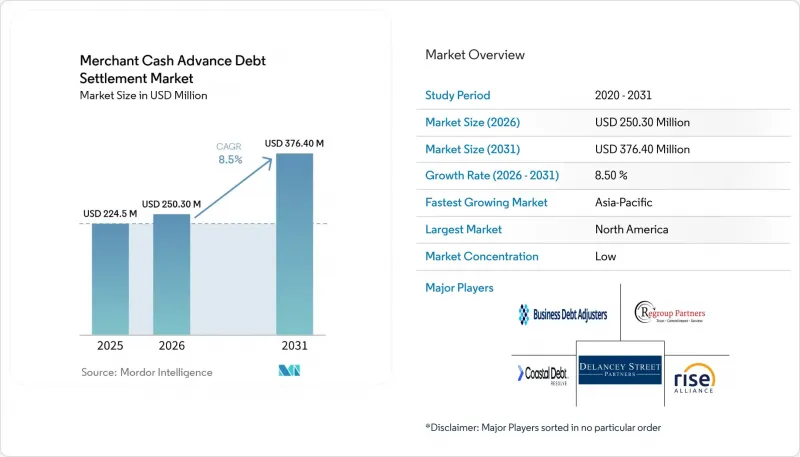
According to Mordor Intelligence, the merchant cash advance debt settlement market size was valued at USD 224.5 million in 2025 and is projected to expand from USD 250.3 million in 2026 to USD 376.4 million by 2031, registering a CAGR of 8.5% between 2026 and 2031.
Global Merchant Cash Advance Debt Settlement Market Trends and Insights
Rising Prevalence of Stacked MCA Obligations
Stacked positions occur when a business carries 2 or more merchant cash advances at the same time. This pattern increases settlement demand because each new daily debit reduces the cash available for payroll, rent, inventory, and taxes. A business with several positions must usually resolve claims in an order shaped by lien rights, contract terms, and each funder's willingness to negotiate. This coordination requirement favors providers with experience in multi-funder cases and legal documentation. Stacked/Multi-Position cases held the largest share of the merchant cash advance debt settlement market in 2025 and also had the highest growth rate within this segmentation. The merchant cash advance debt settlement market remains exposed to this issue because underwriting across separate providers may not fully identify obligations already supported by the same business revenue.
Increasing Merchant Cash-Flow Stress and MCA Delinquencies
Merchant cash-flow pressure increases the need for a negotiated resolution when fixed daily withdrawals continue during weaker trading periods. Restaurants face particular pressure because food and labor costs take a large share of sales, while payments under an advance are often linked to gross receipts rather than net profit. The National Restaurant Association reported that 42% of operators were not profitable in 2025, which illustrates why a daily withdrawal can become unsustainable when margins narrow. Merchants that seek support before a default may have more options to reconcile payment obligations or negotiate a revised schedule. This earlier intervention can widen the range of cases served by the merchant cash advance debt settlement market. It can also reduce the likelihood that a business waits until the debt burden requires a formal insolvency process.
Non-Standardized MCA Contract Structures and Settlement Terms
Non-standardized contracts make every settlement case different and increase the time needed for review. Agreements can differ in their reconciliation terms, lien language, withdrawal authorization, venue provisions, and treatment of alleged default. The issue is more difficult when a merchant has several funders because the parties may have different filing dates and competing claims. A settlement provider must assess each position before proposing a coordinated payment plan. This work reduces case throughput and can raise the cost of serving smaller accounts. The merchant cash advance debt settlement market must therefore balance tailored case work with the need for procedures that can be applied consistently.
Other drivers and restraints analyzed in the detailed report include:
- Increasing Legal Challenges to MCA Contract Enforceability
- Greater Regulatory Scrutiny and Disclosure of MCA Financing
- Limited Funder Willingness to Accept Principal Discounts
For complete list of drivers and restraints, kindly check the Table Of Contents.
Segment Analysis
Lump-Sum Settlement held 50.4% of the merchant cash advance debt settlement market size by settlement structure in 2025. This format gives a funder a defined recovery date and allows a merchant to close an obligation without maintaining a long payment schedule. It is generally most practical when a business can access a one-time source of capital. Settlement firms may also prefer this format when their compensation depends partly on documented savings. The continued lead of lump-sum arrangements shows that speed and certainty remain important to both sides of a case.
Structured/Installment Settlement offers a reduced balance that is repaid across a longer period. It can suit a merchant that continues to generate cash but cannot fund a one-time payment. Hybrid Close combines a discounted upfront payment with a limited modified payment stream. Hybrid Close is forecast to expand at a 12.2% CAGR, making it the fastest-growing settlement structure in the merchant cash advance debt settlement market. Its growth reflects the need for an arrangement that recognizes both a merchant's limited liquidity and a funder's preference for immediate recovery. Wider use of this structure could reduce the share held by lump-sum settlements during the forecast period.
Stacked/multi-position cases accounted for 62.1% of the merchant cash advance debt settlement market share in 2025. They are also forecast to grow at a 9.8% CAGR through 2031, which makes them both the largest and fastest-growing position-complexity category. These cases involve several active advances and often require coordinated communication with multiple funders. Lien priority, bank account access, withdrawal disputes, and different contract terms can all influence the settlement sequence. The category's large share indicates that the most severe payment pressure is concentrated among merchants with multiple obligations.
Single-position cases represent the remaining cases and can often be handled through a more direct discussion with one funder. They do not usually require the same level of coordination across several liens or payment claims. Stacked cases may arise when providers assess revenue deposits without a complete view of advances already tied to those deposits. This can leave a merchant with obligations that each relies on the same underlying cash flow. A centralized record of outstanding advances or stronger reporting practices could reduce this problem over time. Until then, the merchant cash advance debt settlement market is likely to retain a strong need for specialists who can manage complex multi-funder resolutions.
Complete Report Scope:
- By Settlement Structure
- Lump-Sum Settlement
- Structured / Installment Settlement
- Hybrid Close
- By MCA Position Complexity
- Single-Position
- Stacked / Multi-Position
- By Enrolled Remaining Purchased Amount
- Small-Balance
- Medium-Balance
- Large-Balance
- By Merchant Industry
- Retail & E-commerce
- Food Service & Hospitality
- Healthcare
- Construction & Contracting
- Transportation & Logistics
- Professional & Business Services
- Other Industries (Manufacturing and industrial businesses, wholesale and distribution, etc.)
- By Geography
- North America
- United States
- Canada
- Mexico
- South America
- Brazil
- Argentina
- Rest of South America
- Europe
- United Kingdom
- Germany
- France
- Italy
- Spain
- Rest of Europe
- Asia-Pacific
- China
- Japan
- India
- South Korea
- Australia
- Indonesia
- Thailand
- Malaysia
- Singapore
- Vietnam
- Rest of Asia-Pacific
- Middle East and Africa
- Saudi Arabia
- United Arab Emirates
- Turkey
- South Africa
- Egypt
- Rest of Middle East and Africa
- North America
Geography Analysis
North America held 91.2% of the merchant cash advance debt settlement market share in 2025. The United States remains the primary base for merchant cash advance activity and for the associated debt-resolution demand. Its legal environment, commercial finance practices, and concentration of service providers support a large number of negotiated cases. Canada holds a smaller but distinct position through its licensed insolvency and business restructuring framework. Mexico remains at an earlier stage because comparable commercial financing products have not produced settlement demand on the same scale. North America is likely to remain the primary revenue base even as growth becomes more balanced across regions.
South America represented a small share of the merchant cash advance debt settlement market in 2025. Brazil has a substantially small business debt burden and a broad need for debt renegotiation, although its structure differs from the United States model. Government-backed programs can provide businesses with alternatives to private fee-based settlement services. Argentina also has restructuring mechanisms that may be used before a formal bankruptcy process. These public and legal channels may limit the pace at which a stand-alone merchant cash advance settlement model develops. The region's opportunity depends on how revenue-based business financing evolves and how merchants access restructuring support.
Asia-Pacific is projected to grow at a 14.8% CAGR through 2031, the fastest regional rate in the merchant cash advance debt settlement market. Its growth is linked to the broader development of revenue-based financing, merchant funding, embedded finance, and related payment-linked products. India's MSME financing ecosystem is supported by digital lending infrastructure, while Malaysia has introduced sales-linked merchant financing products. Indonesia adopted a framework for buy-now-pay-later and embedded financing through POJK 32/2025, which took effect in December 2025. Australia brought low-cost credit contracts into a dedicated regulatory approach from June 2025. Europe is anchored by the United Kingdom's alternative lending activity, while the Middle East and Africa remain early-stage because formal alternative lending and debt-resolution services are less developed.
- Coastal Debt Resolve
- Rise Alliance
- Delancey Street
- Business Debt Adjusters
- Regroup Partners
- Corporate Rescue Advisors
- Business Debt Law Group
- Grant Phillips Law
- Tayne Law Group
- MCA Debt Advisors
- Eastern Financial Partners
- National Credit Partners
- The Law Offices of Kenneth H. Dramer, P.C.
- United Settlement
- Credible Law
- Business Debt Insider
- MCA Debt Relief
- MCA Settlement
- Business Debt Relief
- American Debt Services
Additional Benefits:
- The market estimate (ME) sheet in Excel format
- 3 months of analyst support
TABLE OF CONTENTS
1 INTRODUCTION
- 1.1 Study Assumptions and Market Definition
- 1.2 Scope of the Study
2 RESEARCH METHODOLOGY
3 EXECUTIVE SUMMARY
4 MARKET LANDSCAPE
- 4.1 Market Overview
- 4.2 Market Drivers
- 4.2.1 Rising Prevalence of Stacked MCA Obligations
- 4.2.2 Increasing Merchant Cash-Flow Stress and MCA Delinquencies
- 4.2.3 Growing Demand for Revenue-Based Repayment Restructuring
- 4.2.4 Increasing Legal Challenges to MCA Contract Enforceability
- 4.2.5 Greater Regulatory Scrutiny and Disclosure of MCA Financing
- 4.2.6 Increasing Complexity of Multi-Funder MCA Debt Resolution
- 4.3 Market Restraints
- 4.3.1 Non-Standardized MCA Contract Structures and Settlement Terms
- 4.3.2 Limited Funder Willingness to Accept Principal Discounts
- 4.3.3 Fragmented MCA Regulatory and Enforcement Frameworks
- 4.3.4 Limited Transparency of MCA Settlement Outcomes and Recovery Rates
- 4.4 Value Chain Analysis
- 4.4.1 MCA Debt Case Origination and Merchant Intake
- 4.4.2 Financial, Contractual and Legal Assessment
- 4.4.3 Cash-Flow Stabilization and Creditor Negotiation
- 4.4.4 Settlement Execution, UCC Release and Post-Settlement Recovery
- 4.5 Regulatory Landscape
- 4.5.1 Commercial-Finance Disclosure and MCA-Specific Conduct Requirements
- 4.5.2 Debt-Settlement Licensing and Attorney / Non-Attorney Practice Boundaries
- 4.5.3 MCA Collection, ACH, UCC and Confession-of-Judgment Requirements
- 4.5.4 Client-Fund, Privacy, KYC/AML and Commercial-Protection Requirements
- 4.6 Porter's Five Forces Analysis
- 4.6.1 Threat of New Entrants
- 4.6.2 Bargaining Power of Suppliers
- 4.6.3 Bargaining Power of Buyers
- 4.6.4 Threat of Substitutes
- 4.6.5 Competitive Rivalry
5 MARKET SIZE AND GROWTH FORECASTS
- 5.1 By Settlement Structure
- 5.1.1 Lump-Sum Settlement
- 5.1.2 Structured / Installment Settlement
- 5.1.3 Hybrid Close
- 5.2 By MCA Position Complexity
- 5.2.1 Single-Position
- 5.2.2 Stacked / Multi-Position
- 5.3 By Enrolled Remaining Purchased Amount
- 5.3.1 Small-Balance
- 5.3.2 Medium-Balance
- 5.3.3 Large-Balance
- 5.4 By Merchant Industry
- 5.4.1 Retail & E-commerce
- 5.4.2 Food Service & Hospitality
- 5.4.3 Healthcare
- 5.4.4 Construction & Contracting
- 5.4.5 Transportation & Logistics
- 5.4.6 Professional & Business Services
- 5.4.7 Other Industries (Manufacturing and industrial businesses, wholesale and distribution, etc.)
- 5.5 By Geography
- 5.5.1 North America
- 5.5.1.1 United States
- 5.5.1.2 Canada
- 5.5.1.3 Mexico
- 5.5.2 South America
- 5.5.2.1 Brazil
- 5.5.2.2 Argentina
- 5.5.2.3 Rest of South America
- 5.5.3 Europe
- 5.5.3.1 United Kingdom
- 5.5.3.2 Germany
- 5.5.3.3 France
- 5.5.3.4 Italy
- 5.5.3.5 Spain
- 5.5.3.6 Rest of Europe
- 5.5.4 Asia-Pacific
- 5.5.4.1 China
- 5.5.4.2 Japan
- 5.5.4.3 India
- 5.5.4.4 South Korea
- 5.5.4.5 Australia
- 5.5.4.6 Indonesia
- 5.5.4.7 Thailand
- 5.5.4.8 Malaysia
- 5.5.4.9 Singapore
- 5.5.4.10 Vietnam
- 5.5.4.11 Rest of Asia-Pacific
- 5.5.5 Middle East and Africa
- 5.5.5.1 Saudi Arabia
- 5.5.5.2 United Arab Emirates
- 5.5.5.3 Turkey
- 5.5.5.4 South Africa
- 5.5.5.5 Egypt
- 5.5.5.6 Rest of Middle East and Africa
- 5.5.1 North America
6 COMPETITIVE LANDSCAPE
- 6.1 Market Concentration
- 6.2 Strategic Moves
- 6.3 Market Share Analysis (Top 5-6 players)
- 6.4 Company Profiles (includes Global Level Overview, Market Level Overview, Core Segments, Financials as available, Strategic Information, Market Rank/Share, Products and Services, Recent Developments)
- 6.4.1 Coastal Debt Resolve
- 6.4.2 Rise Alliance
- 6.4.3 Delancey Street
- 6.4.4 Business Debt Adjusters
- 6.4.5 Regroup Partners
- 6.4.6 Corporate Rescue Advisors
- 6.4.7 Business Debt Law Group
- 6.4.8 Grant Phillips Law
- 6.4.9 Tayne Law Group
- 6.4.10 MCA Debt Advisors
- 6.4.11 Eastern Financial Partners
- 6.4.12 National Credit Partners
- 6.4.13 The Law Offices of Kenneth H. Dramer, P.C.
- 6.4.14 United Settlement
- 6.4.15 Credible Law
- 6.4.16 Business Debt Insider
- 6.4.17 MCA Debt Relief
- 6.4.18 MCA Settlement
- 6.4.19 Business Debt Relief
- 6.4.20 American Debt Services
7 MARKET OPPORTUNITIES AND FUTURE OUTLOOK
- 7.1 White-Space and Unmet-Need Assessment
- 7.1.1 Standardized MCA Settlement-Outcome Data and Pricing Benchmarks
- 7.1.2 Integrated Multi-MCA Resolution and UCC Release Services
- 7.1.3 Accessible Legal and Settlement Support for Microbusinesses
- 7.2 Future Operating Model
- 7.2.1 Data-Driven Early Intervention and Cash-Flow Monitoring
- 7.2.2 Embedded MCA Resolution Within Alternative-Finance Platforms
- 7.2.3 Integrated Legal, Financial and Technology-Led Resolution Platforms

