PUBLISHER: Mordor Intelligence | PRODUCT CODE: 2163622

PUBLISHER: Mordor Intelligence | PRODUCT CODE: 2163622
Merchant Cash Advance - Market Share Analysis, Industry Trends & Statistics, Growth Forecasts (2026 - 2031)
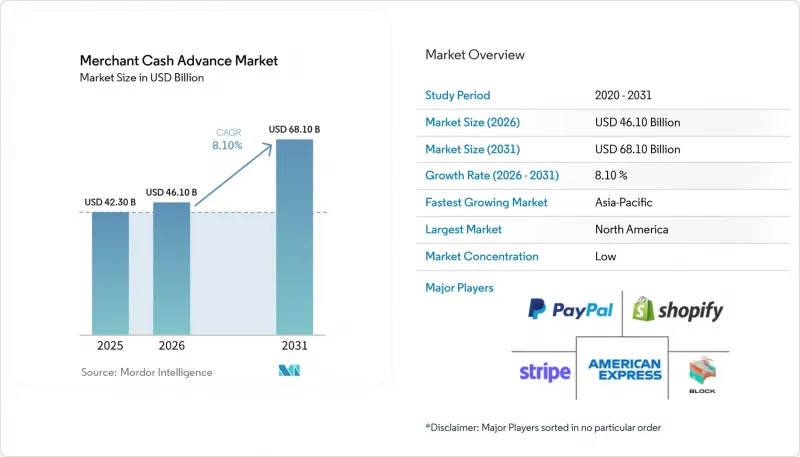
According to Mordor Intelligence, the merchant cash advance market size was valued at USD 42.30 billion in 2025 and is estimated to grow from USD 46.10 billion in 2026 to reach USD 68.10 billion by 2031, at a CAGR of 8.10% during the forecast period (2026-2031).
Global Merchant Cash Advance Market Trends and Insights
Fast Working-Capital Funding for Merchants with Uneven Cash Flows
Seasonal sales patterns in food service, retail, and hospitality create funding needs that fixed loan repayments may not suit. A merchant cash advance adjusts remittances to daily card receipts, which helps businesses manage periods when revenue is lower. Operating expenses were the leading reason for financing among 56% of small-business applicants in the 2025 survey. This use case makes the merchant cash advance market relevant for routine cash-flow planning rather than only emergency funding. Renewal and recontract activity held a 57.2% share in 2025, showing that many merchants return after completing an advance cycle. Standardized disclosure rules in 10 United States states may also help merchants compare products more clearly before accepting an offer.
Growth in Digital Card and Merchant Payment Transactions
More card and digital-wallet payments provide the transaction records used to assess a merchant's cash flow. Visa processed 257.5 billion transactions in fiscal 2025, which was 10% higher than the prior year. Visa Direct processed 12.6 billion transactions in the same year, up 27%, which points to faster growth in real-time payment activity. These payment records can support faster underwriting and more informed pricing for the merchant cash advance market. Retailers and e-commerce sellers usually have frequent settlements and detailed sales records, which support pre-approved financing offers. Growing digital merchant acquiring also broadens the potential borrower base in Asia-Pacific, the Middle East, Africa, and South America.
High Effective MCA Financing Costs and Limited Pricing Transparency
High financing costs and unclear pricing remain barriers for merchants considering an advance. The Federal Reserve reported that 60% of businesses using online lenders experienced higher-than-expected costs, compared with 37% at small banks and 32% at large banks. This difference points to the importance of clear pricing information, not only the absolute cost of financing. California's SB 362, effective January 1, 2026, requires providers to disclose the annualized cost again when a charge, pricing metric, or financing amount is presented to a prospective recipient. These rules increase compliance work during sales interactions and in automated application flows. Providers with built-in disclosure processes can manage this burden more easily than smaller independent sales organizations, while repayment stacking can further strain merchant cash flow.
Other drivers and restraints analyzed in the detailed report include:
- Embedded MCA Offers Through Payment and POS Platforms
- Continued Small-Business Access Gaps in Conventional Credit
- Regulatory Scrutiny of MCA Contracts, Disclosures, and Receivables-Purchase Structures
For complete list of drivers and restraints, kindly check the Table Of Contents.
Segment Analysis
Renewal and recontract deals captured 57.2% of market value in 2025. This share shows the value of repeat relationships in the merchant cash advance market. Merchants often return to a provider before a prior advance has been fully remitted when the product has met working-capital needs. New originations are projected to grow at a 9.7% CAGR from 2026 to 2031. Embedded offers inside payment platforms make the first financing interaction easier because merchants do not need to complete a separate application. These offers use payment history already available to the platform to assess the merchant. Shopify Capital's USD 4.2 billion in 2025 originations illustrate the scale that can be reached through a platform with an existing merchant base.
Independent sales organizations and brokers remain important for merchants outside platform ecosystems. State commercial-financing rules in California, New York, and Texas require disclosure of broker compensation, which can affect broker fee structures. New platform-linked originations can involve smaller advances and transaction-verified customers. Broker-sourced advances can have larger average funded amounts, but merchants may also face greater repayment-stacking risk. Direct platform distribution gives a provider early access to the merchant relationship. The merchant cash advance market is therefore shifting toward direct distribution through payment platforms. Providers seeking new customers need deeper platform connections rather than a larger broker network alone.
Micro and small enterprises held 72.1% of market value in 2025 and are forecast to grow at an 8.9% CAGR through 2031. The combination of the largest share and the highest growth rate makes this group central to the merchant cash advance market. Small firms can struggle to meet bank requirements for collateral, personal guarantees, and long operating histories. This makes speed and simpler qualification requirements important product features. Their financing needs also tend to be closely tied to day-to-day operating expenses. Medium-sized and large enterprises represent the remaining volume. Their growth is slower because they can access revolving credit, Small Business Administration-backed lending, and commercial paper more readily.
Transaction-based underwriting supports advances below USD 25,000 by reducing manual review needs. Providers can use point-of-sale transaction feeds, bank-statement application programming interfaces, and current revenue data to assess smaller merchants. This process lets funders evaluate recent sales activity instead of relying only on conventional financial records. QashierLoans used proprietary point-of-sale data to provide more than USD 10 million to over 100 Singapore-based small and medium-sized enterprises after its June 2025 launch. California SB 362 and New York's Commercial Finance Disclosure Law require disclosure practices that apply across enterprise sizes. Clearer comparisons can be particularly useful for smaller merchants that have fewer resources to evaluate financing options. These conditions keep micro and small businesses at the center of the merchant cash advance industry.
Complete Report Scope:
- By Deal Type
- New Origination
- Renewal / Recontract
- By Enterprise Size
- Micro and Small Enterprises
- Medium-Sized Enterprises
- Large Enterprises
- By Original Funded Amount
- Up to USD 25,000
- USD 25,001-50,000
- USD 50,001-250,000
- USD 250,001-500,000
- Above USD 500,000
- By End-User Industry
- Retail and E-Commerce
- Restaurants, Food Services and Hospitality
- Healthcare and Personal Care Services
- Construction, Contractors and Building Services
- Professional and Business Services
- Transportation, Logistics and Automotive Services
- Manufacturing and Wholesale
- Travel, Leisure and Entertainment
- Other Merchant Businesses
- By Geography
- North America
- United States
- Canada
- Mexico
- South America
- Brazil
- Argentina
- Rest of South America
- Europe
- United Kingdom
- Germany
- France
- Italy
- Spain
- Rest of Europe
- Asia-Pacific
- China
- Japan
- India
- South Korea
- Australia
- Indonesia
- Thailand
- Malaysia
- Singapore
- Vietnam
- Rest of Asia-Pacific
- Middle East and Africa
- Saudi Arabia
- United Arab Emirates
- Turkey
- South Africa
- Egypt
- Rest of Middle East and Africa
- North America
Geography Analysis
North America accounted for 81.3% of the global merchant cash advance market size in 2025. The region has established independent sales organizations and broker networks, widespread card acceptance, and access to institutional syndication capital. The United States remains the center of origination activity. Canada is developing as the next-tier market through the expansion of embedded revenue-based financing programs for more than 202,000 small and medium-sized businesses in March 2026. Mexico offers a longer-term opportunity as digital payments increase among informal merchants. The region's established payments environment supports both broker-led and platform-led origination. Multi-state United States disclosure requirements are changing how independent sales organization networks manage compliance and are favoring providers that can automate these workflows.
Asia-Pacific is forecast to grow at a 12.7% CAGR from 2026 to 2031, the fastest rate among the regions. India's Unified Payments Interface processed 24,162 crore transactions in fiscal year 2025-26, representing 30% year-on-year growth. This payment infrastructure creates a substantial real-time transaction record for merchant underwriting. Southeast Asian providers are expanding platform-based origination, including Qashier's point-of-sale-based lending in Singapore. These payment rails can make sales-based remittances easier to administer for merchants and providers. China's merchant financing ecosystem is primarily embedded within Alibaba, Tencent, and JD Finance platforms. This distribution approach continues to influence newer platform entrants across Southeast Asia.
Europe has a meaningful share of activity outside North America, with the United Kingdom as the region's most established revenue-based financing market. The United Kingdom has an established fintech environment and a mature revenue-based financing ecosystem. CrediNord secured more than EUR 10 million (USD 11.1 million) in June 2026 to expand embedded financing through the myPOS network in Europe, starting in the Netherlands. YouLend's partnership with REA Card extends revenue-based financing to offline retail merchants in Germany using point-of-sale data. These examples show the use of merchant payment data in European financing offers. South America remains at an earlier stage, while Brazil and Argentina offer potential because of informal merchant activity and expanding card acceptance. The Middle East and Africa have longer-term potential as the United Arab Emirates and Saudi Arabia's payment infrastructure and fintech investment programs create more merchant transaction data.
- Block, Inc.
- Shopify Inc.
- PayPal Holdings Inc.
- American Express Company
- Stripe, Inc.
- CAN Capital, Inc.
- Rapid Finance
- Credibly Holdings LLC
- Fora Financial LLC
- National Funding
- Libertas Funding LLC
- Reliant Funding
- Greenbox Capital LLC
- BFS Capital Inc.
- Kalamata Capital Group LLC
- Forward Financing
- Everest Business Funding
- Kapitus
- Liberis
- Perfect Alliance Capital LLC
Additional Benefits:
- The market estimate (ME) sheet in Excel format
- 3 months of analyst support
TABLE OF CONTENTS
1 INTRODUCTION
- 1.1 Study Assumptions and Market Definition
- 1.2 Scope of the Study
2 RESEARCH METHODOLOGY
3 EXECUTIVE SUMMARY
4 MARKET LANDSCAPE
- 4.1 Market Overview
- 4.2 Market Drivers
- 4.2.1 Fast Working-Capital Funding for Merchants with Uneven Cash Flows
- 4.2.2 Growth in Digital Card and Merchant Payment Transactions
- 4.2.3 Embedded MCA Offers Through Payment and POS Platforms
- 4.2.4 Continued Small-Business Access Gaps in Conventional Credit
- 4.2.5 Real-Time Transaction-Based Underwriting and Automated MCA Decisioning
- 4.2.6 Expansion of Digital Merchant Acquiring and Alternative Working-Capital Financing
- 4.3 Market Restraints
- 4.3.1 High Effective MCA Financing Costs and Limited Pricing Transparency
- 4.3.2 Regulatory Scrutiny of MCA Contracts, Disclosures, and Receivables-Purchase Structures
- 4.3.3 Repayment Stacking and Merchant Cash-Flow Compression
- 4.3.4 Dependence on Merchant Transaction Data and Payment-Platform Access
- 4.4 Value Chain Analysis
- 4.4.1 Merchant Lead Generation, ISO/Broker Origination and Application Submission
- 4.4.2 MCA Underwriting, Risk Assessment and Fraud Screening
- 4.4.3 Capital Funding, Syndication and Receivables-Purchase Execution
- 4.4.4 Servicing, Remittance Collection, Portfolio Monitoring and Renewals
- 4.5 Regulatory Landscape
- 4.5.1 Commercial Financing Disclosure and Cost-Transparency Requirements
- 4.5.2 Loan-versus-Receivables-Purchase Characterization and Enforceability
- 4.5.3 MCA Broker/ISO Conduct, Marketing and Merchant-Protection Requirements
- 4.5.4 Merchant Data Privacy, Transaction-Data Access and Cross-Border Compliance
- 4.6 Technological Outlook
- 4.6.1 AI-Enabled MCA Underwriting and Alternative Transaction-Data Analysis
- 4.6.2 POS, Payment Processor, Bank-Account and Accounting-System Integrations
- 4.6.3 Real-Time Revenue Monitoring and Dynamic Remittance Management
- 4.6.4 Automated Fraud, Stacking and Account-Takeover Detection
- 4.7 Porter's Five Forces Analysis
- 4.7.1 Threat of New Entrants
- 4.7.2 Bargaining Power of Suppliers
- 4.7.3 Bargaining Power of Buyers
- 4.7.4 Threat of Substitutes
- 4.7.5 Competitive Rivalry
5 MARKET SIZE AND GROWTH FORECASTS
- 5.1 By Deal Type
- 5.1.1 New Origination
- 5.1.2 Renewal / Recontract
- 5.2 By Enterprise Size
- 5.2.1 Micro and Small Enterprises
- 5.2.2 Medium-Sized Enterprises
- 5.2.3 Large Enterprises
- 5.3 By Original Funded Amount
- 5.3.1 Up to USD 25,000
- 5.3.2 USD 25,001-50,000
- 5.3.3 USD 50,001-250,000
- 5.3.4 USD 250,001-500,000
- 5.3.5 Above USD 500,000
- 5.4 By End-User Industry
- 5.4.1 Retail and E-Commerce
- 5.4.2 Restaurants, Food Services and Hospitality
- 5.4.3 Healthcare and Personal Care Services
- 5.4.4 Construction, Contractors and Building Services
- 5.4.5 Professional and Business Services
- 5.4.6 Transportation, Logistics and Automotive Services
- 5.4.7 Manufacturing and Wholesale
- 5.4.8 Travel, Leisure and Entertainment
- 5.4.9 Other Merchant Businesses
- 5.5 By Geography
- 5.5.1 North America
- 5.5.1.1 United States
- 5.5.1.2 Canada
- 5.5.1.3 Mexico
- 5.5.2 South America
- 5.5.2.1 Brazil
- 5.5.2.2 Argentina
- 5.5.2.3 Rest of South America
- 5.5.3 Europe
- 5.5.3.1 United Kingdom
- 5.5.3.2 Germany
- 5.5.3.3 France
- 5.5.3.4 Italy
- 5.5.3.5 Spain
- 5.5.3.6 Rest of Europe
- 5.5.4 Asia-Pacific
- 5.5.4.1 China
- 5.5.4.2 Japan
- 5.5.4.3 India
- 5.5.4.4 South Korea
- 5.5.4.5 Australia
- 5.5.4.6 Indonesia
- 5.5.4.7 Thailand
- 5.5.4.8 Malaysia
- 5.5.4.9 Singapore
- 5.5.4.10 Vietnam
- 5.5.4.11 Rest of Asia-Pacific
- 5.5.5 Middle East and Africa
- 5.5.5.1 Saudi Arabia
- 5.5.5.2 United Arab Emirates
- 5.5.5.3 Turkey
- 5.5.5.4 South Africa
- 5.5.5.5 Egypt
- 5.5.5.6 Rest of Middle East and Africa
- 5.5.1 North America
6 COMPETITIVE LANDSCAPE
- 6.1 Market Concentration
- 6.2 Strategic Moves
- 6.3 Market Share Analysis (Top 5-6 players)
- 6.4 Company Profiles (includes Global Level Overview, Market Level Overview, Core Segments, Financials as available, Strategic Information, Market Rank/Share, Products and Services, Recent Developments)
- 6.4.1 Block, Inc.
- 6.4.2 Shopify Inc.
- 6.4.3 PayPal Holdings Inc.
- 6.4.4 American Express Company
- 6.4.5 Stripe, Inc.
- 6.4.6 CAN Capital, Inc.
- 6.4.7 Rapid Finance
- 6.4.8 Credibly Holdings LLC
- 6.4.9 Fora Financial LLC
- 6.4.10 National Funding
- 6.4.11 Libertas Funding LLC
- 6.4.12 Reliant Funding
- 6.4.13 Greenbox Capital LLC
- 6.4.14 BFS Capital Inc.
- 6.4.15 Kalamata Capital Group LLC
- 6.4.16 Forward Financing
- 6.4.17 Everest Business Funding
- 6.4.18 Kapitus
- 6.4.19 Liberis
- 6.4.20 Perfect Alliance Capital LLC
7 MARKET OPPORTUNITIES AND FUTURE OUTLOOK
- 7.1 White-Space and Unmet-Need Assessment
- 7.1.1 Transparent Cost, Remittance and Payback Simulators
- 7.1.2 Flexible Seasonality- and Cash-Flow-Aware Remittance Structures
- 7.1.3 Multi-Platform Transaction-Data Portability for Merchant Underwriting
- 7.2 Future Outlook
- 7.2.1 Institutional Funding and Scalable MCA Capital Markets
- 7.2.2 Open-Banking, Payment and Embedded-Finance Integration
- 7.2.3 Regulatory-Ready and Responsible MCA Underwriting

