PUBLISHER: Mordor Intelligence | PRODUCT CODE: 2163399

PUBLISHER: Mordor Intelligence | PRODUCT CODE: 2163399
United States Farm Implements - Market Share Analysis, Industry Trends & Statistics, Growth Forecasts (2026 - 2031)
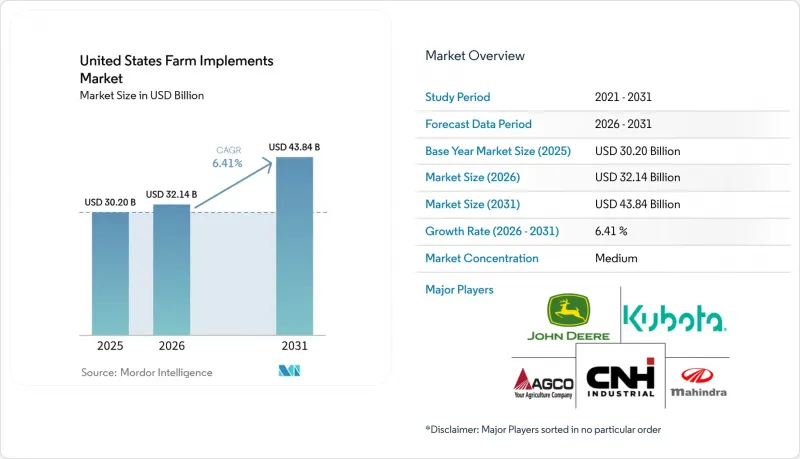
According to Mordor Intelligence, the United States farm implements market was valued at USD 30.20 billion in 2025 and is projected to grow from USD 32.14 billion in 2026 to USD 43.84 billion by 2031, at a CAGR of 6.41% during the forecast period from 2026 to 2031.
United States Farm Implements Market Trends and Insights
Precision Farming Retrofit Adoption Across Existing Fleets
High upfront costs associated with precision agriculture technologies are driving demand for retrofit solutions that add advanced capabilities to existing farm machinery. The United States Government Accountability Office reported in January 2024 that precision agriculture technologies, including GPS, automation, and variable-rate systems, can improve resource management and farm profitability, although high upfront acquisition costs remain a significant barrier to adoption. Equipment manufacturers are responding with retrofit technologies that enable farmers to add guidance, connectivity, automation, and precision application capabilities to tractors, planters, sprayers, combines, and other existing equipment. John Deere offers Precision Upgrades for machinery already owned by farmers, while AGCO's PTx portfolio provides retrofit solutions across mixed-brand fleets. These solutions allow producers to modernize existing equipment without replacing entire machines, supporting demand for precision-enabled farm implements and aftermarket technology upgrades.
Original Equipment Manufacturer Electrification and Low-Horsepower Product Refresh Cycles
Original equipment manufacturers are accelerating electrification and product refresh cycles in compact agricultural equipment, creating new growth opportunities in the United States farm implements market. In Fiscal Year 2025, the United States Department of Agriculture announced that the Rural Energy for America Program provides 80% of loan guarantees for eligible renewable energy and energy-efficiency improvement projects, reducing financing barriers for advanced agricultural technologies . This policy environment encourages investment in electrically powered and energy-efficient farm equipment. As a result, manufacturers are expanding low-horsepower electric platforms and compatible implements, enabling farmers to improve operational efficiency, modernize equipment, and advance sustainable agricultural practices.
Commodity Price Weakness Delaying Replacement Cycles
Weak commodity prices and declining farm profitability are prompting producers to postpone purchases of new agricultural equipment, limiting growth in the United States farm implements market. According to the United States Department of Agriculture, Economic Research Service, farm cash receipts are forecast to reach USD 514.7 billion in 2026, a decline of USD 14.2 billion from 2025, primarily due to lower livestock and animal product receipts. Reduced farm revenues are constraining capital spending, prompting growers to extend the operating life of existing machinery rather than invest in new implements. As a result, replacement cycles are lengthening, slowing equipment demand and creating pricing pressure across the market.
Other drivers and restraints analyzed in the detailed report include:
- Telematics-Led Predictive Maintenance and Uptime Guarantees
- Climate-Smart Program Funding for Water and Input Efficiency
- Dealer Technician Shortages Slowing Equipment Service Capacity
For complete list of drivers and restraints, kindly check the Table Of Contents.
Segment Analysis
Tractors accounted for the largest share of the United States farm implements market at 50.6% in 2025. This reflects their role as the primary power source for tillage, planting, seeding, material handling, and specialty crop operations across diverse farming systems. Large tractors remain essential for high-acreage row-crop production, while compact models support orchards, vineyards, and livestock farms. Manufacturers continue introducing advanced platforms featuring precision guidance, connectivity, and electrified implement capabilities to improve field efficiency. Harvesters also represent an important product category, supporting mechanized harvesting across major grain and specialty crop production regions.
Irrigation and crop-protection implements are projected to grow at the fastest CAGR, 9.3%, from 2026 to 2031. Rising water conservation requirements, precision input management, and increasing adoption of automated application technologies continue to support demand across major agricultural regions. Precision irrigation systems integrate soil moisture monitoring, variable-rate application, and automated controls to improve water-use efficiency while reducing operating costs. Precision sprayers and autonomous field equipment are also gaining commercial acceptance as producers prioritize labor efficiency and sustainable crop management. Soil preparation, planting, seeding, haying, and forage implements remain essential as they serve recurring seasonal farming operations.
Complete Report Scope:
- By Product Type
- Tractors
- Harvesters
- Soil Preparation and Cultivation Equipment
- Planting, Seeding, and Fertilizing Equipment
- Irrigation and Crop-Protection Implements
- Precision and Autonomous Implements
- Haying and Forage Equipment
- Other Implements
- By Mode of Operation
- Powered Implements
- Unpowered Implements
- By Power Output
- Below 30 HP
- 31-70 HP
- 71-130 HP
- Above 130 HP
List of Companies Covered in this Report:
- Deere and Company
- CNH Industrial N.V.
- AGCO Corporation
- Kubota Corporation
- Mahindra & Mahindra Limited
- CLAAS KGaA mbH
- KUHN SAS (Bucher Industries AG)
- SAME DEUTZ-FAHR S.p.A.
- Kinze Manufacturing, Inc.
- HORSCH Maschinen GmbH
- Ploeger Oxbo Group B.V. (Royal Reesink B.V.)
- Argo Tractors S.p.A.
Additional Benefits:
- The market estimate (ME) sheet in Excel format
- 3 months of analyst support
TABLE OF CONTENTS
1 INTRODUCTION
- 1.1 Study Assumptions and Market Definition
- 1.2 Scope of the Study
2 RESEARCH METHODOLOGY
3 EXECUTIVE SUMMARY
4 MARKET LANDSCAPE
- 4.1 Market Overview
- 4.2 Market Drivers
- 4.2.1 Precision Farming Retrofit Adoption Across Existing Fleets
- 4.2.2 Original Equipment Manufacturer Electrification and Low-Horsepower Product Refresh Cycles
- 4.2.3 Telematics-Led Predictive Maintenance and Uptime Guarantees
- 4.2.4 Climate-Smart Program Funding for Water and Input Efficiency
- 4.2.5 Bespoke Leasing and Subscription Models for Cash-Strapped Farms
- 4.2.6 Specialty Crop Robotics Adoption in Orchards, Vineyards, and Nursery Operations
- 4.3 Market Restraints
- 4.3.1 Commodity Price Weakness Delaying Replacement Cycles
- 4.3.2 Dealer Technician Shortages Slowing Equipment Service Capacity
- 4.3.3 Rural Connectivity Gaps Limiting Connected Implement Adoption
- 4.3.4 Emissions Compliance Lead Times and Supply Disruptions
- 4.4 Regulatory Landscape
- 4.5 Technological Outlook
- 4.6 Porter's Five Forces Analysis
- 4.6.1 Bargaining Power of Suppliers
- 4.6.2 Bargaining Power of Buyers
- 4.6.3 Threat of New Entrants
- 4.6.4 Threat of Substitutes
- 4.6.5 Intensity of Competitive Rivalry
5 MARKET SIZE AND GROWTH FORECASTS
- 5.1 By Product Type
- 5.1.1 Tractors
- 5.1.2 Harvesters
- 5.1.3 Soil Preparation and Cultivation Equipment
- 5.1.4 Planting, Seeding, and Fertilizing Equipment
- 5.1.5 Irrigation and Crop-Protection Implements
- 5.1.6 Precision and Autonomous Implements
- 5.1.7 Haying and Forage Equipment
- 5.1.8 Other Implements
- 5.2 By Mode of Operation
- 5.2.1 Powered Implements
- 5.2.2 Unpowered Implements
- 5.3 By Power Output
- 5.3.1 Below 30 HP
- 5.3.2 31-70 HP
- 5.3.3 71-130 HP
- 5.3.4 Above 130 HP
6 COMPETITIVE LANDSCAPE
- 6.1 Market Concentration
- 6.2 Strategic Moves
- 6.3 Market Share Analysis
- 6.4 Company Profiles (Includes Global Level Overview, Market Level Overview, Core Segments, Financials as Available, Strategic Information, Market Rank/Share for Key Companies, Products and Services, and Recent Developments)
- 6.4.1 Deere and Company
- 6.4.2 CNH Industrial N.V.
- 6.4.3 AGCO Corporation
- 6.4.4 Kubota Corporation
- 6.4.5 Mahindra & Mahindra Limited
- 6.4.6 CLAAS KGaA mbH
- 6.4.7 KUHN SAS (Bucher Industries AG)
- 6.4.8 SAME DEUTZ-FAHR S.p.A.
- 6.4.9 Kinze Manufacturing, Inc.
- 6.4.10 HORSCH Maschinen GmbH
- 6.4.11 Ploeger Oxbo Group B.V. (Royal Reesink B.V.)
- 6.4.12 Argo Tractors S.p.A.
7 MARKET OPPORTUNITIES AND FUTURE OUTLOOK

