PUBLISHER: Mordor Intelligence | PRODUCT CODE: 2163428

PUBLISHER: Mordor Intelligence | PRODUCT CODE: 2163428
Non-Alcoholic Wine and Beer - Market Share Analysis, Industry Trends & Statistics, Growth Forecasts (2026 - 2031)
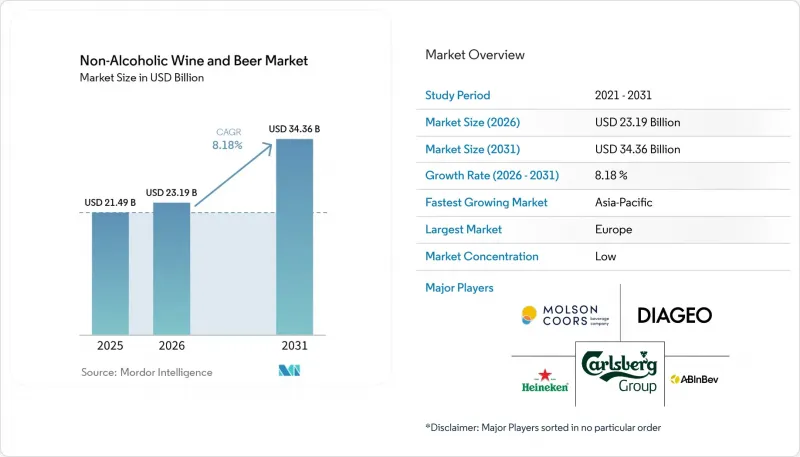
According to Mordor Intelligence, the non-alcoholic wine and beer market size is expected to grow from USD 21.49 billion in 2025 to USD 23.19 billion in 2026 and is forecast to reach USD 34.36 billion by 2031 at a 8.18% CAGR over 2026-2031.
Global Non-Alcoholic Wine and Beer Market Trends and Insights
Growing Health and Wellness Focus on Alcohol Moderation
Growing consumer focus on health and wellness is prompting many to reconsider their alcohol consumption and adopt more moderate drinking habits. According to a January 2025 Beer Institute poll, 60% of Americans participating in Dry January reported that low- and no-alcohol beer helps them achieve their moderation goals, highlighting the role of alcohol alternatives in moderation-oriented consumption. Additionally, the International Food Information Council (IFIC)'s 2026 findings show that 56% of Americans consider healthfulness an influential factor in food and beverage purchasing decisions, even as convenience surpassed healthfulness as a priority for the first time. This broader focus on healthier consumption supports interest in beverages that allow consumers to participate in social and everyday drinking occasions while reducing or avoiding alcohol. As a result, non-alcoholic wine and beer are increasingly positioned as practical options for moderation-oriented consumption.
Mainstream Adoption of Sober-Curious and Mindful Drinking
The growing emphasis on mindful drinking is encouraging consumers to reduce alcohol intake while still participating in social and recreational drinking occasions. The Centers for Disease Control and Prevention (CDC) states that drinking less alcohol lowers health risks and notes that about 178,000 people die from excessive alcohol use each year in the United States. The CDC also states that alcohol consumption is linked to several types of cancer and that the risk of some cancers increases with any amount of alcohol use. This growing awareness of alcohol-related health risks is supporting greater acceptance of moderation and alcohol-free choices, creating opportunities for non-alcoholic wine and beer to serve consumers seeking familiar drinking experiences without alcohol.
Sensory Limitations Compared with Conventional Wine and Beer
Sensory limitations compared with conventional wine and beer can constrain consumer acceptance and repeat purchases in the non-alcoholic category. Removing or limiting alcohol can affect the balance of flavor, aroma, mouthfeel, body, and finish that consumers associate with traditional beverages. These differences may be more noticeable among consumers who are familiar with established wine and beer products and have specific expectations regarding taste and drinking experience. As a result, some non-alcoholic offerings may be perceived as less authentic or satisfying than their conventional counterparts. This can make consistent sensory quality an important challenge for brands seeking to encourage trial and build long-term consumer loyalty.
Other drivers and restraints analyzed in the detailed report include:
- Improving Product Quality, Taste, and Premiumization
- Expanding Retail, Hospitality, and E-Commerce Availability
- Higher Production and Distribution Costs
For complete list of drivers and restraints, kindly check the Table Of Contents.
Segment Analysis
Non-Alcoholic Beer accounted for 92.32% of the market in 2025, making it the dominant product segment. Its leading position is supported by the established presence of non-alcoholic beer products across major markets, broader consumer familiarity, and the extensive portfolios offered by major brewers. The segment also benefits from the availability of multiple beer styles and formats, which allows producers to address a wide range of consumer preferences and consumption occasions. These factors have contributed to the relatively mature position of non-alcoholic beer within the overall market.
Non-Alcoholic Wine is expected to be the fastest-growing product segment, with a projected CAGR of 9.12% during 2026-2031. Growth is supported by increasing product development, improvements in flavor and sensory characteristics, and the expansion of non-alcoholic wine offerings across retail and hospitality channels. Producers are also introducing more premium and differentiated products, helping broaden the segment's appeal beyond consumers seeking basic alcohol-free alternatives. As product quality and availability continue to improve, non-alcoholic wine is expected to gain a larger share of the overall market during the forecast period.
Complete Report Scope:
- By Product Type
- Non-Alcoholic Beer
- Non-Alcoholic Wine
- By Packaging
- Cans
- Glass Bottles
- Plastic Bottles
- Cartons
- By Distribution Channel
- On-Trade
- Off-Trade
- Supermarkets/Hypermarkets
- Speciality Stores
- Online Retail Stores
- Others Distribution Channel
- By Geography
- North America
- United States
- Canada
- Mexico
- Rest of North America
- Europe
- Germany
- United Kingdom
- Italy
- France
- Spain
- Netherlands
- Poland
- Belgium
- Sweden
- Rest of Europe
- Asia-Pacific
- China
- India
- Japan
- Australia
- Indonesia
- South Korea
- Thailand
- Singapore
- Rest of Asia-Pacific
- South America
- Brazil
- Argentina
- Colombia
- Chile
- Peru
- Rest of South America
- Middle East and Africa
- South Africa
- Saudi Arabia
- United Arab Emirates
- Nigeria
- Egypt
- Morocco
- Turkey
- Rest of Middle East and Africa
- North America
Geography Analysis
Europe accounted for 42.57% of the Non-Alcoholic Wine and Beer Market in 2025, making it the largest regional market. The region benefits from relatively established consumer acceptance of alcohol-free beverages, supported by broad product availability and strong participation from major beverage producers. Non-alcoholic beer has gained particular traction across several European markets, while non-alcoholic wine is also expanding as producers introduce more varied and premium offerings. The established retail and hospitality infrastructure across the region further supports consumer access and category development.
Asia-Pacific is projected to be the fastest-growing regional market, with a CAGR of 10.46% during 2026-2031. Growth is supported by increasing consumer awareness of alcohol-free alternatives, expanding product portfolios, and greater availability through modern retail and online channels. Japan represents a relatively established market, while China and other developing markets provide additional opportunities as consumer acceptance develops. Increasing investment by international and regional beverage producers is also expected to strengthen the category's presence across the region.
North America represents a substantial regional market, supported by growing consumer interest in alcohol moderation and the increasing availability of non-alcoholic beverages across retail, hospitality, and e-commerce channels. The United States remains the primary contributor to regional demand, with Canada also providing opportunities for category expansion. A broad presence of established beverage companies and specialized brands is strengthening product availability and consumer awareness. The region's developed distribution infrastructure and diverse consumption occasions are expected to support continued market expansion.
- Anheuser-Busch InBev SA/NV
- Heineken N.V.
- Athletic Brewing Company
- Carlsberg Breweries A/S
- Diageo plc
- Asahi Group Holdings, Ltd.
- Molson Coors Beverage Company
- Suntory Holdings Limited
- Kirin Holdings Company, Limited
- The Boston Beer Company, Inc.
- BrewDog plc
- Big Drop Brewing Co.
- Krombacher Brauerei Bernhard Schadeberg GmbH & Co. KG
- Privatbrauerei Erdinger WeiBbrau Werner Brombach GmbH
- Schloss Wachenheim AG
- Giesen Group Ltd
- Domaines Pierre Chavin
- Miguel Torres S.A.
- Australian Vintage Limited
- DGB (Pty) Ltd
- Thomson and Scott
Additional Benefits:
- The market estimate (ME) sheet in Excel format
- 3 months of analyst support
TABLE OF CONTENTS
1 INTRODUCTION
- 1.1 Study Assumptions and Market Definition
- 1.2 Scope of the Study
2 RESEARCH METHODOLOGY
3 EXECUTIVE SUMMARY
4 MARKET LANDSCAPE
- 4.1 Market Overview
- 4.2 Market Drivers
- 4.2.1 Growing health and wellness focus on alcohol moderation
- 4.2.2 Mainstream adoption of sober-curious and mindful drinking
- 4.2.3 Improving product quality, taste, and premiumization
- 4.2.4 Expanding retail, hospitality, and e-commerce availability
- 4.2.5 Growing adoption of zebra striping and flexible alcohol consumption
- 4.2.6 Expansion of health, fitness, and next-day performance occasions
- 4.3 Market Restraints
- 4.3.1 Sensory limitations compared with conventional wine and beer
- 4.3.2 Higher production and distribution costs
- 4.3.3 ABV thresholds and labeling fragmentation across markets
- 4.3.4 Resource intensity of dealcoholization and aroma recovery
- 4.4 Consumer Behavior Analysis
- 4.5 Regulatory Landscape
- 4.6 Porter's Five Forces Analysis
- 4.6.1 Threat of New Entrants
- 4.6.2 Bargaining Power of Suppliers
- 4.6.3 Bargaining Power of Buyers
- 4.6.4 Threat of Substitutes
- 4.6.5 Intensity of Competitive Rivalry
5 MARKET SIZE AND GROWTH FORECASTS (VALUE AND VOLUME)
- 5.1 By Product Type
- 5.1.1 Non-Alcoholic Beer
- 5.1.2 Non-Alcoholic Wine
- 5.2 By Packaging
- 5.2.1 Cans
- 5.2.2 Glass Bottles
- 5.2.3 Plastic Bottles
- 5.2.4 Cartons
- 5.3 By Distribution Channel
- 5.3.1 On-Trade
- 5.3.2 Off-Trade
- 5.3.2.1 Supermarkets/Hypermarkets
- 5.3.2.2 Speciality Stores
- 5.3.2.3 Online Retail Stores
- 5.3.2.4 Others Distribution Channel
- 5.4 By Geography
- 5.4.1 North America
- 5.4.1.1 United States
- 5.4.1.2 Canada
- 5.4.1.3 Mexico
- 5.4.1.4 Rest of North America
- 5.4.2 Europe
- 5.4.2.1 Germany
- 5.4.2.2 United Kingdom
- 5.4.2.3 Italy
- 5.4.2.4 France
- 5.4.2.5 Spain
- 5.4.2.6 Netherlands
- 5.4.2.7 Poland
- 5.4.2.8 Belgium
- 5.4.2.9 Sweden
- 5.4.2.10 Rest of Europe
- 5.4.3 Asia-Pacific
- 5.4.3.1 China
- 5.4.3.2 India
- 5.4.3.3 Japan
- 5.4.3.4 Australia
- 5.4.3.5 Indonesia
- 5.4.3.6 South Korea
- 5.4.3.7 Thailand
- 5.4.3.8 Singapore
- 5.4.3.9 Rest of Asia-Pacific
- 5.4.4 South America
- 5.4.4.1 Brazil
- 5.4.4.2 Argentina
- 5.4.4.3 Colombia
- 5.4.4.4 Chile
- 5.4.4.5 Peru
- 5.4.4.6 Rest of South America
- 5.4.5 Middle East and Africa
- 5.4.5.1 South Africa
- 5.4.5.2 Saudi Arabia
- 5.4.5.3 United Arab Emirates
- 5.4.5.4 Nigeria
- 5.4.5.5 Egypt
- 5.4.5.6 Morocco
- 5.4.5.7 Turkey
- 5.4.5.8 Rest of Middle East and Africa
- 5.4.1 North America
6 COMPETITIVE LANDSCAPE
- 6.1 Market Concentration
- 6.2 Strategic Moves
- 6.3 Market Share Analysis
- 6.4 Company Profiles (Includes Company Highlights, Core Segments, Financials (if available), Strategic Information, Market Share Analysis for Key Companies, Products, and Recent Developments)
- 6.4.1 Anheuser-Busch InBev SA/NV
- 6.4.2 Heineken N.V.
- 6.4.3 Athletic Brewing Company
- 6.4.4 Carlsberg Breweries A/S
- 6.4.5 Diageo plc
- 6.4.6 Asahi Group Holdings, Ltd.
- 6.4.7 Molson Coors Beverage Company
- 6.4.8 Suntory Holdings Limited
- 6.4.9 Kirin Holdings Company, Limited
- 6.4.10 The Boston Beer Company, Inc.
- 6.4.11 BrewDog plc
- 6.4.12 Big Drop Brewing Co.
- 6.4.13 Krombacher Brauerei Bernhard Schadeberg GmbH & Co. KG
- 6.4.14 Privatbrauerei Erdinger WeiBbrau Werner Brombach GmbH
- 6.4.15 Schloss Wachenheim AG
- 6.4.16 Giesen Group Ltd
- 6.4.17 Domaines Pierre Chavin
- 6.4.18 Miguel Torres S.A.
- 6.4.19 Australian Vintage Limited
- 6.4.20 DGB (Pty) Ltd
- 6.4.21 Thomson and Scott
7 MARKET OPPORTUNITIES AND FUTURE OUTLOOK

