PUBLISHER: Mordor Intelligence | PRODUCT CODE: 2163446

PUBLISHER: Mordor Intelligence | PRODUCT CODE: 2163446
Aniline Derivatives - Market Share Analysis, Industry Trends & Statistics, Growth Forecasts (2026 - 2031)
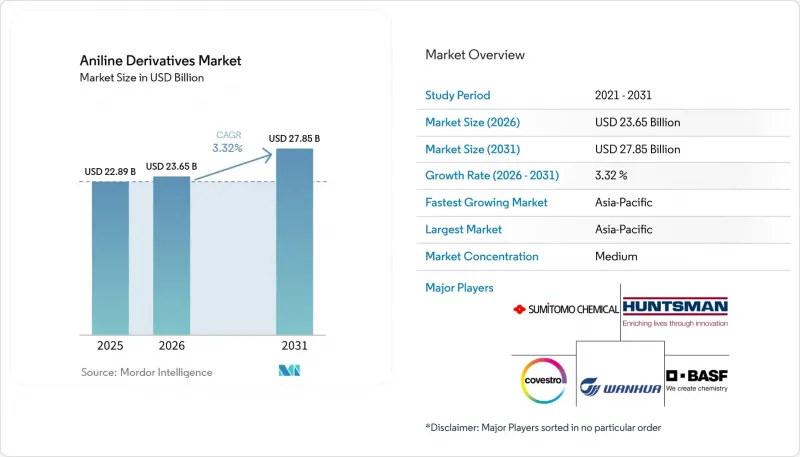
According to Mordor Intelligence, the aniline derivatives market size was valued at USD 22.89 billion in 2025 and is estimated to grow from USD 23.65 billion in 2026 to reach USD 27.85 billion by 2031, at a CAGR of 3.32% during the forecast period (2026-2031).
Global Aniline Derivatives Market Trends and Insights
MDI and Polyurethane Demand in Construction, Appliances, and Automotive
MDI-grade aniline remained the most consistent demand driver for the aniline derivatives market because more than 71% of global aniline output was directed to isocyanate synthesis. Rigid polyurethane foam supports heat management in residential and commercial buildings, which makes demand responsive to building energy requirements. The European Union revised its Energy Performance of Buildings Directive, and U.S. building energy standards also reinforced the use of efficient insulation materials. Appliance demand added another source of consumption because cyclopentane-blown rigid foam is used in refrigerators and commercial cold-chain equipment. BASF advanced its feasibility study for an MDI complex in Dahej, Gujarat, after securing industrial land through BASF India Polyurethanes Private Limited, while its Geismar, Louisiana, expansion reached final commissioning. Covestro AG planned a 660-kiloton-per-year MDI train at its Shanghai integrated site using AdiP technology designed for net-zero Scope 1 and 2 greenhouse-gas emissions.
Rubber Processing Demand from Tires and Industrial Rubber
Rubber chemicals support growth in the aniline derivatives market through anti-degradants, accelerators, and antiozonants used in tires and industrial rubber. N-phenyl-p-phenylenediamine materials remained important, but the review of N-(1,3-dimethylbutyl)-N'-phenyl-p-phenylenediamine (6PPD) oxidation products in the United States encouraged work on alternative formulations. LANXESS introduced Vulkanox 4060 (N-Cyclohexyl-N'-phenyl-p-phenylenediamine, CCPD) and began European Registration, Evaluation, Authorisation and Restriction of Chemicals (REACH) registration for volumes above 1,000 metric tons per year. This shift supports higher-purity chloroaniline and nitroaniline intermediates used in newer anti-degradant chemistries. LANXESS expanded its Qingdao site to 30,000 metric tons per year in 2025 and began producing rubber processing promoters in Bushy Park, South Carolina, to improve supply security for tire manufacturers. Electric vehicle tires need higher load ratings, lower rolling resistance, and stronger wear resistance, which can increase chemical loading per tire.
Toxicity, Exposure Controls, and Compliance Costs
Toxicity, exposure controls, and compliance costs limit smaller participants in the aniline derivatives market. The European Union classified aniline as Carc. 2, Muta. 2, and Acute Tox. 3 under the Classification, Labelling and Packaging (CLP) Regulation. Commission Delegated Regulation (EU) 2025/1222 updated CLP harmonized classification entries in June 2025, and Commission Regulation (EU) 2025/1731 added 16 new carcinogenic, mutagenic, or reprotoxic substances to REACH Annex XVII in August 2025. These changes increased the need for closed transfer systems, ventilation, exposure monitoring, and operating controls. The costs are harder to absorb for smaller derivative processors because the required infrastructure does not scale down easily. LANXESS reformulated its Rhenogran and Rhenoslab ranges to talc-free products after the International Agency for Research on Cancer classified talc as probably carcinogenic, showing how regulatory changes can add reformulation costs across rubber chemicals.
Other drivers and restraints analyzed in the detailed report include:
- Dyes, Pigments, and Textile Manufacturing Expansion
- Pharmaceutical and Agrochemical Intermediate Demand
- Benzene Price and Petrochemical Feedstock Volatility
For complete list of drivers and restraints, kindly check the Table Of Contents.
Segment Analysis
Aniline held 55.13% of the aniline derivatives market size in 2025 because it is the direct precursor for MDI and a feedstock for anti-degradants and dye intermediates. Its position is reinforced by the large volume of MDI used in insulation, appliances, automotive components, and adhesives. Integrated MDI capacity in China requires corresponding upstream aniline volumes as new plants begin operating. Wanhua completed the Fujian MDI base expansion in 2026, adding 700,000 metric tons per year and taking its global MDI capacity above 4.5 million metric tons per year. The scale of these projects keeps the parent compound central to the aniline derivatives market.
Nitroaniline and chloroaniline serve more specialized roles in pharmaceutical intermediates, optical brighteners, and next-generation rubber anti-degradants. These derivatives can command stronger pricing where purity requirements and documentation standards are high. Regulatory review of 6PPD oxidation products may support demand for alternative anti-degradants using chloroaniline and nitroaniline intermediates. Toluidine is used as a dye-intermediate precursor and rubber accelerator feedstock, with demand linked to India's colorant exports. Specialty derivatives are less dependent on MDI volumes, although their scale is smaller. Producers with established purity controls and compliance records can preserve margins in specialty customer accounts.
Complete Report Scope:
- By Derivative Type
- Aniline
- Nitroaniline
- Chloroaniline
- Toluidine
- Other Derivative Types
- By Application
- Rubber Chemicals
- Dyes and Pigments
- Pharmaceuticals
- Agrochemicals
- Other Applications
- By Geography
- Asia-Pacific
- China
- India
- Japan
- South Korea
- ASEAN Countries
- Rest of Asia-Pacific
- North America
- United States
- Canada
- Mexico
- Europe
- Germany
- United Kingdom
- France
- Italy
- NORDIC Countries
- Rest of Europe
- South America
- Brazil
- Argentina
- Rest of South America
- Middle East and Africa
- Saudi Arabia
- South Africa
- Rest of Middle East and Africa
- Asia-Pacific
Geography Analysis
Asia-Pacific held 43.48% of the aniline derivatives market size in 2025 and is projected to advance at a 4.01% CAGR through 2031. China is the central production and consumption base, supported by large MDI, automotive, tire, and downstream chemical capacity. China Risun Group Limited brought Jilin Connell Group's total 300,000-metric-ton-per-year aniline capacity into full operation in 2024, 1 month ahead of schedule. India is an important import-demand market because domestic aniline production covers close to half of national consumption. This gap leaves derivative processors reliant on merchant supply from China and South Korea.
India's pharmaceutical manufacturing, infrastructure investment, and dye production can expand derivative demand where local feedstock supply is constrained. Japan and South Korea contribute to technology-intensive production for electronics, pharmaceuticals, and performance-polymer applications. Association of Southeast Asian Nations (ASEAN) countries are developing as secondary consumption centers through automotive assembly and tire manufacturing investment. North America is mature, but the environmental review of 6PPD oxidation products is changing demand toward alternative rubber chemical formulations. In Europe, sustainability specifications and occupational controls create demand for high-purity and lower-carbon inputs.
South America and the Middle East and Africa have smaller consumption bases, but their downstream needs are gradually broadening. Brazil's agricultural activity supports demand for agrochemical intermediates. Covestro AG began a feasibility study for a 660-kiloton-per-year MDI facility in Al Ruwais Industrial City in the United Arab Emirates, supported by XRG and the TA'ZIZ chemicals hub. If sanctioned, the project would shift part of the regional derivative demand from imports toward local MDI production. Saudi Arabia is developing specialty chemical clusters through Vision 2030 capital programs, while South Africa remains a distribution hub for sub-Saharan markets.
- BASF
- BONDALTI
- BorsodChem Zrt.
- China Petroleum & Chemical Corporation
- China Risun Group Limited
- Covestro AG
- Dow
- Gujarat Narmada Valley Fertilizers & Chemicals Limited
- Huntsman International LLC
- LANXESS
- Mitsubishi Chemical Corporation
- Shandong Jinling Chemical Co., Ltd
- Sumitomo Chemical Co., Ltd.
- Tosoh Corporation
- Wanhua
Additional Benefits:
- The market estimate (ME) sheet in Excel format
- 3 months of analyst support
TABLE OF CONTENTS
1 Introduction
- 1.1 Study Assumptions and Market Definition
- 1.2 Scope of the Study
2 Research Methodology
3 Executive Summary
4 Market Landscape
- 4.1 Market Overview
- 4.2 Market Drivers
- 4.2.1 MDI and Polyurethane Demand in Construction, Appliances, and Automotive
- 4.2.2 Rubber Processing Demand from Tires and Industrial Rubber
- 4.2.3 Dyes, Pigments, and Textile Manufacturing Expansion
- 4.2.4 Pharmaceutical and Agrochemical Intermediate Demand
- 4.2.5 Low-Emission and Bio-Based Aniline Process Commercialization
- 4.3 Market Restraints
- 4.3.1 Toxicity, Exposure Controls, and Compliance Costs
- 4.3.2 Benzene Price and Petrochemical Feedstock Volatility
- 4.3.3 Bio-Based Substitution Risk in Sustainability-Sensitive Applications
- 4.4 Value Chain Analysis
- 4.5 Porter's Five Forces Analysis
- 4.5.1 Threat of New Entrants
- 4.5.2 Bargaining Power of Suppliers
- 4.5.3 Bargaining Power of Buyers
- 4.5.4 Threat of Substitutes
- 4.5.5 Competitive Rivalry
5 Market Size and Growth Forecasts (Value)
- 5.1 By Derivative Type
- 5.1.1 Aniline
- 5.1.2 Nitroaniline
- 5.1.3 Chloroaniline
- 5.1.4 Toluidine
- 5.1.5 Other Derivative Types
- 5.2 By Application
- 5.2.1 Rubber Chemicals
- 5.2.2 Dyes and Pigments
- 5.2.3 Pharmaceuticals
- 5.2.4 Agrochemicals
- 5.2.5 Other Applications
- 5.3 By Geography
- 5.3.1 Asia-Pacific
- 5.3.1.1 China
- 5.3.1.2 India
- 5.3.1.3 Japan
- 5.3.1.4 South Korea
- 5.3.1.5 ASEAN Countries
- 5.3.1.6 Rest of Asia-Pacific
- 5.3.2 North America
- 5.3.2.1 United States
- 5.3.2.2 Canada
- 5.3.2.3 Mexico
- 5.3.3 Europe
- 5.3.3.1 Germany
- 5.3.3.2 United Kingdom
- 5.3.3.3 France
- 5.3.3.4 Italy
- 5.3.3.5 NORDIC Countries
- 5.3.3.6 Rest of Europe
- 5.3.4 South America
- 5.3.4.1 Brazil
- 5.3.4.2 Argentina
- 5.3.4.3 Rest of South America
- 5.3.5 Middle East and Africa
- 5.3.5.1 Saudi Arabia
- 5.3.5.2 South Africa
- 5.3.5.3 Rest of Middle East and Africa
- 5.3.1 Asia-Pacific
6 Competitive Landscape
- 6.1 Market Concentration
- 6.2 Strategic Moves
- 6.3 Market Share (%)/Ranking Analysis
- 6.4 Company Profiles (includes Global Overview, Market Overview, Core Segments, Financials as available, Strategic Information, Products and Services, and Recent Developments)
- 6.4.1 BASF
- 6.4.2 BONDALTI
- 6.4.3 BorsodChem Zrt.
- 6.4.4 China Petroleum & Chemical Corporation
- 6.4.5 China Risun Group Limited
- 6.4.6 Covestro AG
- 6.4.7 Dow
- 6.4.8 Gujarat Narmada Valley Fertilizers & Chemicals Limited
- 6.4.9 Huntsman International LLC
- 6.4.10 LANXESS
- 6.4.11 Mitsubishi Chemical Corporation
- 6.4.12 Shandong Jinling Chemical Co., Ltd
- 6.4.13 Sumitomo Chemical Co., Ltd.
- 6.4.14 Tosoh Corporation
- 6.4.15 Wanhua
7 Market Opportunities and Future Outlook
- 7.1 White-Space and Unmet-Need Assessment

