PUBLISHER: Mordor Intelligence | PRODUCT CODE: 2163587

PUBLISHER: Mordor Intelligence | PRODUCT CODE: 2163587
Pipes For Data Centers - Market Share Analysis, Industry Trends & Statistics, Growth Forecasts (2026 - 2031)
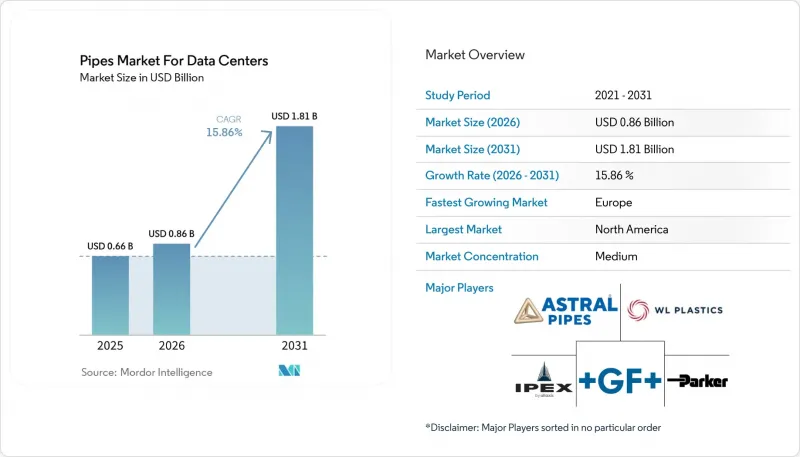
According to Mordor Intelligence, the pipes market for data centers industry size is expected to increase from USD 0.66 billion in 2025 to USD 0.86 billion in 2026 and reach USD 1.81 billion by 2031, at a CAGR of 15.86% over 2026-2031.
Insights and Trends of Pipes Market For Data Centers
Rapid Expansion of Hyperscale and Colocation Data Centers
The pipes market for data centers benefits when hyperscale and colocation operators build larger facilities on compressed delivery schedules. Each campus needs extensive chilled-water distribution, condenser-water branches, fire-suppression networks, and dedicated manifolds for dense computing areas. New capacity favors suppliers that can provide qualified components and assembled systems before on-site installation begins. Colocation operators also need standardized, tested pipe assemblies that can be installed without disrupting adjacent operating halls. Procurement is moving earlier in project planning because piping must align with cooling equipment, information technology equipment, and building construction schedules. This timing increases the value of suppliers that can coordinate materials, fabrication, testing, and delivery within a single project schedule.
Rising AI and High-Performance Computing Workloads
Artificial intelligence and high-performance computing workloads are changing the thermal requirements of new facilities. NVIDIA stated that its GB200 NVL72 rack can draw more than 120 kW per cabinet, placing greater demands on cooling circuits and coolant delivery equipment. The International Energy Agency projected global data center electricity use to rise from 415 TWh in 2024 to 945 TWh by 2030. Cooling infrastructure contributes to this increase and requires reliable fluid movement throughout the building. These conditions favor clean polymer systems where coolant purity and corrosion control matter for cold plates and quick-connect components. The pipes market for data centers, therefore, depends not only on more facilities, but also on greater pipe density within each artificial intelligence-enabled hall.
High Installation and Infrastructure Costs
Piping infrastructure becomes more expensive when liquid-cooled designs add technology cooling system branches to the usual plant-side equipment. Field welding and fusion joining can add labor requirements when a project contains many manifold connections. Design revisions can also require rerouting when hardware layouts change during construction. These costs are harder to absorb in enterprise and edge projects with smaller capital budgets. Requirements under the American Society of Mechanical Engineers B31.3 process-piping standards and the American Society of Heating, Refrigerating and Air-Conditioning Engineers Technical Committee 9.9 guidance can add documentation and testing work for some installations. The pipes market for data centers must, therefore, balance higher initial system complexity against the thermal needs of high-density computing equipment.
Other drivers and restraints analyzed in the detailed report include:
- Increasing Adoption of Direct-to-Chip and Immersion Cooling
- Growth of Edge and Modular Data Center Deployments
- Leakage and Mission-Critical Reliability Risks
For complete list of drivers and restraints, kindly check the Table Of Contents.
Segment Analysis
Metal-based pipes accounted for 71.04% of revenue in 2025, supported by their established use in chilled-water distribution, condenser-water systems, plant headers, and other critical data center infrastructure. Their high mechanical strength, pressure-handling capacity, durability, and suitability for large-bore piping networks make them the preferred choice for large-scale and hyperscale facilities. Carbon steel, stainless steel, copper, and ductile iron serve different applications based on pressure, temperature, corrosion exposure, and water-quality requirements. Despite their higher weight and greater corrosion-management needs than polymer alternatives, metal-based pipes remain the dominant material type due to their extensive installed base and ability to support demanding cooling infrastructure.
Polymer-based pipes are projected to be the fastest-growing material type and are expected to register a CAGR of 20.93% during 2026-2031. Their growth is driven by the increasing adoption of lightweight, corrosion-resistant, and low-maintenance piping systems for data center cooling infrastructure. Materials such as polypropylene, high-density polyethylene, chlorinated polyvinyl chloride, and polyvinylidene fluoride resist corrosion and chemical exposure while offering easier handling and installation than conventional metal systems. Their suitability for chilled-water, condenser-water, drainage, and specialized liquid-cooling applications supports their adoption as data center operators increasingly prioritize system durability, cleanliness, and lifecycle performance.
Chilled water distribution accounted for 49.26% of application revenue in 2025, making it the largest application segment in the data center pipes market. These systems connect cooling plants to cooling equipment and data halls, facilitating chilled-water circulation for heat removal across conventional and high-density computing environments. Their established use in air-cooled data centers and growing integration with liquid-cooling systems continue to drive demand for reliable, high-pressure piping networks.
Others, including drainage and wastewater systems and underground utility networks, are projected to be the fastest-growing application segment, set to expand at a CAGR of 17.56% during 2026-2031. Growth is driven by the expansion of data center campuses, rising water-management requirements, and increased emphasis on the efficient handling of process water, condensate, and wastewater streams. As data centers increase in scale and cooling-water use, drainage infrastructure must handle larger water volumes while ensuring corrosion resistance and reliable long-term performance. Polymer-based piping systems are gaining importance in these applications due to their resistance to corrosion and chemical exposure, supporting the expansion of drainage and wastewater networks alongside core cooling infrastructure.
Complete Report Scope:
- By Material Type
- Polymer-based Pipes
- PE Pipes
- PP Pipes
- PVC Pipes
- Other Polymer Pipes
- Metal-based Pipes
- Carbon Steel Pipes
- Stainless Steel Pipes
- Copper Pipes
- Polymer-based Pipes
- By Application
- Chilled Water Distribution
- Condenser Water Systems
- Fire Protection Systems
- Water Supply and Treatment
- Other Applications (Drainage and Wastewater Systems, and Underground Utility Networks)
- By Cooling Technology
- Air-cooled Data Centers
- Liquid-cooled Data Centers
- Hybrid Cooling Technologies
- By Data Center Type
- Hyperscale Data Centers
- Colocation Data Centers
- Enterprise Data Centers
- Edge Data Centers
- By Geography
- Asia-Pacific
- China
- India
- Japan
- South Korea
- ASEAN
- Rest of Asia-Pacific
- North America
- United States
- Canada
- Mexico
- Europe
- Germany
- United Kingdom
- France
- Italy
- Rest of Europe
- South America
- Brazil
- Rest of South America
- Middle East and Africa
- Saudi Arabia
- United Arab Emirates
- South Africa
- Rest of Middle East and Africa
- Asia-Pacific
Geography Analysis
North America held 61.73% of revenue in 2025, representing the largest regional position in the pipes market for data centers. The United States drives requirements for new campuses, cooling retrofits, and liquid-cooling-ready halls. Texas and Indiana have gained activity alongside established Northern Virginia development. This distribution supports regional fabrication and supply arrangements for chilled-water, condenser-water, and technology cooling systems. Telehouse Canada deployed direct-to-chip liquid cooling in Toronto and integrated waste-heat recovery with Enwave's district energy system.
Asia-Pacific includes new construction in Southeast Asia and capacity additions in India, China, and Japan. Malaysia's Johor increased operational capacity from 401 MW to 897 MW in 2025, while Mumbai reached 768 MW after a 42% increase. These projects require large-volume procurement and close scheduling between component suppliers and construction teams. The broad regional pipeline supports both outdoor utility applications and rack-level cooling systems.
Europe is projected to advance at a 18.07% CAGR through 2031. The region remains important for higher-specification piping across the Frankfurt, London, Amsterdam, Paris, and Dublin cluster. The European Union Energy Efficiency Directive requires certain data centers above 500 kW to report energy and water data, which increases attention to cooling-water use and system losses. ISOPLUS Group supplied DN700 district-heating pipes for Microsoft's Espoo data center waste-heat project with Fortum. Brazil supports South American demand through hyperscale and colocation development in Sao Paulo. Saudi Arabia and the United Arab Emirates require reliable liquid-cooling infrastructure because high ambient temperatures increase cooling needs.
- Agru Kunststofftechnik GmbH
- Aliaxis
- Aquatherm
- Asahi/America
- ASTRAL PIPES
- BRUGG Pipes
- Future Pipe Industries
- GF Piping Systems
- IPEX Inc.
- NIBCO
- PARKER HANNIFIN CORP
- Pipelife (Wienerberger Group)
- POLYMELT Pipe Systems GmbH
- Rehau
- Sekisui Chemical
- Uponor
- Wavin
- WL Plastics
Additional Benefits:
- The market estimate (ME) sheet in Excel format
- 3 months of analyst support
TABLE OF CONTENTS
1 Introduction
- 1.1 Study Assumptions and Market Definition
- 1.2 Scope of the Study
2 Research Methodology
3 Executive Summary
4 Market Landscape
- 4.1 Market Overview
- 4.2 Market Drivers
- 4.2.1 Rapid Expansion of Hyperscale and Colocation Data Centers
- 4.2.2 Rising AI and High-Performance Computing Workloads
- 4.2.3 Increasing Adoption of Direct-to-Chip and Immersion Cooling
- 4.2.4 Growth of Edge and Modular Data Center Deployments
- 4.2.5 Demand for Prefabricated and Factory-Tested Piping Systems
- 4.3 Market Restraints
- 4.3.1 High Installation and Infrastructure Costs
- 4.3.2 Leakage and Mission-Critical Reliability Risks
- 4.3.3 Coolant Compatibility and Water-Chemistry Uncertainty
- 4.4 Value Chain Analysis
- 4.5 Porter's Five Forces Analysis
- 4.5.1 Bargaining Power of Suppliers
- 4.5.2 Bargaining Power of Buyers
- 4.5.3 Threat of New Entrants
- 4.5.4 Threat of Substitutes
- 4.5.5 Competitive Rivalry
5 Market Size and Growth Forecasts (Value)
- 5.1 By Material Type
- 5.1.1 Polymer-based Pipes
- 5.1.1.1 PE Pipes
- 5.1.1.2 PP Pipes
- 5.1.1.3 PVC Pipes
- 5.1.1.4 Other Polymer Pipes
- 5.1.2 Metal-based Pipes
- 5.1.2.1 Carbon Steel Pipes
- 5.1.2.2 Stainless Steel Pipes
- 5.1.2.3 Copper Pipes
- 5.1.1 Polymer-based Pipes
- 5.2 By Application
- 5.2.1 Chilled Water Distribution
- 5.2.2 Condenser Water Systems
- 5.2.3 Fire Protection Systems
- 5.2.4 Water Supply and Treatment
- 5.2.5 Other Applications (Drainage and Wastewater Systems, and Underground Utility Networks)
- 5.3 By Cooling Technology
- 5.3.1 Air-cooled Data Centers
- 5.3.2 Liquid-cooled Data Centers
- 5.3.3 Hybrid Cooling Technologies
- 5.4 By Data Center Type
- 5.4.1 Hyperscale Data Centers
- 5.4.2 Colocation Data Centers
- 5.4.3 Enterprise Data Centers
- 5.4.4 Edge Data Centers
- 5.5 By Geography
- 5.5.1 Asia-Pacific
- 5.5.1.1 China
- 5.5.1.2 India
- 5.5.1.3 Japan
- 5.5.1.4 South Korea
- 5.5.1.5 ASEAN
- 5.5.1.6 Rest of Asia-Pacific
- 5.5.2 North America
- 5.5.2.1 United States
- 5.5.2.2 Canada
- 5.5.2.3 Mexico
- 5.5.3 Europe
- 5.5.3.1 Germany
- 5.5.3.2 United Kingdom
- 5.5.3.3 France
- 5.5.3.4 Italy
- 5.5.3.5 Rest of Europe
- 5.5.4 South America
- 5.5.4.1 Brazil
- 5.5.4.2 Rest of South America
- 5.5.5 Middle East and Africa
- 5.5.5.1 Saudi Arabia
- 5.5.5.2 United Arab Emirates
- 5.5.5.3 South Africa
- 5.5.5.4 Rest of Middle East and Africa
- 5.5.1 Asia-Pacific
6 Competitive Landscape
- 6.1 Market Concentration
- 6.2 Strategic Moves
- 6.3 Market Share (%)/Ranking Analysis
- 6.4 Company Profiles (includes Global Overview, Market Overview, Core Segments, Financials as available, Strategic Information, Products and Services, and Recent Developments)
- 6.4.1 Agru Kunststofftechnik GmbH
- 6.4.2 Aliaxis
- 6.4.3 Aquatherm
- 6.4.4 Asahi/America
- 6.4.5 ASTRAL PIPES
- 6.4.6 BRUGG Pipes
- 6.4.7 Future Pipe Industries
- 6.4.8 GF Piping Systems
- 6.4.9 IPEX Inc.
- 6.4.10 NIBCO
- 6.4.11 PARKER HANNIFIN CORP
- 6.4.12 Pipelife (Wienerberger Group)
- 6.4.13 POLYMELT Pipe Systems GmbH
- 6.4.14 Rehau
- 6.4.15 Sekisui Chemical
- 6.4.16 Uponor
- 6.4.17 Wavin
- 6.4.18 WL Plastics
7 Market Opportunities and Future Outlook
- 7.1 White-Space and Unmet-Need Assessment

