PUBLISHER: Mordor Intelligence | PRODUCT CODE: 2163591

PUBLISHER: Mordor Intelligence | PRODUCT CODE: 2163591
Landfill Gas - Market Share Analysis, Industry Trends & Statistics, Growth Forecasts (2026 - 2031)
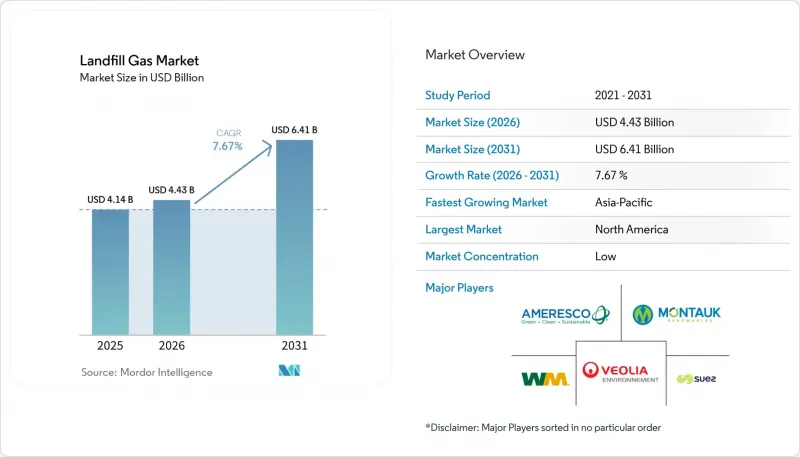
According to Mordor Intelligence, the landfill gas market size was valued at USD 4.14 billion in 2025 and is estimated to grow from USD 4.43 billion in 2026 to reach USD 6.41 billion by 2031, at a CAGR of 7.67% during the forecast period (2026-2031).
Global Landfill Gas Market Trends and Insights
Methane-Emission Compliance and Monitoring
Municipal solid waste landfills were the third-largest source of methane emissions in the United States, keeping compliance spending high across the operating fleet. The landfill gas market is supported by Clean Air Act rules that require qualifying sites to install gas collection and control systems. Those rules also require quarterly surface monitoring and monthly wellhead checks for temperature, oxygen, nitrogen, and pressure. In October 2024, the EPA opened a docket on monitoring technologies and work practices for municipal solid waste landfills. The European Union methane regulation, which entered into force on August 4, 2024, established measurement, monitoring, reporting, and verification obligations in the energy sector. These rules create recurring demand for collection, monitoring, maintenance, and upgrade work even when energy prices are weak.
Renewable Natural Gas and Biomethane Offtake Demand
The landfill gas market is gaining support from long-term renewable natural gas offtake agreements. These agreements can give project owners a more stable basis for financing than short-term carbon credit sales. The American Biogas Council reported that 68 of 70 new United States biogas projects commissioned in 2025 were designed to produce renewable natural gas. Landfill-sourced gas supplied 64% of the United States renewable natural gas production reported in 2025. Industrial users in chemicals, food processing, and manufacturing are also considering renewable gas for process heat and internal emissions programs. This wider group of buyers can extend contract demand beyond transportation fuel applications.
High Capital Cost and Interconnection Delays
Pipeline interconnection can absorb 30-45% of a renewable natural gas project budget and can require 24-36 months in some jurisdictions. The landfill gas market faces this constraint most directly when a project needs transmission or distribution pipeline access. A 2025 presentation for the Short Mountain project in Oregon showed potential interconnection costs from USD 7.46 million to USD 11.3 million, depending on the configuration and metering requirements. The European Biogas Association reported that cost-sharing practices differ across member states and between transmission and distribution connections. Uncertain costs and long approvals can delay debt commitments and prevent technically viable projects from reaching construction. Developers are therefore placing more value on sites with known connection rights, existing gas infrastructure, or viable local uses for the gas.
Other drivers and restraints analyzed in the detailed report include:
- Government Incentives and Low-Carbon Fuel Credits
- Digital Wellfield Balancing and Remote Leak Detection
- Organic-Waste Diversion Reducing Future Landfill Feedstock
For complete list of drivers and restraints, kindly check the Table Of Contents.
Segment Analysis
Collection systems held 47.4% of the landfill gas market revenue in 2025. This position reflects requirements for regulated municipal solid waste sites to capture and control landfill gas before it is flared or used. Active systems include extraction wells, high-density polyethylene piping, blower-flare stations, and condensate management equipment. Expansion work continues when landfill cells are added or operating sites need greater coverage. Gas upgrading technologies are forecast to grow at a 9.1% CAGR through 2031.
The landfill gas market size for gas upgrading is supported by renewable natural gas pipeline injection and carbon-intensity-based revenue opportunities. Greenlane Renewables filed a patent application in October 2025 for a Linear Nitrogen Rejection Unit that uses a stepwise pressure swing adsorption process. The company reported methane recovery of up to 99.5% during testing across varying nitrogen-to-methane ratios. A 2025 peer-reviewed study found that a hybrid membrane and vacuum pressure swing adsorption configuration could achieve methane purity of at least 96% and recovery of at least 99% in modeled optimization. These developments matter because landfill gas often presents more difficult nitrogen and oxygen removal conditions than other biogas feedstocks.
Complete Report Scope:
- By Technology
- Landfill Gas Collection Systems
- Gas Treatment Technologies
- Gas Upgrading Technologies
- By Landfill Type
- Municipal Solid Waste (MSW) Landfills
- Industrial Landfills
- Commercial Landfills
- Other Landfill Types
- By End Use
- Electricity Generation
- Direct Thermal/Medium-Btu Gas Use
- Renewable Natural Gas (RNG)
- Vehicle Fuel
- Pipeline Injection
- Combined Heat and Power
- Industrial and Commercial Applications
- By Geography
- North America
- United States
- Canada
- Mexico
- Europe
- Germany
- France
- Italy
- Spain
- United Kingdom
- Poland
- Russia
- Rest of Europe
- Asia-Pacific
- China
- India
- Japan
- South Korea
- Australia
- Indonesia
- Vietnam
- Thailand
- Rest of Asia-Pacific
- South America
- Brazil
- Argentina
- Chile
- Rest of South America
- Middle East and Africa
- Saudi Arabia
- United Arab Emirates
- Egypt
- South Africa
- Morocco
- Rest of Middle East and Africa
- North America
Geography Analysis
North America held 41.5% of the landfill gas market revenue in 2025. The United States supports this position through a mature collection-system fleet, federal landfill requirements, and active renewable natural gas development. The landfill gas market size in the region is also supported by a listed pipeline of 705 additional candidate United States landfills beyond 599 sites already equipped with capture systems. Canada has a growing opportunity where regulated sites retain suitable municipal solid waste volumes despite organic diversion measures. Europe is the second-largest geography, with Germany holding substantial installed capacity and the United Kingdom retaining an established landfill gas-to-electricity fleet.
Europe had 1,620 biomethane plants in the first quarter of 2025, and 86% were grid-connected. France had the highest plant count, with 760 facilities reported in the same source. Asia-Pacific is forecast to expand at a 10.5% CAGR through 2031. China and India have high-organic-content municipal waste streams that can support large collection systems. China combines waste-sector methane objectives with electricity purchase support and carbon-market mechanisms.
India is adding demand through urban growth, higher organic waste content, and pressure to modernize waste-management infrastructure. South Korea, Vietnam, Indonesia, and Thailand are at earlier stages of collection-system adoption, where electricity sales remain the principal route because pipeline networks are limited. The Middle East and Africa had the smallest share among major geographies, while urban waste growth is creating long-term project interest. Johannesburg began a biodigester pilot at Robinson Deep landfill in September 2026, designed to process 50 metric tons of biodegradable waste each day and scheduled for commissioning in March 2027.
- Air Liquide
- Air Products and Chemicals, Inc.
- Ameresco, Inc.
- Archaea Energy
- Brightmark LLC
- DMT Environmental Technology
- EDL
- Greenlane Renewables Inc.
- Infinis Energy Management Limited
- Landfill Systems Ltd.
- Montauk Renewables, Inc.
- Republic Services, Inc.
- SUEZ
- Tetra Tech, Inc.
- Veolia Environnement S.A.
- Waste Management, Inc.
- Waga Energy
- Xebec Adsorption Inc.
Additional Benefits:
- The market estimate (ME) sheet in Excel format
- 3 months of analyst support
TABLE OF CONTENTS
1 INTRODUCTION
- 1.1 Study Assumptions and Market Definition
- 1.2 Scope of the Study
2 RESEARCH METHODOLOGY
3 EXECUTIVE SUMMARY
4 MARKET LANDSCAPE
- 4.1 Market Overview
- 4.2 Market Drivers
- 4.2.1 Methane-Emission Compliance and Monitoring
- 4.2.2 Renewable Natural Gas and Biomethane Offtake Demand
- 4.2.3 Government Incentives and Low-Carbon Fuel Credits
- 4.2.4 Expansion of Landfill Gas-to-Energy Infrastructure
- 4.2.5 Digital Wellfield Balancing and Remote Leak Detection
- 4.2.6 Increasing Demand for Local Baseload Renewable Energy
- 4.3 Market Restraints
- 4.3.1 High Capital Cost and Interconnection Delays
- 4.3.2 Declining Gas Yield at Mature Landfills
- 4.3.3 Nitrogen and Oxygen Removal Challenges in Landfill Gas Upgrading
- 4.3.4 Organic-Waste Diversion Reducing Future Landfill Feedstock
- 4.4 Supply-Chain Analysis
- 4.5 Porter's Five Forces Analysis
- 4.5.1 Bargaining Power of Suppliers
- 4.5.2 Bargaining Power of Buyers
- 4.5.3 Threat of New Entrants
- 4.5.4 Threat of Substitutes
- 4.5.5 Competitive Rivalry
- 4.6 Technology Outlook
- 4.7 Regulatory Landscape
- 4.8 Investment Analysis
5 MARKET SIZE AND GROWTH FORECASTS
- 5.1 By Technology
- 5.1.1 Landfill Gas Collection Systems
- 5.1.2 Gas Treatment Technologies
- 5.1.3 Gas Upgrading Technologies
- 5.2 By Landfill Type
- 5.2.1 Municipal Solid Waste (MSW) Landfills
- 5.2.2 Industrial Landfills
- 5.2.3 Commercial Landfills
- 5.2.4 Other Landfill Types
- 5.3 By End Use
- 5.3.1 Electricity Generation
- 5.3.2 Direct Thermal/Medium-Btu Gas Use
- 5.3.3 Renewable Natural Gas (RNG)
- 5.3.4 Vehicle Fuel
- 5.3.5 Pipeline Injection
- 5.3.6 Combined Heat and Power
- 5.3.7 Industrial and Commercial Applications
- 5.4 By Geography
- 5.4.1 North America
- 5.4.1.1 United States
- 5.4.1.2 Canada
- 5.4.1.3 Mexico
- 5.4.2 Europe
- 5.4.2.1 Germany
- 5.4.2.2 France
- 5.4.2.3 Italy
- 5.4.2.4 Spain
- 5.4.2.5 United Kingdom
- 5.4.2.6 Poland
- 5.4.2.7 Russia
- 5.4.2.8 Rest of Europe
- 5.4.3 Asia-Pacific
- 5.4.3.1 China
- 5.4.3.2 India
- 5.4.3.3 Japan
- 5.4.3.4 South Korea
- 5.4.3.5 Australia
- 5.4.3.6 Indonesia
- 5.4.3.7 Vietnam
- 5.4.3.8 Thailand
- 5.4.3.9 Rest of Asia-Pacific
- 5.4.4 South America
- 5.4.4.1 Brazil
- 5.4.4.2 Argentina
- 5.4.4.3 Chile
- 5.4.4.4 Rest of South America
- 5.4.5 Middle East and Africa
- 5.4.5.1 Saudi Arabia
- 5.4.5.2 United Arab Emirates
- 5.4.5.3 Egypt
- 5.4.5.4 South Africa
- 5.4.5.5 Morocco
- 5.4.5.6 Rest of Middle East and Africa
- 5.4.1 North America
6 COMPETITIVE LANDSCAPE
- 6.1 Market Concentration
- 6.2 Strategic Moves
- 6.3 Market Share Analysis
- 6.4 Company Profiles (includes Global Level Overview, Market Level Overview, Core Segments, Financials as available, Strategic Information, Market Rank/Share, Products and Services, Recent Developments)
- 6.4.1 Air Liquide
- 6.4.2 Air Products and Chemicals, Inc.
- 6.4.3 Ameresco, Inc.
- 6.4.4 Archaea Energy
- 6.4.5 Brightmark LLC
- 6.4.6 DMT Environmental Technology
- 6.4.7 EDL
- 6.4.8 Greenlane Renewables Inc.
- 6.4.9 Infinis Energy Management Limited
- 6.4.10 Landfill Systems Ltd.
- 6.4.11 Montauk Renewables, Inc.
- 6.4.12 Republic Services, Inc.
- 6.4.13 SUEZ
- 6.4.14 Tetra Tech, Inc.
- 6.4.15 Veolia Environnement S.A.
- 6.4.16 Waste Management, Inc.
- 6.4.17 Waga Energy
- 6.4.18 Xebec Adsorption Inc.
7 MARKET OPPORTUNITIES AND FUTURE OUTLOOK
- 7.1 White-Space and Unmet-Need Assessment

